Data Analyst Courses Online (Self-Paced): 2026 Guide
By the InfiniSynapse Data Team · Published: 2026-07-08 · Last updated: 2026-09-24 · We build an AI-native data analysis platform and have completed dozens of self-paced programs; this guide identifies what works for independent learners.
Table of Contents
- TL;DR
- How We Evaluated These Programs
- Why Self-Paced Works for Many Learners
- Top Self-Paced Programs
- What to Look For
- Staying Accountable Without a Cohort
- Self-Paced vs Cohort-Based
- Building a Portfolio on Your Own Schedule
- AI Practice in Self-Paced Learning
- Self-Paced Readiness Scorecard
- Practical Next Steps
- Frequently Asked Questions
- Conclusion
TL;DR
Direct answer: A self paced data analytics course is a flexible track you finish on your own clock — typically about 10 hours a week for three to six months. The data analyst courses online that hold up are the ones with interactive SQL labs, a written path from fundamentals to a capstone, and a project you can publish. Video libraries without a runnable environment leave the queries untested.
Who this is for: independent learners, working professionals, and parents who need flexible analytics training.
What you'll learn: how we evaluated data analyst courses online, why the format works, specific top picks, accountability strategies, and how to build a portfolio without a cohort.
This guide sits under the data analyst certification hub; for cohort-based options, see data analyst course online and courses by level in data analyst courses.
How We Evaluated These Programs
We selected data analyst courses online using criteria that mirror what hiring managers list in 2026 job postings. Each program was checked against four dimensions: interactive SQL practice with immediate feedback, structured progression from fundamentals to capstone, portfolio-ready project output, and whether the curriculum acknowledges AI-assisted analysis workflows. We cross-referenced skill requirements with the Bureau of Labor Statistics occupational profile for data analysts and hiring-trend data from LinkedIn's 2025 Future of Recruiting report, which notes that skills assessments and portfolio evidence increasingly influence hiring alongside formal credentials.
Self-paced formats add a fifth criterion: completion feasibility without cohort deadlines. A data analyst courses online program with sixty hours of video and five hours of practice loses to one with twenty hours of interactive SQL labs if you are studying alone. We favor programs with transparent syllabi, embedded coding environments, and public learner reviews from working analysts who completed the track independently.
Why Self-Paced Works for Many Learners
Self-paced data analyst courses online remove the constraint of fixed schedules, which matters because most career changers cannot pause their lives for cohort-based programs. You study when your calendar allows: early mornings, lunch breaks, weekends, or late evenings. This flexibility is the primary reason self-paced formats dominate the online analytics training market.
Self-paced data analyst courses online also let you control your pace through material. Speed through topics you already understand and slow down where you struggle. Repeat difficult sections without falling behind a cohort. This personalization produces deeper understanding than uniform pacing when you are honest about where you need more time.
The risk of self-paced data analyst courses online is procrastination and incomplete programs. Without deadlines and peer pressure, many learners start strong and fade within weeks. The strategies in this guide address that risk directly. Self-paced formats work for disciplined, self-motivated people and stall for those who need external structure. Know which type you are before committing. The analytical skills themselves, as described in the Wikipedia data analysis overview, are equally learnable in either format.
Top Self-Paced Programs
Strong self-paced data analyst courses online share common traits regardless of provider. They offer interactive coding environments where you write and execute SQL against real databases. They structure content in progressive modules that build from fundamentals to capstone projects. They provide optional community forums or discussion boards for when you get stuck. They issue recognized certificates upon completion.
When evaluating self-paced options, prioritize practice depth over content volume. A data analyst courses online program with twenty hours of interactive SQL labs beats one with sixty hours of video lectures and five hours of practice. Check whether capstone projects produce portfolio-worthy work and whether the certificate carries recognition in your target job market. We compare broader options in data analyst course and free programs in data analyst course free.
The table below compares the data analyst courses online we most often recommend to independent learners in 2026. Hours and list prices move; re-check the provider before you enroll.
| Program | Provider | Core skills | Hours / week | Cost (list) | Typical timeline | Best for |
|---|---|---|---|---|---|---|
| Google Data Analytics Professional Certificate | Google / Coursera | Spreadsheets, SQL, Python, Tableau, capstone | ~10 | About $49 / month after trial | 3–6 months part-time | Complete beginners wanting a recognized credential |
| IBM Data Analyst Professional Certificate | IBM / Coursera | Excel, SQL, Python, Cognos, dashboards | ~10 | About $49 / month after trial | 4–6 months part-time | Beginners who want Python in the curriculum |
| Kaggle Learn | Kaggle | Python, pandas, SQL, data visualization | 3–6 | Free | 2–8 weeks | Self-starters who want bite-sized practice |
| SQLBolt | SQLBolt | SQL queries, joins, aggregations | 3–5 | Free | 2–4 weeks | Anyone building SQL fluency from zero |
| freeCodeCamp Data Analysis with Python | freeCodeCamp | Python, NumPy, pandas, visualization | 8–12 | Free | 3–5 months | Learners who want a free credential |
| Mode Analytics SQL tutorials | Mode | SQL on real-world-style queries | 3–5 | Free | 4–6 weeks | Intermediate SQL after basics |
Practical example: a working parent who completes the Google Data Analytics Professional Certificate on a self-paced schedule — two hours each weekday morning — then publishes two supplemental analyses on public retail datasets (monthly revenue trends with SQL, cohort churn with charts), can cite both the credential and live portfolio links in applications. Recruiters see the certificate as proof of structured learning and the portfolio as proof of execution — the combination that Harvard Business Review's skills-based hiring research describes as increasingly decisive in hiring decisions.
Long free tracks (hundreds of hours, no weekly deadline) still belong on the free course page. Put them on this shortlist only when the SQL labs are runnable without a paid seat.
What to Look For
Four features separate effective data analyst courses online from passive content libraries.
Interactive practice environments: In data analyst courses online, you must write, run, and debug SQL queries within the platform. Video demonstrations alone do not build skill. The best programs provide immediate feedback on your queries and hints when you are stuck.
Structured progression: Content should build logically from fundamentals through intermediate skills to a capstone project. Randomly ordered modules without clear prerequisites produce gaps. Look for data analyst courses online with defined learning paths rather than unstructured course catalogs.
Community support: Even self-paced data analyst courses online should offer discussion forums, peer review, or optional office hours. Getting unstuck quickly prevents the frustration that leads to abandonment. Active communities transform solitary self-paced learning into supported practice.
Portfolio integration: Capstone projects should be designed as portfolio pieces from the start. The best self-paced data analyst courses online include guidance on documenting your process, publishing findings, and presenting work professionally.
Staying Accountable Without a Cohort
The biggest challenge with self-paced data analyst courses online is maintaining momentum without external deadlines. Several strategies help. Set a fixed weekly study schedule and treat it as non-negotiable, the same way you would attend cohort sessions. Define milestone dates for completing each module rather than leaving the timeline open-ended.
Find an accountability partner, another learner in the same or a similar program. Share weekly progress, review each other's queries, and push through difficult sections together. Many data analyst courses online have active community forums where you can find study partners. Posting your goals publicly in these communities creates social commitment that mirrors cohort pressure.
Track visible progress. Maintain a learning journal documenting what you studied, what you built, and what confused you. Publish portfolio pieces as you complete them rather than waiting until the program ends. Visible output creates momentum that abstract progress bars cannot. If you miss a week, resume immediately rather than abandoning the program entirely. Consistency over months matters more than intensity over days.
Self-Paced vs Cohort-Based
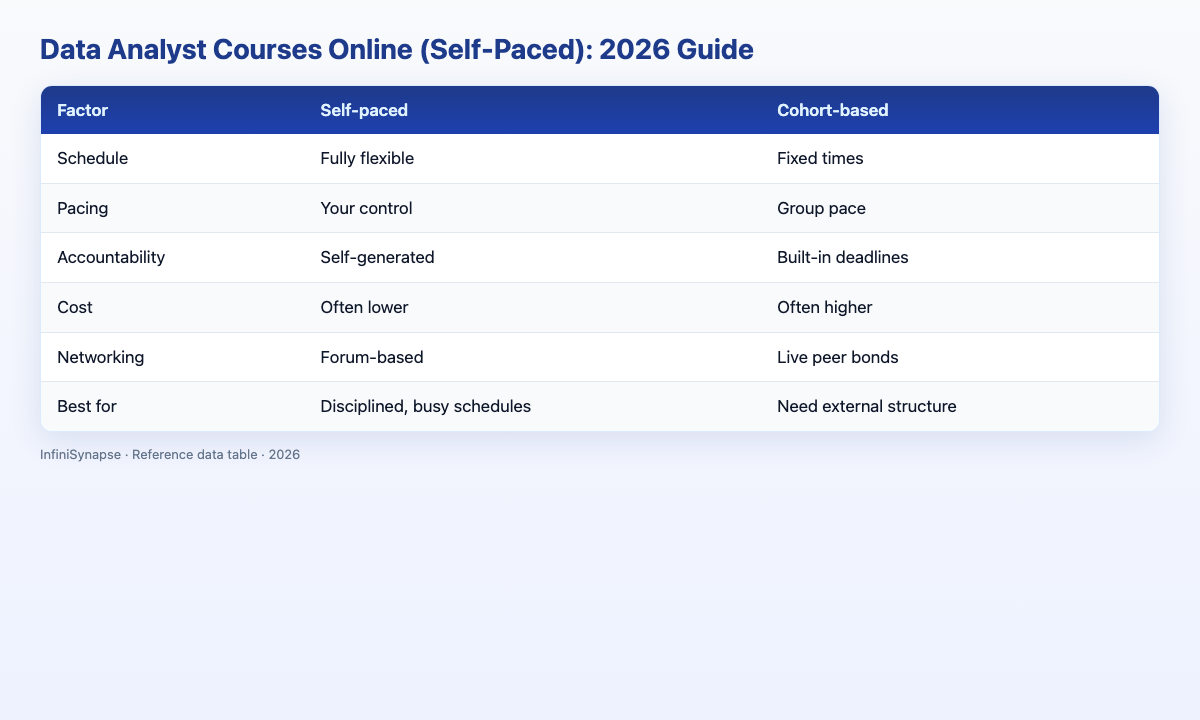
Both formats have legitimate strengths. Self-paced data analyst courses online offer maximum flexibility, personalized pacing, and often lower cost. Cohort-based programs offer fixed deadlines, live instructor interaction, peer bonding, and structured career support. Your choice should reflect your learning style and life constraints. The move toward augmented workflows, outlined in IBM's augmented analytics overview, frames how teams evaluate modern tooling.
| Factor | Self-paced | Cohort-based |
|---|---|---|
| Schedule | Fully flexible | Fixed times |
| Pacing | Your control | Group pace |
| Accountability | Self-generated | Built-in deadlines |
| Cost | Often lower | Often higher |
| Networking | Forum-based | Live peer bonds |
| Best for | Disciplined, busy schedules | Need external structure |
Many providers now offer hybrid data analyst courses online: self-paced content with optional live sessions and periodic cohort events. This model captures flexibility while providing occasional accountability boosts. If you are unsure which format suits you, start self-paced with strong accountability practices; you can always switch to a cohort program if you find yourself stalling. Cohort calendars and live hours stay on data analyst course online.
Building a Portfolio on Your Own Schedule
Self-paced learning and portfolio-building are natural partners because you control both timelines. Treat every module exercise as a potential portfolio piece. When a data analyst courses online program assigns a dataset analysis, go beyond the minimum: document your process, add context about the business question, create polished visualizations, and write a clear summary of findings.
Publish work incrementally rather than hoarding projects until you finish the data analyst courses online program. A portfolio with one polished analysis published mid-course is more valuable for networking and job searching than three analyses completed but unpublished at the end. Share your work in program communities, on LinkedIn, and in analytics forums for feedback.
Supplement course projects with independent analyses on topics you find interesting. Public datasets from government agencies, open data portals, and competition platforms provide unlimited practice material. The combination of structured coursework and self-directed projects demonstrates both taught skills and genuine curiosity, which employers value. We detail portfolio strategy in how to become a data analyst.
AI Practice in Self-Paced Learning
Self-paced formats are particularly well-suited for learning AI-native analysis tools because you can experiment freely without cohort deadlines pressing you forward. Take time to explore how AI agents translate natural-language questions into SQL, how they handle messy data, and where their outputs need human validation.
Look for self-paced data analyst courses online that include AI modules or at minimum discuss how AI changes the analyst role. Supplement any program with hands-on practice on AI-native platforms regardless of whether the curriculum covers them. This exploratory approach builds AI fluency that lecture-based programs miss. We explore the paradigm in what AI-native data analysis means, and the Stanford HAI AI Index documents how central these skills have become. Self-paced learners who invest time in AI practice alongside traditional skills enter the job market with a meaningful advantage.
Self-Paced Readiness Scorecard
Assess whether self-paced data analyst courses online suit you (1 point each):
| Check | Applies to me? |
|---|---|
| I can commit to a fixed weekly study schedule | |
| I am self-motivated without external deadlines | |
| My schedule varies and needs flexibility | |
| I can find or create accountability structures | |
| I learn well from written and video content | |
| I will publish portfolio work as I progress | |
| I can seek help in forums when stuck | |
| I have completed self-paced learning before |
6–8: self-paced data analyst courses online are a strong fit. 3–5: try hybrid or cohort formats. Below 3: cohort-based programs will serve you better.
Practical Next Steps
Verify against real job postings
Before you pay for data analyst courses online, pull five recent job postings in your target market and list the SQL, visualization, and communication skills each repeats. Align your learning plan to those patterns rather than a generic syllabus.
Ship one portfolio artifact this month
Employers hire on demonstrated ability. Publish one finished analysis — with a clear question, reproducible queries, and a short executive summary — alongside any credential or course completion.
Frequently Asked Questions
What is a self paced data analytics course?
A self paced data analytics course is a program you start and finish without a live cohort calendar. On this desk that usually means about ten hours a week for three to six months, with SQL you can run inside the platform. People say “data analytics” and “data analysis” for the same junior-analyst skill set; the format question is whether you can keep the weekly hours without a class meeting. Picks for a data analytics course that ignore the self-paced test sit on data analyst course.
Which data analyst courses online work without a cohort?
The data analyst courses online that work without a cohort offer interactive SQL practice, structured progression, capstone portfolio projects, and community support. The Google Data Analytics Professional Certificate, IBM Data Analyst Professional Certificate, and free resources like Kaggle Learn and SQLBolt are strong options. Choose based on practice depth and your ability to maintain self-directed momentum.
Can I really learn data analysis self-paced?
Yes, if you are disciplined and choose data analyst courses online with substantial hands-on practice. Self-paced programs have produced many working analysts. The key is maintaining consistent practice, building a portfolio, and creating accountability structures that compensate for the lack of cohort deadlines.
How long do self-paced courses take?
Most learners complete comprehensive data analyst courses online in three to six months studying ten to fifteen hours per week. You set the timeline, but stretching beyond six months without consistent practice reduces skill retention. Set milestone dates to maintain momentum.
Are self-paced courses cheaper than cohort programs?
Often yes. Self-paced data analyst courses online typically cost less because they do not include live instruction and career services. Free and low-cost self-paced options exist alongside premium ones. Price correlates imperfectly with quality; evaluate practice depth over cost.
How do I stay motivated without a cohort?
Set fixed weekly study times, find an accountability partner, post goals publicly in course communities, publish portfolio pieces incrementally, and track visible progress in a learning journal. These strategies replicate the accountability that cohort-based data analyst courses online provide automatically.
Conclusion
Self-paced data analyst courses online in 2026 offer flexible, effective analytics training for disciplined independent learners. Choose programs with interactive practice, structured progression, and portfolio integration; create accountability structures that compensate for the lack of cohort deadlines; and supplement coursework with AI-native tool practice. The format works when you work it consistently.
To practice the AI-era skills employers want, read what AI-native data analysis means and try the InfiniSynapse web app free on registration, no credit card required.