AI Data Analyst Explained: What It Does and How Teams Use It
- "AI data analyst" names two different things: a software system that performs analyst workflows end to end, and a human analyst who supervises AI tools. Conflating the two senses is the most common mistake in both buying and hiring conversations.
- Real analysis work has seven steps, from interpreting the question to delivering recommendations. The honest split: the software executes the retrieval-heavy middle five, and humans keep the first and last — the task map below shows exactly where the line falls.
- Accuracy claims need grounding: on the BIRD benchmark, human engineers reach 92.96% execution accuracy and models still trail. That residual gap is why plan review and verification — not bigger prompts — define a credible AI data analyst.
Direct answer: what is an AI data analyst
Definition
The software sense sits inside the agent paradigm that Anthropic's Building Effective Agents describes: systems where the model directs its own process and tool usage instead of following a fixed script. Two 2025 academic surveys — LLM/Agent-as-Data-Analyst and A Survey of Data Agents — now treat this as a distinct research category.
What is an AI data analyst — software or job title?
Searchers use what is an AI data analyst for two different things, and most pages answer only one. You should know which question you are asking before you compare vendors or write a job post.
Meaning 1: the software category
An agent that does analyst work: it connects to your databases and files, retrieves your metric definitions, plans an analysis, executes it, and explains the result. This is the sense vendors mean, and it is the main subject of this page.
It is a sibling of the broader data agent category, specialized for analysis rather than general data operations.
Meaning 2: the human role
An analyst whose job now includes supervising AI systems: curating the context they read, reviewing their plans, and verifying their outputs. The deliverable shifts from hand-written queries to quality-controlled, AI-assisted analysis.
The weekly workflow, skills matrix, and career paths live in AI Data Analyst: Role, Tools, and Workflow in 2026. If you are hiring, the AI data analyst job description guide has a copyable JD and interview questions.
The two senses converge in practice: the software only works well when a human in the second sense supervises it. Keep that pairing in mind as you read the task map below.
What does an AI data analyst do?
What does an AI data analyst do in practice? It covers the same seven steps a competent human analyst runs — not just the SQL in the middle. The software executes the retrieval-heavy middle; humans keep the first and last steps.
| Step | What the AI does | What stays human |
|---|---|---|
| 1. Understand the business question | Parses intent, asks clarifying questions, maps the request to known metrics and past cases | Deciding the question is worth answering; supplying the business stakes behind it |
| 2. Determine metric definitions | Retrieves definitions from a knowledge base of data dictionaries, metric definitions, and analysis playbooks | Resolving definition disputes; approving any new or changed metric definition |
| 3. Locate tables and fields | Runs schema retrieval across connected sources and ranks candidate tables | Spot-checking that the right system of record was chosen |
| 4. Identify relationships across systems | Proposes join keys across sources — for example, phone number across two e-commerce platforms | Confirming join logic where keys are messy, duplicated, or sensitive |
| 5. Clean, join, and aggregate | Executes the plan across databases and files through a multi-source execution layer | Reviewing the plan before execution on high-stakes runs |
| 6. Consult documents and external context | Pulls knowledge-base documents and web search results into the analysis | Judging source credibility for contested or external claims |
| 7. Produce charts, conclusions, recommendations | Drafts visuals, summaries, and an evidence trail for every number | Final judgment, narrative framing, and the decision itself |
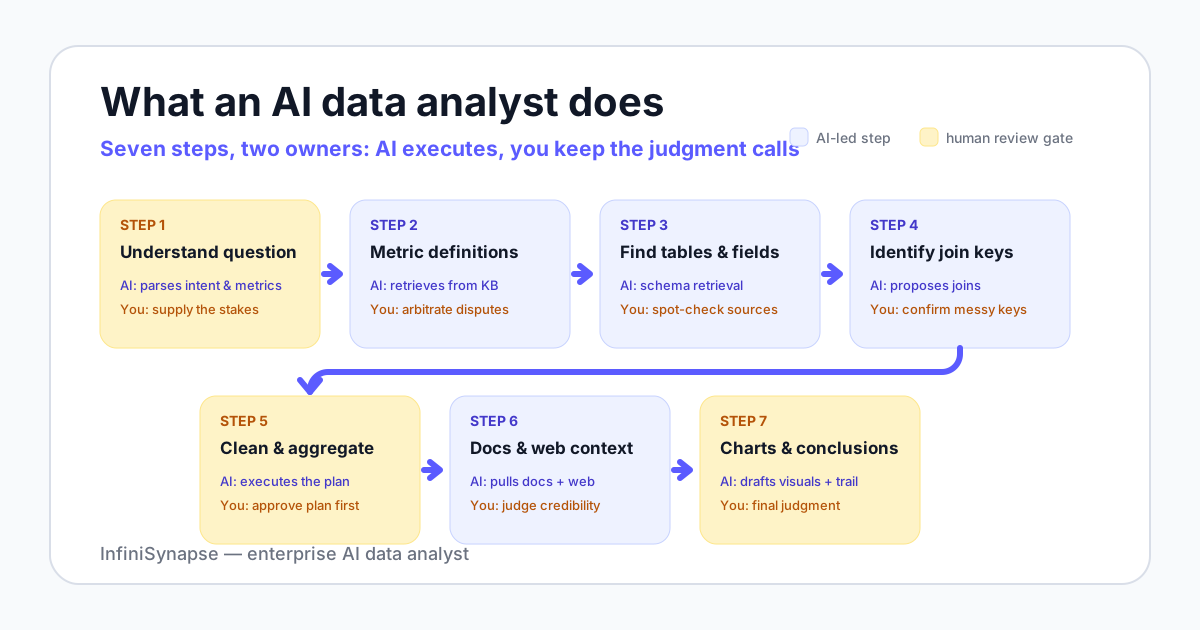
The architecture behind those seven steps is in how an AI data analyst works below. The short version: retrieval and plan review are what make the middle five steps defensible.
A tool that only writes SQL automates one step out of seven. The other six are why analysis takes days.
How does an AI data analyst work?
The loop is the same whether you evaluate InfiniSynapse or another vendor: interpret the question, retrieve the right definitions and schema, propose a plan, execute across sources, then attach an evidence trail. Tools that skip retrieval or verification are query generators, not AI data analysts.
In InfiniSynapse, question interpretation, metric lookup, and document context run on a self-developed LLM-Native RAG layer over data dictionaries, metric definitions, analysis playbooks, and past cases. Table location, joins, and aggregation run through InfiniSQL, an LLM-optimized intermediate representation connected to a multi-source execution layer.
Plan mode keeps the human column real rather than decorative: the agent drafts the full analysis plan, you review and adjust it, and only then does it execute. The ReAct line of research (2022) showed why this structure matters — interleaving reasoning steps with actions measurably reduces error versus one-shot generation.
AI data analyst use cases
Abstract task maps hide the texture of the work, so here are five AI data analyst use cases drawn from documented InfiniSynapse capabilities. Each one shows which steps the agent runs and where you stay in the loop.
Revenue anomaly triage
Yesterday's revenue lands below trend, and the first question of the day is why. You ask the agent to break the dip down by region, channel, and product line, and it drafts a plan you approve in one glance.
Minutes later you have the decomposition with an evidence trail attached — which queries ran, against which tables, under which metric definitions. The judgment call about whether the cause is a promotion ending or a tracking bug stays yours, and the trail is what makes that call reviewable, as we argue in explainable AI data analysis.
Cross-source customer ranking
A documented InfiniSynapse demo task: using phone number as the key, rank the highest-spending customers across JD and Tmall platform data, then match their real names from a CSV file and chart the result. That is two platform databases plus a file in one question.
The agent proposes the phone-number join, executes across all three sources without an ETL migration, and verifies the join produced plausible row counts. The traditional route — migrate everything into one warehouse first — is measured in days rather than minutes.
Sentiment on a feedback table
Support exports a table of customer comments, and the owner wants to know what changed this month. The agent runs language-model analysis over the comment column — sentiment and theme classification on text fields is a demonstrated capability, not a roadmap item — and joins the labels back to order data.
You get a structured answer to an unstructured question: which complaint themes grew, and whether they correlate with a product change. The human step is deciding what to do about it.
Competitor price pull
Pricing asks for current competitor prices on twenty products. Through Browser Use — a Chrome extension for data collection, page extraction, and multi-step web workflows — the agent collects the listed prices into a table you can join against your own catalog.
Web data is the lowest-trust input in the stack, so you review the extracted table before anyone prices against it. The agent gathers; you vouch.
Weekly report assembly
End of week, the recurring revenue pack is due. Through the Agent Tool Market, the agent assembles the analysis into an Excel workbook and a PPT deck — spreadsheet editing, document generation, and file conversion are tools the agent can call, not separate manual jobs.
Your role compresses to review and sign-off. The hours that used to go into assembling the deck go into the commentary that actually gets read.
What an AI data analyst cannot do
The 2025 survey pointedly subtitled "Emerging Paradigm or Overstated Hype?" exists because vendors routinely oversell this category. Here is the honest boundary, including for our own product.
Safe to delegate
- Recurring pulls and report assembly
- Cross-source joins and aggregations
- First-pass anomaly decomposition
- Chart drafting and evidence-trail capture
- Text-field classification, such as sentiment on comment columns
Keep human
- Business judgment about what a number means and what to do next
- Stakeholder negotiation and trade-off decisions
- Novel metric definitions — an agent retrieves definitions, it does not arbitrate them
- Garbage-in context: an agent will faithfully automate your ambiguity
- Accountability — a system cannot own a decision
The garbage-in point deserves emphasis: if two departments define "active user" differently and nobody has written the canonical version down, the agent will compute one of them confidently. Fixing that is knowledge-base work, covered in data agent memory explained, and it is a precondition rather than a feature.
Apply the same skepticism to roadmaps, ours included. InfiniSynapse demonstrates structured-data analysis plus language-model analysis of text fields today; voice and video interfaces are a stated vision, not a current capability.
AI data analyst vs ChatGPT
ChatGPT is a general assistant: it reasons about whatever you paste into the conversation, but it is not connected to your databases, metric definitions, or permissions. An AI data analyst is wired into those systems — it retrieves your schema and definitions, executes governed queries, verifies results, and leaves an evidence trail your team can audit.
| ChatGPT | AI data analyst | |
|---|---|---|
| Sources | What you paste or upload this session | Connected warehouses, databases, and files |
| Metric definitions | Whatever the model infers | Retrieved from a governed knowledge base |
| Permissions | None on your private data | Read-only roles you grant |
| Evidence | A chat transcript | Queries, tables, and definitions you can audit |
The chat-sandbox pattern is covered in ChatGPT data analysis. The copilot comparison — suggestion layer versus workflow ownership — is in data agent vs AI copilot.
AI data analyst vs ChatBI, NLP2SQL, and dashboards
ChatBI, NLP2SQL, copilots, and dashboards get marketed with overlapping language. The table separates them by what each one is, where it genuinely wins, and where it loses to an AI data analyst. For a deeper BI comparison, use AI data analyst vs BI tools.
| Tool | What it is | Where it wins | Where it loses |
|---|---|---|---|
| ChatBI | A conversational layer over metrics already modeled in a BI semantic layer | Fast, safe answers on pre-modeled metrics | Fails outside the semantic layer; no cross-source or open-ended analysis |
| Analytics copilot | A suggestion layer embedded in a host tool, such as Microsoft 365 Copilot | Drafting and summarizing inside software you already use | You still execute and verify everything; scope ends at the host app |
| NLP2SQL | A generator that turns a question into one query against one source | Narrow, single-source query tasks | One-shot generation with no context or verification — the exact gap BIRD measures |
| BI dashboard | Pre-built visuals refreshed on a schedule | Daily monitoring of known metrics; cheapest per view at scale | Cannot answer a new question without a build cycle |
The copilot comparison is the one buyers most often get wrong, because the marketing language is nearly identical; the full treatment is in data agent vs AI copilot. The category-level shift away from dashboards is covered in agentic analytics explained.
Analyst firms track this convergence under the Gartner augmented analytics umbrella, which is useful for shortlisting but too broad to distinguish agents from copilots. Use workflow ownership as the dividing question: who runs the analysis, and who shows the evidence.
What does it cost to adopt an AI data analyst?
Budget three things beyond the license: connecting sources with read-only credentials, seeding a knowledge base with metric definitions and data dictionaries, and reviewer time during the pilot. Shared cloud is the cheapest way to start. Private cloud and air-gapped installs add infrastructure so data stays inside your boundary.
Do not treat the license line as the whole cost. The knowledge-base seed and the first month of plan review usually dwarf the seat fee. Score vendors with the how to evaluate an AI data analyst scorecard before you expand seats.
How teams adopt an AI data analyst
The successful pilots we see follow the same four-step path. Each step has a verifiable exit condition, so you know when to proceed.
- Pick three real questions your team answered manually last quarter: one single-source, one cross-source, one open-ended "why" question. You already know the correct answers, which turns the pilot into a graded test instead of a demo.
- Connect one or two sources read-only and seed minimal context. Your top ten metric definitions plus one data dictionary page is enough to start; the knowledge layer matters more than model choice, as our memory guide argues. Exit condition: the agent cites your definitions back in its plans.
- Run the three questions in plan-review mode. Score each run on plan quality, correctness against the known answers, and the usefulness of the evidence trail. The eight-dimension evaluation checklist gives you a vendor-neutral rubric.
- Decide the deployment boundary before scaling. Shared cloud, private cloud, on-premises, or air-gapped each carry different security reviews; the architecture trade-offs are mapped in our AI-native data platform guide. The NIST AI RMF gives you and your security team a shared governance language for this conversation.
Who gets value first
- Data analysts shed repetitive pulling and keep the judgment work.
- Business owners get answers without joining a sprint queue.
- Data and BI teams finally capture definitions in a knowledge base instead of tribal memory.
- IT and security get private deployment options — Docker Compose installs, private cloud, on-premises, or air-gapped — instead of an unreviewable SaaS black box.
When InfiniSynapse is not the right fit
If you only need a fixed dashboard, have no connected sources, or have not assigned metric ownership, start with classic BI or a governance effort instead. An AI data analyst amplifies the data foundation you already have — including its problems.
Watch the seven steps run on your own data
Connect a database or upload a CSV, ask one cross-source question, and review the plan, the result, and the evidence trail. One graded run on your real data beats any feature comparison — including this page.
Try InfiniSynapse onlineFAQ
Methodology and review notes
Last updated: 2026-09-14 · Next scheduled review: 2026-12-14
The task map and scenarios are grounded in published agent research (ReAct, the 2025 data agent surveys), public benchmarks (BIRD), labor-market outlook data (US BLS, cited qualitatively), governance frameworks (NIST AI RMF), and vendor documentation. Capabilities attributed to InfiniSynapse come from InfiniSynapse product documentation; the cross-source ranking scenario is a documented product demonstration, not an independent benchmark.
Conflict of interest: InfiniSynapse publishes this guide and sells in this category. To reduce bias, the page includes an honest-limits section, explicit cases where simpler tools win, and external sources for every numeric claim.
Update cadence: Reviewed every 90 days for terminology, source links, benchmark figures, and schema consistency.
Sources and references
- [Independent] BIRD-SQL: A Big Bench for Large-Scale Database Grounded Text-to-SQL Evaluation. BIRD benchmark leaderboard.
- [Independent] Yao et al. (2022). ReAct: Synergizing Reasoning and Acting in Language Models. arXiv 2210.03629.
- [Vendor] Anthropic (2024). Building Effective Agents. anthropic.com/research/building-effective-agents.
- [Independent] US Bureau of Labor Statistics. Occupational Outlook Handbook: Data Scientists. bls.gov/ooh/math/data-scientists.htm.
- [Independent] A Survey of Data Agents: Emerging Paradigm or Overstated Hype? (2025). arXiv 2510.23587.
- [Independent] LLM/Agent-as-Data-Analyst: A Survey (2025). arXiv 2509.23988.
- [Independent] NIST. AI Risk Management Framework (AI RMF 1.0, 2023). nist.gov/itl/ai-risk-management-framework.
- [Vendor] Microsoft Learn. What is Microsoft 365 Copilot? learn.microsoft.com.