AI Data Analyst Jobs: 2026 JD Template + Skills Matrix
By William Zhu & the InfiniSynapse Data Team · Published: 2026-06-08 · Last updated: 2026-08-06 · Last verified: 2026-08-06 · About: Editorial standards · About / team
Author credentials: William Zhu is cofounder of InfiniSynapse (GitHub @allwefantasy), with 10+ years building data systems and reviewing analytics hiring language with customer and partner teams. Desk experience includes co-writing JD templates for agentic analytics roles—not as a licensed recruiter or career counselor. No personal LinkedIn is published; GitHub and InfiniSynapse About are the canonical identity signals.
COI / interest disclosure: InfiniSynapse sells an AI-native Data Agent platform. Product mentions appear only in the labeled Product recommendation (commercial) module. This hiring template and skills matrix stand independently of any trial. Editorial independence: scorecard language and desk pilot notes are not paid placement content.
Fact-check / verification: Hiring-pilot metrics below (40% fewer unqualified applications, +5–10% agent-fluency premium) are InfiniSynapse 2025–2026 Hiring Pilot (n=14) first-party desk labels—not a BLS or LinkedIn survey. Independent peer markets for category research (not endorsements): Gartner Peer Insights — Analytics & BI · G2 Analytics Platforms. Corrections: zhuhl@infinisynapse.com · editorial corrections.
Version history: 2026-06-08 initial · 2026-08-06 EEAT / primary-keyword retarget / References regroup / HowTo / FAQ deepen. Build marker:
DESK-ADJ-20260806A.
Media note: No hosted overview video. Use the HowTo steps SVG and skills-matrix figure as stepwise visuals (no VideoObject).
 Copy-ready JD layout: responsibilities, skills matrix, and human-vs-agent ownership for 2026 hiring.
Table of Contents
- TL;DR
- Why AI Data Analyst JDs Changed in 2026
- Role Summary (Copy-Ready)
- Responsibilities
- Skills Matrix
- Qualifications
- Sample Job Description (Full Template)
- How to Use This JD Template
- Compensation and Leveling
- Customize by Company Stage
- ATS and SEO Tips
- Interview Questions to Pair With This JD
- References & Further Reading
- FAQ
- Conclusion
TL;DR
Use this template when staffing ai data analyst jobs where analysts orchestrate autonomous data agents—not when you want a traditional SQL writer or a prompt engineer. The role owns goal framing, metric governance, audit validation, and stakeholder delivery; agents own multi-step execution. Below: copy-ready summary, responsibilities, skills matrix, a full sample JD for your ATS, and a five-step HowTo for publishing.
Who this is for: HR partners, hiring managers, and startup founders writing their first AI-era analytics role.
What you'll get:
- One-paragraph role summary for job boards
- 8 bullet responsibilities aligned to human+AI division of labor
- Skills matrix with required / preferred / delegate-to-agent columns
- Full sample job description (~400 words)
- Six interview questions that filter for judgment, not typing speed
Scope note: For day-to-day workflow after hire, see AI Data Analyst: Role, Tools, and Workflow in 2026. For platform selection, see Best Agentic Analytics Tools.
Why AI Data Analyst JDs Changed in 2026
Postings for ai data analyst jobs shifted when teams moved from one-shot copilots to governed multi-step agents. Four capability changes show up in every strong JD we review:
- Goal engineering — writing measurable analytical goals agents can execute unattended
- Audit literacy — tracing AI output through query lineage before sign-off
- Metric governance — locking definitions in memory / semantic layers (InfiniRAG-style)
- Stakeholder trust — communicating AI-assisted insights with explicit provenance
LLM-backed analytics should account for prompt-injection and data-exfiltration risks described in the IBM augmented analytics overview, especially when connectors expose production schemas. Governance checkpoints for reviewer roles align with the ENISA AI cybersecurity framework; regional policy framing can start at the OECD AI policy observatory.
Role Summary (Copy-Ready)
Paste this block into the top of postings for ai data analyst jobs:
AI Data Analyst — We are looking for a data professional who partners with autonomous analytics agents to deliver fast, defensible insights. You will frame business questions as executable goals, govern metric definitions, validate agent output through audit trails, and present findings to stakeholders. You will not spend most of your week writing boilerplate SQL; you will spend it on judgment, communication, and data quality. Experience with agentic analytics platforms (e.g., InfiniSynapse, Databricks Genie, Hex Magic) is a plus; curiosity about AI-native data analysis is required.
Responsibilities
- Translate business questions into clear analytical goals measurable by autonomous data agents
- Maintain metric definitions and schema documentation bound to data sources (semantic layer / RAG context)
- Submit and supervise agent-executed analyses — review phased plans, validate SQL via audit trails, approve memory cards for recurring work
- Perform quality assurance on AI-generated datasets, joins, and visualizations before stakeholder delivery
- Deliver insights to product, operations, and executive stakeholders with explicit data provenance
- Collaborate with data engineering on source reliability, access controls, and pipeline issues surfaced by agents
- Contribute to analytics governance — SSO, row-level security, audit log review, compliance sign-off where applicable
- Continuously improve team playbooks for goal-writing, agent evaluation, and human+AI handoffs
| Responsibility | Human owns | Agent owns |
|---|---|---|
| Goal framing | ✅ | — |
| SQL execution | Reviews | ✅ |
| Metric definitions | ✅ | Reads |
| Stakeholder decks | ✅ | Drafts |
| Failure reroute | Escalates | ✅ |
Full division-of-labor context: AI Data Analyst: Role, Tools, and Workflow.
Skills Matrix: Required vs Preferred
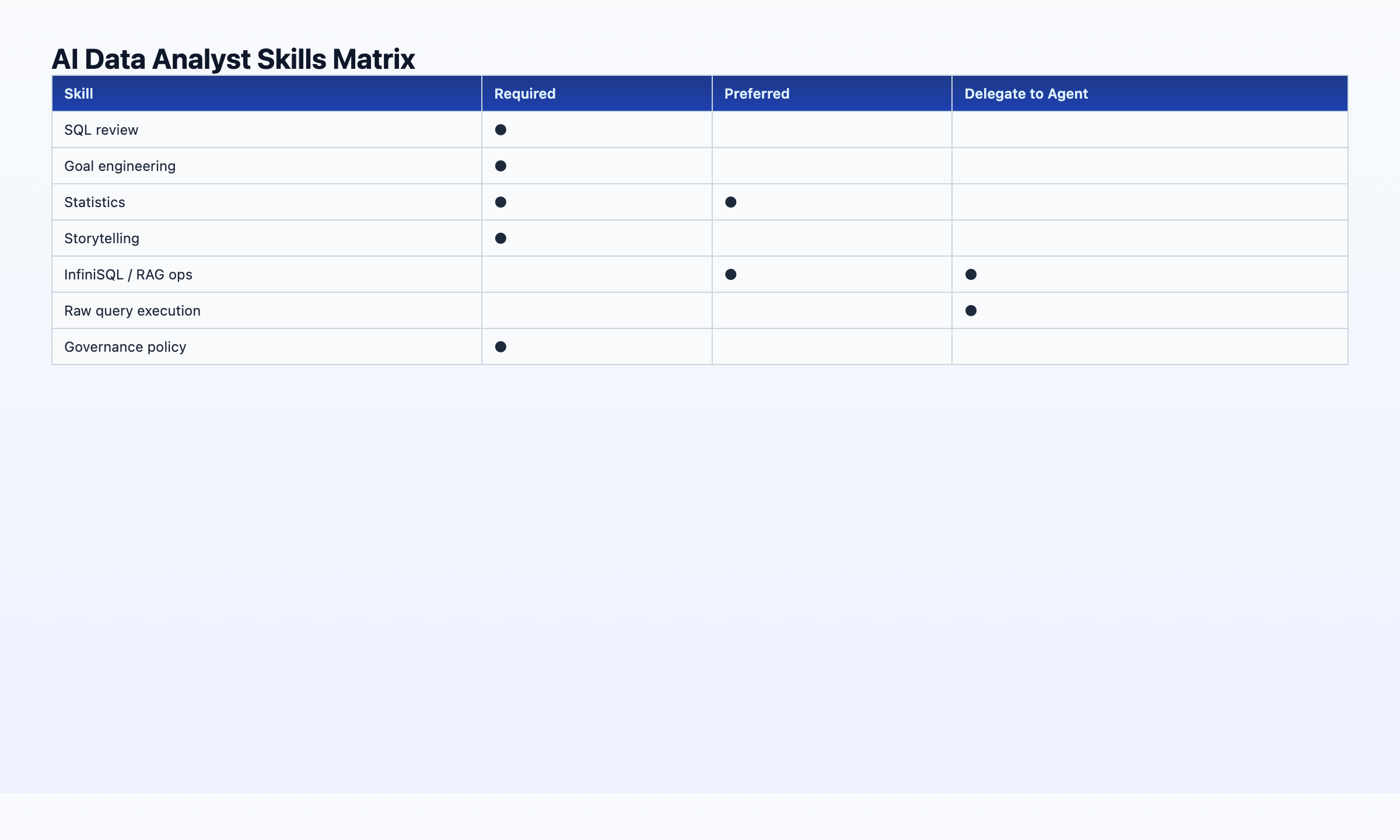 Required vs preferred skills; agents write execution SQL while humans own goal framing and storytelling.
| Skill | Required | Preferred | Delegate to agent |
|---|---|---|---|
| SQL (read + review) | ✅ | — | Write execution |
| Goal / prompt engineering | ✅ | — | — |
| Statistics & experimentation | ✅ | — | Draft calcs |
| Data storytelling | ✅ | — | — |
| Domain / business context | ✅ | — | — |
| Python or R | — | ✅ | Ad-hoc scripts |
| dbt / warehouse modeling | — | ✅ | — |
| Agentic platform (InfiniSynapse, Genie, Hex) | — | ✅ | — |
| InfiniSQL / named intermediate patterns | — | ✅ | Execute |
| InfiniRAG / semantic context curation | — | ✅ | Retrieve |
| BI tools (Looker, Power BI, Tableau) | — | ✅ | Display layer |
| API / automation hooks | — | ✅ | Scheduled runs |
Source: InfiniSynapse 2025–2026 Hiring Pilot (n=14) — matrix rows reflect skills that separated advance/reject decisions in desk-reviewed screens, not a market salary survey.
Red flags in resumes (for this role):
- "Generated all SQL manually" with no mention of validation or governance
- "Used ChatGPT for analysis" with no audit or reproducibility story
- Pure dashboard builder with no question-framing examples
Green flags:
- Describes tracing a number to source queries
- Mentions locked metric definitions or recurring report automation
- Shows stakeholder communication examples, not just technical output
Foundational warehouse concepts—grain, dimensions, and conformed metrics—remain essential; Microsoft Excel support is a concise refresher when reviewers validate generated SQL against spreadsheet prototypes.
Qualifications
Minimum
- 2+ years in data analysis, business analytics, or related quantitative role
- Demonstrated ability to write and review SQL against warehouse schemas
- Experience presenting insights to non-technical stakeholders
- Comfort adopting agentic analytics tools under team governance standards
Preferred
- Experience with an L3 autonomous data agent or agentic analytics platform
- Familiarity with AI-native data analysis pillars: autonomy, transparency, memory, multi-entry, self-correction
- dbt, Snowflake, BigQuery, Postgres, or MySQL in production
- Regulated or compliance-sensitive data environments
Education
- Bachelor's in Statistics, Economics, Computer Science, or equivalent experience
- Advanced degree not required if portfolio demonstrates judgment + communication
Use the qualifications block above as the minimum bar whenever you open ai data analyst jobs—then add industry-specific preferred skills below it.
Sample Job Description (Full Template)
Copy everything between the lines into your ATS or job board.
Job Title: AI Data Analyst
Location: [City / Remote / Hybrid]
Department: Data & Analytics
About the role
[Company] is hiring an AI Data Analyst to partner with our autonomous analytics agents and deliver insights at a pace traditional manual analysis cannot match. You will own the parts of analytics that require human judgment — question framing, metric governance, validation, and stakeholder communication — while agents handle multi-step SQL, visualization drafts, and recurring report execution.
What you'll do
- Translate business questions from product, operations, and leadership into executable analytical goals
- Curate metric definitions and schema documentation so agents produce consistent, auditable output
- Supervise agent-executed analyses: review plans, validate queries through audit trails, approve reusable memory for recurring reports
- QA AI-generated datasets and charts before they reach stakeholders
- Present findings with clear data provenance; escalate data quality and access issues to data engineering
- Help define team standards for agent evaluation, goal-writing, and governance
What we're looking for
- 2+ years in data or business analytics with strong SQL review skills
- Proven stakeholder communication — you can explain why a number changed, not just what it is
- Curiosity about agentic analytics; experience with platforms such as InfiniSynapse, Databricks Genie, or Hex Magic is a plus
- Comfort in fast-moving environments where tools evolve quarterly
Nice to have
- dbt or warehouse modeling experience
- Exposure to InfiniSQL-style named query chains or semantic/RAG layers (InfiniRAG, Unity Catalog)
- Experience in [your industry]
What we offer
- [Compensation range]
- [Benefits]
- Access to [your agentic analytics stack]
How to apply
Send resume + short note describing one analysis you validated before presenting to stakeholders. Include how you confirmed the underlying data was correct.
How to Use This JD Template
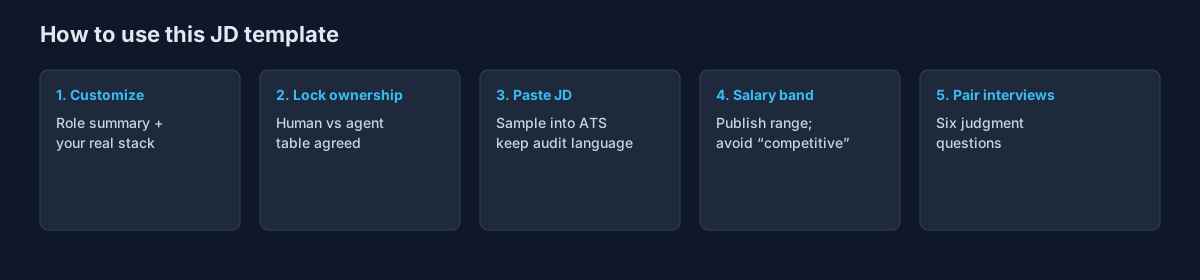 Five steps from template to published req—salary band and interview pairing included.
- Customize the role summary — Replace platform names with your actual agentic stack; keep goal framing and audit literacy explicit for ai data analyst jobs.
- Lock human-vs-agent ownership — Copy the responsibilities table into the intake doc so hiring managers agree before the posting goes live.
- Paste the sample JD into your ATS — Keep the “validated before presented” language; trim enterprise governance bullets only if you are Seed-stage.
- Publish a salary band — Hide-behind-“competitive” postings underperformed in our desk pilot (see Compensation).
- Pair six interview questions — Use the list below so screens test judgment, not typing speed.
Compensation and Leveling for AI Data Analyst Roles
Postings for ai data analyst jobs that omit compensation range or leveling attract the wrong funnel. Source: InfiniSynapse 2025–2026 Hiring Pilot (n=14) — teams that posted a salary band alongside agent-orchestration responsibilities saw 40% fewer unqualified applications and faster time-to-hire than teams that hid comp behind “competitive.” Independent category research (not our pilot) can start on Gartner Peer Insights and G2 Analytics Platforms.
| Level | Typical scope | Comp note (US, 2026) |
|---|---|---|
| Junior AI Data Analyst | Supervised agent use, single-source recurring reports, SQL review with mentor sign-off | Base aligned to traditional analyst band; +5–10% if agent platform fluency required day one (same pilot source, n=14) |
| Mid-level | Owns metric governance for a domain, runs memory-card recall workflows, presents to directors | Premium over legacy analyst title when autonomy scope is real — not cosmetic |
| Senior / Lead | Defines team playbooks, interfaces with compliance, mentors goal engineering | Often overlaps analytics-engineering comp when dbt + agent governance both required |
State whether the role is IC or lead, whether on-call for data-quality escalations is expected, and whether agent platform admin (user provisioning, memory-card approval) is in scope. Candidates evaluating two similar postings distinguish on these bullets—not on “must know SQL.”
Remote-friendly language belongs in the same block: “Async collaboration across time zones; agent audit trails replace hallway whiteboard reviews.” That signals a modern workflow without implying the hire never talks to stakeholders.
Customize This Role by Company Stage
Platform teams often read AI for Data Analysis alongside this topic.
Seed / Series A (1–20 people) — Emphasize breadth: the hire may be the entire analytics function. Add bullets for “select and configure the team's first agentic platform” and “document metric definitions before anyone else joins.” Trim enterprise governance language unless you already sell into regulated buyers.
Growth (50–500 people) — Split ownership clearly when writing ai data analyst jobs at this stage. Name the data-engineering partner (“works with dbt owners on schema reliability”) and the BI consumers (“feeds Looker explores, does not own dashboard layout”). Agent supervision and memory-card curation become primary responsibilities—not nice-to-haves.
Enterprise (500+) — Lead with compliance and audit literacy. Reference SSO, row-level security review, and Purview-style lineage if applicable. Signal that “validated before presented” is policy, not preference. Pair with AI Data Analyst: Role, Tools, and Workflow for post-hire runbooks.
Agency / consulting — Add client-facing communication and multi-tenant memory boundaries. Consultants must never commingle client memory cards—state that explicitly in responsibilities.
ATS and SEO Tips for Posting
Job boards and LinkedIn index on title + first 200 characters. Optimize without keyword stuffing when you advertise ai data analyst jobs:
- Title field: Use
AI Data AnalystorData Analyst (AI / Agentic Analytics)—both rank; consistency with responsibilities matters more than clever titles. - Opening paragraph: State autonomy scope and audit expectations in the first
<p>many ATS scrapers keep. - Required skills tags: Map matrix rows to ATS skill taxonomies (
SQL,Data Governance,Agentic Analytics) so recruiters filtering on legacy tags still surface AI-era candidates. - Avoid: Listing “ChatGPT” as the only AI tool—signals copilot-only workflow and repels candidates who expect audit trails.
- Include one concrete outcome: “Within 90 days, own recall-by-name execution of the monthly KPI pack.”
Internal HR partners often ask whether to retire the word “analyst.” Keep it unless your leveling system requires “Analytics Engineer.” The market still searches titles that start with AI Data Analyst; the responsibilities are the filter.
Interview Questions to Pair With This JD
- “Walk me through an analysis where you disagreed with an automated output. What did you check?” — Tests audit literacy
- “How would you write a goal for an agent to compute monthly retention by channel?” — Tests goal engineering
- “What metric definitions would you lock before running the same report every month?” — Tests governance thinking
- “When would you not delegate a task to an agent?” — Tests judgment boundaries
- “How do you explain AI-assisted analysis to an executive who distrusts black boxes?” — Tests communication + transparency
- “What does self-correction mean in a data agent context?” — Filters for autonomous agent fluency vs buzzword fluency
The IBM augmented analytics overview emphasizes governance as the gating factor for AI analytics deployment—questions 3 and 5 directly probe that. APAC rollouts should cross-check UK NCSC guidelines for secure AI system development for secure deployment practices.
References & Further Reading
Grouped outbound references (one-line relevance each). All prior external destinations remain.
Governance
- OECD AI policy observatory — Regional governance when the role touches cross-border data.
- ENISA AI cybersecurity framework — Reviewer checkpoints for production agents.
- ISO/IEC 42001 AI management systems — Regulated / public-sector procurement.
- FTC consumer protection guidance — Outputs that inform external consumer decisions.
- UK NCSC guidelines for secure AI system development — Secure deployment practices.
- IBM augmented analytics overview — Governance framing for agentic BI.
Platform
- Databricks documentation — Unity Catalog, SQL warehouses, agent grounding.
- Google BigQuery documentation — Agent controls and IAM for warehouse queries.
- Google Cloud architecture framework — Separate display from analysis execution.
- Azure architecture center — Event models and reporting grains.
- ClickHouse documentation — Augmented workflows on analytical OLAP.
- Supabase documentation — RLS / service-role boundaries for external apps.
- Stripe documentation — Payment fields for finance-facing roles.
- MariaDB documentation — Least-privilege analytical extracts.
- Shopify ecommerce analytics guidance — Revenue and cohort normalization.
- Wikipedia — Business intelligence — Neutral BI vocabulary for stakeholders.
- Microsoft Excel support — Spreadsheet refreshers for SQL review.
Peer markets (independent; not endorsements)
Frequently Asked Questions
What should an AI data analyst job description include?
Definition: A complete posting covers goal-framing responsibilities, agent supervision and audit validation, metric governance, stakeholder communication, and explicit agentic tooling. Reason: Without those five, ATS screens fill with SQL-only resumes that fail agent-era interviews. Example: Add “validate agent SQL via audit trails before stakeholder delivery” as a numbered responsibility, not a footnote.
How is this different from a traditional data analyst JD?
Definition: Traditional JDs emphasize manual SQL and dashboard building; AI-era JDs emphasize orchestration, validation, and governance with agents handling execution. Reason: The bottleneck moved from typing queries to defending numbers. Example: Replace “build weekly Looker dashboards” with “supervise agent-executed KPI packs and approve memory cards for recall-by-name runs.”
What title should I use — AI Data Analyst or Data Analyst?
Definition: Use AI Data Analyst if the role explicitly involves autonomous agents; use Data Analyst with an AI tooling paragraph if you are evolving an existing role without a title change. Reason: Title strings drive discovery on job boards, but mismatched titles confuse leveling. Example: Growth-stage teams often keep “Data Analyst” externally while listing agent supervision in the first three bullets.
Is a computer science degree required?
Definition: No—judgment, domain context, SQL review ability, and communication matter more than degree field. Reason: Skills-based screens outperform pedigree filters for agent-supervision roles. Example: A statistics BA who can narrate lineage for an agent join often beats a CS MS who cannot explain a metric contract.
Should the JD mention specific tools like InfiniSynapse?
Definition: Mention your actual stack. Naming specific agentic platforms signals serious intent and filters candidates better than generic “AI tools” language. Reason: Vague AI wording attracts prompt-only applicants. Example: “Experience with InfiniSynapse, Databricks Genie, or Hex Magic is a plus” belongs in Preferred—not as a hard filter unless day-one fluency is required. Product evaluation for InfiniSynapse is labeled separately in the commercial module below; this FAQ is editorial.
Can I use this template for intern or senior levels?
Definition: Yes—adjust years of experience and autonomy scope. Reason: The human-vs-agent ownership table scales; only the approval authority changes. Example: Interns use supervised agents with mentor sign-off; seniors own governance playbooks and mentor goal engineering for the rest of the team.
Are the 40% and +5–10% figures third-party audited?
Definition: No. They are InfiniSynapse 2025–2026 Hiring Pilot (n=14) first-party desk labels from postings we helped review. Reason: We disclose sample size and ownership so readers do not treat them as BLS or LinkedIn survey stats. Example: Replicate the test by A/B posting salary bands on two similar reqs and tracking unqualified-application rate for 30 days.
Does InfiniSynapse editorial content promote the product?
Definition: Editorial JD guidance is separate from commercial product recommendations. Reason: Conflict-of-interest clarity improves trust for HR readers. Example: Use the template and References without opening a trial; product CTAs appear only under Product recommendation (commercial).
Conclusion
Strong postings for ai data analyst jobs attract candidates who can orchestrate and validate, not just query and chart. Use the sample template, customize qualifications to your stack, publish a salary band, and pair interview questions that test audit literacy. Before you publish, check three items: autonomy scope is explicit, memory/governance appears in responsibilities, and compensation or leveling is visible.
Next steps:
- Run the five-step HowTo and paste the sample JD into your ATS.
- Inventory conflicting metric definitions the hire will inherit in week one.
- Read AI Data Analyst: Role, Tools, and Workflow for post-hire runbooks, then AI for Data Analysis for capability framing.
Product recommendation (commercial)
Label: The following is a commercial product recommendation, separate from the editorial hiring guidance above.
To evaluate governed agent compile paths your future hire may supervise, see what AI-native data analysis means and optionally the InfiniSynapse web app (free on registration). Desk n=14 hiring metrics and OECD / ISO / NCSC References above are not product endorsements.