What Is an AI-Native Data Platform? (2026 Buyer's Guide)
By William Zhu & the InfiniSynapse Data Team · Published: 2026-06-09 · Last updated: 2026-07-31 · About: Editorial standards · About / team
Author credentials: William Zhu — InfiniSynapse cofounder; public engineering profile GitHub @allwefantasy. Desk contact: zhuhl@infinisynapse.com. Reviewers: data platform · analytics engineering.
Disclosure: We build InfiniSynapse and sell an ai-native data platform. This buyer's guide reflects architecture patterns and evaluation criteria from production deployments—InfiniSynapse appears as one reference implementation, not the only option. Scoring examples are first-party self-assessment; re-run the checklist on your own schema.
Third-party anchors: NIST AI RMF, NIST SP 800-53, ISO/IEC 42001, OWASP Top 10 for LLM Applications, Gartner Peer Insights — Analytics & BI, G2 Business Intelligence, Databricks Genie / data-agent post. Peer-review archive: editorial standards.
Table of Contents
- TL;DR
- Definition
- Platform Architecture: Five Layers
- The Five Pillars — Platform Requirements
- AI-Native vs AI-Enabled vs Traditional BI
- Migration Path: AI-Enabled → AI-Native
- Buying Criteria: 12-Question Checklist
- Market Landscape (Neutral Comparison)
- Reference Implementation: InfiniSynapse
- Deployment Patterns
- FAQ
- Who wrote this
- References
- Conclusion
TL;DR
Canonical answer: An ai-native data platform is software architected from day one around autonomous Data Agents—not a BI dashboard with an AI copilot bolted on. It connects to enterprise data sources, runs goal-driven multi-step analysis with full audit trails, distills completed work into reusable memory, and exposes the same agent capability through chat, web, and API. The 2026 buyer's question is not "does it have AI?" but "was the workflow designed for agents, or retrofitted?"
Who this is for: heads of data, analytics platform leads, CTOs, and procurement teams evaluating whether an ai-native data platform belongs in their 2026 analytics infrastructure budget.
What you'll learn:
- A precise ai-native data platform definition distinct from copilot add-ons
- Five architecture layers every AI-native platform must ship
- Five operational pillars as pass/fail buying tests
- A 12-question evaluation checklist plus a neutral market landscape
- How to validate claims with a recurring-question demo (not a one-shot SQL trick)
Conflict of interest: InfiniSynapse publishes this guide and sells related software. Scoring examples below are first-party self-assessment—re-run the checklist on your own schema.
Related: Data Agent Manifesto · What Is a Data Agent? · Best AI Tools for Data Analysis. The warehouse and pipeline layer those agents query is mapped in the data engineering hub.
Account for prompt-injection and exfiltration risks in the OWASP Top 10 for LLM Applications. Align connector design with the NIST AI Risk Management Framework.
Independent buyer directories (not our scores)
Buyer reviews for analytics and BI platforms are catalogued on Gartner Peer Insights — Analytics and Business Intelligence Platforms. Use those directories to calibrate vendor claims; this page does not invent star ratings or market-share percentages.
Peer product grids for BI tooling also appear on G2 Business Intelligence. Cross-check shortlist vendors there—and run your own POC—before treating any self-scored checklist as proof.
Definition
Key Definition: An ai-native data platform is an integrated system where Data Agents are the primary workflow—connecting to structured and unstructured data sources, executing autonomous multi-step analysis, persisting audit trails and distilled memory, and delivering consistent capability across multiple entry points—as opposed to traditional BI platforms that optimize for dashboard display with optional AI assistance layered on top.
Three terms to disambiguate:
| Term | What it optimizes for |
|---|---|
| Traditional BI platform | Displaying pre-built dashboards |
| AI-enabled analytics | Copilot accelerates analyst steps inside existing BI |
| AI-native data platform | Agent executes analysis; human validates and decides |
Data Agent (definition): a system that takes a business goal, plans multi-step analysis, executes tools (usually SQL and retrieval), validates intermediate results, and returns evidence a human can audit—see What Is a Data Agent?.
For the workflow paradigm, see AI-native data analysis. When evaluating an ai-native data platform, ask: was it designed so agents execute analysis, or so humans execute analysis with AI suggestions? That distinction—not connector count—separates native from enabled.
Platform Architecture: Five Layers
Layer 1 — Connector & Asset Fabric
Bind databases (MySQL, Postgres, Snowflake, BigQuery), document stores (MongoDB), files (XLSX, CSV, Parquet), and knowledge sources (docs, dictionaries, prior analyses). The agent must discover assets—not rely on the user pasting schema every session. Access reviews should map roles and retention to controls such as NIST SP 800-53.
What “good” looks like: Multi-source binding with retrieval scoped per connector; the agent picks a source per sub-question without re-uploading files each session.
Layer 2 — Agent Runtime (Data Agent)
Orchestration loop: plan → execute tool calls → validate → self-correct → summarize. Not single-turn chat. This is the heart of an ai-native data platform—without a runtime, “AI” is only a UI feature.
Layer 3 — Knowledge Layer
Retrieve business definitions, prior analyses, and metric contracts per query (RAG / memory), so agents do not depend on pasted schema dumps. Knowledge must be versioned and approvable—session chat history alone is not a knowledge layer.
Layer 4 — Audit & Governance
Task timeline with every SQL, dataset, and chart inspectable. Role-based access, approval flows for memory cards (DRAFT → human approved), exportable evidence for finance and compliance reviews. AI management programs may also map to ISO/IEC 42001.
Layer 5 — Multi-Entry Access
Same agent capability via chat (light queries), web app (deep tasks), and API (embedding in Code Agent workflows, kanban systems, or custom agents). Entry-point parity is a platform requirement—not a feature request.
[Connectors] → [Agent Runtime] ↔ [Knowledge/RAG]
                    ↓
            [Audit Timeline] → [Memory Store]
                    ↓
            [Chat | Web App | API]
The Five Pillars — Platform Requirements
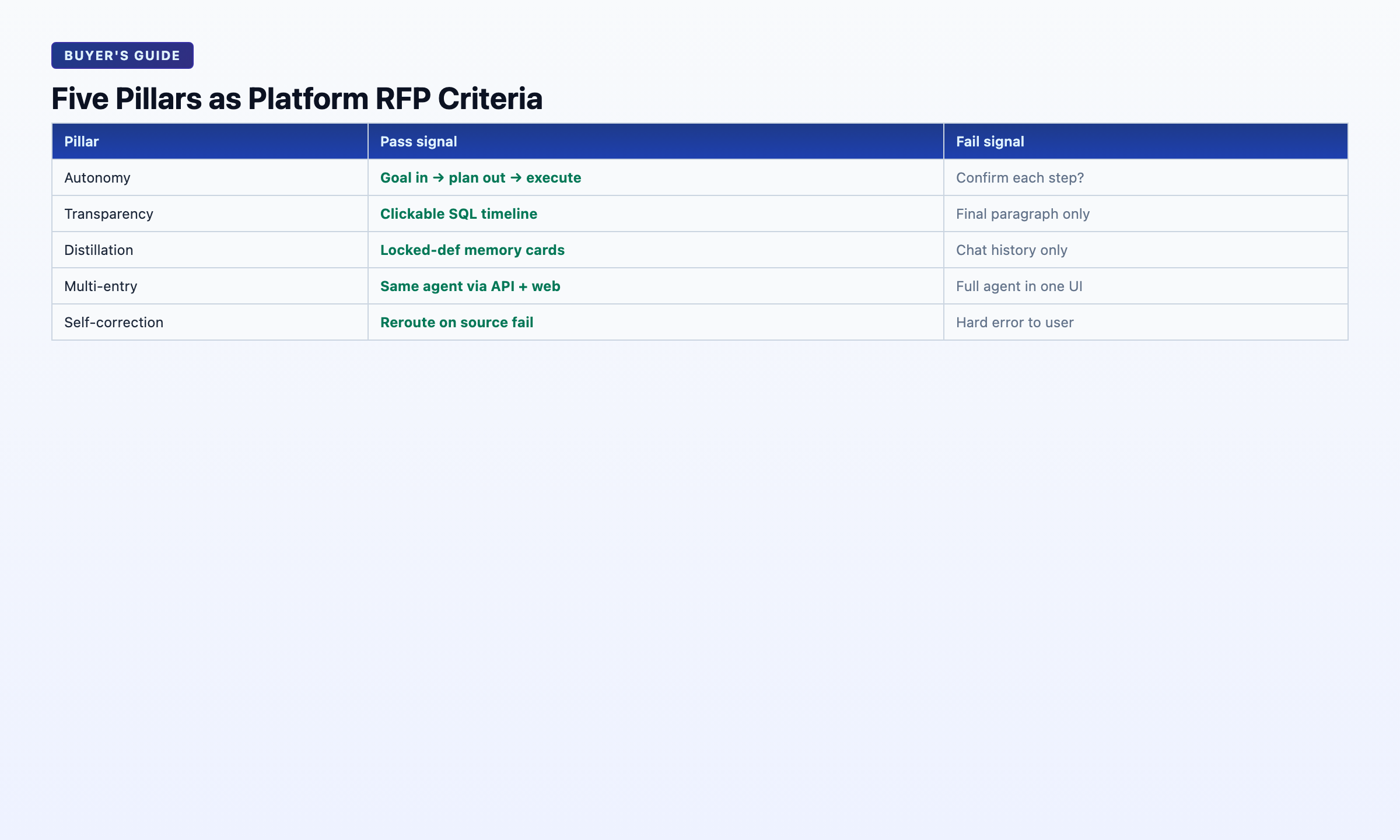
Use these as RFP criteria for any ai-native data platform. A product failing more than one pillar is usually AI-enabled with marketing.
| Pillar | Platform requirement | Fail signal |
|---|---|---|
| 1. Autonomy | Goal in → phased plan out → execution without per-step prompting | “Confirm each step?” dialogs |
| 2. Process transparency | Clickable audit timeline for every task | Final answer only |
| 3. Knowledge distillation | Memory cards with locked definitions, human approval | Session-only history |
| 4. Multi-entry parity | Identical agent via chat, web, API | Full agent in one UI only |
| 5. Self-correction | Reroute on source failure, empty join, timeout | Hard fail to user |
These pillars are defined in depth in the Data Agent Manifesto and operationalized by the Data Agent runtime hosted on an ai-native data platform. Foundational warehouse concepts—grain, dimensions, and conformed metrics—remain essential when reviewers validate generated SQL.
AI-Native vs AI-Enabled vs Traditional BI
| Dimension | Traditional BI | AI-enabled | AI-native platform |
|---|---|---|---|
| Primary artifact | Dashboard | Copilot suggestion | Completed analysis + audit |
| User mode | Click filters | Prompt per step | Submit goal |
| Memory | Saved dashboards | Chat history | Distilled memory cards |
| Failure handling | Broken chart | Error to user | Agent reroutes |
| Best for | Known KPIs | Analyst acceleration | Recurring + multi-source analysis |
| 2026 budget line | Maintenance | Pilot copilot | Agent infrastructure |
When traditional BI wins: Fixed executive dashboards, governed semantic layers, known metrics displayed daily.
When an ai-native data platform wins: Ad-hoc and recurring questions across mixed sources, analyst unavailable, audit required, method must compound month over month.
An ai-native data platform is not a replacement for every BI seat. It is the layer that handles work between dashboard refreshes—discovery, ad-hoc cuts, recurring KPI packages—while governed dashboards remain the executive consumption surface. For the human-in-the-loop middle path, see Augmented analytics.
Migration Path: AI-Enabled → AI-Native
Most enterprises are not greenfield. They already run ThoughtSpot, Power BI, Hex, or Databricks with copilot features enabled. Adopting an ai-native data platform follows a predictable HowTo sequence:

- Shadow mode (2–4 weeks) — Run the same recurring question through your existing copilot and through a candidate ai-native data platform. Compare audit depth and rerun time—not just answer text.
- Recurring workloads (1–2 months) — Route weekly KPIs and monthly cohorts to the native stack. Keep BI for fixed dashboards. Bind RAG to existing semantic definitions where possible to avoid duplicate metric layers.
- Embedded access (ongoing) — Enable chat, API, or kanban triggers so PMs and engineers request analysis without ticket queues. Multi-entry parity is a platform requirement once adoption scales.
- Governance hardening — Formalize memory-card approval flows, exportable audit trails for finance, and role-based connector access. Budget is earned when compliance teams can replay evidence—not when analysts say the numbers “look right.”
Teams that skip Phase 1 and buy on demo SQL often discover their copilot and native stack produce identical answers—but only a true ai-native data platform remembers definitions next month.
Buying Criteria: 12-Question Checklist
Score each Yes / Partial / No when you POC an ai-native data platform. Any No on questions 1–5 is a disqualifier for the AI-native label. This checklist is an evaluation framework—not a product star rating.

- Does the user submit a goal, not steps?
- Does the system produce a reviewable plan before executing?
- Can stakeholders inspect every SQL and intermediate dataset?
- Does completed work distill into reusable memory with approval flow?
- Does the agent self-correct when a source fails?
- Are relational DBs + files + docs queryable in one task?
- Is business knowledge retrieved per query (RAG), not pasted?
- Is the same agent available via API without feature gaps?
- Does the platform support human-in-the-loop approval for memory?
- Can tasks run while the user is away (async completion)?
- Is there a free tier or POC path under two weeks?
- Does the vendor publish first-party case evidence with inspectable metrics?
Treat questions 1–5 as veto criteria for any vendor claiming to sell an ai-native data platform. Partial scores on 6–8 often indicate a strong warehouse-native agent that still struggles with files or API parity—acceptable for some teams, disqualifying for mixed-source estates.
Market Landscape (Neutral Comparison)
Buyers comparing an ai-native data platform compete across several neighboring categories. Fit depends on where your data lives and how much multi-source orchestration you need:
| Category | Typical products | Strength | Common gap vs full AI-native |
|---|---|---|---|
| Warehouse-native NL | Snowflake Cortex Analyst, Databricks Genie | Strong when data gravity is one platform | Weaker multi-cloud + file + API parity |
| Governed search BI | ThoughtSpot, Power BI Copilot | Business self-serve on semantic models | Less multi-step agent planning |
| Notebook / IDE AI | Hex Magic, Mode | Analyst craft + transparency | Exec self-serve and memory cards |
| Multi-source Data Agent platforms | InfiniSynapse and peers | Goal → plan → evidence across sources | Requires metric contracts to shine |
Warehouse vendors describe governed NL agents in Databricks’ Genie / data-agent post—compare memory and audit depth on your requirements. Tool rankings: Best AI Tools for Data Analysis. Lakehouse fork: Databricks Genie vs Data Agent. Shortlist only products that pass pillars 1–5 before debating UI polish of an ai-native data platform.
Reference Implementation: InfiniSynapse
Optional product note (commercial): InfiniSynapse is one ai-native data platform used as a reference architecture—not a claim that it is the only compliant product. Map every component below to the five layers and pillars, then re-score competitors the same way. Skip this section if you only need the educational framework.
| Component | Role |
|---|---|
| InfiniAgent | Orchestration and phased planning |
| InfiniSQL | Federated agentic query across connectors |
| InfiniRAG | Business knowledge bound to sources |
| Memory cards | Distillation with DRAFT → approved workflow |
| Task timeline | Full audit trail per analysis |
| Multi-entry | Chat, web, agent_infini API |
Illustrative first-party cases (not third-party audited) — use them as a demo script for any candidate, not as independent benchmarks:
- Lobster Moonlight (2026-05-14): 7,444×22 Excel; chat request → five autonomous phases in ~6 minutes; 12 charts; ~90 seconds user input.
- April → May rerun (2026-05-12): Growth analysis distilled to a memory card; May rerun in one sentence (compounding vs session chat).
For methods context: AI for Data Analysis. InfiniSynapse’s team self-scores Yes on checklist items 1–12 via app.infinisynapse.com—treat as a vendor claim and verify in POC against Gartner Peer Insights / G2 directories and your own schema.
Deployment Patterns
| Pattern | How teams use an ai-native data platform |
|---|---|
| A — Analyst primary | Web for deep tasks; memory cards for weekly/monthly reruns; API for scheduling |
| B — Business self-serve | Chat for light questions; escalate when complexity exceeds one SQL |
| C — Embedded engineering | Agent API from Code Agent / kanban when tickets need data evidence |
| D — Hybrid with BI | Native platform for discovery/ad-hoc/recurring; Tableau/Power BI for fixed dashboards |
Educational content ends at the FAQ and References. The app CTA in the conclusion is optional.
Frequently Asked Questions
What is an AI-native data platform?
An ai-native data platform is software designed from the ground up for autonomous Data Agents—connecting to enterprise sources, running goal-driven multi-step analysis with audit trails, distilling reusable memory, and exposing agents through multiple entry points. It is not a traditional BI tool with an AI chatbot added.
How is an AI-native data platform different from an AI-enabled BI tool?
AI-enabled BI adds copilots to dashboard workflows—the user still drives each step and the primary artifact is a chart. An ai-native data platform treats the agent as the workflow: goal in, audited analysis + memory out.
Do I still need a data warehouse?
Often yes. An ai-native data platform connects to your warehouse, databases, and files—it does not replace storage. It replaces the manual loop of discovery → query → chart → forget → repeat.
What connectors should I require in an RFP?
For an ai-native data platform, minimum: one relational DB, one file type (XLSX/CSV), and one knowledge source (docs or dictionary). Ideal: MySQL/Postgres + MongoDB + warehouse + file upload + RAG on business definitions. Confirm connector depth in a POC, not a slide.
How do I evaluate AI-native claims in vendor demos?
Run the same recurring question twice on any candidate ai-native data platform. First session: full analysis. Second session: ask to rerun with new data and the same definitions. If the vendor re-explains schema from scratch, it is not AI-native.
Is InfiniSynapse an AI-native data platform or just a Data Agent?
Both. InfiniSynapse is an ai-native data platform that hosts Data Agents (orchestration + SQL tools + RAG + audit + memory). “Data Agent” names the actor; “AI-native platform” names the system it runs in. See What Is a Data Agent?.
Who is accountable for this article?
William Zhu and the InfiniSynapse Data Team, under editorial standards. First-party cases are labeled—not third-party audits.
Educational vs commercial content?
Teaching sections (definition, layers, pillars, migration HowTo, checklist, FAQ) stand alone. The InfiniSynapse reference-implementation note is optional and marked commercial.
Who wrote this
Named author. William Zhu — InfiniSynapse cofounder (GitHub @allwefantasy). Team: InfiniSynapse Data Team. About: editorial standards. Corrections: zhuhl@infinisynapse.com.
References
- [Framework] NIST. AI Risk Management Framework. nist.gov/itl/ai-risk-management-framework. Accessed 2026-07-31.
- [Framework] NIST. SP 800-53 Rev. 5. csrc.nist.gov/pubs/sp/800/53/r5/final. Accessed 2026-07-31.
- [Standard] ISO. ISO/IEC 42001:2023. iso.org/standard/81230.html. Accessed 2026-07-31.
- [Security] OWASP. Top 10 for Large Language Model Applications. owasp.org/www-project-top-10-for-large-language-model-applications/. Accessed 2026-07-31.
- [Vendor] Databricks. Pushing the frontier of data agents with Genie. databricks.com/blog/pushing-frontier-data-agents-genie. Accessed 2026-07-31.
- [Independent] Gartner. Peer Insights — Analytics and Business Intelligence Platforms. gartner.com/reviews/market/analytics-business-intelligence-platforms. Accessed 2026-07-31. (Buyer reviews; we do not invent market-share %.)
- [Independent] G2. Business Intelligence category. g2.com/categories/business-intelligence. Accessed 2026-07-31.
- [Internal hub] InfiniSynapse. Data Agent Manifesto. infinisynapse.com/en/blog/data-agent-manifesto. Accessed 2026-07-31.
- [Internal hub] InfiniSynapse. What Is a Data Agent? infinisynapse.com/en/blog/what-is-a-data-agent. Accessed 2026-07-31.
- [Internal hub] InfiniSynapse. AI-native data analysis. infinisynapse.com/en/blog/ai-native-data-analysis. Accessed 2026-07-31.
- [Internal hub] InfiniSynapse. Augmented analytics. infinisynapse.com/en/blog/augmented-analytics. Accessed 2026-07-31.
- [Internal hub] InfiniSynapse. AI for Data Analysis. infinisynapse.com/en/blog/ai-for-data-analysis. Accessed 2026-07-31.
- [Internal hub] InfiniSynapse. Databricks Genie vs Data Agent. infinisynapse.com/en/blog/databricks-genie-vs-data-agent. Accessed 2026-07-31.
- [Use case] InfiniSynapse. Best AI Tools for Data Analysis. infinisynapse.com/use-cases/best-ai-tools-for-data-analysis. Accessed 2026-07-31.
- [Person] William Zhu. Cofounder, InfiniSynapse. github.com/allwefantasy. Accessed 2026-07-31.
Conclusion
The 2026 buyer's question for analytics infrastructure: was this platform built for agents, or did AI arrive as an add-on?
An ai-native data platform connects sources, runs autonomous agents, retrieves business knowledge, logs auditable evidence, distills memory, and delivers parity across entry points. Evaluate with the five pillars and twelve-question checklist—then validate with a recurring-question demo, not a one-shot SQL trick. The migration path from AI-enabled to native is phased; skipping shadow mode is the most common procurement mistake when buying agent infrastructure.
Start with AI-native data analysis for the paradigm, What Is a Data Agent? for the actor, what an AI data analyst does for the analysis-specialized software, the unstructured data platform in the content plane for documents and multimodal files, and AI for Data Analysis for the methods landscape.
Optional product note (commercial): To try a multi-source agent path, begin at https://app.infinisynapse.com/.