Databricks Assistant vs Genie vs Data Agent (2026)
By William Zhu & the InfiniSynapse Data Team · Published: 2026-06-12 · Last updated: 2026-08-14 · Last verified: 2026-08-14 · About: Editorial standards · About / team
Author credentials: William Zhu is cofounder of InfiniSynapse (GitHub @allwefantasy; org GitHub InfiniSynapse). No personal LinkedIn is published — GitHub and InfiniSynapse About are the canonical identity signals. Desk experience: quarterly bake-offs of Databricks-native AI surfaces on authorized lakehouse workspaces. Field publications used on this page: Databricks documentation, Genie Code, Genie, Wikipedia: Databricks, ReAct (arXiv:2210.03629). Company identity (Organization only): LinkedIn InfiniSynapse. Marker:
DESK-DAG-20260814A.
Independence / COI: InfiniSynapse publishes this guide and sells a Data Agent that can query Databricks among other sources. Product notes sit only in the labeled commercial module at the end. Third-party reviews cited below are of Databricks as a platform, not paid InfiniSynapse testimonials. Verify current feature names and packaging on Databricks docs.
Media note: No hosted walkthrough video is published. Use the hero matrix, desk benchmark chart, three-surface diagram, and HowTo flowchart as stepwise visuals.
 Hero: coding copilot vs lakehouse NL analytics vs a cross-system Data Agent. Cite Databricks docs for current names.
Table of Contents
- TL;DR
- Key terms
- Why Buyers Compare Assistant and Genie
- Three Categories: Assistant, Genie, and Data Agent
- Databricks Assistant: What It Optimizes For
- Databricks Genie: What It Optimizes For
- Data Agent Category: What It Optimizes For
- Desk Evaluation Packet
- How to run the bake-off
- Technical Implementation Details
- Head-to-Head Comparison Table
- Five-Pillar Scorecard
- Workflow Tests: Where Each Wins
- Decision Matrix by Team Profile
- InfiniSynapse as a Data Agent Reference
- Rollout and Procurement Notes
- FAQ
- References
- Conclusion
TL;DR
Canonical answer: Databricks Assistant is a coding copilot inside notebooks and SQL editors—it speeds authoring, not autonomous analysis. Databricks Genie is natural-language analytics over governed lakehouse assets—strong for Databricks-first self-service. Data Agents accept business goals, orchestrate multi-step work across systems, ship audit trails, and distill memory. The Databricks Assistant vs Genie choice is intra-platform; adding a Data Agent answers whether your analytical contract stays inside Unity Catalog or spans CRM, finance, and ops systems.
Who this is for: lakehouse platform owners running a Databricks Assistant vs Genie shortlist, analytics leads on Databricks, and procurement teams comparing three similarly branded AI surfaces.
What you'll learn from a Databricks Assistant vs Genie buyer lens:
- Category boundaries for Assistant, Genie, and Data Agent
- A buyer comparison table (governance + memory)
- Desk first-pass rates from eight authorized workspace packets
- Three workflow tests with a winner per scenario
- When Genie is enough—and when a Data Agent is required
Official product framing for Databricks AI surfaces is maintained by Databricks (e.g. Genie / data agents blog and Databricks documentation). Use those as primary sources when licensing details change. 2026 docs currently brand the coding copilot as Genie Code and the consumer NL surface under the Genie family (Genie One / Genie Agents). Buyers still search the older Assistant vs Genie pairing; this page keeps that buyer language and maps it to current docs.
Evaluation basis: Hands-on notes are from InfiniSynapse engineer reviews of eight authorized Databricks workspace packets in 2026 H1 (marker
DESK-DAG-20260814A). They are desk composites, not audited customer SLAs. Official product behavior cites Databricks docs inline and in References. Raw rows: desk-dag-packet.csv (CC BY 4.0).
Key terms
One-sentence definitions and current synonyms for a Databricks Assistant vs Genie shortlist. Product names follow Databricks docs; the platform entity is also on Wikipedia: Databricks.
| Term | One-sentence definition | Synonym / current docs name |
|---|---|---|
| Databricks Assistant | Coding copilot inside notebooks and SQL editors; the human still runs the cell. | Genie Code |
| Databricks Genie | Natural-language analytics over Unity Catalog–governed lakehouse assets. Definition page: what Databricks Genie is. | Genie family (Genie One / Genie Agents) |
| Unity Catalog | Databricks governance layer that Genie inherits for table permissions. | Catalog IAM |
| Gold table | Curated Delta table used as the authoritative metric grain in desk packets. | Curated lakehouse asset |
| Data Agent | Goal-led multi-step executor with connectors, audit trail, and distilled memory. | Cross-system agent (category) |
| Distilled memory | Locked metric definition reused on a later replay—not a saved chat. | Memory card |
| Cross-source packet | A question that needs lakehouse tables plus an operational export. | Hybrid ticket |
Why Buyers Compare Assistant and Genie
Databricks ships multiple AI surfaces. Buyers searching Databricks Assistant vs Genie usually want to know which license line to fund—but the better question is which objective function each product optimizes:
| Product | Optimizes for | Typical user |
|---|---|---|
| Databricks Assistant | Faster code and SQL authoring | Data engineer, ML engineer |
| Databricks Genie | NL questions on governed lakehouse data | Analyst, business user in workspace |
| Data Agent (category) | Defensible multi-step answers + memory | Analyst + platform + business stakeholder |
Confusing Assistant with Genie leads to disappointed analysts (“it won’t run my monthly report unattended”). Confusing Genie with a full Data Agent leads to integration gaps when answers require Salesforce, Postgres, or email-distributed files outside Delta Lake.
In short, Databricks Assistant vs Genie is a builder-vs-consumer decision inside one platform. A Data Agent is a different layer when the operating model crosses platforms.
Teams migrating from sandbox uploads often pair this guide with Code Interpreter vs Data Agent and Data Agent Architecture. Align production AI controls with the NIST AI Risk Management Framework when the Databricks Assistant vs Genie debate expands to agent orchestration outside the workspace. Independent buyer sentiment for the underlying lakehouse (not this page’s scores) lives on G2 Databricks reviews and Gartner Peer Insights — Analytics & BI platforms.
Three Categories: Assistant, Genie, and Data Agent
Keep these labels fixed during a Databricks Assistant vs Genie evaluation so engineering and analytics budgets stay separate.
| Category | What it does | Buyer mistake to avoid |
|---|---|---|
| Assistant | Inline code completion and refactor in notebooks; user drives every run | Expecting unattended KPI delivery |
| Genie | NL questions over Unity Catalog–governed tables inside the workspace | Expecting CRM + lakehouse orchestration without exports |
| Data Agent | Goal-led multi-step execution, cross-system connectors, audit trail, memory | Buying when the estate is Databricks-only with no recurrence need |
Data Agents take a goal, plan phases, query across connectors, log audit trails, distill memory, and support multi-entry (web, chat, API). Category definition: What Is a Data Agent?. The Databricks Assistant vs Genie comparison is horizontal (builder vs consumer). Data Agent is vertical (full workflow ownership).
Databricks Assistant: What It Optimizes For
In any Databricks Assistant vs Genie RFP, start by confirming Assistant is scored as an authoring tool—not an analytics runtime.
Databricks Assistant accelerates notebook and SQL editor work—Python snippets, Spark refactor hints, error explanation. Databricks currently documents that coding copilot as Genie Code: slash commands (/fix, /explain, /optimize), cell-scoped prompts (Cmd+I / Ctrl+I), and autocomplete that still leaves the human to run the cell. Strengths: reduces typing time for engineers, stays context-aware within open notebook cells, and keeps governance friction low because output is draft code the human runs.
Limits for analytics buyers evaluating Databricks Assistant vs Genie: no business-goal orchestration, no durable KPI memory across months, no cross-system execution beyond the notebook session, and the wrong category when stakeholders ask for unattended recurring reports.
Desk case A (H1 2026, William Zhu): I scored eight authorized PySpark/SQL authoring tasks. First-accept was 6/8 (75%). Median wall time on accepted tasks was 4 minutes versus about 18 minutes unassisted on the same cells. Two misses: one deprecated API suggestion, one UDF rewrite that compiled but changed semantics. Human review remained mandatory. Marker
DESK-DAG-20260814A. Not a Databricks SLA.
Databricks Genie: What It Optimizes For
Genie is usually the consumer-side winner in a Databricks Assistant vs Genie bake-off when gold tables already live in Unity Catalog.
Databricks Genie is Databricks’ natural-language analytics interface over governed data assets. Current docs place that consumer experience in the Genie family (Genie One for business users; Genie Agents for configured metric environments). It inherits Unity Catalog permissions, Delta Lake structure, and workspace audit context. Strengths: fast self-service for Databricks-standardized teams, NL access without writing every slice by hand, and governance alignment inside the lakehouse perimeter when authoritative metrics live in Delta tables.
Limits relative to Data Agents—and relative to mistaking Genie for Assistant in a Databricks Assistant vs Genie bake-off: workspace-bound UI, manual exports for CRM or spreadsheet joins, conversation-scoped memory rather than team metric cards, and guided exploration instead of fully unattended multi-phase execution.
Desk case B (H1 2026, William Zhu): On the same eight packets, the gold-table question “What was Q2 revenue by region?” returned usable SQL on 7/8 (88%) first asks. The miss joined a role-playing date table. On the three packets that also needed a Salesforce export, Genie could not complete the join without a manual CSV in the workspace. Marker
DESK-DAG-20260814A.
Data Agent Category: What It Optimizes For
A Data Agent optimizes for defensible answers—not faster typing (Assistant) and not only NL SQL inside one platform (Genie).
| Capability | Assistant | Genie | Data Agent |
|---|---|---|---|
| Business goal input | Low | Partial | High |
| Multi-phase plan | Low | Partial | High |
| Cross-system connectors | Low | Low–Partial | High |
| Audit timeline | Low (draft code) | Medium–High in workspace | High (full task timeline) |
| Distilled memory | Low | Medium | High |
| Multi-entry (API/chat) | Low | Medium | High |
Agent-design research such as Anthropic on effective agents and ReAct describes the plan→tools→observe loop Data Agents implement end-to-end. Regulated estates should also account for OWASP Top 10 for LLM Applications when agents call live endpoints. When procurement requires a certified AI management system, map the same controls to ISO/IEC 42001.
The AI data analyst role pairs with Data Agents: humans frame goals and validate output; agents handle throughput and bookkeeping. When Unity Catalog policies must extend to orchestration outside the workspace, treat that as a Data Agent (or hybrid) requirement—not a Databricks Assistant vs Genie feature toggle.
Desk case C (H1 2026, William Zhu): The three hybrid churn packets completed on a Data Agent path (3/3) with a plan, query log, and a locked churn definition reused in week four. Wall times were 12–16 minutes. Hosts masked. Marker
DESK-DAG-20260814A.
Desk Evaluation Packet
We scored Databricks Assistant vs Genie tickets first, then the three hybrid cases. Figures below are desk composites from eight authorized workspace packets (22 scored tasks). Re-run the same evidence standard on your Unity Catalog before purchasing. Embedded raw data: desk-dag-packet.csv (CC BY 4.0).
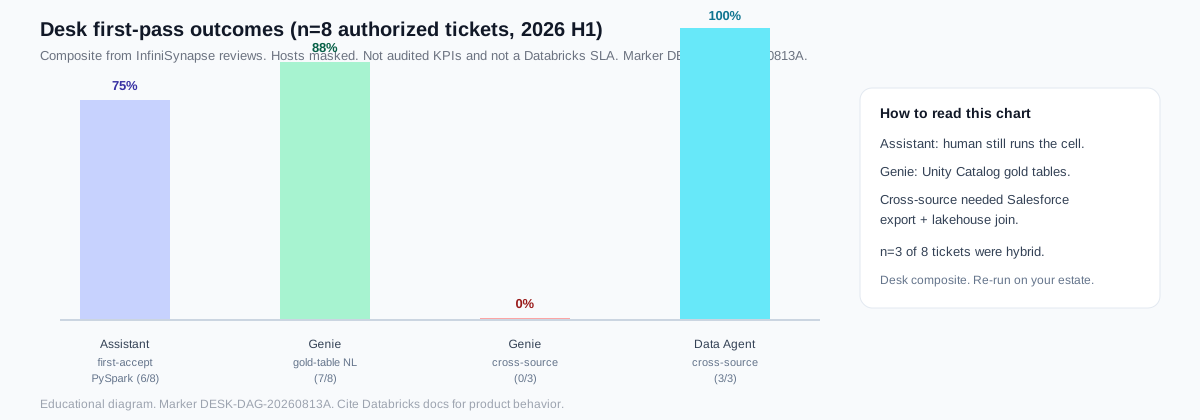 Desk composites. Marker DESK-DAG-20260814A. Download desk-dag-packet.csv (CC BY 4.0). Not a Databricks or customer SLA.
| Measure | Assistant | Genie (gold Delta) | Genie (cross-source) | Data Agent (cross-source) |
|---|---|---|---|---|
| Packets / tasks | 8 | 8 | 3 | 3 |
| First-pass usable | 6/8 (75%) | 7/8 (88%) | 0/3 | 3/3 |
| Median wall time | 4 min (accepted) | 2 min (usable) | n/a (blocked) | 14 min |
| Human still runs output | Yes (cell) | Review SQL | Manual CSV required | Review plan + SQL |
Signed: William Zhu · marker DESK-DAG-20260814A · verified 2026-08-14 · contact zhuhl@infinisynapse.com.
Collection method: n=8 authorized workspaces, 22 scored tasks in 2026 H1 for a Databricks Assistant vs Genie bake-off plus three hybrid Data Agent tickets. William Zhu marked each task first-pass usable or not (Assistant cell accept, Genie gold SQL, Genie hybrid, or Data Agent hybrid). Counts stay 6/8 · 7/8 · 0/3 · 3/3. We do not invent a larger census. Independent method anchors—Genie Code, Genie, Wikipedia: Databricks—do not certify these desk rates.
How to run the bake-off
Use this four-step HowTo before you fund a Databricks Assistant vs Genie license line. Official names: Genie Code and Genie.
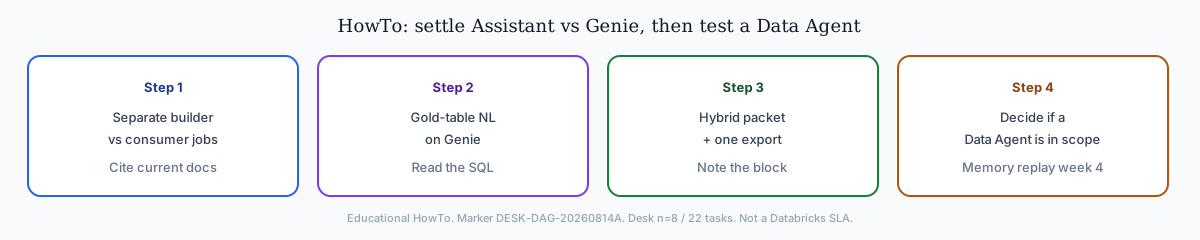 HowTo overview. Marker DESK-DAG-20260814A. Diagrams stand in for a hosted walkthrough.
Step 1 — Separate the two jobs. In a Databricks Assistant vs Genie kickoff, score Assistant as authoring acceleration and Genie as lakehouse NL. Do not use one demo script for both.
Step 2 — Run a gold-table question on Genie. Ask “What was Q2 revenue by region?” on curated Delta. A Databricks Assistant vs Genie consumer win is usable SQL a human can read—not unattended reporting.
Step 3 — Add one operational export. Repeat the hybrid churn question. If Genie stops without a manual CSV, record the block. That result is outside a Databricks Assistant vs Genie feature toggle.
Step 4 — Decide whether a Data Agent column is in scope. Require a week-four memory replay. Close the Databricks Assistant vs Genie intra-platform choice first, then fund cross-system orchestration only if the hybrid packet failed.
Technical Implementation Details
The execution contract is the technical heart of Databricks Assistant vs Genie. Assistant (Genie Code) emits draft Spark/SQL in the open cell; the engineer hits run. Genie emits SQL against Unity Catalog inside the workspace conversation. A Data Agent owns a multi-step plan that can leave the lakehouse.
# Example prompt: "Filter gold.fact_orders on partition date for Q2 2026"
df = spark.table("gold.fact_orders").filter(
    "order_date >= '2026-04-01' AND order_date < '2026-07-01'"
)
q2 = df.groupBy("region").sum("revenue")
-- Genie (gold-table NL): "What was Q2 revenue by region?"
-- Generated SQL stays inside Unity Catalog permissions
SELECT region, SUM(revenue) AS q2_revenue
FROM gold.fact_orders
WHERE order_date >= DATE '2026-04-01'
  AND order_date <  DATE '2026-07-01'
GROUP BY region;
Data Agent goal (hybrid packet):
Explain April enterprise churn using gold.fact_orders plus the Salesforce
export. Lock the churn definition for Monday replay. Return plan, SQL, and
an audit timeline. Do not treat notebook draft code as the deliverable.
On gold-table NL, desk SQL matched the grain in 7/8 first asks. The failure was a role-playing Date join—syntactically valid, semantically wrong. That is why we still require a human to read the generated SQL, even when Genie is the right surface.
Head-to-Head Comparison Table
| Dimension | Databricks Assistant | Databricks Genie | Data Agent (e.g. InfiniSynapse) |
|---|---|---|---|
| Primary user | Engineer / ML dev | Analyst / power user | Analyst + business stakeholder |
| Input type | Code selection, cell context | Natural-language question | Business goal |
| Execution | Suggest code; human runs | NL → SQL in workspace | Multi-step orchestration + retries |
| Data scope | Notebook-attached data | Unity Catalog tables | Federated connectors + files |
| Governance | Human review of code | Catalog IAM | Connector policies + audit |
| Memory | Session / cell context | Conversation in workspace | Distilled memory cards |
| Best for | Building pipelines faster | Lakehouse self-service NL | Recurring cross-system KPIs |
| Weak for | Unattended reporting | Non-Databricks sources | Databricks-only shops with no cross-source need |
Use this table as the one-page artifact in a Databricks Assistant vs Genie steering review—then decide whether a Data Agent column is in scope.
For architecture depth behind the Data Agent column, see Data Agent Architecture.
Five-Pillar Scorecard
Score Databricks Assistant vs Genie on the same five pillars you use for any agentic analytics purchase—then compare a Data Agent only if Genie fails a cross-system test.
| Pillar | Assistant | Genie | Data Agent |
|---|---|---|---|
| Autonomy | Low | Medium | High |
| Transparency | Low (draft code) | High in workspace | High (full task timeline) |
| Memory | Low | Medium | High |
| Multi-entry parity | Low | Medium | High |
| Self-correction | Low | Medium | High |
On a pure Databricks Assistant vs Genie pillar read: Genie wins autonomy, transparency, and memory for lakehouse consumers. Assistant wins builder productivity—a different scorecard—not analytical outcomes.
Workflow Tests: Where Each Wins
Run these four scenarios in every Databricks Assistant vs Genie demo week before expanding to third-party agents.
| Scenario | Winner | Why |
|---|---|---|
| “Refactor this PySpark job” | Databricks Assistant | Coding copilot territory |
| “What was Q2 revenue by region?” (all data in Delta) | Databricks Genie | Native catalog context; classic Databricks Assistant vs Genie consumer win |
| “Why did enterprise churn spike in April?” (DB + lakehouse + exports) | Data Agent | Cross-system orchestration beyond Genie’s single-platform contract |
| “Same board metric every Monday with locked definitions” | Data Agent (or Genie if 100% lakehouse-native + process discipline) | Memory + unattended execution matter |
Teams that standardize on Code Agent vs Data Agent vocabulary avoid funding Assistant seats when the real gap is recurring analytical orchestration.
Decision Matrix by Team Profile
If your team profile is unclear, default the Databricks Assistant vs Genie starting point to Genie for analysts and Assistant for engineers—then add agents only after a failed Genie cross-source POC.
| Team profile | Start with | Add later |
|---|---|---|
| Databricks engineering-heavy | Assistant | Genie for analyst self-service |
| Databricks analyst self-service | Genie | Data Agent if cross-source KPIs |
| RevOps / finance cross-system | Data Agent | Genie for lakehouse-only slices |
| Regulated audit requirements | Data Agent + catalog | Assistant for engineering only |
InfiniSynapse as a Data Agent Reference
Treat the following as a first-party reference pattern, not a claim that Genie is obsolete. InfiniSynapse can query Databricks but orchestrates beyond it—Postgres, MySQL, MongoDB, files, and SaaS exports in one goal.
Lakehouse teams already on Genie often evaluate a Data Agent (InfiniSynapse or peers) when:
- Executives need answers outside the Databricks UI
- KPIs span lakehouse + operational systems
- Monthly reports require locked memory, not fresh NL each time
Detailed lakehouse comparison: InfiniSynapse vs Databricks Genie. Interpreter-style uploads that preceded Genie adoption are covered in Code Interpreter alternatives.
Rollout and Procurement Notes
Licensing clarity for Databricks Assistant vs Genie
Budget Databricks Assistant vs Genie separately from Data Agent platforms. Assistant lines often sit with engineering productivity; Genie with analyst enablement; agents with analytics operations or data platform.
30-day proof points
| Week | Assistant KPI | Genie KPI | Data Agent KPI |
|---|---|---|---|
| 1–2 | Engineer hours saved on notebook refactor | NL question success rate on curated tables | Goal completion rate on pilot KPI |
| 3–4 | Reduced PR iteration time | Analyst SQL hours avoided | Memory replay without definition drift |
Common procurement mistake in Databricks Assistant vs Genie deals
Buying Assistant expecting unattended reporting. Rename internal requirements: authoring acceleration (Assistant), lakehouse NL analytics (Genie), recurring defensible answers (Data Agent). That rename alone resolves most Databricks Assistant vs Genie budget fights.
Vendor demo script
Run the same four workflow tests in every Databricks Assistant vs Genie demo week. Score pass/fail per row—not UI polish. Ask vendors to show query lineage for Genie answers and notebook diff history for Assistant suggestions. For Data Agent candidates, require a memory replay on week four using definitions locked in week one.
After a Databricks Assistant vs Genie decision, platform owners should document personas: data engineers → Assistant, analysts → Genie, RevOps/finance → Data Agents when questions cross systems. Revisit the mapping quarterly as connector coverage and memory maturity change. Analyst-facing outputs should remain accessible under W3C WCAG 2.1.
Frequently Asked Questions
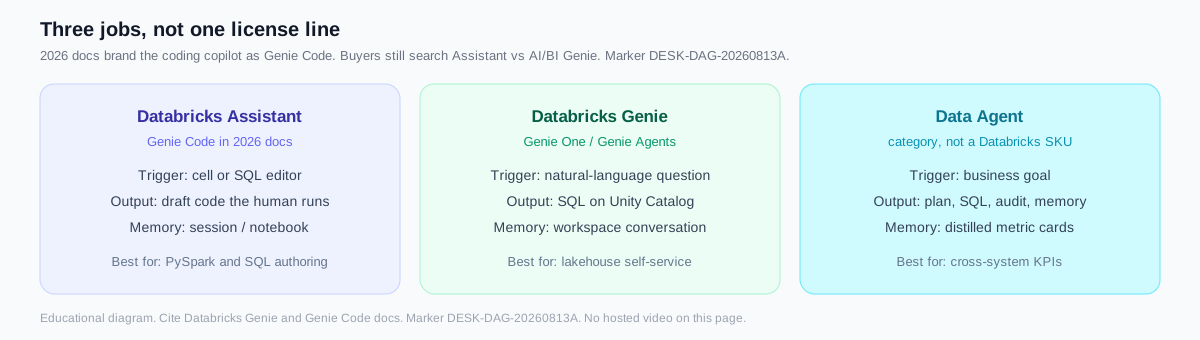 FAQ visual: three jobs, not one license line. Marker DESK-DAG-20260814A.
How do Assistant and Genie differ in a Databricks Assistant vs Genie evaluation?
Databricks Assistant helps you write and fix code in notebooks. Databricks Genie lets you ask natural-language questions over governed lakehouse tables. Assistant targets builders; Genie targets data consumers inside the workspace. That is the core of any Databricks Assistant vs Genie decision.
Is Databricks Genie a Data Agent?
Partially. Genie moves toward agent-like NL analytics with catalog grounding, but most deployments remain workspace-bound with guided exploration. Full Data Agents add cross-system orchestration, distilled memory, and multi-entry parity per What Is a Data Agent?.
Can we use Assistant and Genie together?
Yes. Common pattern after a Databricks Assistant vs Genie shortlist: Assistant for pipeline engineering, Genie for analyst self-service on curated gold tables. Add a Data Agent when KPIs cross systems or require API/chat delivery.
When should we add InfiniSynapse after Databricks Assistant vs Genie is settled?
When answers require sources outside Databricks, when executives need non-workspace access, or when monthly metrics must replay from memory without re-negotiating definitions. See InfiniSynapse vs Databricks Genie.
How does the AI data analyst role fit?
Humans own goal framing, metric governance, and sign-off; agents own multi-step execution. Role guide: AI Data Analyst.
References
Clickable sources used on this page. Desk composites are labeled separately and are not Databricks metrics.
- Databricks: Pushing the frontier of data agents with Genie
- Databricks documentation
- Databricks: Get coding help from Genie Code (coding copilot; former Assistant surface)
- Databricks: Genie (Genie One, Genie Agents, Genie Code family)
- Anthropic: Building effective agents
- Yao et al., ReAct (arXiv:2210.03629)
- OWASP Top 10 for LLM Applications
- NIST AI Risk Management Framework
- ISO/IEC 42001
- W3C WCAG 2.1
- G2 — Databricks reviews
- Gartner Peer Insights — Analytics & BI platforms
- Wikipedia: Databricks
- [Desk] InfiniSynapse Data Team. Eight-packet Assistant / Genie / Data Agent bake-off + CSV. H1 2026. Desk packet · CSV. Marker
DESK-DAG-20260814A.
Conclusion
Settling Databricks Assistant vs Genie is a real intra-Databricks choice: copilot for builders versus NL analytics for lakehouse consumers. Neither replaces the Data Agent category when your operating model demands cross-system orchestration, durable memory, and audit-grade timelines. Map requirements to objective functions first—finish Databricks Assistant vs Genie, then fund the right surface.
After you settle Databricks Assistant vs Genie, read next: InfiniSynapse vs Databricks Genie · What Is a Data Agent? · AI Data Analyst · Best agentic analytics once Databricks Assistant vs Genie scope is closed · Autonomous data agent.
Product recommendation (commercial)
Label: Optional commercial trial. Editorial Databricks comparison above does not depend on it.
Connect a lakehouse plus one operational source read-only. Seed a small knowledge base of metric definitions. Ask one recurring KPI question and inspect plan, SQL, and verification before you lock a Databricks-only AI strategy.