Data Agent: Architecture, Use Cases & Fit
- 2026-09-21 — Visible-layer destuff: Title/H1 now lead with
data agent; question definition stays on what is a data agent. Architecture and use-case sections unchanged. - 2026-07-31 — EEAT refresh: named author + About links, fixed JSON-LD names, Speakable/HowTo/ImageObject, fit-decision diagram, evaluation HowTo, peer-market citations; AI crawler Allow in site
robots.txt. No hosted architecture video (see media note). - 2026-07-24 — Schema and meta polish pass.
- 2026-06-28 — Initial publication.
- A data agent is a domain-specific AI agent that reads, queries, and reasons over structured data — databases, warehouses, and tabular files.
- Inside it sit five parts: a planner, a retriever bound to a business knowledge base, a SQL executor, a verifier, and a memory store that holds the evidence trail.
- It is narrower than a generic AI agent (no web browsing, no code editing) and wider than NL2SQL (it loops, retrieves context, and checks itself).
- It wins on open-ended cross-source questions; BI tools still win on agreed dashboards.
- Production hinges on read-only roles, plan review, evidence trails, and a bound knowledge base your team owns.
Data agent: direct answer
Why the term emerged in 2024-2026
Vendor materials around 2024 started separating two ideas that earlier got blurred. One was the chatbot wrapper around NL2SQL — a single-shot translator that converts a sentence into one SQL query. The other was the agentic loop pattern described in the ReAct paper, where a model interleaves reasoning steps with tool calls and feedback. The structured-data specialization of that second pattern is what practitioners now call a data agent.
By 2026 the working definition is stable enough for architecture diagrams and procurement checklists. The InfiniSynapse category definition page is the formal reference; this companion focuses on use cases and the five-part stack.
The shift mirrors how Anthropic's building effective agents note describes an agent: a system in which an LLM dynamically directs its own processes and tool usage — here scoped to structured data, with narrower tools and higher audit needs than a general-purpose assistant.
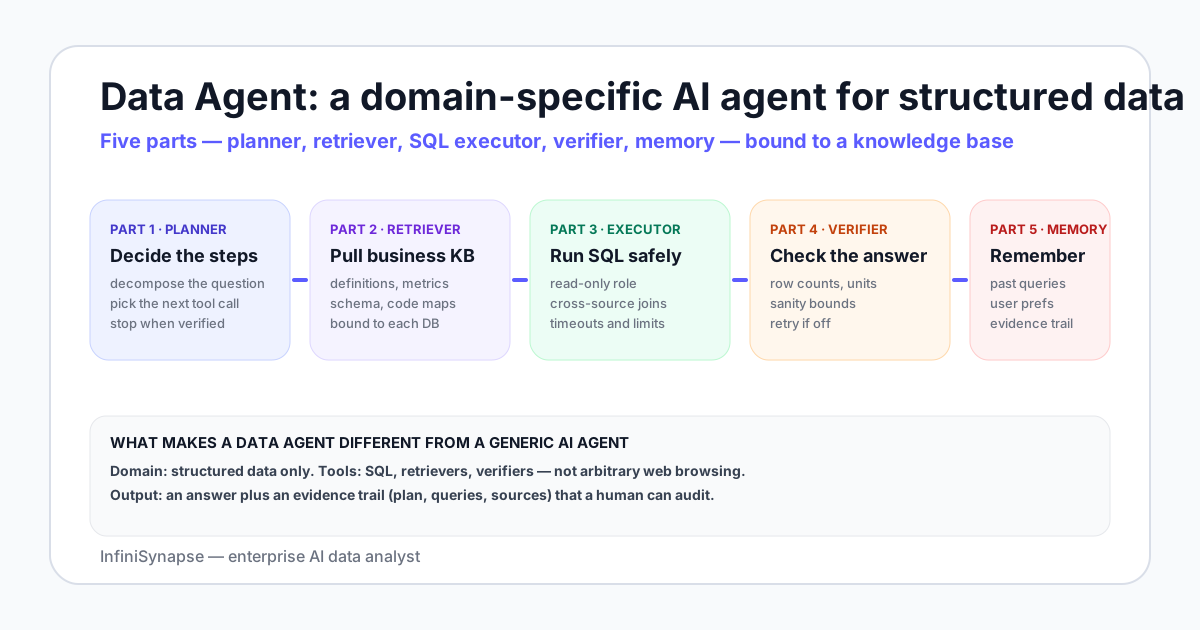
Architecture: the five parts
Most working systems in 2026 share the same five parts. Vendors name them differently — orchestrator, retriever, executor, judge, memory — but the roles are stable.
1. Planner
The planner decomposes a plain-English question into steps. For "show me Q2 revenue by region versus plan", the steps might be: identify which table holds bookings, look up how "region" maps to the customer table, look up how "plan" is defined, draft the SQL, run it, check the totals, and present the answer. This is where the stack looks most like a junior analyst writing a one-page memo.
2. Retriever (bound to a knowledge base)
The retriever is the part most often missing from early NL2SQL systems. Before writing a query it asks: what does this term mean here? Which event counts as a refund? Which status code maps to active? The answers live in a curated knowledge base that the operating team owns. InfiniSynapse calls this "database + knowledge base binding" and treats the binding as the central correctness mechanism, not a nice-to-have.
3. SQL executor
The executor runs SQL against connected sources — Postgres, MySQL, Snowflake, Supabase, S3 buckets, CSV files. In production it operates with a read-only role, scoped grants, timeouts, and row limits. It also handles cross-source joins, which is why most ad-hoc questions are hard: the data lives in five places.
4. Verifier
The verifier checks the output before returning it. Did the row count fall to zero unexpectedly? Are the units consistent? Does the total match a sanity bound from the knowledge base? If something looks off, control loops back through the planner. That loop is what makes the output defensible to a finance reviewer rather than a fluent guess.
5. Memory
Memory holds two things. Short-term: the working state of the current investigation — past queries, intermediate results, branching decisions. Long-term: the evidence trail per finished question, plus team-level patterns that can be reused. The memory deep-dive covers the trade-offs.
Vs generic AI agent
The phrase "AI agent" covers a wider universe — coding assistants, browser automations, customer support routers, computer-use systems. A data agent is one specialization. Two differences matter most.
| Dimension | Generic AI agent | Structured-data agent |
|---|---|---|
| Tool surface | Open: web, files, code, shell, browsers | Narrow: retrievers, SQL, verifiers, charting |
| Output type | Prose, files, actions in other systems | Numbers, tables, charts with an evidence trail |
| Correctness check | Often external, often after the fact | In-loop verifier on units, bounds, row counts |
| Audit posture | Variable — depends on the task | High by default — finance and security review it |
| Failure cost | Often low (re-run, redo) | Often high (decisions made on the number) |
| Knowledge base | Optional, often general docs | Required, business-specific, bound per source |
The line is not philosophical. It is about which failure mode you are willing to absorb. A generic agent that hallucinates a stack trace is annoying; a revenue hallucination is dangerous. The narrower tool surface and the in-loop verifier shift failure cost down to what a real analytics workflow needs.
Vs NL2SQL
NL2SQL — natural-language-to-SQL — is the older idea: take a sentence, return a query. Benchmarks like Spider and BIRD measure how well models do this in isolation. On BIRD, human engineers reach 92.96% execution accuracy and models still trail that bar — which is why the field shifted from "bigger NL2SQL model" to "wrap it in an agent that retrieves context and verifies".
NL2SQL is one tool inside a data agent. It is not a replacement for the agent itself.
Used well, the loop does three things a bare model cannot. It pulls business definitions before drafting SQL so "active customer" means what the business means. It inspects the output rather than handing SQL back as the answer. And it branches when row counts look implausible. The companion piece on AI database query walks through the loop in code.
{
  "question": "Q2 EMEA revenue vs plan",
  "retrieved_defs": ["region=EMEA", "plan=FY26_board"],
  "sql": ["SELECT ... FROM bookings b JOIN customers c ..."],
  "verifier": {"row_count_ok": true, "units": "USD", "bound_check": "pass"},
  "decision": "return_with_evidence"
}
Data agent use cases that work today
Five buckets cover most production deployments we see across the InfiniSynapse user base and public case material.
Use case 1 — Funnel diagnostics and conversion investigations
Product teams ask "where did sign-ups drop between Tuesday and Friday?" The system retrieves the funnel definition from the bound knowledge base, runs cohort SQL across the events table, joins to the marketing source table, and surfaces the step where the drop happened — with SQL and the data slice a PM can defend in a meeting.
Use case 2 — Cohort retention and lifecycle analysis
"Show me 30-day retention for users who first signed up in Q2 versus Q1, split by acquisition channel." This almost never sits on a dashboard but always sits in a PM's head. The agent answers on demand; a BI tool needs an analyst to model the view first.
Use case 3 — Finance reconciliations and variance explanations
"Why did Q2 EMEA revenue come in 3% under plan?" Pull the plan definition, run actuals, join for the EMEA cut, and produce the deal-level list. Finance accepts this when queries and rows behind each line ship with the answer — the evidence trail is the deliverable.
Use case 4 — Supply chain and inventory questions
"Which SKUs are at risk of stocking out in 14 days given the open POs?" Join ERP inventory, open purchase orders, and sales velocity; apply lead-time rules from the knowledge base; return the at-risk list. This used to mean a two-hour notebook.
Use case 5 — Ad-hoc executive questions across multiple sources
"How does NPS correlate with renewal across the top 50 accounts last year?" Pull NPS from one source, renewals from another, and the top-50 list from the CRM. The cross-source join is the work; the answer is the by-product. The same pattern on MySQL — including a worked commerce SQL example and dialect gotchas — is in our MySQL analytics tools guide.
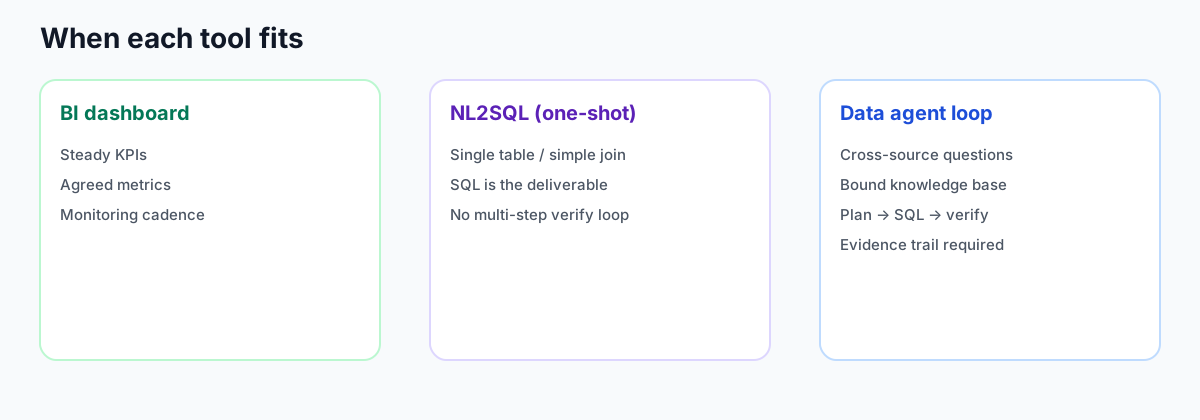
HowTo: evaluate a data agent in 90 minutes
- List open-ended questions — five asks that never made a dashboard and need cross-source joins.
- Check knowledge-base ownership — name an owner for definitions (active user, refund, region, plan).
- Require read-only + plan review — SELECT-scoped roles and a human stop before SQL fires.
- Measure the evidence trail — plan, retrieved definitions, SQL, and verifier checks on every answer.
- Compare to BI and NL2SQL — BI for steady KPIs; single-shot NL2SQL for simple one-table asks; the agent loop for the rest.
Where a data agent is the wrong tool
Three patterns recur when pilots in this category fail.
Good fits
- Open-ended, cross-source investigations
- Questions that never made it onto a dashboard
- Variance and root-cause analyses
- One-off audit and reconciliation requests
- Internal users who can read a plan and a SQL block
Poor fits
- Steady KPI monitoring — use a BI tool
- Hard real-time decisions inside an application path
- Customer-facing chat with arbitrary inputs
- Questions whose answer is not in structured data
- Environments without a maintained knowledge base
If your team has zero appetite for owning a knowledge base, you will get SQL that runs and numbers that do not match the business. That is the most common reason a pilot stalls. See the manifesto on knowledge-base binding for the long-form argument.
Production governance and guardrails
The four-line operational answer most security teams accept when approving a data agent:
- Read-only by default. Connect with a database role that has SELECT-only grants and scoped views. Promote to write only with a separate review.
- Plan review before execute. Emit a plan — questions, tables, joins, rationale — that a human can stop before any SQL fires. InfiniSynapse calls this "Plan mode"; other vendors have analogous features.
- Query logging end to end. Log every query with the prompt, retrieved context, and verifier verdict. That is the audit log a regulator or board reviewer asks for.
- Bound knowledge base with an owner. Someone on the data team owns definitions, reviews changes, and signs off updates. The AI data analyst job description spells out who that owner is.
The NIST AI Risk Management Framework and ISO/IEC 42001 give a shared structure for regulated environments. Use them to frame the rollout, not to slow it down. For category peer reviews (independent of this vendor page), see Gartner Peer Insights and G2 Analytics Platforms.
Optional product note — try the pattern on your data
InfiniSynapse runs the five-part pattern on Postgres, MySQL, Snowflake, Supabase, S3, and CSV. Connect read-only, seed a small knowledge base, and run one open-ended question — review the plan, queries, and evidence trail before deciding whether this category belongs in your stack.
Try InfiniSynapse onlineFAQ
Methodology and review notes
Last updated: 2026-09-21 · Next scheduled review: 2026-12-21
Architecture and use-case sections for the data agent category are grounded in vendor documentation (InfiniSynapse and peers), public benchmarks (BIRD, Spider), agent research (Anthropic, ReAct), and governance frameworks (NIST AI RMF, ISO/IEC 42001, EU AI Act). The five-part model is a working consolidation; vendors may merge or split parts.
Conflict of interest: InfiniSynapse publishes this guide and sells in this category. Bias controls: a poor-fit section, an honest BI filter, and external sources for every numeric claim.
Update cadence: Reviewed every 90 days for terminology, product changes, benchmark figures, and schema consistency. Visible changelog below for AI freshness signals.
Version changelog
- 2026-09-21 (v1.3) — Title/H1 destuff to
Data Agent: Architecture, Use Cases & Fit. Question definition stays on what is a data agent. Architecture and use-case headings unchanged. - 2026-07-31 (v1.2) — Named author William Zhu + About/Vision; repaired Organization/FAQ JSON-LD; Speakable + HowTo + ImageObject; fit-decision SVG; evidence-trail JSON sketch; Gartner/G2 peer-market links (not endorsements); site robots Allow for ChatGPT-User / PerplexityBot; keyword dens retuned to 1.1–1.2%. Explicitly no video schema without a hosted video.
- 2026-07-24 (v1.1) — Meta and structured-data polish.
- 2026-06-28 (v1.0) — First public version of this concept guide.
Sources and references
- [Independent] Yao et al. ReAct: Synergizing Reasoning and Acting in Language Models. arxiv.org/abs/2210.03629.
- [Vendor] Anthropic. Building Effective Agents. anthropic.com/research/building-effective-agents.
- [Independent] BIRD-SQL. bird-bench.github.io.
- [Independent] Spider. yale-lily.github.io/spider.
- [Independent] NIST. AI Risk Management Framework. nist.gov/itl/ai-risk-management-framework.
- [Independent] ISO. ISO/IEC 42001. iso.org/standard/81230.
- [Independent] EU AI Act overview. artificialintelligenceact.eu.
- [Reference] Retrieval-augmented generation. en.wikipedia.org/wiki/Retrieval-augmented_generation.
- [Peer market] Gartner Peer Insights — Analytics & BI. gartner.com/reviews.
- [Peer market] G2 — Analytics Platforms. g2.com/categories/analytics-platforms.