AI Database Query Explained: From Plain English to Verified Cross-Source Results
- An AI database query is a plain-English question that an agent owns end to end: context retrieval, plan review, cross-source execution, verification, and a delivered answer with an evidence trail.
- The pattern exists because text-to-SQL plateaued below the trust threshold. On the BIRD benchmark, human engineers reach 92.96% execution accuracy and models still trail that bar.
- The real moat is not query generation. It is the knowledge base binding that pairs each connected database with its own business semantics so the agent knows what the numbers mean, not just how to fetch them.
Direct answer: what an AI database query does for your team
What an AI database query is — and is not
An AI database query is not a fancier SQL editor. The shift is workflow ownership: the agent decides which tables to read, when to ask the knowledge base for a definition, and when its own output needs another check. Anthropic frames this as the working definition of an agent — a system that dynamically directs its own processes and tool usage rather than following a fixed script.
That distinction matters because most "AI for SQL" features stop at sentence-to-statement translation. A real AI database query keeps going: through verification, source citation, and a result you can hand to a finance lead without a follow-up email.
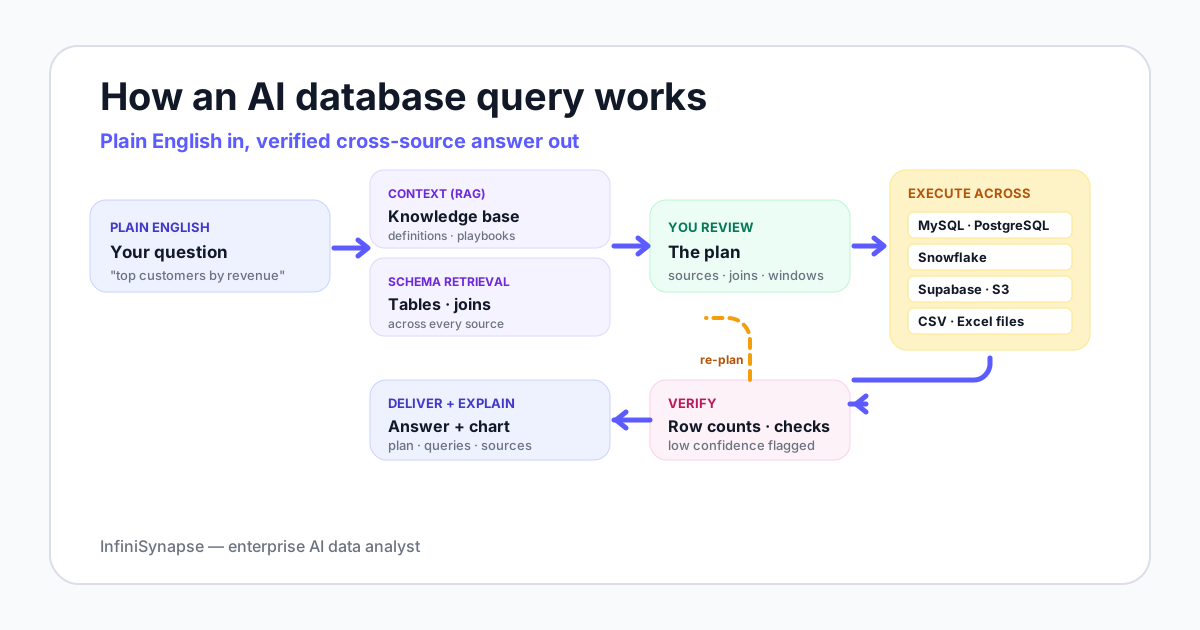
How it works in six stages
Every credible AI database query implementation runs some version of the same loop. The stages matter more than the branding because each catches a specific class of error.
1. Plain-English intent
Your team writes the question the way they would Slack an analyst — "which channels drove the East China repeat-purchase drop last quarter?" No SQL, no field names, no metric notation.
2. Context retrieval from a bound knowledge base
The agent retrieves your metric definitions, data dictionary, and analysis playbooks before touching the database. This is the difference between a clever SQL generator and a useful one: it knows your company defines "repeat purchase" as a second order within 90 days, not 30.
3. Schema retrieval across connected sources
The agent searches your connected databases for the right tables, fields, and join keys. Retrieval-augmented generation over schema replaces the older pattern of stuffing every table description into the prompt.
4. Plan review before execution
The agent drafts a plan — sources, joins, time windows, output format — and shows it to you. In InfiniSynapse this surfaces as an explicit Plan mode you can edit before anything runs against production. The pattern has academic roots: the ReAct paper showed that interleaving reasoning steps with actions reduces error against single-shot generation.
5. Cross-source execution
Execution can mix SQL against multiple warehouses, an LLM-optimized intermediate representation that connects to a multi-source execution layer, file reads against CSV and Excel, and document retrieval. Read-only credentials are the sane default for production.
6. Verification, explanation, and delivery
The agent sanity-checks the result — row counts, null rates, second-path metric validation — then delivers the answer with the plan, the queries it actually ran, the sources it pulled from, and the caveats. That trail is what makes the number reviewable.
The fastest way to evaluate an AI database query tool: ask who ran the query, then ask for the evidence trail.
Why this pattern exists now
Force 1: Text-to-SQL hit a trust ceiling
The Spider benchmark and BIRD made the gap visible. Models generate plausible SQL, but plausible against messy production schemas is not the same as correct. Closing that last gap requires business context and result verification — workflow capabilities, not bigger prompts.
Force 2: Real questions cross sources by default
The questions that actually back up in your analyst queue look like "compare e-commerce revenue across two platforms and match customers via a phone-number CSV from CRM." That spans two databases and a file. Single-warehouse ChatBI cannot touch this without a prior ETL project.
Force 3: Audit pressure is rising
The EU AI Act, the NIST AI Risk Management Framework, and ISO/IEC 42001 all push the same direction: automated outputs need traceable provenance. An AI database query that surfaces its plan, queries, and sources is built for this; a copy-pasted ChatGPT SQL snippet is not.
The cross-source moat: one question, three sources
Here is a documented InfiniSynapse demonstration, useful because it is exactly the shape of question that breaks single-warehouse tools:
"Using phone number as the key, find the highest-spending customers across the JD and Tmall platforms, match their real names from a CSV file, and chart the ranking."
The agent retrieves schema from both platform databases, plans the cross-source join on phone number, aggregates spend per customer, joins names from the uploaded CSV, verifies the join produced sane row counts, and renders the chart — in one request. The traditional alternative is an ETL project measured in days: migrate sources into one warehouse, standardize fields, write the join, then visualize.
This is the structural reason InfiniSynapse lists support for MySQL, PostgreSQL, Snowflake, Supabase, and S3 in the same query plane: cross-source analysis without an ETL prerequisite is the differentiator, not which warehouse you happen to use today.
Knowledge base binding: the moat under the moat
Cross-source connectivity gets you to "I can ask the question." Knowledge base binding gets you to "I can trust the answer." InfiniSynapse pairs each connected data source with a curated knowledge base of metric definitions, data dictionary entries, business rules, and analysis playbooks. The agent retrieves from that knowledge base as a tool call before running SQL — so the database tells the agent what happened and the knowledge base tells the agent what it means in business terms.
Without this binding, even a competent agent guesses at meaning. With it, the agent stops guessing and starts citing. A documented WinClaw telemetry case showed the difference: against an unbound PostgreSQL connection, the agent could only count PAGEVIEW and DOWNLOAD rows. Against the same connection bound to a knowledge base, the agent correctly explained that download:tool:windows:x64:agent_excel represents an Office workflow automation demand cluster — and separated computed facts from interpretation in its output.
| Layer | What it answers | What breaks without it |
|---|---|---|
| Database | What happened, at what scale, when | Nothing — but the numbers stand alone, unexplained |
| Bound knowledge base | What those facts mean to the business | The agent guesses definitions; ambiguous metrics get computed wrong silently |
| Agent loop | How to ask the right questions in the right order | Single-shot SQL with no verification or self-correction |
This is why InfiniSynapse documentation calls the knowledge base a tool the agent calls during analysis, not a passive document store. It is the same retrieval-augmented generation primitive used elsewhere in AI — applied specifically to business semantics rather than general knowledge.
Supported databases and per-source guides
InfiniSynapse documents support for these connections, with cross-source joins between any combination. Each guide below walks through the workflow on that specific source with a worked example.
AI database query vs older patterns
These four terms blur in vendor marketing; the table separates them.
| Dimension | SQL editor + autocomplete | Text-to-SQL | ChatBI | AI database query (agent) |
|---|---|---|---|---|
| Core job | Help you write SQL faster | Generate one SQL statement | Answer modeled-metric questions | Run the whole analysis |
| Workflow ownership | You | You | Tool, within semantic layer | Agent plans, you review |
| Cross-source | Whatever you wire up | Single statement, single DB | BI-connected sources only | Databases + files + documents |
| Business context | None automatic | Whatever you prompt | Pre-built model | Retrieved from bound knowledge base |
| Verification | You run and check | You run and check | Tool checks against model | Agent checks, flags low confidence |
| Audit trail | Query history | The SQL it produced | Tool logs | Question + plan + queries + sources + checks |
| Typical failure | You wrote a bad join | Plausible SQL, wrong table | "Metric not found" | Bad plan — caught at review |
When to use an AI database query — and when not to
Good fit
- Questions that span databases, files, and documents
- "Why did X change?" investigations with no pre-built dashboard
- Teams with an analyst backlog of routine pulls
- Organizations that can grant scoped, read-only access
- Outputs that need reviewable evidence trails
Wrong tool for the job
- A fixed daily dashboard — classic BI is cheaper
- No connected sources yet — fix connectivity first
- No agreed metric definitions — an agent will faithfully automate your ambiguity
- Sub-second operational queries inside an app — that is a database problem
- Single-spreadsheet workflows — use the spreadsheet
A five-step pilot you can run this week
- Pick three real questions your team answered manually last quarter — one single-source, one cross-source, one open-ended "why." You want questions whose correct answers you already know.
- Connect one or two sources read-only. A warehouse plus an exported CSV is enough to test cross-source behavior. Watch the agent retrieve schema without you describing tables.
- Seed minimal context. Add your top ten metric definitions and a one-page data dictionary to the knowledge base — and confirm the agent cites them back in its plans.
- Score plans before execution. Run each question, review the plan, then run. Track plan quality, answer correctness, and evidence-trail usefulness.
- Compare against a vendor-neutral checklist — context quality, schema retrieval, planning transparency, execution safety, verification, explainability, memory, deployment control. Use the same checklist across InfiniSynapse and any other AI database query tool you trial.
Run the three-question test on your own database
Connect a MySQL, Snowflake, Supabase, or S3 source, ask one cross-source question, and review the plan, result, chart, and evidence trail. One real run is worth more than any feature list — including this page.
Try InfiniSynapse onlineFAQ
Methodology and review notes
Last updated: 2026-06-15 · Next scheduled review: 2026-09-15
Claims on this page are grounded in published agent research (ReAct), public text-to-SQL benchmarks (BIRD, Spider), governance frameworks (NIST AI RMF, EU AI Act, ISO/IEC 42001), and InfiniSynapse product documentation. The cross-source and write-back examples are documented product demonstrations, not independent benchmarks.
Conflict of interest: InfiniSynapse publishes this guide and sells in the AI database query category. To reduce bias, the page includes a vendor-neutral evaluation checklist, explicit cases where simpler tools win, and an external source for every numeric claim.
Update cadence: Reviewed every 90 days for terminology, source links, benchmark figures, and schema consistency.
Sources and references
- [Independent] BIRD-SQL: A Big Bench for Large-Scale Database Grounded Text-to-SQL Evaluation. BIRD benchmark leaderboard.
- [Independent] Yu et al. Spider: a large-scale, complex and cross-domain semantic parsing and text-to-SQL benchmark. Yale Spider.
- [Independent] Yao et al. (2022). ReAct: Synergizing Reasoning and Acting in Language Models. arXiv 2210.03629.
- [Vendor] Anthropic (2024). Building Effective Agents. anthropic.com/research/building-effective-agents.
- [Independent] Wikipedia. Retrieval-augmented generation. en.wikipedia.org/wiki/Retrieval-augmented_generation.
- [Independent] NIST. AI Risk Management Framework (AI RMF 1.0, 2023). nist.gov/itl/ai-risk-management-framework.
- [Independent] European Commission. Regulatory framework on AI. EU AI Act.
- [Independent] ISO/IEC 42001:2023 AI management systems. iso.org/standard/42001.