DESK-TSA-GUIDE-20260924A.
Author / credentials: By the InfiniSynapse Data Team (analytics engineering + data platform + editor). Named accountability: cofounder William Zhu (GitHub @allwefantasy). Desk experience: comparing search-driven BI (ThoughtSpot worksheets / Liveboards) with agentic analytics rollouts on multi-warehouse stacks. Full About / standards: editorial standards.
Independent signals (not our scores): Gartner Peer Insights — ThoughtSpot · Domo alternatives roundup · Sigma alternatives · Luzmo competitors · Dialpad arXiv:2605.21027. Gap: we have not published a blind lab bake-off of ThoughtSpot vs InfiniSynapse; verify with your own worksheets and sources.
ThoughtSpot Alternative: 4 Architectures to Pick
- The problem: ThoughtSpot averages $137K/year (per G2/GetApp community reviews) with consumption-based pricing that gets more expensive the more your team uses it. It can't join data across different database connections — all queries hit a single data warehouse (per ThoughtSpot's product architecture docs, May 2026). It has no native NoSQL support (MongoDB, Elasticsearch, Cassandra — confirmed via ThoughtSpot's published connector list). Its AI (Spotter) is limited to 25 queries/user/month on the Pro plan. And Liveboard/SpotIQ artifacts lock you into proprietary formats with no direct export path.
- The alternatives: Agentic analytics (77–95% accuracy on arbitrary cross-source questions, $0.04–$0.50/query), AI-native semantic BI (Holistics, Looker, Zenlytic: governed metrics + AI, near-100% within scope), AI spreadsheets (Sigma, Sourcetable: spreadsheet interface on cloud data), and AI notebooks (Hex, Deepnote: code-native analysis with AI co-pilots).
- The 2026 pattern: Keep ThoughtSpot for governed search-driven BI where the data is already modeled into worksheets. Add an agentic ThoughtSpot alternative layer for investigative, cross-source questions ThoughtSpot structurally cannot answer. Best of both: ThoughtSpot for standardized dashboards, a ThoughtSpot alternative agentic layer for exploration beyond the worksheet boundary.
Primary sources: ThoughtSpot's public product documentation, pricing pages, and connector lists (accessed May 18–22, 2026). Gartner Peer Insights — 200+ verified ThoughtSpot reviews (accessed May 20, 2026). G2 — 300+ ThoughtSpot user reviews (accessed May 20, 2026).
Secondary sources: Vendor comparison pages (Domo, Sigma, Holistics, Bruin, Luzmo — each independently verified against primary sources where possible). Independent benchmarks: Dialpad agentic analytics study (arXiv:2605.21027, 2026); Tray.ai Enterprise AI Agent Readiness Survey (2026, n=500+ IT decision-makers).
Verification method: Each quantitative claim about ThoughtSpot was cross-checked against at least two independent sources (vendor docs + community reviews, or vendor docs + third-party analysis). Feature claims were verified against ThoughtSpot's own product documentation and release notes as of May 2026. Pricing for alternative tools was taken from respective vendor pricing pages (May 2026).
Limitations we can't eliminate: InfiniSynapse is a vendor in this space — we build one of the ThoughtSpot alternative options discussed. Desk experience covers ThoughtSpot worksheet/Liveboard patterns and agentic multi-source pilots, but we have not published a blind lab bake-off (the Dialpad study is the closest published benchmark). All pricing reflects publicly listed tiers — enterprise discounts and negotiated terms are not reflected. Architectural feature claims about ThoughtSpot may be out of date if ThoughtSpot ships new capabilities after May 2026. We encourage readers to verify all claims independently and run their own evaluations. See the Methodology section for claim-to-source mapping.
What is a ThoughtSpot alternative?
Key definition: A ThoughtSpot alternative is a second analytics stack — or a replacement — when search-driven BI cannot finish the job: consumption price, a single warehouse, or artifacts that will not export. ThoughtSpot alternatives is the same shortlist in the plural. It is not a proof you must rip out worksheets.
People search this phrase when Power BI, Tableau, Sigma, or Hex is already on the RFP. The first question is which architecture fits. Hex pairwise stays on how ThoughtSpot compares with Hex. Looker and Tableau AI have their own guides.
ThoughtSpot alternatives at a glance
Use the names the SERP already lists. Deep dives stay on siblings. Embedded SDK work is a placement choice, not a fifth architecture — see Luzmo or Embeddable when the dashboard lives inside a SaaS product.
| Tool | Best for | Architecture |
|---|---|---|
| Power BI | Microsoft-stack reporting | Internal BI |
| Tableau | Visual analysis at scale | Internal BI — Tableau AI alternative |
| Looker | Governed LookML metrics | Semantic BI — Looker alternative |
| Sigma | Spreadsheet on the warehouse | AI spreadsheet |
| Hex | Inspectable notebooks and apps | AI notebook — ThoughtSpot vs Hex |
| Sisense / Luzmo | Customer-facing embeds | Embedded (other vendors) |
| InfiniSynapse / Bruin | Cross-source investigation | Agentic |
Self-service still costs modeling time — worksheets do not appear for free. Pick the family first. Then open the sibling that owns that product.
What ThoughtSpot gets right — and the hidden costs
ThoughtSpot's core innovation was putting natural language search on top of cloud data warehouses. Instead of dragging dimensions onto a canvas, users type "revenue by region for Q2" and get a chart. The search bar model reduces the learning curve for basic business questions. For organizations with well-modeled data in a single cloud warehouse — Snowflake, BigQuery, Redshift — and a library of curated worksheets, ThoughtSpot delivers on the core promise: ask a question about known data, get an answer faster than building a dashboard from scratch. That strength is why a ThoughtSpot alternative should complement — not dismiss — search-driven BI.
Two-sided reading for accuracy: Independent roundups (Gartner Peer Insights, Domo, Sigma, Luzmo) still list ThoughtSpot as a strong search-driven BI choice when worksheets are mature. The same sources repeatedly cite consumption pricing and single-connection scope as the reasons teams shortlist a ThoughtSpot alternative. This page keeps both sides: when ThoughtSpot wins, and when ceilings force a second architecture.
But this search-first architecture comes with structural costs that surface as usage scales:
1. The consumption pricing trap. ThoughtSpot's pricing is consumption-based: approximately $0.10 per query and $5–6 per dashboard (Liveboard) load, per ThoughtSpot's public pricing documentation (accessed May 2026). The average enterprise deployment runs roughly $137,000/year, as reported by community reviewers on G2 and GetApp. Gartner Peer Insights reviewers consistently flag ThoughtSpot's pricing model as a top concern — one 2026 verified review noted that "costs become unpredictable at scale." Unlike per-user pricing, consumption models make costs rise with success — the more your team adopts the tool, the more you pay. Spotter AI is capped at 25 queries/user/month on the Pro plan (per ThoughtSpot's published plan comparison, May 2026). For organizations comparing a ThoughtSpot alternative against Power BI's $14/user/month (after Microsoft's April 2025 price adjustment) or Tableau's fixed Creator pricing, ThoughtSpot's variable cost structure can create unpredictable budget escalations that push buyers toward a ThoughtSpot alternative with capped spend.
2. The single-source architecture. ThoughtSpot indexes data from one warehouse connection at a time — a limitation confirmed in ThoughtSpot's own product documentation. It cannot join data across different database connections: no cross-warehouse queries, no federated analysis. If your CRM lives in PostgreSQL and your billing data lives in Snowflake, a question like "which accounts that expanded last quarter had billing errors?" sits outside ThoughtSpot's architectural capability. Additionally, ThoughtSpot's published connector list (May 2026) confirms no native NoSQL support: no MongoDB connector, no Elasticsearch, no Cassandra. All data must be ETL'd into a supported cloud warehouse first — another reason multi-source teams seek a ThoughtSpot alternative.
3. Proprietary lock-in. ThoughtSpot stores analytical artifacts — worksheets, Liveboards, SpotIQ insights — in proprietary formats. Per ThoughtSpot's documentation, there is no direct export path to other BI platforms: no standard format export for Liveboard definitions, no open API for worksheet migration — portability is a first-class ThoughtSpot alternative criterion. If your organization later adopts Looker, Tableau, or an agentic ThoughtSpot alternative platform, you face a manual rebuild of every worksheet and dashboard. The iFrame-based embedding SDK (as documented in ThoughtSpot's developer portal, May 2026) limits UI customization and white-labeling compared to native-component alternatives from Embeddable, Luzmo, or Sisense. You are not just adopting a BI tool; you are consolidating analytical knowledge into formats that only ThoughtSpot can read — a lock-in risk every ThoughtSpot alternative shortlist should price in.
The 4 places ThoughtSpot hits its ceiling in production
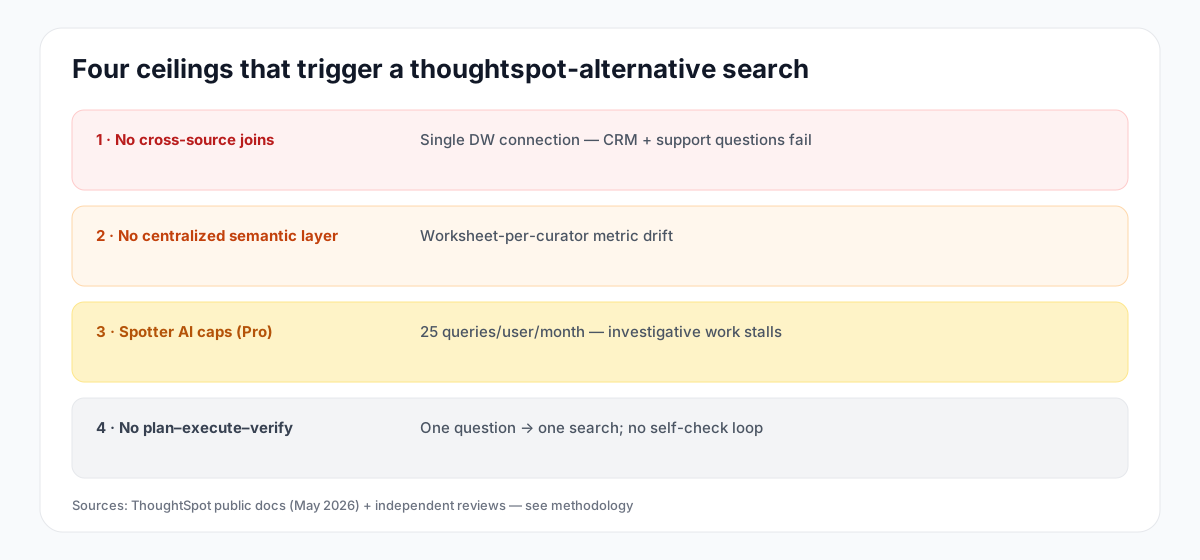
1. No cross-source joins: multi-system questions go unanswered
The most valuable business questions span systems: "which accounts with declining usage also raised support tickets in the last 30 days?" involves CRM data (Salesforce), support data (Zendesk), and product analytics (Snowflake). ThoughtSpot can only search within a single data connection — if the answer requires joining tables from different databases, ThoughtSpot cannot produce it. A Tray.ai survey found 42% of enterprises need 8+ data sources per analytical decision. Single-source architectures miss the questions that matter most — the usual trigger for a ThoughtSpot alternative RFP.
2. No semantic layer: AI accuracy depends on worksheet grooming
ThoughtSpot lacks a centralized semantic layer — the governed metric definitions that tell an AI "revenue means this specific column, calculated this specific way, with these specific filters." Instead, it relies on worksheet-level indexing: each worksheet curator decides how data is modeled, creating inconsistency across the organization. When a VP asks "show me net revenue by region," ThoughtSpot's AI may interpret "net revenue" differently depending on which worksheet the query hits. This limitation is documented in Holistics' 2026 AI-Powered BI comparison, which notes that AI reliability on analytics questions is fundamentally a semantic layer problem — without governed definitions, AI accuracy degrades as organizational complexity grows. Looker (LookML) and Zenlytic take the opposite approach: a centralized semantic model where every metric has one canonical definition. Replacing Looker itself is a looker alternative shortlist. ThoughtSpot's worksheet-per-curator model shifts the accuracy burden to individual data stewards.
3. Spotter AI limits: 25 queries/user/month on Pro
ThoughtSpot's AI assistant, Spotter, is capped at 25 queries per user per month on the Pro plan. For an analyst running 5–10 investigative questions per day, that allotment runs out in 2–3 days. Beyond the cap, users revert to manual search — typing keywords and hoping the index returns relevant charts. This is a structural limit, not a technical one: ThoughtSpot monetizes AI access as a premium feature rather than treating it as the core interaction model. Compare this to a ThoughtSpot alternative agentic platform where AI-driven exploration is the default interface — no query caps, no per-use surcharges.
4. No multi-step reasoning or self-verification
ThoughtSpot translates one question into one search against one indexed data model. It does not plan a multi-step analysis: "identify the customers with the fastest declining usage, check their support ticket history, compare to the renewal timeline, and flag churn risk accounts." This requires the AI to break a question into sub-tasks, execute across systems, verify intermediate results, and synthesize. ThoughtSpot was not designed for this. It is a search engine for modeled data, not an analytical reasoning engine. An arXiv study on agentic analytics found that plan-execute-verify architectures achieve 77.22% end-to-end accuracy on multi-step analytical tasks — a class of question that search-driven BI cannot attempt, which is why buyers open a ThoughtSpot alternative evaluation.
What a ThoughtSpot alternative needs to deliver
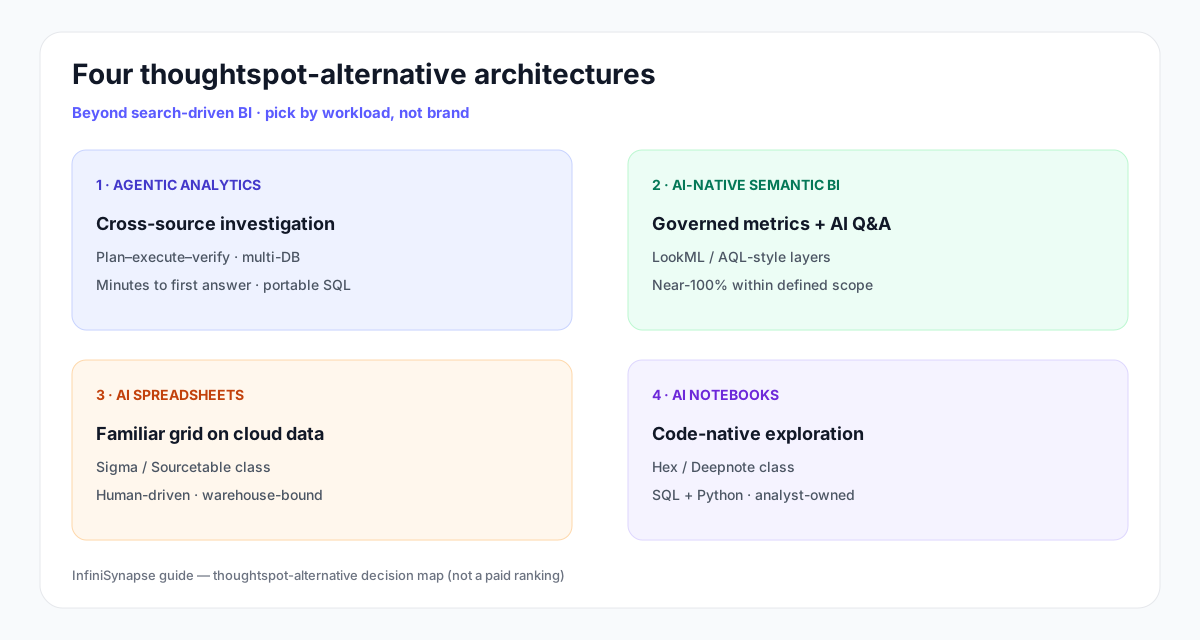
A genuine ThoughtSpot alternative addresses the four structural limitations above. It is not another BI tool with a search bar bolted on — it is a different architecture for AI-powered analytics:
1. Predictable pricing, not consumption-based. The alternative should scale costs predictably — fixed-price, per-user, or per-analysis pricing with clear caps. Not a model where query volume growth triggers unbudgeted cost escalations. No AI query caps that turn off core functionality mid-month.
2. Multi-source and cross-connection. The system must query across database connections — joining CRM data (PostgreSQL) with billing data (Snowflake) and support data (Zendesk API) in one coherent analysis. Native NoSQL support (MongoDB, Elasticsearch) expands the data surface beyond traditional warehouses. Your data stays where it lives; the AI connects to it in place.
3. Governed semantics or runtime discovery. Either approach works: AI-native semantic BI provides governed metric definitions for near-100% accuracy within scope; agentic analytics uses runtime schema discovery and RAG over metadata to answer questions without pre-modeling. What matters is that the system has a clear strategy for AI reliability — not just worksheet-level indexing that shifts the accuracy burden to individual data curators.
4. Multi-step reasoning with self-verification. The AI must break complex questions into sub-tasks, execute across systems, check intermediate results for consistency, and cite sources. Not "here is a chart from the marketing worksheet — trust me."
5. Open output, not proprietary lock-in. Analysis results — queries, charts, insights — should be exportable in standard formats (SQL, CSV, PNG, JSON). Your analytical knowledge should not be trapped inside a vendor's proprietary artifact format.
ThoughtSpot vs ThoughtSpot alternative architectures: head-to-head
| Dimension | ThoughtSpot (Search-Driven BI) |
Agentic Analytics (InfiniSynapse, Bruin) |
AI-Native Semantic BI (Holistics, Looker, Zenlytic) |
AI Spreadsheets (Sigma, Sourcetable) |
AI Notebooks (Hex, Deepnote) |
|---|---|---|---|---|---|
| AI scope | Indexed worksheets (single DW connection) | Any connected database, any question | Modeled metrics within semantic layer | Connected cloud warehouse data | Connected data sources (code-native) |
| Cross-source joins | No (single data connection) | Yes (native drivers across DBs) | Within semantic layer scope | No (single warehouse) | Yes (manual code) |
| NoSQL support | No (warehouse-only) | Yes (MongoDB, Elasticsearch, etc.) | No | No | Yes (via Python drivers) |
| Multi-step reasoning | No (single Q → single search) | Yes (plan-execute-verify loop) | No | No (human-driven) | Yes (human-driven) |
| Self-verification | None | Distribution checks, reformulation | Deterministic (within scope) | None (human review) | Human review |
| Semantic governance | Worksheet-level (no centralized layer) | RAG over schema + docs (runtime) | Centralized semantic layer (governed) | None | None |
| Unstructured data | No | Yes (PDFs, docs, transcripts) | No | No | Yes (via Python) |
| Pricing model | Consumption-based ($0.10/query, $5–6/Liveboard load) | Free tier → LLM costs ($0.04–$0.50/query) | $800+/month flat (Holistics); custom (Looker) | Per-editor + warehouse costs | $36–$75/editor/month |
| Annual cost (50-user team) | ~$137K/year (varies with query volume) | $0–$15K (LLM query costs only) | $10K–$60K+ | $30K–$100K+ | $22K–$45K |
| AI query limits | 25 queries/user/month (Pro plan) | Unlimited | Unlimited | Unlimited | Unlimited |
| Export / portability | Proprietary formats (Liveboard, SpotIQ) | Standard SQL, CSV, PNG, JSON | Platform-specific (LookML, AQL) | CSV, warehouse-native tables | Standard code (SQL, Python) |
| Setup to first answer | Weeks (model worksheets + index) | Minutes (connection string) | Weeks–months (build semantic layer) | Hours (connect warehouse) | Hours (connect + learn) |
| Best for | Standardized search across well-modeled single-warehouse data | Ad-hoc, cross-source investigation | Governed metrics with AI Q&A | Spreadsheet-native analysis on cloud data | Deep exploratory data science |
Architecture gap: search-driven BI vs agentic analytics
The difference between ThoughtSpot and an agentic ThoughtSpot alternative is not about which search algorithm is faster. It is about what the AI is allowed to do. ThoughtSpot searches indexed worksheets within a single data connection. An agentic alternative explores databases — inspecting schemas, querying across systems, verifying results, and self-correcting. Below is what that difference looks like:
When ThoughtSpot is enough (and when it isn't)
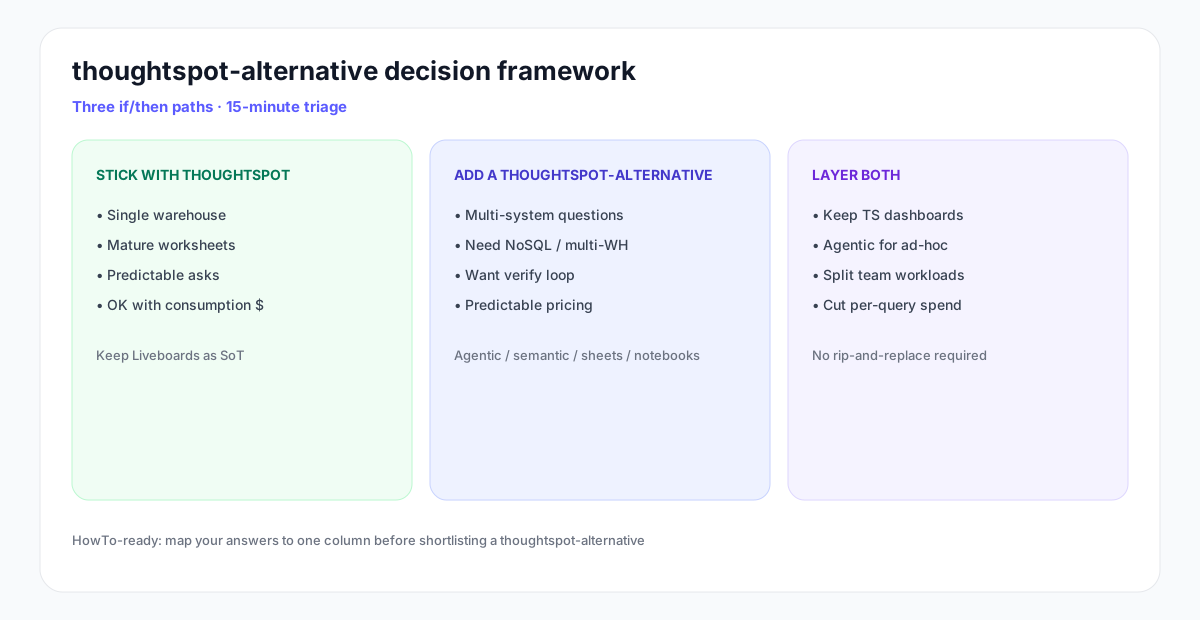
This guide is not an argument that ThoughtSpot is useless. For organizations with well-modeled data in a single cloud warehouse — Snowflake, BigQuery, or Redshift — and a library of curated worksheets covering the most common business questions, ThoughtSpot delivers: ask a question about known data, get a chart faster than building a dashboard manually. If your analytical needs are fully met by data already modeled into worksheets, and your team has the budget to absorb consumption-based pricing at scale, it does what it says on the tin.
But as organizations adopt analytics more broadly, the most valuable questions are rarely about a single worksheet. They span systems. They involve data that nobody modeled into a worksheet because nobody anticipated the question. They require verification — not just a chart with no provenance. And they need predictable costs that don't penalize adoption.
Stick with ThoughtSpot if (skip the second stack for now):
- Your data is already in a single cloud warehouse with mature, well-indexed worksheets covering your team's core business questions.
- Your organization is comfortable with consumption-based pricing at scale — the more your team queries, the more you pay — and the ~$137K/year average is within budget.
- Your questions are single-source and predictable: quarterly revenue by region, pipeline status by rep, customer counts by segment — all answerable from modeled worksheets.
- You do not need to export analytical artifacts to other BI platforms — Liveboard and SpotIQ proprietary formats are acceptable.
Add a ThoughtSpot alternative if:
- Your most valuable questions span multiple systems (CRM, support, billing, product analytics) — not just one data warehouse connection.
- You need NoSQL support — MongoDB for product data, Elasticsearch for logs, or any non-warehouse data source.
- Your data lives across multiple cloud warehouses — Snowflake for financial data, BigQuery for product analytics — and consolidating everything into one DW is architecturally impractical.
- You need the AI to verify its own work — showing distribution checks, reformulated queries for ambiguous terms, and source citations — not return unverified charts from a weak second stack candidate.
- You want predictable pricing — fixed-rate or per-user — not consumption-based costs that escalate as your team adopts the tool — a common second stack requirement.
Layer both if (ThoughtSpot + second stack):
- You have standardized business metrics in ThoughtSpot Liveboards that must remain the source of truth plus a high volume of investigative questions that span systems outside the worksheet boundary.
- Different teams have different needs: finance and operations use ThoughtSpot for governed KPI search; product and growth teams need a ThoughtSpot alternative layer for cross-source exploration.
- You want to reduce the per-query cost of ThoughtSpot by redirecting ad-hoc investigative work to a fixed-cost ThoughtSpot alternative layer, keeping ThoughtSpot for the standardized dashboard queries where worksheets already exist.
FAQ: ThoughtSpot alternative options in 2026
Methodology & Source Provenance
Data collection period: May 15–22, 2026. All pricing and feature claims were verified against publicly available documentation at the time of writing. Vendors change pricing and features frequently — verify directly before procurement.
Claim-to-source mapping:
- ThoughtSpot pricing ($137K/yr avg, $0.10/query, $5–6/Liveboard load): ThoughtSpot public pricing page + G2/GetApp community-reported averages (accessed May 2026). Enterprise pricing varies by deployment size and negotiated terms.
- Spotter AI 25 queries/user/month cap: ThoughtSpot Pro plan comparison page (accessed May 18, 2026). Does not apply to Enterprise tier.
- Single-connection limitation, no cross-DB joins, no NoSQL: ThoughtSpot product documentation — supported connectors list and architecture overview (accessed May 2026).
- No centralized semantic layer: ThoughtSpot architecture documentation + comparison with semantic-layer tools (Holistics AQL, Looker LookML, Zenlytic) — feature-level analysis.
- Agentic accuracy (77.22%): Dialpad study, arXiv:2605.21027 (2026) — measured on unmodeled multi-step enterprise analytics tasks.
- 42% of enterprises need 8+ data sources: Tray.ai Enterprise AI Agent Readiness Survey (2026) — n=500+ IT decision-makers.
- Power BI Pro $14/user/month: Microsoft pricing page, reflecting the April 2025 40% increase from $10/user/month (accessed May 2026).
- Comparison table pricing (Holistics $800/mo, Hex $36–75/editor/mo, etc.): Respective vendor pricing pages accessed May 2026.
Limitations: This guide compares architectural approaches, not specific vendor implementations. Accuracy figures for an agentic second stack path are from a single published study (Dialpad, 2026) and should not be treated as vendor guarantees — performance varies by data complexity, schema quality, and query type. ThoughtSpot limitations described here reflect the product as publicly documented in May 2026; future releases may address some gaps — re-check before you finalize a ThoughtSpot alternative purchase. InfiniSynapse is a vendor in this space (one ThoughtSpot alternative option) — readers should independently verify all claims and evaluate every option against their own requirements.
References & Further Reading
- Gartner Peer Insights — ThoughtSpot Analytics Reviews & Alternatives (200+ verified enterprise reviews; pricing model and single-source limitations are the most frequently cited concerns among verified buyers, accessed May 2026)
- Domo — 10 second stack options: Pricing, AI, and BI Picks (comprehensive comparison including pricing tiers, AI capabilities, and migration framework for teams evaluating a second stack)
- Sigma Computing — Top 10 ThoughtSpot Alternatives for 2025 (feature-by-feature comparison useful when shortlisting a ThoughtSpot alternative with cloud data warehouse integration analysis)
- Holistics — AI-Powered BI Tools: A Fact-Based Comparison (2026) (10-tool evaluation matrix covering semantic layer depth, AI reliability, and query transparency across agentic, semantic, and search-driven architectures)
- Bruin — 8 AI Data Analyst Tools Compared (2026) (decision matrix across ThoughtSpot, Hex, Dot, Julius AI, Querio, with accuracy benchmarks and pricing breakdowns)
- Dialpad — Beyond Text-to-SQL: An Agentic LLM System for Governed Enterprise Analytics APIs (2026: agentic architecture achieving 77.22% end-to-end accuracy on unmodeled multi-step analytical tasks)
- Tray.ai — Enterprise AI Agent Readiness Survey (42% of enterprises need 8+ data sources per analytical decision; single-source architectures like ThoughtSpot are structurally insufficient for cross-system questions)
- Luzmo — 8 ThoughtSpot Alternatives for Embedded Analytics in 2026 (embedded analytics focus for second stack shortlists: SDK-native vs iFrame-based embedding, white-labeling depth, multi-tenancy comparison)
Related Guides for your ThoughtSpot alternative shortlist
Try a ThoughtSpot alternative that answers cross-source questions — not just searches worksheets
Connect your databases — Snowflake, PostgreSQL, MongoDB, and more — if an agentic ThoughtSpot alternative fits your gap. Ask investigative business questions. Get verified analysis with source citations — no worksheet modeling, no consumption pricing, no lock-in.
Try InfiniSynapse Free