Looker Alternative: Omni, Lightdash, or Stay
By William Zhu and the InfiniSynapse Data Team · Updated September 23, 2026 · Vendor disclosure and sources sit with the methodology.
- The problem: Looker requires building a semantic layer in LookML before anyone can ask their first question — a multi-week to multi-month bottleneck. Your analytics are capped at data pre-defined in LookML explores — the ceiling that opens a Looker Alternative search — unmodeled questions return nothing. Looker is deeply bound to Google Cloud (BigQuery-native, Gemini-only AI, GCP IAM). LookML is a proprietary language: skills don't transfer to any other BI platform — a Looker Alternative scorecard item. Enterprise pricing starts at $50,000+/year (a Looker Alternative TCO comparison must include AE headcount) — before analytics engineer headcount for building and maintaining the semantic layer.
- The alternatives: Agentic Looker Alternative stacks (explore databases at runtime, no pre-modeling, answers in minutes), search-driven Looker Alternative options (ThoughtSpot: worksheet indexing without a modeling language), AI spreadsheet Looker Alternative tools (Sigma, Sourcetable: spreadsheet-native analysis on cloud data), and AI notebook Looker Alternative tools (Hex, Deepnote: code-native exploration with AI co-pilots).
- The 2026 pattern: Keep Looker for governed KPI dashboards and the canonical metric definitions already modeled in LookML. Add an agentic Looker Alternative for ad-hoc, cross-source investigative questions that were never — and never will be — modeled in Looker's semantic layer. The job split is Agentic Analytics vs. Traditional BI Tools. Best of both: semantic governance for known metrics, a Looker Alternative runtime layer for everything else.
Looker alternative shortlist
Use this table to pick a path. Prices below are the public bands already cited on this page (May 2026). Omni and Lightdash prices are not listed here — read their pricing pages before a budget meeting. InfiniSynapse is the agentic row we ship; it is not a rank.
| Option | Choose it when | What happens to the semantic layer |
|---|---|---|
| Stay on Looker | LookML already covers the governed KPIs, and the team will keep maintaining it | LookML stays the metric contract |
| Omni | You still want one governed model, with faster exploration than a LookML ticket queue | A separate governed model. Do not assume LookML files import |
| Lightdash | Metrics and dimensions already live in dbt, and you want an open-source explore UI | dbt YAML is the model. A second LookML repo is the thing you are avoiding |
| ThoughtSpot | The job is natural-language search over worksheets on one warehouse | Worksheet indexing, not LookML. See the ThoughtSpot alternative |
| Sigma | Finance or ops wants a spreadsheet on the warehouse | Spreadsheet logic. Thinner metric governance than LookML |
| Hex | Analysts already work in SQL and Python notebooks | Code in the notebook. Governance is review, not a LookML explore |
| Metabase or Power BI | You need a lighter BI tool, or the company already standardizes on Microsoft | Their own models. Power BI's DAX path is the Power BI Copilot alternative |
| InfiniSynapse | The question was never going to be modeled, and it spans more than one source | Runtime explore. Keep Looker for the KPI explores you already trust |
Looker vs Looker Studio
Looker is the LookML product: explores, governed metrics, and warehouse queries. Looker Studio is the report canvas (the product formerly called Data Studio). A looker alternative search often mixes the two. If the pain is a shared report that is slow or hard to brand, you are in Looker Studio. If the pain is a metric that does not exist until an analytics engineer edits LookML, you are in Looker, and the shortlist above applies. Replacing Looker Studio does not remove a LookML backlog, and replacing Looker does not redraw an existing Looker Studio report.
FAQ: Looker Alternative options in 2026
Stay on Looker when LookML already covers governed KPIs. Otherwise shortlist Omni for a governed model with faster exploration, Lightdash when metrics already live in dbt, ThoughtSpot for search, Sigma for spreadsheets, or Hex for notebooks. InfiniSynapse is one agentic option on that list.
More detail
Agentic platforms (InfiniSynapse, Bruin) answer in minutes without a semantic layer. Search-driven BI indexes worksheets on one warehouse. Spreadsheets keep a familiar UI on cloud tables. Notebooks keep SQL/Python transferable. Each path trades Looker's LookML consistency for speed, multi-cloud flexibility, or code-native exploration — see the head-to-head table below.
Teams open an alternatives-to-Looker search for three reasons: LookML modeling weeks/months before first answers; deepening GCP/Gemini lock-in; and a hard ceiling on unmodeled or cross-source questions. Tray.ai reports 42% of enterprises need 8+ sources per decision.
More detail
Looker's strength — one governed metric definition — becomes a queue when every new ask needs an analytics engineer. Gemini-only AI and BigQuery-centric packaging raise multi-cloud cost. Independent Peer Insights and Holistics/Bruin matrices echo the same pressures; verify against your own LookML backlog.
Looker queries a pre-built LookML model (high accuracy inside scope, empty outside). Agentic analytics stacks plan-execute-verify at runtime across connected sources. Trade-off: minutes to first answer and cross-source reach vs Looker's governed metric consistency.
More detail
Example: "which customers showing usage decline also raised tickets?" spans CRM + support + billing — outside most LookML explores. Dialpad (arXiv:2605.21027) cites 77.22% end-to-end accuracy on unmodeled multi-step tasks; treat as a published benchmark, not an InfiniSynapse SLA.
Yes. Keep Looker for governed KPIs and LookML definitions; add an agentic analytics layer for unmodeled, cross-source investigation on the same warehouses (BigQuery, Snowflake, Redshift, PostgreSQL). No rip-and-replace required.
More detail
Finance/compliance keep auditable Looker dashboards. Product/growth use the runtime layer for discovery. This layered pattern is the 2026 default when LookML covers ~20% recurring KPIs and ad-hoc work is the long tail.
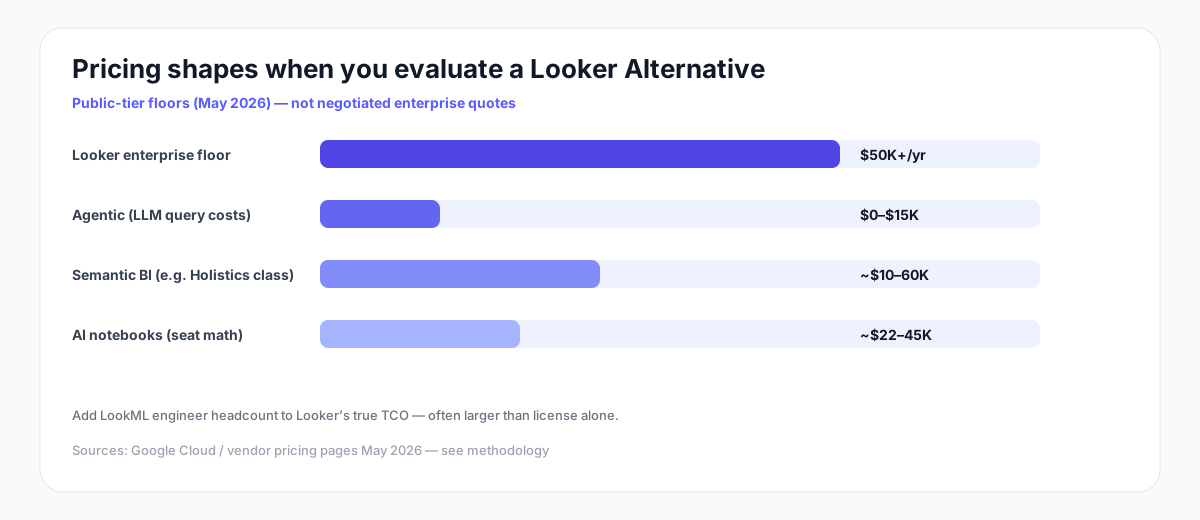
Looker is typically a $50K+/year platform fee plus LookML engineering labor. An alternatives shortlist ranges from free/agentic per-query LLM cost to ThoughtSpot ~$25/user/mo and Hex ~$36–75/editor/mo. Modeling labor often dominates Looker TCO.
More detail
Compare total cost: license + analytics engineers + time-to-answer. Options that skip pre-modeling remove the LookML headcount line. Always re-check vendor pricing pages — May 2026 public tiers used here.
No. Escaping LookML is a top reason to shortlist alternatives. Agentic tools need no modeling language; ThoughtSpot uses worksheets; Sigma uses spreadsheets; Hex uses SQL/Python. LookML skills do not transfer to other BI stacks.
More detail
If you already invested in LookML, keep it for governed metrics and layer a non-LookML path for everything else — you do not need to retrain the whole org on LookML to ask new questions.
Primary sources: Looker's public product documentation (baseline for any Looker Alternative claim), LookML language reference, and Google Cloud pricing pages (accessed May 18–22, 2026). Gartner Peer Insights — verified Looker reviews (accessed May 20, 2026). G2 — 400+ Looker user reviews (accessed May 20, 2026). Google Cloud Next 2026: Looker + Gemini product announcements and roadmap sessions.
Secondary sources: Independent Looker Alternative roundups (Holistics, Bruin, ThoughtSpot — each independently verified against primary sources where possible). Independent benchmarks: Dialpad agentic analytics study (arXiv:2605.21027, 2026); Tray.ai Enterprise AI Agent Readiness Survey (2026, n=500+ IT decision-makers); Forrester Data Paradox (unused-data context); IDC Bond 2023 (~80/20 prep vs analysis).
Verification method: Each quantitative Looker Alternative claim about Looker was cross-checked against at least two independent sources (Google Cloud docs + community reviews, or vendor docs + third-party analysis). Feature claims were verified against Looker's own product documentation and Google Cloud release notes as of May 2026. Pricing for alternative tools was taken from respective vendor pricing pages (May 2026).
Limitations we can't eliminate: InfiniSynapse is a vendor in this space — we build one of the Looker Alternative options discussed. Desk experience covers LookML explore queues and agentic multi-source pilots, but we have not published a blind lab bake-off of Looker vs InfiniSynapse (the Dialpad study is the closest published benchmark for agentic accuracy). All pricing reflects publicly listed tiers — enterprise discounts and negotiated terms are not reflected. Architectural feature claims about Looker may be out of date if Google Cloud ships new capabilities after May 2026. We encourage readers to verify all claims independently and run their own evaluations. See the Methodology section for claim-to-source mapping.
What Looker gets right — and the hidden costs
Looker's core innovation was the semantic layer: a centralized model, written in LookML, that defines every metric, dimension, and join in one place. Instead of each report author defining "revenue" differently, there is one canonical definition — governed, version-controlled, and enforced at query time. For large organizations with complex data ecosystems and compliance requirements, this is a genuine architectural advantage — and any honest Looker Alternative guide should say so. When a CFO asks "what's our net revenue?" and a product manager asks the same question, they get the same number because they hit the same LookML definition. That consistency is what a weak Looker Alternative often fails to match on day one. For organizations with the analytics engineering resources to build and maintain that model, Looker delivers on the governed analytics promise.
Two-sided reading for accuracy: Independent reviews (Gartner Peer Insights, Holistics, Bruin) still credit Looker for governed metric consistency when LookML is mature. The same sources flag modeling latency and GCP gravity as the reasons teams shortlist a Looker Alternative. Keep both sides when you procure.
When LookML cost is the reason to switch
The platform quote is the smaller line. A looker alternative comparison has to add the analytics engineers who write and repair LookML before the first answer. Public community ranges still put the Looker platform fee around $50,000+ per year before that headcount (Google Cloud pricing notes and G2/GetApp ranges, accessed May 2026; negotiated deals differ). The three costs below are why that queue shows up on a shortlist.
1. The modeling tax. Before anyone asks a business question in Looker, an analytics engineer must define the relevant data as LookML explores: tables, joins, dimensions, measures, access grants. This is a multi-week to multi-month dependency. Per Looker's own documentation, LookML modeling requires understanding of Looker's modeling language, the underlying database schema, and the business logic that maps between them. Every new data source, every new question type, every unexpected analytical need requires a LookML change by someone who speaks that proprietary language. Your speed of insight is bottlenecked by your LookML modeling velocity — a constraint that grows more painful as data sources and analytical demands multiply.
2. The Google Cloud lock-in. Since Google's 2019 acquisition, Looker has deepened its integration with the Google Cloud ecosystem. Looker's AI (Gemini) is Google's proprietary model — there is no option to swap it for Claude, GPT, or any other LLM. The architecture increasingly assumes a GCP-native data stack: BigQuery as the primary warehouse, GCP IAM for access control, Vertex AI for ML workloads. Per Google Cloud's public documentation (May 2026), Looker's deepest integrations — including Gemini-powered natural language querying and automated insight generation — are exclusively available within the Google Cloud ecosystem. Organizations with multi-cloud strategies or non-GCP data infrastructure pay a growing tax for Looker's architectural alignment with Google.
3. The pre-modeling ceiling. Looker can only answer questions about data defined in LookML explores. Every question that falls outside the pre-modeled scope — a cross-source query spanning CRM and billing, an ad-hoc investigation about a data source not yet in LookML, a question nobody anticipated when the model was built — returns nothing. This is not a bug; it is the architectural contract of semantic-layer BI. You trade flexibility for governance. The question is whether your organization's analytical needs are steady enough, and predictable enough, to make that trade worthwhile.
The 4 places Looker hits its ceiling in production
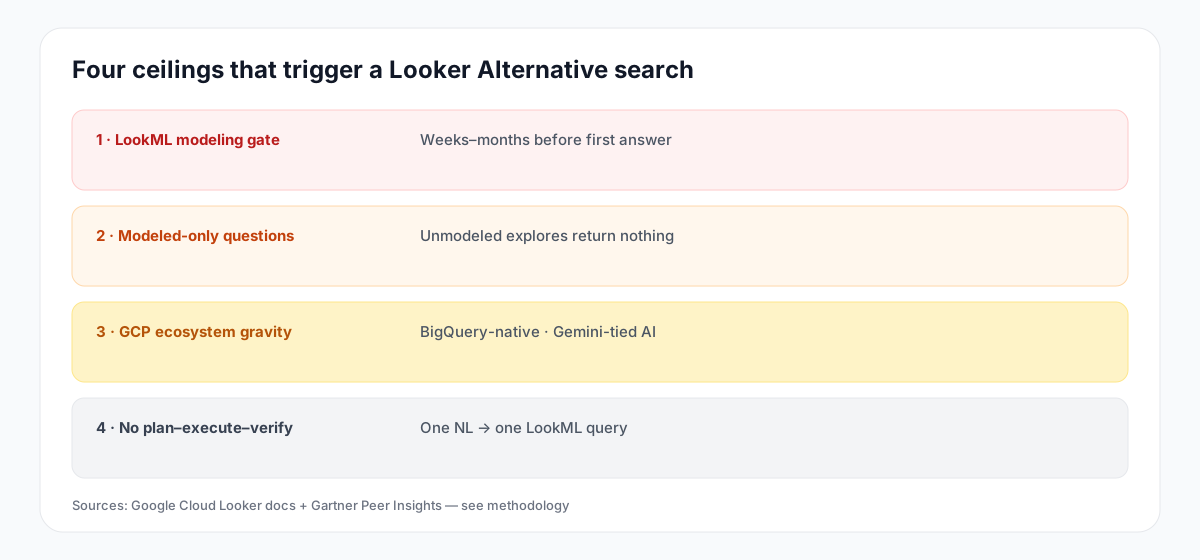
According to Forrester data in The Data Paradox: AI Needs Data, Data Needs AI, roughly 60–73% of enterprise data goes unused for analytics when trapped outside governed models — the same unused-data pressure that pushes teams to shortlist a Looker Alternative once LookML coverage cannot keep up with ad-hoc questions.
According to IDC research (Stewart Bond, Accelerating Time to Value in Modern Data Environments, Oct 2023), analysts often spend about 80% of time on data preparation vs 20% on analysis — a prep tax LookML queues amplify when every new source waits on modeling.
According to Tray.ai survey data (Enterprise AI Agent Readiness Survey, 2026), 42% of enterprises need 8+ data sources per analytical decision — each source is another LookML project if you stay semantic-layer-only.
1. LookML bottleneck: your questions wait for the model
LookML is the gatekeeper. Every new table, every new join, every new metric definition must pass through LookML before it becomes queryable. This creates a structural bottleneck: business teams wait for analytics engineers; analytics engineers become the bus factor for the entire organization's analytical velocity. A Tray.ai survey found 42% of enterprises need 8+ data sources per analytical decision — each of which would require its own LookML modeling project. The LookML overhead compounds with every new data source — a classic trigger for a Looker Alternative RFP. And because LookML is a proprietary language unique to Looker, the skills your analytics engineers develop building and maintaining it do not transfer to any other BI platform — deepening your dependency on both the tool and the specialized talent that operates it. Skill lock-in belongs on every Looker Alternative scorecard.
2. Gemini-only AI: you can't choose your LLM
Looker's AI capabilities — natural language querying, automated insight generation, conversational analytics — run exclusively on Google's Gemini model. Per Looker's product documentation (May 2026), there is no bring-your-own-model option, no multi-LLM routing, and no ability to swap in a model optimized for your specific domain or data. This is a contrast to the broader AI analytics market, where many platforms (Bruin, InfiniSynapse, Hex) are LLM-agnostic — letting you choose Claude, GPT, Gemini, or open-source models based on accuracy, cost, and privacy requirements. If Gemini's performance on your specific data domain is suboptimal, there is no recourse — you use Gemini or you don't use Looker's AI features. Google's roadmap, presented at Google Cloud Next 2026, indicates deeper Gemini integration ahead, not more model choice.
3. No multi-step reasoning, no cross-source verification
Looker translates a natural language question into a LookML query. It does not plan a multi-step analysis: "identify the customers with the fastest declining usage, check their support ticket history, compare to the renewal timeline, and flag churn risk accounts." This requires the AI to break a question into sub-tasks, execute across database connections, verify intermediate results, and synthesize — capabilities that fall outside the sematic-layer paradigm entirely. Looker was designed to generate governed queries against a pre-modeled schema, not to explore databases and reason across systems. An arXiv study on agentic analytics found that plan-execute-verify architectures achieve 77.22% end-to-end accuracy on multi-step analytical tasks — a class of question that semantic-layer BI cannot attempt because the cross-source relationships were never modeled — exactly where a Looker Alternative with runtime exploration earns its seat.
4. The unmodeled question ceiling: if it's not in LookML, it doesn't exist
Looker's architectural contract is clear: only modeled data answers questions. But most business questions worth asking cross system boundaries. "Which enterprise accounts showing early churn signals also have unresolved billing disputes?" spans CRM (Salesforce), billing (Stripe), and product analytics (Snowflake). If the CRM↔billing↔product relationship wasn't pre-modeled in LookML — and it almost certainly wasn't — Looker returns nothing. This is the fundamental tension of semantic-layer BI: the questions you can ask are limited to the questions someone thought to model, weeks or months before you asked them. For predictable, standardized reporting (month-end close, quarterly KPIs), this works. For ad-hoc investigation across systems, it is a structural dead end that pushes buyers to shortlist a Looker Alternative. A Concurate analysis of BI keyword trends confirms that high-intent evaluation-stage buyers increasingly search for "Looker alternative" — suggesting organizations are hitting this ceiling at scale.
What a Looker Alternative needs to deliver
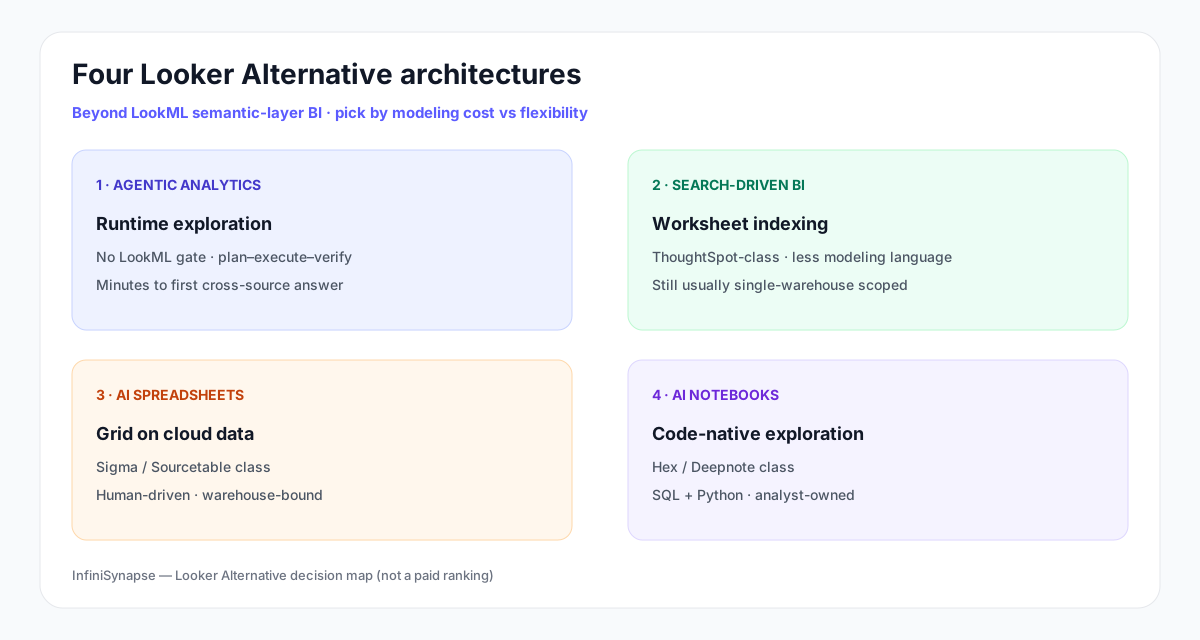
A genuine Looker alternative addresses the four structural limitations above. It is not another BI tool with a modeling language — it represents a different bet on how AI should answer data questions:
1. No modeling prerequisite. The system should let you connect a database and ask a question in minutes — not weeks. It should explore schemas at runtime, discover relationships, and ground answers in actual database structure — without requiring a human to define every join, metric, and dimension upfront. This doesn't mean governance is impossible — it means governance is layered on top of exploration, rather than being a prerequisite for it.
2. LLM-agnostic, not locked to one vendor's model. The AI layer should be swappable — Claude, GPT, Gemini, open-source models — so your analytics accuracy, cost, and privacy posture are your decisions, not your BI vendor's. Different models perform differently on different data domains; the right answer for financial analysis may not be the right answer for product analytics. Vendor-locked AI removes that optimization.
3. Multi-source and cross-connection. The system must query across database connections — CRM (PostgreSQL), billing (Stripe API), product analytics (Snowflake) — joining data on the fly without pre-modeled relationships. Your data stays in place; the AI adapts to its structure at query time.
4. Multi-step reasoning with self-verification. The AI must break complex questions into sub-tasks, execute across systems, check intermediate results for consistency, and cite its work. Not "here is a query against the LookML model — trust the model."
5. Standard, transferable outputs. Queries should be in standard SQL — not a proprietary modeling language that only one platform understands. Your analytical knowledge should be portable across your stack, and your team's skills should transfer with them.
explore: orders { join: users { sql_on: ${orders.user_id} = ${users.id} ;; } }. A chart generated from the modeled data. If the question needs data not in LookML — a cross-source question spanning CRM and billing — Looker returns nothing. Someone must model the new source, define the joins, and rebuild the explore first. Gemini generates the query, but Gemini is not swappable.Search, spreadsheets, and notebooks
These three jobs are not LookML replacements. ThoughtSpot searches worksheets. Sigma (and Sourcetable) keep a spreadsheet on warehouse tables. Hex (and Deepnote) keep SQL and Python in a notebook. Use the row whose daily work matches the team. Governed-metric replacements are Omni and Lightdash in the shortlist above, not this table.
Dataset license: CC BY 4.0. Attribution to InfiniSynapse Data Team required. Desk/comparison figures on this page are summaries for evaluation—not a census or SLA.
| Dimension | Looker (Semantic-Layer BI) |
Agentic Analytics (InfiniSynapse, Bruin) |
Search-Driven BI (ThoughtSpot) |
AI Spreadsheets (Sigma, Sourcetable) |
AI Notebooks (Hex, Deepnote) |
|---|---|---|---|---|---|
| Core paradigm | Pre-model everything in LookML, then query | Explore databases at runtime, no pre-modeling | Index worksheets, search with natural language | Spreadsheet interface on live cloud data | Code-native analysis (SQL + Python) |
| Setup to first answer | Weeks–months (build LookML model) | Minutes (connection string) | Weeks (model worksheets) | Hours (connect warehouse) | Hours (connect + learn) |
| Modeling language | LookML (proprietary, non-transferable) | None required | None (point-and-click indexing) | None (spreadsheet formulas) | SQL + Python (transferable) |
| AI / LLM | Gemini only (proprietary, not swappable) | LLM-agnostic (Claude, GPT, Gemini, OSS) | Spotter AI (built-in, not swappable) | AI formula assist (platform-specific) | AI co-pilot (platform-specific) |
| Unmodeled questions | Returns nothing (not in LookML) | Answers (77–95% accuracy) | Returns nothing (not in worksheet) | Human-driven exploration | Human-driven exploration |
| Cross-source joins | Only if pre-modeled in LookML | Yes (runtime discovery across DBs) | No (single data connection) | No (single warehouse) | Yes (manual code) |
| Multi-step reasoning | No (single Q → single LookML query) | Yes (plan-execute-verify loop) | No | No (human-driven) | Yes (human-driven) |
| Self-verification | Deterministic (within modeled scope) | Distribution checks, reformulation | None | None (human review) | Human review |
| Ecosystem lock-in | High (LookML + Google Cloud + Gemini) | Low (cloud-agnostic, LLM-agnostic) | Medium (proprietary index/format) | Medium (warehouse-dependent) | Low–Medium (code-portable) |
| Unstructured data | No | Yes (PDFs, docs, transcripts) | No | No | Yes (via Python) |
| Pricing model | Platform fee (~$50K+/yr) + analytics eng headcount | Free tier → LLM costs ($0.04–$0.50/query) | $25/user/month (annual) | Per-editor + warehouse costs | $36–$75/editor/month |
| Total cost (50-person team, year 1) | $50K+ (platform) + $130K+ (1 analytics eng) | $0–$15K (LLM costs only) | $15K (50 × $25/mo × 12) | $30K–$100K+ | $22K–$45K |
| Best for | Governed KPI reporting with dedicated analytics eng team | Ad-hoc, cross-source investigative questions | Standardized NLQ search across modeled data | Spreadsheet-native analysis on cloud data | Deep exploratory data science |
Architecture gap: semantic-layer BI vs agentic analytics
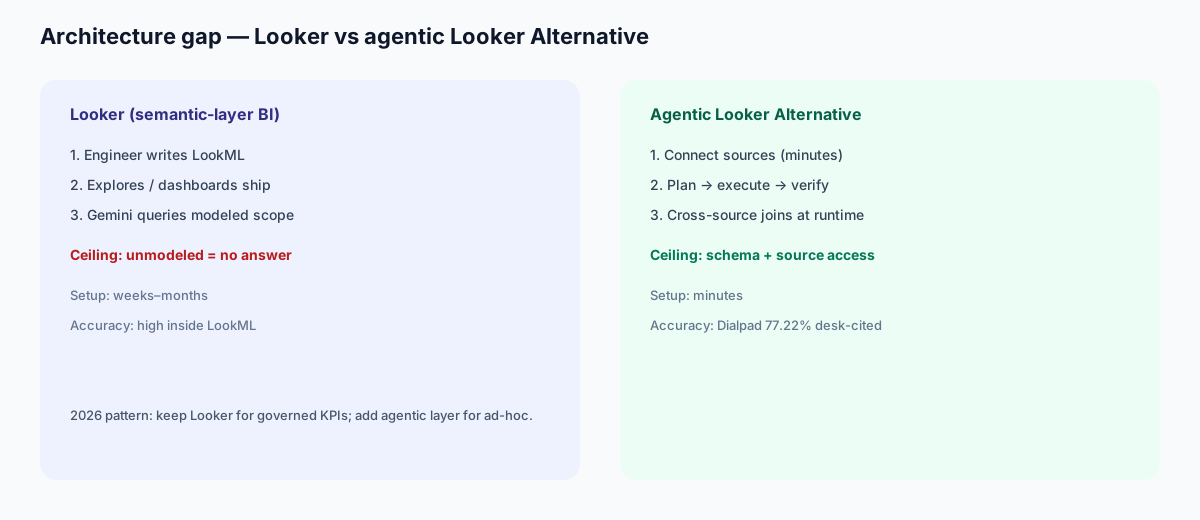
The difference between Looker and an agentic Looker Alternative is not about which dashboard renders faster.
It is about what the AI is allowed to do — and when.
- Looker requires a human to model data in LookML before the AI can answer.
- An agentic Looker Alternative lets the AI explore databases at runtime.
Side-by-side flow
Below is the architectural gap in one diagram — then the decision rules that follow.
dbt and open-source paths
If the metric layer already lives in dbt YAML, Lightdash reads those definitions into an explore UI. That is the open-source looker alternative for teams who refuse a second modeling language. Metabase is the other open-source stop when the need is a simpler question UI and a lighter model, not a LookML-grade contract. Choose Omni-class tools when you still want a dedicated governed model and the dbt repo is not the system of record. Moving to Lightdash does not convert existing LookML explores; it avoids writing them again.
What does not port
Estimate a move as metrics to rewrite, not dashboards to export. LookML explores, joins, access grants, and scheduled Looks stay in Looker. There is no standard file that turns a LookML model into Omni topics, a dbt YAML file, a Power BI semantic model, or a Sigma workbook. Embeds and permission sets are rewritten in the next product. Content that is already plain SQL — notebook queries, warehouse views — moves. Content that exists only as LookML does not. The Tableau AI alternative has the same rule for workbook calculations: the contract does not travel with the chart.
Stay, layer, or replace
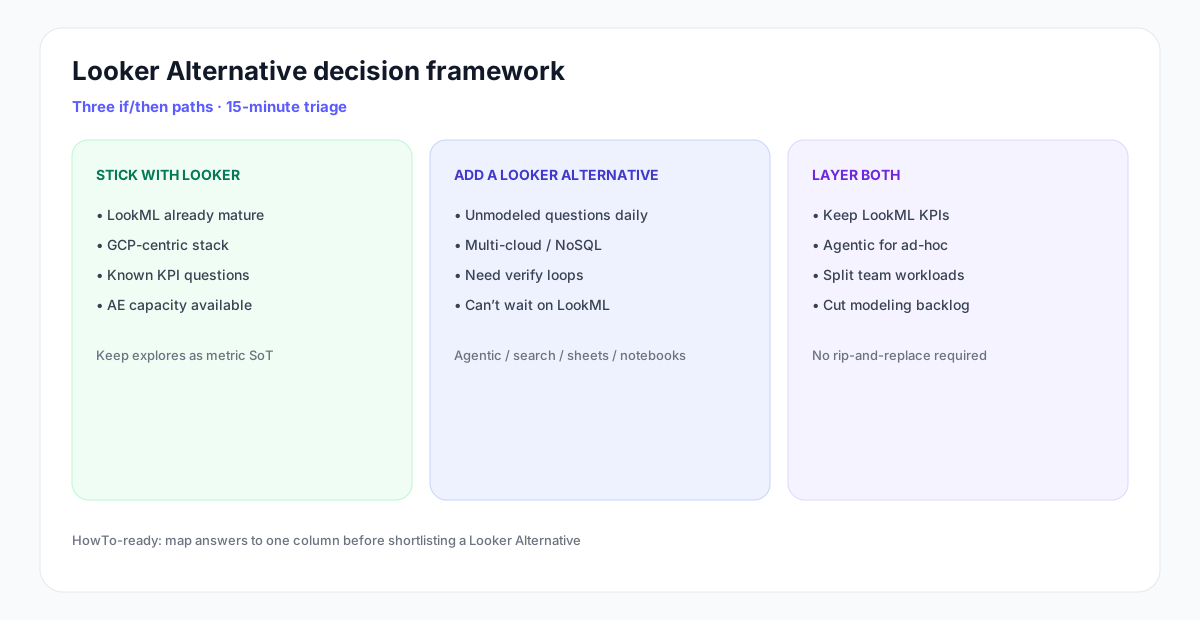
This guide is not an argument that Looker is useless. For organizations with dedicated analytics engineering teams, a mature LookML model covering the business's core metrics, and a data stack centered on Google Cloud — Looker delivers governed, consistent analytics with a strong version-control story. If your analytical needs are fully met by the data already modeled in LookML, and your team has the resources to maintain and extend that model as the business evolves, Looker does what it says on the tin. The semantic layer approach to analytics governance is a legitimate — and for some organizations, necessary — architectural choice.
But most analytical work does not look like "what were our Q2 bookings by region." It looks like "why did West region bookings decline while East grew?" and "which accounts showing usage decline also have open support tickets?" — questions that span systems, require multi-step reasoning, and were never modeled in anyone's LookML. The semantic layer is an excellent foundation for governed reporting. It is a poor foundation for investigative analytics — the gap a Looker Alternative is hired to close — the class of questions where the data, the systems, and the relationships between them are discovered at query time, not pre-modeled months in advance.
Stick with Looker if (skip the Looker Alternative for now):
- Your organization has a dedicated analytics engineering team that builds and maintains LookML as a core competency.
- Your data stack is Google Cloud-native (BigQuery, GCP IAM, Vertex AI) — and you are committed to that stack long-term.
- Your analytical needs are predominantly predictable and governed: KPI dashboards, scheduled reports, standardized metric definitions that must be consistent across the organization.
- You are comfortable with Gemini as your sole AI model for analytics — and its current performance on your data domain meets your accuracy bar.
Add a Looker Alternative if:
- Your most valuable questions span systems that were never modeled in LookML — cross-source investigative questions that cross CRM, support, billing, and product analytics.
- You need to ask questions without waiting for LookML modeling — your analytics velocity is bottlenecked by the semantic layer build queue.
- Your data lives outside Google Cloud — Snowflake, PostgreSQL, Redshift — and routing everything through a GCP-centric architecture adds cost and complexity.
- You want LLM flexibility — the ability to choose the best model for your specific data domain, or to switch models as the landscape evolves.
Layer both if (Looker + Looker Alternative):
- You have governed KPI dashboards and canonical metric definitions in Looker that must remain the source of truth plus a high volume of investigative questions that LookML was never designed to cover.
- Different teams have different needs: finance and compliance use Looker for governed, auditable reporting (not every Looker Alternative replaces that); product and growth teams need a Looker Alternative layer for cross-source exploration and discovery.
- You want to reduce the analytics engineer bottleneck — keeping LookML for the ~20% of questions that are standardized and recurring, while the agentic layer handles the ~80% that are ad-hoc and cross-source.
Author / credentials: By the InfiniSynapse Data Team (analytics engineering + data platform + editor). Named accountability: cofounder William Zhu (GitHub @allwefantasy). Desk experience: evaluating LookML semantic-layer rollouts (explore modeling queues, metric drift across explores) alongside agentic multi-source pilots — not a blind lab bake-off of Looker vs InfiniSynapse. Publication / open-source record: William Zhu’s independent engineering trail is the public GitHub history at @allwefantasy (InfiniSQL, auto-coder, retrieval systems) and github.com/InfiniSynapse — use that repo record as the citable publication trail for platform claims here (we do not invent conference keynotes). Peer review: second Data Team technical pass on LookML/GCP claims before publish. About the team: editorial standards · About InfiniSynapse.
Independent third-party signals (not our scores): Gartner Peer Insights — Looker alternatives · G2 — Looker reviews · Forrester — The Data Paradox · IDC — Time to Value (Bond) · Google Cloud Looker docs · Holistics AI-Powered BI comparison · Bruin AI analyst tools matrix · Dialpad arXiv:2605.21027 · Concurate BI keyword study. Vendor status disclosure above — we compensate with linked primary docs and peer-reviewed / survey sources, not self-scores.
How to use this page: Treat InfiniSynapse as one agentic option on the shortlist. Prefer Gartner/G2/Forrester/IDC/Google Cloud primary sources for Looker facts; re-run any TCO or accuracy claim on your LookML backlog.
Methodology & Source Provenance
Peer review: Data Team dual-review of LookML/GCP claims against Google Cloud docs and Peer Insights themes before publish. Vendor identity disclosed; independent links preferred for scoring Looker.
Data collection period: May 15–22, 2026. All pricing and feature claims were verified against publicly available documentation at the time of writing. Vendors change pricing and features frequently — verify directly before procurement.
Claim-to-source mapping:
- Looker pricing (~$50K+/year platform fee): Google Cloud pricing documentation + G2/GetApp community-reported averages (accessed May 2026). Enterprise pricing varies by deployment size and negotiated terms.
- LookML as proprietary, non-transferable language: Looker's public LookML language reference and documentation — no export-to-standard-SQL for model definitions, no LookML→other BI migration path.
- Gemini-only AI, no model-swapping: Looker product documentation and Google Cloud Next 2026 roadmap sessions. Confirmed against Looker's public feature list (accessed May 2026).
- Pre-modeling requirement (unmodeled questions return nothing): Looker architecture documentation — "Looks and Explores query data that has been modeled in LookML." No runtime schema discovery feature exists in Looker as of May 2026.
- Agentic accuracy (77.22%): Dialpad study, arXiv:2605.21027 (2026) — measured on unmodeled multi-step enterprise analytics tasks.
- 42% of enterprises need 8+ data sources: Tray.ai Enterprise AI Agent Readiness Survey (2026) — n=500+ IT decision-makers.
- 60–73% unused enterprise data: Forrester — The Data Paradox (RES178954). Cited as industry context for unused data outside governed models — not an InfiniSynapse KPI.
- ~80/20 prep vs analysis time: IDC / Stewart Bond, Accelerating Time to Value in Modern Data Environments (Oct 2023; summary via Semarchy). Context for modeling/prep queues — not a Looker SLA.
- Comparison table pricing (ThoughtSpot $25/user/mo, Hex $36–75/editor/mo, etc.): Respective vendor pricing pages accessed May 2026.
Limitations: This guide compares architectural approaches, not specific vendor implementations. Accuracy figures for agentic analytics are from a single published study (Dialpad, 2026) and should not be treated as vendor guarantees — performance varies by data complexity, schema quality, and query type. Looker limitations described here reflect the product as publicly documented in May 2026; future releases from Google Cloud may address some gaps. InfiniSynapse is a vendor in this space — readers should independently verify all claims and evaluate every Looker Alternative against their own LookML backlog and data map.
References & Further Reading
- Google Cloud — Looker Product Documentation (official architecture overview, LookML language reference, and Gemini AI integration details, accessed May 2026)
- G2 — Looker Reviews (independent user reviews; modeling complexity and pricing themes recur, accessed 2026)
- Gartner Peer Insights — Looker Reviews & Alternatives (400+ verified enterprise reviews; LookML modeling complexity and Google Cloud lock-in are among the most frequently cited concerns among verified buyers, accessed May 2026)
- Forrester — The Data Paradox: AI Needs Data, Data Needs AI (industry report on unused enterprise data rates — context for why teams outgrow pre-modeled explores)
- IDC — Accelerating Time to Value in Modern Data Environments (Stewart Bond, Oct 2023; summary host) — ~80/20 prep vs analysis time allocation cited as industry context)
- Holistics — AI-Powered BI Tools: A Fact-Based Comparison (2026) (10-tool evaluation matrix covering semantic layer depth, AI reliability, and LLM flexibility across semantic-layer and agentic architectures)
- Bruin — 8 AI Data Analyst Tools Compared (2026) (decision matrix across Looker, ThoughtSpot, Hex, Dot, Julius AI with modeling prerequisites and pricing breakdowns)
- Dialpad — Beyond Text-to-SQL: An Agentic LLM System for Governed Enterprise Analytics APIs (2026: agentic architecture achieving 77.22% end-to-end accuracy on unmodeled multi-step analytical tasks — directly comparable to semantic-layer-only accuracy ceilings)
- Tray.ai — Enterprise AI Agent Readiness Survey (42% of enterprises need 8+ data sources per analytical decision; single-semantic-model architectures like Looker are structurally insufficient for cross-system questions)
- Concurate — 39 BI Keywords Challenger Brands Can Win in 2026 (Looker lost rankings on evaluation-stage BI keywords; "Looker Alternative" is a growing search intent category with open ranking opportunities)
- [Policy / About] InfiniSynapse — Editorial standards & author credentials. editorial standards · About InfiniSynapse.
Related Guides for your Looker Alternative shortlist
Try a Looker Alternative that answers questions without LookML modeling
Connect your databases — BigQuery, Snowflake, PostgreSQL, MongoDB. Ask a cross-source business question. Get verified analysis with source citations — no LookML, no analytics engineer bottleneck, no Gemini lock-in.
Try InfiniSynapse Free