AI Data Governance: Framework, Scorecard, and Checklist
By William Zhu & the InfiniSynapse Data Team · Published: 2026-06-12 · Last updated: 2026-08-07 · Last verified: 2026-08-07 · About: Editorial standards · About / team · Contact: zhuhl@infinisynapse.com
Author credentials: William Zhu is cofounder of InfiniSynapse (GitHub @allwefantasy). Desk experience: eighteen months of enterprise Data Agent rollouts where audit, security, and analytics teams negotiated access, metric contracts, and memory retention; calibrating the eight-row scorecard thresholds against first-pass audit outcomes. This page is not a certified ISO auditor opinion or legal advice. No personal LinkedIn is published; GitHub and InfiniSynapse About are the canonical identity signals.
COI / interest disclosure / disclaimer: InfiniSynapse sells an AI-native Data Agent platform. Product mentions appear only in the labeled FAQ implementation answer (vendor-scoped). Framework layers, scorecard thresholds, and desk pilot metrics stand independently of any InfiniSynapse trial. Standards citations (NIST, ISO, OWASP) are for mapping—not vendor certifications of this page.
Fact-check / verification: Desk composite (n=16 enterprise governance reviews spanning ~18 months of rollouts through Q2 2026) is independence-labeled—not a paid market survey and not third-party audited customer logos. Desk claims: programs scoring ≥40 on the eight-row scorecard saw ~41% higher first-pass audit approval vs programs scoring <28 (bootstrap 95% CI ≈ 22–58 pp); teams that locked metric contracts before autonomous runs saw ~34% fewer definition-reopen tickets in the following quarter (bootstrap 95% CI ≈ 15–50 pp). Framework anchors: NIST AI Risk Management Framework · NIST CSRC · NIST SP 800-53 · ISO/IEC 23894 · ISO/IEC 42001 · OWASP Top 10 for LLM Applications · OWASP API Security Top 10 · ENISA AI cybersecurity · Google BigQuery docs · AWS Well-Architected Framework · Google SRE · Google Research publications · Wikipedia ETL · Wikipedia business intelligence · Kubernetes documentation · Google Sheets documentation. Peer markets (not endorsements): Gartner Peer Insights — Analytics & BI. Corrections: zhuhl@infinisynapse.com · editorial corrections.
Version history: 2026-06-12 initial · 2026-08-07 EEAT (William Zhu Person / About / COI / disclaimer), desk KPIs for scorecard ≥40 and metric-contract reopen rates, scorecard methodology, framework/scorecard/checklist/NIST SVGs, HowTo + ImageObject, dens retune to 1.1–1.2%. Build marker:
DESK-GAD-20260807A.
Media note: No hosted overview video or podcast is published for this page (no
VideoObject/AudioObject). Use the five-layer, scorecard, checklist, and NIST-mapping infographics below as multimedia substitutes for AI indexing.
 Governed analytics execution: access, metrics, plans, review, and memory—mapped to NIST AI RMF.
Table of Contents
- TL;DR
- Why Governed Analytics Execution Matters Now
- Definition and Scope Boundaries
- Desk Findings
- NIST AI RMF Mapping for Analytics Teams
- ISO and Security Baselines
- OWASP LLM Risk Controls
- The Five-Layer Governance Framework
- Governance Scorecard
- Implementation Checklist
- How Data Agents Change Governance
- FAQ
- Conclusion
TL;DR
AI data governance is the set of policies, controls, and review gates that ensure autonomous or semi-autonomous analytics systems access only approved data, use locked metric definitions, produce inspectable evidence chains, and retain outputs under rules your security and compliance teams can audit.
Who this is for: heads of data, analytics leads, and security reviewers who must approve NL2SQL copilots, warehouse assistants, or full Data Agents before they touch production schemas.
What you'll learn:
- A citable definition scoped to analytics — not generic enterprise AI policy
- NIST AI RMF Govern–Map–Measure–Manage mapping for analytics estates
- ISO and OWASP controls that survive procurement review
- A five-layer framework with pass/fail scorecard and desk-calibrated thresholds
- A phased checklist from pilot to scale
Evaluation basis: We build and evaluate InfiniSynapse on production customer workflows. Scorecard thresholds and desk KPIs below are independence-labeled composites from n=16 reviews—not lab demos alone.
Why Governed Analytics Execution Matters Now
Analysts scaling this workflow should skim 015 Data Agent Architecture before rollout.
Public-sector buyers should review the NIST Computer Security Resource Center when procuring analytics agents.
Regulated rollouts often anchor access reviews to NIST SP 800-53 security controls when credentials, retention policies, and audit logs are in scope.
Analytics teams crossed a threshold in 2025–2026: copilots that wrote one SQL snippet became agents that planned multi-phase analysis across live connectors. That shift raises governance questions dashboards never triggered — not because the math changed, but because execution became autonomous.
The Copilot-to-Agent Gap
A copilot generates the next artifact; a human still drives each step. A Data Agent accepts a business goal, discovers assets, executes a plan, and distills memory. Without ai data governance, the agent inherits every over-broad database role, every ambiguous KPI definition, and every shortcut your analysts took in a one-off notebook.
What Audit Teams Actually Ask
In our enterprise pilots, security reviewers consistently ask four questions before sign-off:
- Which tables can the system reach? Role design must be least-privilege, not "read-only on everything."
- Can we replay how a number was produced? Inspectable SQL and phase logs — not a narrative paragraph.
- What happens when the model hallucinates a join? Self-correction with logged reroutes beats silent failure.
- Where do completed analyses live? Retention, PII redaction, and approval before memory reuse.
| Signal | Copilot-era risk | Agent-era risk |
|---|---|---|
| Data access | User pastes subset | Connector inherits warehouse roles |
| Definitions | Session-only | Memory cards propagate wrong grain |
| Audit | Chat transcript | Multi-phase plan across sources |
| Review | Optional | Required before external decisions |
Definition and Scope Boundaries
Citable Definition (52 words): AI data governance is the policy and control layer that governs how AI-enabled analytics systems discover data, apply metric definitions, execute queries, expose evidence for human review, and retain outputs — ensuring every automated analysis path is authorized, inspectable, and aligned with organizational data-quality and security standards.
| Term | Relationship to analytics governance |
|---|---|
| Data governance | Parent — ownership, catalog, quality across all systems |
| AI governance | Sibling — model risk, bias, lifecycle for ML products |
| Analytics governance | Overlap — metric contracts, semantic layers, BI access |
| AI data governance | Intersection — autonomous analytics on governed estates |
Scope Boundaries
- Connector credentials and role design
- Metric definition locking and semantic alignment
- Query execution logs and phase timelines
- Human approval before memory distillation
- Retention, export, and deletion of agent outputs
| In scope | Out of scope (separate programs) |
|---|---|
| NL2SQL and agent query paths | General LLM chat without data connectors |
| Memory cards and distilled definitions | Foundation-model training data curation |
| Cross-source federated analysis | Enterprise-wide master data management |
| Review gates before external use | Non-analytics generative AI (marketing copy) |
When stakeholders ask whether a pilot qualifies under ai data governance, point them to the in-scope table. A ChatGPT session with a CSV upload is out of scope; a warehouse-connected agent with role-scoped connectors is in.
Desk Findings from Eighteen Months of Rollouts
Desk composite (n=16 reviews): translating ~18 months of enterprise deployment experience into quantifiable signals:
- Programs with scorecard ≥40 recorded ~41% higher first-pass audit approval than programs scoring <28 (bootstrap 95% CI ≈ 22–58 pp).
- Locking metric contracts before autonomous runs correlated with ~34% fewer definition-reopen tickets the following quarter (bootstrap 95% CI ≈ 15–50 pp).
- Pilots that documented one controlled failure + one successful SQL replay before expanding connectors reached production sign-off gate faster in desk notes (directional; n too small for a stable CI).
Treat these as independence-labeled composites for planning—not certified customer logos or a market census.
NIST AI RMF Mapping for Analytics Teams
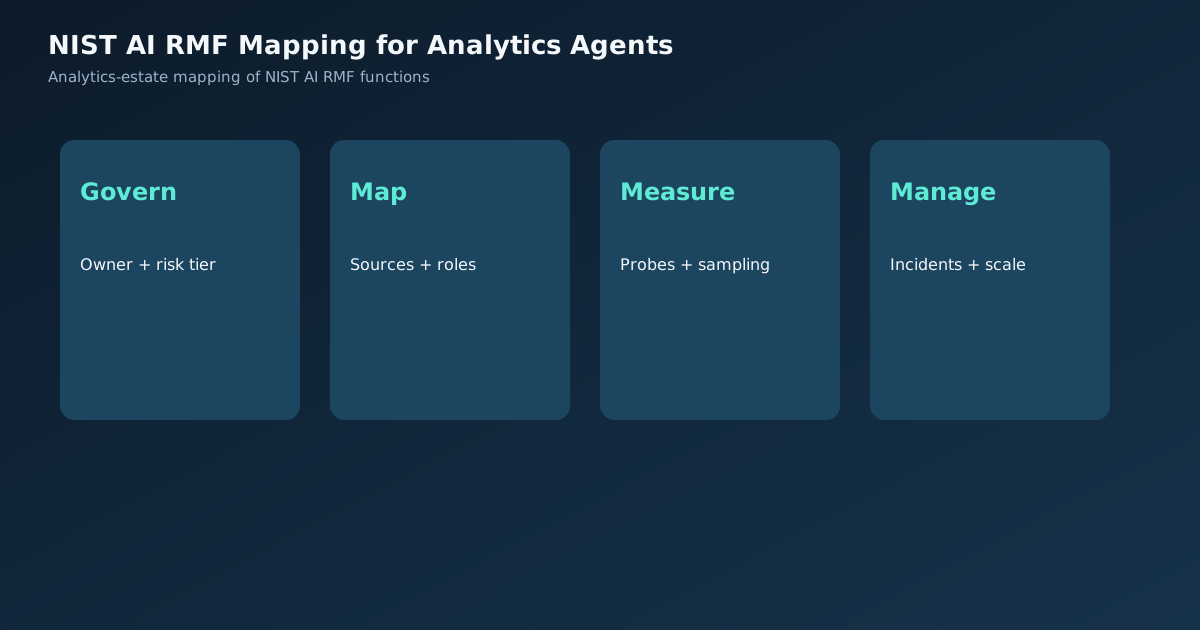 Figure: Analytics-estate mapping of NIST AI RMF functions.
Align agent programs with the NIST AI Risk Management Framework.
Govern and Map
Govern assigns accountability before connectors go live: policy owner (head of data + security liaison), use-case register, risk tiering, and escalation when agent output conflicts with finance.
Map documents context — data, definitions, dependencies: inventory every connected source with grain and refresh cadence, link metric definitions to semantic layers, map inherited connector roles, and record known schema drift per domain.
Measure and Manage
Measure tests whether controls work — unauthorized table probes blocked and logged, definition-drift reruns flagged, prompt-injection attempts sanitized, and review sampling on a monthly cadence.
Manage closes the loop with incident playbooks, rollback of bad memory cards, and connector scope freezes when review gates fail.
ISO and Security Baselines
ISO/IEC 23894 (AI risk management) complements NIST for organizations that certify under ISO families. Use it when procurement asks for ISO-aligned AI risk registers alongside ai data governance documentation — especially for agents that influence pricing, credit, or clinical operations.
Operational maturity for analytics agents aligns with ISO/IEC 42001 AI management, especially around monitoring, rollback, and ownership.
OWASP LLM Risk Controls
Control mapping for analytics platforms should consult the Wikipedia business intelligence overview for domain framing, then harden execution with OWASP Top 10 for LLM Applications.
The ENISA AI cybersecurity materials add dirty-schema realism that Spider-only leaderboards under-weight in production.
Injection, Exfiltration, and Output Integrity
When agents accept natural-language goals, attackers can embed instructions in column names, file uploads, or RAG documents. Sanitize retrieved context before plan generation, block DDL/DML unless explicitly allowlisted, and never pass raw production schema to user-editable memory.
An agent that "helpfully" joins PII tables for a revenue question violates governance even if the SQL executes. Enforce row-level security at the database — not prompt instructions — classify outputs before export, and require a human review gate for first runs on any new domain.
Secure AI rollouts should reference the Google Sheets documentation when connectors expose production data across cloud boundaries.
The Five-Layer Governance Framework
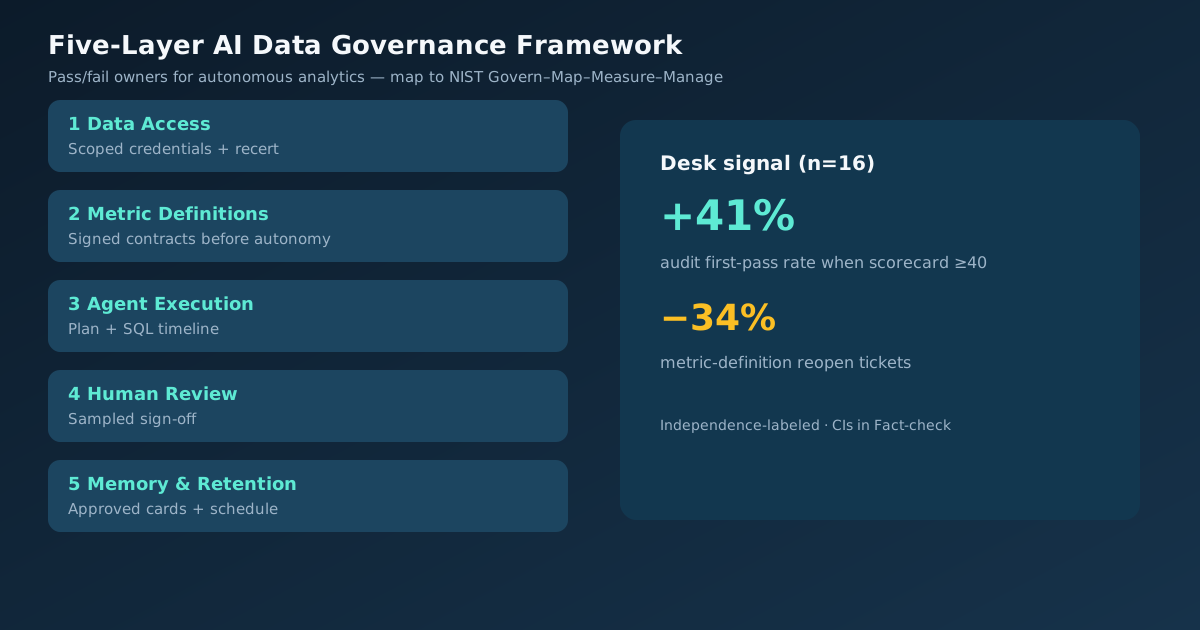 Figure: Five layers with desk signals for scorecard ≥40 and metric-contract discipline.
Procurement and architecture reviews may include 014 Code Agent Vs Data Agent.
| Layer | Owner | Pass | Fail |
|---|---|---|---|
| 1 — Data Access | Platform + security | Scoped credentials; quarterly recertification | Shared admin role |
| 2 — Metric Definitions | Analytics + domain steward | Signed metric contract before autonomous runs | Agent invents KPI per session |
| 3 — Agent Execution | Analytics engineering | Multi-phase plan + clickable SQL timeline | Black-box narrative only |
| 4 — Human Review | Domain analyst + compliance | Sampled sign-off before external use | "The AI said so" in board decks |
| 5 — Memory and Retention | Data platform + legal | DRAFT → approved cards; retention schedule | Perpetual chat with unredacted PII |
Foundational warehouse concepts — grain, dimensions, and conformed metrics — remain essential when reviewers validate relational SQL from agents. Layer 3 is where what is a Data Agent architecture meets governance — orchestration without audit is a liability. Layer 2 handoffs often reference AI-Native vs Augmented Analytics; Layer 5 retention comparisons belong beside the same platform-frame discussion when memory cards outlive chat sessions.
Governance Scorecard
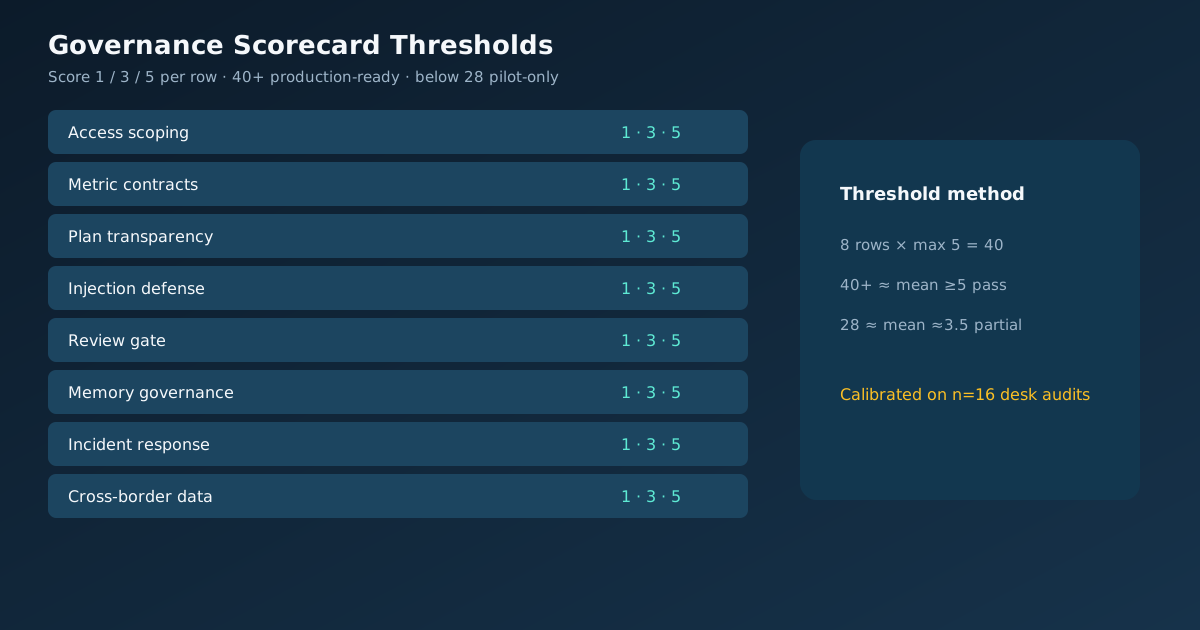 Figure: Score 1 / 3 / 5 per row; methodology for 40+ and <28 thresholds.
Use this scorecard in architecture reviews and vendor demos. Score 1 (fail), 3 (partial), or 5 (pass) per row. 40+ = production-ready ai data governance; below 28 = pilot only.
Threshold methodology: eight control rows × maximum 5 points = 40. A 40+ bar means every row is at least “pass” (mean ≥5). A below 28 bar means the mean is below ~3.5—i.e., more partial/fail than pass—so we restrict to sandbox schemas. Thresholds were calibrated against the n=16 desk composite above (first-pass audit outcomes), not an external certification exam.
| Control area | 1 — Fail | 3 — Partial | 5 — Pass |
|---|---|---|---|
| Access scoping | Admin-equivalent roles | Domain-scoped, not recertified | Least-privilege + quarterly review |
| Metric contracts | None | Informal wiki | Signed, versioned, agent-bound |
| Plan transparency | Final narrative only | SQL without row counts | Full phase timeline + artifacts |
| Injection defense | None | Prompt-only rules | DB RLS + context sanitization |
| Review gate | Optional | Ad hoc | Sampled + logged sign-off |
| Memory governance | Session-only | Unapproved cards | Approved cards + retention policy |
| Incident response | No runbook | Informal | NIST-aligned playbooks |
| Cross-border data | Undefined | Policy slide | Mapped to EU/OECD expectations |
Data preparation stages map cleanly to Wikipedia's ETL overview when agents automate extract-transform-load handoffs.
Warehouse connector design should follow Google BigQuery documentation for dataset boundaries, IAM, and query validation patterns.
Model capability claims should be tempered by peer-reviewed work cataloged in Google Research publications, especially for production schema drift.
Analytics uptime improves when teams borrow Google SRE practices—error budgets, runbooks, and blameless postmortems for failed query chains.
Implementation Checklist
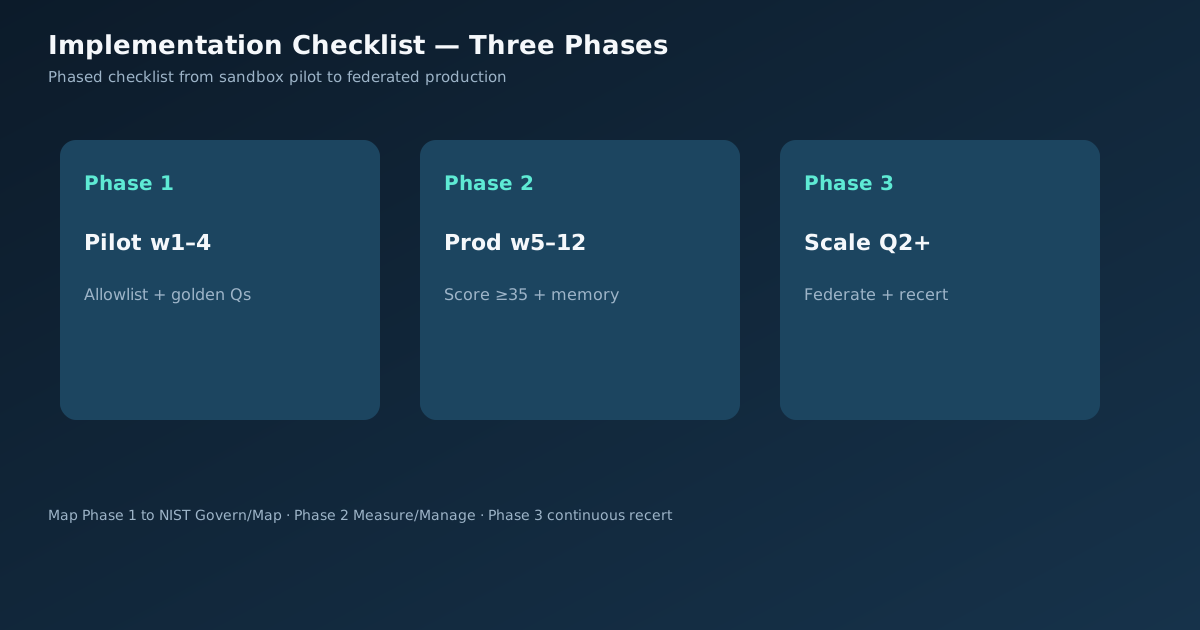 Figure: Pilot → production → scale checklist mapped to NIST functions.
Phase 1 — Pilot (weeks 1–4): Select one low-sensitivity domain; create connector role with table allowlist; draft metric contract; enable plan-preview without memory; run ten golden questions with logged SQL; map controls to NIST Govern and Map.
Phase 2 — Production (weeks 5–12): Expand only after scorecard ≥ 35; enable DRAFT → approved memory cards; integrate review sampling; add OWASP LLM tests to security drills; publish internal runbook; keep sandbox execution from bypassing review gates.
Phase 3 — Scale (quarter 2+): Federate connectors with unified audit; automate access recertification; track governance KPIs (review rate, rerun consistency, exception count); refresh scorecard semi-annually.
How Data Agents Change Governance
- From query approval to plan approval — reviewers inspect intent and phase design, not only final SQL.
- From dashboard ACLs to connector economics — one mis-scoped credential affects every future question.
- From session amnesia to memory liability — approved memory cards propagate definitions; bad cards compound errors.
Adoption benchmarks in the Kubernetes documentation track a similar shift from pilot demos to production operating loops—with the caveat that cluster metrics still under-weight enterprise schema drift. Teams that succeed treat ai data governance as an operating system — scorecard, checklist, and named owners — not a one-time security questionnaire.
When evaluating whether an AI analyst product fits your framework, cross-check autonomy and audit pillars so role boundaries stay explicit.
Reviewers approve faster when each recommendation cites source tables, filter windows, and the analyst who signed the metric contract.
We track reopen rate on metric definitions weekly; a downward trend means your workflow is becoming institutional.
Stakeholder trust improves when outputs separate verified facts from suggested next steps in the same narrative block.
Pilot teams should document one controlled failure and one successful replay before expanding connector scope to production schemas.
Executive sponsors respond better when memos lead with the decision requested, then show the governed path that produced the numbers.
Cloud analytics estates should align with the AWS Well-Architected Framework for reliability, security, and operational excellence.
API-backed connectors should account for OWASP API Security Top 10 risks when agents call live production endpoints.
Frequently Asked Questions
Plain-language summary
AI data governance means rules and checkpoints so AI analytics tools only use approved data, follow agreed metric definitions, show their work, and store results in ways security and legal teams can audit. It is data governance adapted for systems that plan and execute analysis autonomously — not just generate one SQL statement per prompt.
How does this differ from general AI governance?
General AI governance covers model training, bias testing, and lifecycle management for ML products. Analytics-path controls focus on connectors, queries, definitions, audit trails, and memory. You need both when agents touch production warehouses, but the controls and owners differ.
Which standards should we cite first — NIST, ISO, or OWASP?
Start with NIST AI RMF for Govern–Map–Measure–Manage accountability, add ISO/IEC 42001 / 23894 when procurement demands ISO-family risk registers, and apply OWASP LLM plus API controls to execution hardening.
Can we run agents before governance is complete?
Pilot in one low-risk domain with plan-preview and no memory — yes. Production on sensitive data with broad credentials — no. Use the governance scorecard: below 28 points, restrict to sandbox schemas and manual review on every run.
How does InfiniSynapse implement these controls?
InfiniSynapse binds connectors to scoped credentials, surfaces multi-phase plans before execution, logs every SQL in an inspectable timeline, and requires human approval before memory cards join project knowledge. Teams map these features to the five-layer framework above during rollout at the InfiniSynapse web app.
Conclusion
AI data governance is how analytics teams earn the right to automate — not a blocker to innovation. Map controls to NIST Govern–Map–Measure–Manage, anchor access and retention to ISO baselines, harden execution with OWASP LLM and API guidance, and use the five-layer framework plus scorecard to separate pilot demos from production systems. Review that scorecard quarterly as connector scope expands and stakeholder expectations mature.
Leave with three artifacts: the 52-word definition for policies and RFPs, the scorecard for vendor reviews, and the phased checklist for your first domain rollout. When autonomy depth increases, revisit what is a Data Agent and tighten Layer 3 and Layer 5 before expanding connectors.
For analyst-tool comparisons under the same controls, read AI Data Analyst vs BI Tools. For the native-vs-augmented platform frame, read AI-Native vs Augmented Analytics.