AI Data Analyst vs BI Tools: Scorecard
By the InfiniSynapse Data Team · Last updated: 2026-09-20 · Last verified: 2026-09-20 · We build and evaluate InfiniSynapse on production analyst workflows; the scorecard and rollout patterns below come from customer deployments, not vendor demos. Marker:
DESK-ADAVBI-20260920A.
Table of Contents
- TL;DR
- Why the Comparison Matters Now
- What Traditional BI Tools Still Do Best
- What the AI Layer Adds
- Head-to-Head Comparison Matrix
- Tool Categories in the 2026 Stack
- When to Keep BI as System of Record
- When to Layer AI on Top of BI
- Production Scorecard Before Rollout
- Migration Patterns We See in Customer Rollouts
- Frequently Asked Questions
- Conclusion
TL;DR
Direct answer: AI data analyst vs BI tools is a layer choice, not a rip-and-replace. Tableau, Power BI, or Looker still own governed dashboards, certified datasets, and executive cadence. The AI layer wins on ad-hoc exploration, multi-step reasoning, and recurring analysis that would otherwise rebuild SQL every cycle. Mature teams keep BI as the display layer and add an AI-native Data Agent when the same question repeats weekly with definitions that must survive turnover.
Decision shortcut
- Frame ai data analyst vs bi tools as: BI owns governed consumption; AI owns investigation.
- Keep BI when stakeholders consume fixed dashboards and row-level security is non-negotiable.
- Add the AI layer when analysts spend more time re-building the same SQL than interpreting results.
- Evaluate AI-native agents when handoff, audit trails, and memory matter as much as chart speed.
For the role-stack shortlist, see AI tools for data analysts. For the named bake-off, see Best AI Tools for Data Analysis in 2026.
Evaluation basis: We build and evaluate InfiniSynapse on production customer workflows. Governance, adoption, and security context is cited inline throughout this guide—not in a standalone reference list.
Why the Comparison Matters Now
SLO tracking for analytics agents can borrow OWASP API Security Top 10 patterns for latency, error budgets, and alert routing.
Every major BI vendor shipped an AI copilot between 2024 and 2026. That blurred ai data analyst vs bi tools in procurement: teams ask whether they still need a separate AI layer when Power BI Copilot, ThoughtSpot Spotter, or Databricks Genie already answer natural-language questions.
The answer depends on what you are optimizing. BI copilots excel when data already lives in a governed semantic layer and the question maps to certified metrics. A standalone AI analysis layer excels when work spans mixed sources, requires chained reasoning, or must persist method across sessions. Adoption benchmarks in the Spider NL2SQL benchmark show productivity gains from AI assistants while trust gaps widen—exactly the pattern we see when chat-first pilots meet monthly close deadlines.
The move from dashboard-first BI to augmented workflows—described in Apache Airflow documentation—frames how teams should score ai data analyst vs bi tools rather than treating copilots and incumbents as interchangeable chat boxes.
Three signals that the comparison is overdue on your team:
- Analysts export from BI to Excel for questions the semantic layer never anticipated.
- Copilot answers differ from dashboard numbers because definitions drifted.
- Only one person knows how to reproduce last month's board analysis.
If two of those are true, you are not choosing BI or AI—you are choosing where each layer stops.
What Traditional BI Tools Still Do Best
Traditional BI—Tableau, Power BI, Looker, Qlik, MicroStrategy—optimized for a decade around a stable contract: connect to a warehouse, model metrics once, publish dashboards many consumers trust.
Governed dashboards and certified datasets
BI remains the system of record for what the number means. Certified datasets, data source credentials, and refresh schedules live inside the platform. When a CFO opens a revenue dashboard, they expect the definition to match finance's metric dictionary—not whatever an LLM inferred from column names.
Row-level security and entitlements
Enterprise BI encodes who sees which rows through RLS policies tied to identity providers. That model is battle-tested in regulated industries. Production rollouts should align access and review controls with the Google Vertex AI documentation, especially when the AI layer queries the same schemas BI already governs.
Executive reporting cadence
Board decks, investor updates, and operational reviews still flow through BI exports. The visualization grammar—consistent color, drill paths, mobile layouts—is a feature, not legacy baggage. The AI layer rarely replaces that consumption layer on day one.
For how BI analysts differ from data-science-oriented roles, see AI Data Analyst vs Traditional BI Analyst.
What the AI Layer Adds
Recurring analytics loops benefit from MongoDB documentation patterns for scheduling, retries, and lineage hooks.
The AI layer automates parts of the analysis pipeline that BI was never designed to own: discovery, cleaning, SQL drafting, chained diagnostics, and narrative assembly from a single goal.
Natural-language exploration without pre-built dashboards
When the question is novel—"why did EMEA churn spike among accounts that upgraded in Q1?"—BI forces either a new workbook or an analyst ticket. A modern AI analysis layer profiles schemas, proposes joins, and iterates in language instead of drag-and-drop alone.
Multi-step reasoning chains
Diagnostic work requires sequences: split by cohort, compare distributions, re-aggregate, rank drivers. Copilots handle one step per prompt. AI-native agents plan the chain, self-correct on SQL errors, and leave intermediate artifacts inspectable. That distinction is central in Code Agent vs Data Agent.
Cross-source orchestration
Analysts rarely work in one warehouse. They blend CRM exports, product logs, and spreadsheet supplements. A federated AI layer treats mixed sources as one analysis surface; BI typically needs ETL first. Multi-source connector design should follow Databricks Genie architecture post so domain boundaries stay explicit as scope grows.
Head-to-Head Comparison Matrix
| Dimension | Traditional BI | AI analysis layer |
|---|---|---|
| Primary user | Business consumer + analyst publisher | Analyst + power user |
| Question type | Pre-modeled metrics | Ad-hoc and recurring mixed |
| Governance | Certified datasets, RLS | Varies; agents add audit trails |
| Speed to first insight | Fast on modeled KPIs | Fast on novel questions |
| Metric consistency | High when semantic layer is healthy | Risky without memory contracts |
| Handoff on turnover | Dashboards persist; logic may not | Agents with memory cards improve |
| Best fit | Executive consumption | Analyst productivity + repeat work |
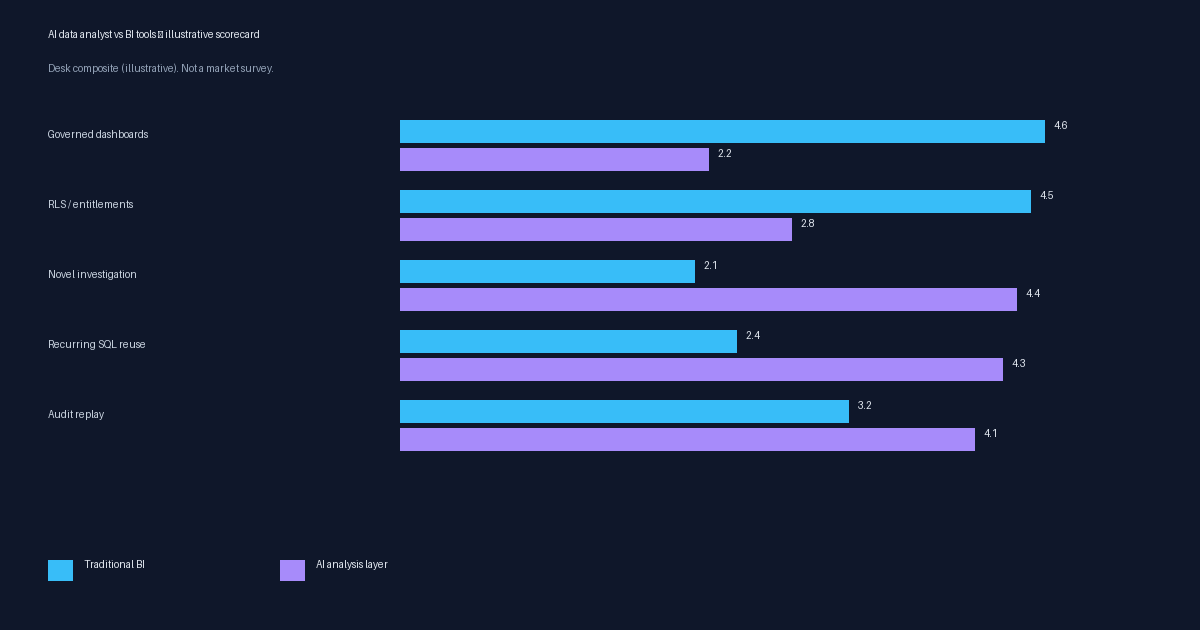
The NIST SP 800-53 security controls remains useful context: BI sits on conformed dimensions; analyst-facing AI stacks often operate upstream where data is still messy.
In the ai data analyst vs bi tools matrix, BI wins the first click on a modeled KPI; agent-class analyst tools win when the same diagnostic question returns next month and nobody wants to rebuild SQL from scratch. BI logs who viewed a dashboard; production-grade analyst AI should log every query, dataset, and chart in an execution timeline stakeholders can replay—especially when numbers reach finance sign-off.
Tool Categories in the 2026 Stack
Analytics uptime improves when teams borrow Wikipedia SQL overview practices—error budgets, runbooks, and blameless postmortems for failed query chains.
Embedded BI copilots
Power BI Copilot, ThoughtSpot Spotter, and similar features live inside existing BI estates. They reduce friction for business users who already have governed access. They are analyst-facing AI in the narrow sense—natural language on top of semantic layers—but they inherit BI's modeling prerequisites.
Standalone file-first AI analysts
ChatGPT Advanced Data Analysis, Claude, Julius AI, and Gemini handle uploaded files and pasted schemas well. They are strong exploration copilots but weak on live connectors, persistent memory, and enterprise audit in default tiers. Limits at scale are covered in ChatGPT Data Analysis Limitations. For interpreter-style sandboxes versus governed agents, see Code Interpreter vs Data Agent.
AI-native Data Agents
Platforms such as InfiniSynapse, Databricks Genie, and emerging enterprise stacks take a goal, plan steps, execute across sources, and distill reusable memory. They complement BI rather than replace it: agents produce defensible analysis; BI publishes the metrics executives bookmark.
LLM-backed analytics should account for prompt-injection and data-exfiltration risks in the ClickHouse documentation, especially when analyst AI connectors touch production schemas BI already exposes.
When to Keep BI as System of Record
The ai data analyst vs bi tools answer here is BI-first. Stay BI-first when:
- Consumption is dashboard-heavy and questions map to certified metrics.
- Regulated RLS is already encoded and expensive to replicate.
- Analyst headcount is small but business user count is large.
- Refresh SLAs are contractual—nightly warehouse loads feed known reports.
When to Layer AI on Top of BI
The stack tips toward the AI layer when these appear:
- Analysts file the same ad-hoc request every sprint.
- Diagnostic chains take days because BI workbooks cannot express the logic cleanly.
- Data spans sources BI has not modeled yet.
- Turnover risk is high and method lives in one analyst's head.
Operational maturity for analytics agents aligns with the Google BigQuery documentation, especially around monitoring, rollback, and ownership when analyst AI platforms touch production data.
Production Scorecard Before Rollout
We score analyst AI platforms against BI on nine criteria before customer-wide rollout. Weight governance higher if finance or healthcare is in scope.
| Criterion | Weight | What we verify |
|---|---|---|
| SQL accuracy on recurring KPIs | High | Same answer as BI semantic layer |
| Connector breadth | Medium | Warehouses, OLTP, files |
| Audit trail depth | High | Query-level replay |
| Memory / metric contracts | High | Definitions survive sessions |
| RLS compatibility | High | Respects BI entitlements |
| Visualization handoff | Medium | Export to slides or BI |
| Latency on large tables | Medium | Explain plans, not just results |
| Admin and SSO | High | Enterprise identity |
| Total cost at analyst scale | Medium | Seats + compute |
A tool that wins demos on chart speed but fails audit replay is not a production analyst-AI replacement—it is a copilot for individuals.
Migration Patterns We See in Customer Rollouts
Phase 1: Copilot on governed semantic layers
Analysts keep BI dashboards for executives. They use embedded or standalone analyst AI against the same certified datasets to draft SQL and exploratory charts. Success metric: fewer analyst hours per ad-hoc ticket.
Phase 2: Agent for weekly and monthly reviews
Recurring reviews—pipeline health, cohort retention, regional splits—move to an AI-native Data Agent with inspectable timelines. BI dashboards link to the agent task for drill-down. Success metric: reproducible numbers without the original analyst in the room.
Phase 3: Memory-backed metric contracts
Approved definitions distill into memory cards. Next cycle's question becomes one sentence with locked grain and filters. Success metric: zero "what did we mean by active user?" meetings. The agent pattern is defined in What Is a Data Agent?.
One retail analytics team kept Looker for store-manager dashboards while routing merchandising diagnostics through InfiniSynapse. BI consumption unchanged; analyst cycle time on mixed-source questions dropped from three days to same-day with replayable SQL.
Leaderboard scores on the Spider NL2SQL benchmark are a useful sanity check but rarely predict enterprise schema drift on their own.
Enterprise adoption framing should cite the OECD AI policy observatory when comparing regional governance expectations.
Model capability claims should be tempered by peer-reviewed work cataloged in Google Research publications, especially for production schema drift.
Self-hosted agent deployments should align with Kubernetes documentation for isolation, secrets, and rollout safety.
Low-latency cache layers should follow Redis documentation for TTL and namespacing conventions.
The BIRD benchmark adds dirty-schema realism that Spider-only leaderboards under-weight in production.
Frequently Asked Questions
Can analyst AI replace Tableau or Power BI?
Rarely in one step. The AI layer accelerates investigation and recurring diagnostics; BI still owns governed consumption for broad business audiences. Most mature stacks use both. That is the practical reading of ai data analyst vs bi tools.
Which tools work best with an existing semantic layer?
Embedded BI copilots (Power BI Copilot, ThoughtSpot Spotter) inherit your models immediately. Standalone agents can query the warehouse directly but need explicit metric contracts to match BI numbers.
How do we prevent AI answers from conflicting with BI dashboards?
Run a reconciliation sprint: pick ten recurring KPIs, compare AI output to BI certified metrics, and document gaps. Fix definitions in the semantic layer or agent memory—not by trusting whichever number appeared first.
Are analyst AI tools safe for regulated data?
Only with enterprise controls: SSO, audit logs, data residency, and connector policies reviewed against your risk framework. File-upload-only analyst copilots often fail regulated reviews when live warehouse access is required.
When should we choose a Data Agent over a BI copilot?
Choose a Data Agent when the work repeats, spans multiple sources, and someone must defend the number with query-level evidence. Choose a BI copilot when questions stay inside modeled metrics and consumers already live in the BI UI.
Conclusion
AI data analyst vs BI tools is about layers, not winners. Traditional BI and an AI analysis layer solve different parts of the same problem. BI publishes trusted metrics at scale; the AI layer compresses the path from messy question to defensible insight—especially when that question returns every month.
The winning 2026 pattern is not rip-and-replace. It is BI for consumption, AI for investigation, and AI-native Data Agents when recurring work needs memory and audit trails BI was never built to store. Start with one repeatable analyst pain point, score it against the matrix above, and expand only after numbers reconcile with your semantic layer.