Data Quality Tools: How They Work & How to Choose
By the InfiniSynapse Data Team · Last updated: 2026-10-12 · We build an AI-native data analysis platform and evaluate quality tooling in buyer pilots; this guide maps jobs to product classes, not a ranked vendor list.
Table of Contents
- TL;DR
- How We Evaluated
- What They Are
- The Main Categories
- How data quality tools differ by job
- How to Choose
- Where Tools Fit
- Engineering teams and governance teams
- Checks to write first
- Common Mistakes
- Building vs Buying Quality Checks
- Tools in the Age of AI
- Selection Scorecard
- Common Misconceptions
- Frequently Asked Questions
- Conclusion
TL;DR
Direct answer: Data quality tools are software that profiles data, validates it against rules, monitors it over time, and routes failures to an owner. In 2026 the useful split is the job, not the feature list: pipeline tests, observability monitors, or a governance suite. Buy the class that matches who will write the next check.
Who this is for: analysts, analytics engineers, and data leaders comparing data quality tools before a purchase.
What you'll learn: what each class does, a representative product map, a first SQL check, and an eight-point scorecard.
This guide sits under the data governance frameworks hub.
The characteristics being measured are defined in data quality.
Software packaging, as distinct from the checking job, is covered in data quality software.
Write the rules and name the owners first in the data quality playbook.
How We Evaluated
We judge data quality tools by whether a named person can add a check that runs where the data already moves. Feature count is a weak signal. Every row below comes from public product documentation and from pilots where a team either kept the check or muted it.
Shared names for accuracy, completeness, consistency, and timeliness come from DAMA International. The product table is a job map. It is not a ranking, a price survey, or an endorsement. Commercial shape means open-source library or paid platform, not a quoted list price.
| Category | What it does | Typical first check |
|---|---|---|
| Profiling | Discovers distributions, nulls, and patterns | Null rate and value frequency |
| Validation | Asserts an explicit rule | Primary key is unique |
| Monitoring | Tracks a metric across runs | Freshness under a threshold |
| Remediation | Routes or quarantines bad rows | Failed rows to an owner queue |
| Observability | Flags volume, freshness, and distribution shifts | Row-count anomaly |
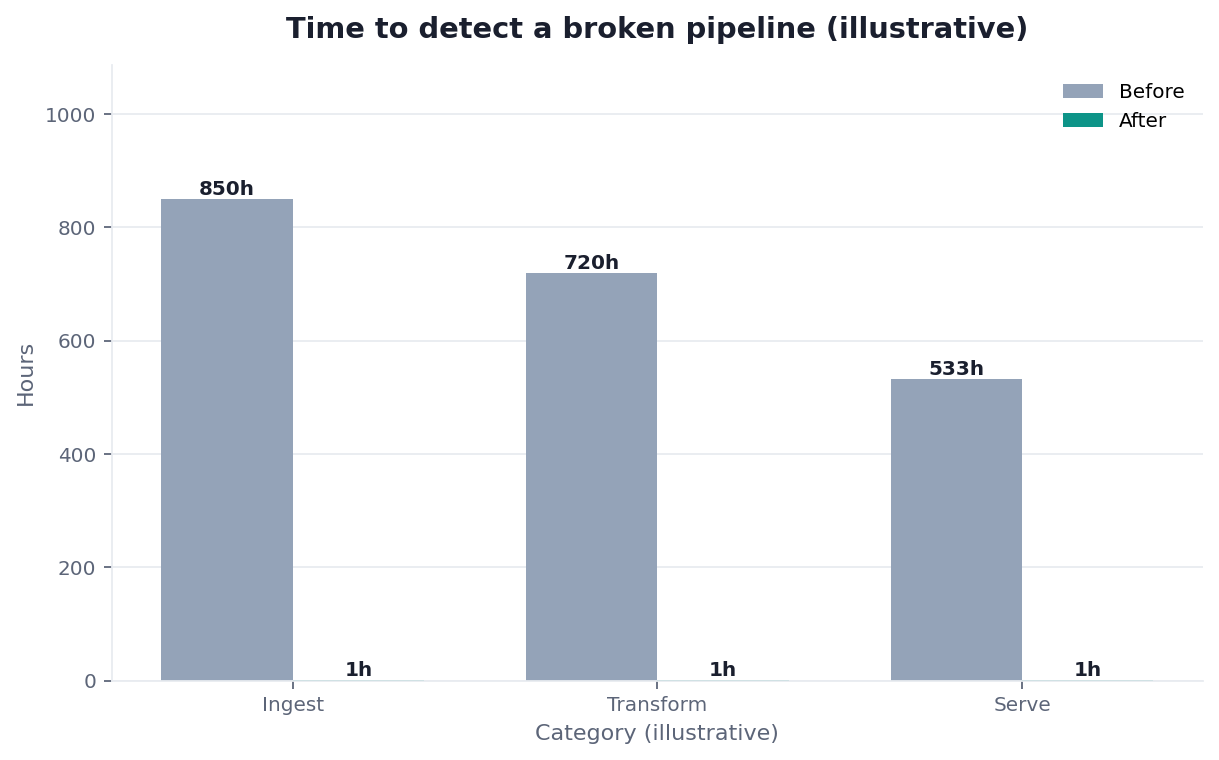
Practical example: a subscription team with no data quality tools learned a billing export had stopped only when finance closed the month. After in-pipeline checks, the same break showed up at ingest, transform, and serve within the hour instead of days later. The chart is illustrative, built to show stage × before/after, not a customer benchmark.
Scope note: Patterns here are from mid-market and enterprise stack reviews in 2026. This is not legal advice or a census of every product. A few SQL checks are enough when only a few tables feed a decision.
What They Are
Data quality tools turn agreed characteristics into checks that run on a schedule or inside a pipeline. They do not decide what "good" means. The team that owns the metric does.
Key Definition: Data quality tools are software systems that profile data, validate it against defined rules, monitor quality over time, and help remediate issues, so problems are detected before they reach a decision.
The leverage shows up only after rules and owners exist. Data quality tools measure and alert. A team with clear assertions gets a gate. A team without them gets a feed nobody acts on. Definition work stays in the playbook. Enforcement is what the software is for.
The Main Categories
Use of data quality tools starts by knowing which category does which job. Most suites overlap. The overlap is why buyers confuse a test library with a monitor.
Profiling and validation
Profiling discovers what the column actually contains: null rate, pattern, and range. Validation then asserts a rule, such as "order_id is unique." Together they are the foundation inside data quality tools. A failed test in the transform step can stop a build.
Monitoring and observability
Monitoring stores the metric over time so a slow null-rate climb is visible. Observability adds anomaly detection on freshness, volume, and distribution when you do not want to hand-write every threshold. Data quality tools in this class catch regressions that a single passing test yesterday will miss today.
How data quality tools differ by job
Category labels still hide the buying decision. Data quality tools that show up in 2026 evaluations cluster into three jobs. Pick the job before you pick a logo.
| Product | Job it is bought for | Where the check lives | Shape |
|---|---|---|---|
| Great Expectations | Assert pipeline outputs in Python | Expectation suites and checkpoints | Open-source library; hosted product sold separately |
| dbt tests | Fail a model build when a rule breaks | SQL tests beside models | Tests ship with dbt; platform pricing is separate |
| Deequ | Check Spark datasets at scale | Constraints inside a Spark job | Open-source library |
| Soda | Shared checks for engineers and stewards | SodaCL in YAML | Commercial platform |
| Monte Carlo | Detect freshness, volume, and distribution breaks | Monitors on the warehouse | Commercial observability |
| Anomalo | Table monitoring without a hand-written rule for every column | Monitors that query the warehouse | Commercial |
| Collibra Data Quality | Tie incidents to owners, policies, and data products | Rules on cataloged assets | Commercial suite |
| IBM data quality | Profile, cleanse, and monitor enterprise sets | Rules in the quality product | Commercial suite |
| Informatica Data Quality | Cleanse, match, and standardize party and product data | Jobs in the quality product | Commercial suite |
| Ataccama ONE | Profile and steward data inside a governance suite | Rules in the quality module | Commercial suite |
Pipeline tests
Pipeline tests fail a build. Great Expectations documents an Expectation as an assertion about a batch, stored so the same check can run again. dbt data tests run singular or generic SQL tests as part of a model build, so a broken key can stop downstream models. Deequ computes constraint metrics on Spark, which matters when the table is too large for a warehouse-only test to finish in the job window. Choose data quality tools in this class when an engineer already owns the pipeline and a failed check should block promotion.
Observability monitors
Observability watches tables you do not want to assert column by column. SodaCL is a YAML check language for freshness, schema, and row rules, aimed at a shared workflow between engineering and business users. Monte Carlo and Anomalo sit in the same buying conversation when the pain is "we do not know which table drifted," not "we need one more unique-key test." Choose data quality tools in this class when coverage across hundreds of tables matters more than a blocking test on one model.
Governance suites
Governance suites attach the incident to an owner, a policy, and a data product. IBM, Collibra, Informatica, and Ataccama are bought when quality has to sit inside a catalog the stewards already open. Lineage is the missing piece that tells you which dashboard inherited the bad column. OpenLineage specifies how jobs emit dataset-level run metadata so that impact is traceable across engines. Choose data quality tools in this class when the organization already argues about ownership, not when the first broken export still has no check at all.
How to Choose
Choosing among data quality tools is pipeline fit, how a check is authored, and whether a failure names an owner. The longest feature list rarely wins. The product your team will still open in week six does.
Score three axes. Can an analyst express a rule without a ticket? Does the check run inside the orchestrator you already use? Does the alert name a person who can fix the table? The strongest data quality tools make the next check cheap and the failure route obvious. A product that needs an engineer for every rule will collect few rules. Connect the choice to the broader data quality practice so the tool does not become a second, unused program.
Where Tools Fit
Data quality tools sit downstream of definitions and ownership, and upstream of decisions that assume the table is fit. Placed there, they close detection and action. Placed as a quarterly audit, they report damage that already shipped. Wire the check into orchestration so a failure blocks bad data before it propagates. Prefer a run inside the pipeline over a console someone has to remember to open.
Engineering teams and governance teams
Engineering-led teams embed validation in CI or the transform job. A red build is the alert. Governance-led teams bind the same failure to a steward, a policy, and a data product. Most programs need both eventually. They should not buy both on day one.
Start with the person who will write check number two. If they live in the repo, pipeline tests come first. If they live in a stewardship forum, pick data quality tools that can assign an incident, and keep a thin set of engineering tests so the suite is not empty. Products that try to be both on day one usually get adopted as neither.
Checks to write first
The first checks inside data quality tools should be boring. Freshness, schema, nulls on required columns, and duplicate keys catch the incidents that reach a dashboard. Distribution tests can wait until those four have an owner.
Freshness and schema
On an orders table, stale data and a drifted schema are the two failures finance notices first. The SQL below is a worked example you can run in a warehouse. It is a starting assertion, not a vendor export. Point orders at your table and set the freshness window to the decision that depends on it.
SELECT
  CASE
    WHEN MAX(order_datetime) < CURRENT_TIMESTAMP - INTERVAL '24' HOUR
    THEN 1 ELSE 0
  END AS is_stale,
  COUNT(*) - COUNT(DISTINCT order_id) AS duplicate_order_ids
FROM orders;
Fail the job when is_stale is 1 or duplicate_order_ids is above zero. A YAML check in SodaCL expresses the same freshness idea for teams that do not want the assertion inside a model. Either form is enough to learn what "good" means before you buy a platform to host hundreds of copies.
Nulls, duplicates, and an owner
Add null checks only on columns a decision requires. A nullable marketing field should not page anyone. Each check names an owner in ticket routing. Data quality tools are only as useful as that route. After two weeks, delete alerts nobody acted on. Loosen a threshold only when a firing alert was noise.
Common Mistakes
Buying data quality tools before the rules exist produces alerts nobody understands. Choosing on feature count produces software that never runs in the pipeline. Alerting on every fluctuation trains people to mute the channel. Treating the install as the program skips the definition of good.
Every check needs a person who can fix the cause. A muted monitor implies the table is watched when it is not. Tune thresholds against incidents you already lived through, and keep that history so the next threshold is a calibration.
Building vs Buying Quality Checks
Early on, SQL in the scheduler covers null rate, duplicate rate, freshness, and a few referential checks. Writing them forces the definition: you cannot assert what you have not decided. That do-it-yourself stage is the point of the orders query above.
Dedicated data quality tools earn their cost when the number of checks, tables, and stakeholders makes routing the job. The signal to buy is organizational. When keeping checks healthy takes more engineering time than writing new ones, a platform that schedules, stores history, and detects anomalies pays for the plumbing you would otherwise rebuild.
Refuse both dogmas. Teams that refuse to build anything buy data quality tools and fill them with generic rules that match no decision. Teams that refuse to buy end up with scripts one engineer understands. Build to learn. Buy to scale. Keep ownership of the assertion with the people who know the table.
Small companies hit the same sequence with less budget. A duplicate-cleanup utility or dbt tests may be the whole stack while the warehouse is small. The jump to Soda, Monte Carlo, or a governance suite is justified when alert routing, not the next unique-key test, is the bottleneck.
Tools in the Age of AI
AI raises the cost of a silent failure. When an agent reads a table, an undetected freshness break becomes a confident wrong number. Data quality tools are the guardrail only if the check sits on the path the agent reads.
Before that path is opened, test four characteristics: accuracy against a named source, completeness of required fields, consistency with the other system that reports the same metric, and uniqueness of the business key. Timeliness is the freshness check in the orders example. Data quality tools do not invent these characteristics. They run them often enough that an agent is less likely to narrate a broken extract. Lineage tells you which answer inherited the bad column after the check fires.
An AI-native platform binds those expectations to the queried data, as described in what AI-native data analysis means. In the InfiniSynapse web app, quality context travels with the dataset, so existing checks improve the answer instead of sitting on a status page the agent never opens.
Selection Scorecard
Score candidate data quality tools 1 point each. Use one pipeline you already distrust as the pilot, not a vendor demo dataset.
| Check | Pass? |
|---|---|
| An analyst can add a rule without a ticket | |
| It runs inside our orchestrator | |
| It profiles a new table without a week of setup | |
| It keeps a history of the metric | |
| Alerts route to a named owner | |
| It can detect freshness or volume drift | |
| It fits warehouse, Spark, or both, as we actually run | |
| Failed checks are visible to the agent or analyst path |
6–8: strong fit for data quality tools on that pipeline. 3–5: pilot more narrowly. Below 3: write rules and name owners before another demo.
Common Misconceptions
Misconception 1: The product defines quality. Data quality tools measure a definition you still have to write.
Misconception 2: More alerts are safer. Alert fatigue hides the incident that mattered. Data quality tools that page on every flicker get muted.
Misconception 3: A monthly audit is enough. In-pipeline checks on ingest, transform, and serve catch breaks that a close process only reports.
Misconception 4: Software replaces the owner. Every alert from data quality tools still needs a person.
Frequently Asked Questions
What are data quality tools?
Data quality tools profile data, validate rules, monitor metrics, and help remediate failures before a decision uses the table. They do not decide what good means. Rules and owners come first. The product then runs those rules on a schedule or inside the pipeline.
What are the main categories?
Profiling discovers shape. Validation asserts a rule. Monitoring tracks a metric over time. Remediation routes or quarantines bad rows. Observability flags freshness, volume, and distribution shifts when a hand-written threshold would not scale. Most buying decisions then collapse into pipeline tests, monitors, or a governance suite.
How do you choose among them?
Score how easily someone can add a rule, whether the check runs in the pipeline you already operate, and whether the alert names an owner. Pick the class that matches the person who will write the next check. Pipeline tests fit engineering-led stacks. Monitors fit wide table coverage. Suites fit programs that already assign stewards.
Where do checks sit in a quality program?
After the definition of good and the name of the owner, and before the decision that trusts the table. Wired into orchestration, they stop bad data from propagating. Run as a separate audit, they describe a miss that already reached a report.
How does quality checking support AI?
An agent that reads a stale or duplicated table will still answer. Continuous checks on freshness, completeness, consistency, and uniqueness are what keep that answer tied to a fit dataset. The check has to be visible on the path the agent reads, not only on a status page the agent never opens.
When are open-source tests enough?
Open-source tests are enough while a few tables, a few rules, and one engineering owner cover the decisions that matter. Great Expectations, dbt tests, and Deequ are built for that stage. A commercial monitor or suite becomes rational when routing, history, and coverage across many owners cost more than the license.
Conclusion
Data quality tools profile, validate, monitor, and help remediate data. They enforce a definition you still set. Choose by job: blocking tests, observability, or a governance suite. Route every failure to an owner, and treat AI consumers as one more downstream that inherits a missed check.
Read what AI-native data analysis means for how quality context travels into an answer. Try the InfiniSynapse web app free on registration.