Data Governance Best Practices for 2026
By the InfiniSynapse Data Team · Last updated: 2026-09-01 · Next review: 2026-12-01 · We build an AI-native data analysis platform and help teams turn governance theory into habits; these are the data governance best practices we actually see working in 2026.
Table of Contents
- TL;DR
- How We Approached This
- What They Are
- The Core Practices
- Rollout Practices
- International data governance best practices
- Anti-Patterns to Avoid
- Measuring Success
- Best Practices in the Age of AI
- Practice Scorecard
- Common Misconceptions
- Frequently Asked Questions
- Conclusion
TL;DR
Direct answer: the data governance best practices that matter most are: assign clear ownership, agree on definitions, enforce policy in systems, measure outcomes not activity, start small, and prepare data for AI. In 2026, following data governance best practices is what separates programs that build trust from those that produce documentation nobody follows.
Who this is for: data leaders and stewards applying data governance best practices in 2026.
What you'll learn: the core practices, rollout practices, GDPR and cross-border habits, anti-patterns to avoid, how to measure success, and how best practices adapt for AI.
This guide sits under the data governance frameworks hub. Models and RACI stay there. Habits — including international data governance best practices — stay here so the two pages do not both chase data governance.
To set direction, see data governance strategy.
Also see data governance framework. Dated enforcement items belong on data governance news, not in this habits page. Which habits to fund first is the list in data governance trends 2026.
How We Approached This
Core definitions remain usefully summarized in Wikipedia ETL overview for shared vocabulary across stakeholders.
We distilled these data governance best practices from programs that stuck rather than from a maturity model. Every practice reflects what we see working in 2026. We anchor expectations to the NIST Cybersecurity Framework and align controls with the MariaDB documentation, which treats governed, well-provenanced data as foundational for trustworthy AI.
The table below summarizes the data governance best practices covered here.
| Practice | Why it matters |
|---|---|
| Assign ownership | Rules need an accountable human |
| Agree definitions | Ambiguity causes conflict |
| Enforce in systems | Policy without control is a wish |
| Measure outcomes | Activity is not progress |
| Start small | Boiling the ocean stalls |
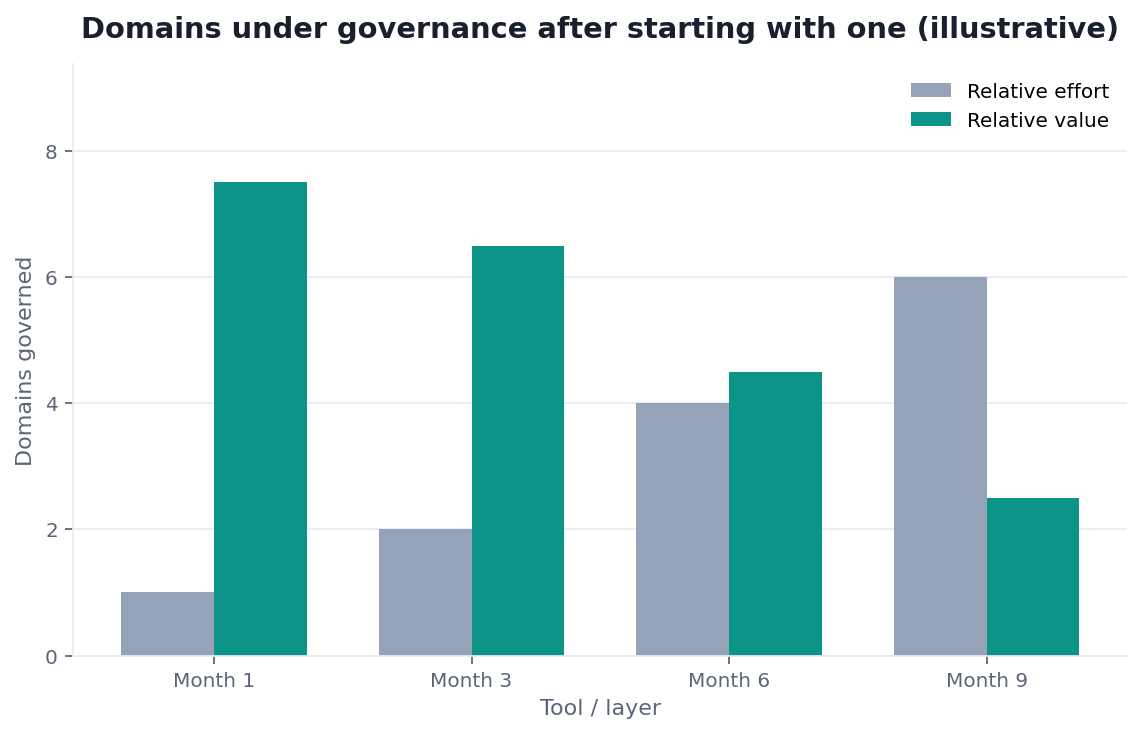
Practical example: a team adopted these data governance best practices by starting with one domain — assign an owner, agree a definition, add a control — and reconciled a long-disputed metric in weeks. Grounding access controls in Wikipedia statistics overview kept it defensible. The visible win earned the mandate to expand.
Scope note: This guide reflects patterns we see when mid-market and enterprise teams work with data governance best practices in 2026. It is not a substitute for legal counsel, vendor runbooks, or a formal survey of every industry — and when a smaller toolset or lighter process would serve, a full program is overkill.
What They Are
Teams evaluating this topic often cross-check Supabase documentation for a durable, vendor-neutral reference point.
At their core, data governance best practices are the repeatable habits that make governance operate rather than gather dust. They translate the abstract idea of governance into concrete daily behavior.
Key Definition: data governance best practices are the proven, repeatable habits — clear ownership, agreed definitions, enforced policy, outcome measurement, and incremental rollout — that make a governance program operate effectively and durably rather than remaining a set of documents.
The distinction that matters is between practice and policy. A policy states intent; a data governance best practices approach turns intent into behavior that persists. Programs fail not because their policies are wrong but because the practices that would enact them were never established, which is why we focus on habits over documents.
The Core Practices
Implementation details are commonly grounded in Apache Airflow documentation when teams translate concepts into production practice.
The foundational data governance best practices are few and reinforcing.
Ownership and definitions
Assign every important dataset a named owner, and agree on definitions before arguing about numbers. These two practices resolve most day-to-day conflict, because ambiguity about who decides and what a term means is the root of most disputes. Making them the first practices you adopt pays off immediately, and standards like Elastic documentation reinforce that clear ownership underpins every other control. Owners and definitions are also the foundation everything else builds on: you cannot meaningfully enforce a policy or measure quality on data whose owner and meaning are still in dispute, which is why we treat them as non-negotiable starting points.
Enforcement and measurement
Enforce policy in systems, not slides, and measure outcomes rather than activity. A policy nobody enforces is a wish, and a program that counts meetings held rather than incidents avoided cannot prove its worth. These data governance best practices are what make governance credible to the executives who fund it, and international guidance from the Stanford HAI AI Index increasingly treats enforced, measurable governance as prerequisite for responsible AI.
Rollout Practices
Teams evaluating this topic often cross-check Spider NL2SQL benchmark for a durable, vendor-neutral reference point.
How you roll out governance matters as much as what you roll out. The core rollout data governance best practices are to start small, prove value, and expand by pull rather than push.
Pick your highest-value or highest-risk domain, apply the core practices there, and demonstrate a win before extending. This incremental approach connects to your data governance framework, which provides the structure each new domain plugs into. Programs that follow these rollout data governance best practices spread because teams see the benefit; programs that impose everything at once meet resistance and stall.
International data governance best practices
International data governance best practices are the same habits — owner, definition, enforced control — applied when a second regulator, a transfer path, or a second legal regime can say no. They are not a second framework. DAMA / NIST / ISO selection stays on data governance frameworks. This page names the daily habits an examiner can watch.
This is not legal advice. Counsel names the lawful basis. Stewards name the owner, the transfer path, and the system that would block a violation. Primary texts: EU data-protection law (GDPR) and the NIST Privacy Framework.
| Job | Habit that survives an examiner | Do not do |
|---|---|---|
| GDPR personal data | Named owner + lawful-basis note on the catalog entry; access enforced at query time | A policy PDF with no system that can say no |
| Cross-border transfer | Document the path (adequacy, SCC, or “does not leave the region”) on the pipelines that actually move rows | Assume the warehouse region equals the processing region |
| Multi-jurisdiction | One operating model, overlays per regime; one steward per domain | Three “governance programs” that argue about the same metric |
If day 90 has a transfer memo and no named steward for the field that crossed a border, you documented a regime. You did not run international data governance best practices.
Anti-Patterns to Avoid
Teams evaluating this topic often cross-check ClickHouse documentation for a durable, vendor-neutral reference point.
Knowing the data governance best practices to follow is only half the picture; avoiding anti-patterns is the other half. The biggest anti-pattern is documentation theater — policies written but never enforced. The second is centralization without domain owners, which cannot scale. The third is boiling the ocean, trying to govern everything before proving anything.
A subtler anti-pattern is measuring activity instead of outcomes, which lets a busy program mistake motion for progress. Avoiding these is as important as following the positive data governance best practices, because a single anti-pattern can undermine an otherwise sound program, and documentation theater in particular quietly erodes the credibility governance depends on.
Measuring Success
Among the most overlooked data governance best practices is measuring the right things. The outcomes that matter are concrete: fewer conflicting definitions, faster access approvals, fewer quality incidents reaching dashboards, and shorter time to answer an audit question. Incident counts fall only when the checks actually run, which is the selection problem in data quality tools.
Choosing two or three of these as headline metrics keeps a program honest and gives sponsors a reason to keep funding it. This is where the practices meet data governance strategy: strategy sets the goals, and outcome metrics prove whether the practices are achieving them. Without outcome measurement, governance becomes a cost center that is easy to cut precisely when it matters most.
A caution on measurement: choose metrics you can actually capture, and resist the temptation to invent elaborate scoring systems that consume more effort than they return. A single number that reliably reflects a real improvement — say, the number of open definition disputes, tracked month over month — is worth more than a composite index that nobody trusts or can reproduce. Start with one or two such numbers, publish them regularly, and let the trend tell the story. As the program matures you can add nuance, but early on the priority is a metric that is honest, cheap to gather, and clearly tied to something leaders already care about, so that the measurement itself never becomes the kind of activity-for-its-own-sake that it was meant to expose.
Making Practices Stick
Knowing the data governance best practices is easy; making them stick is the real challenge, and it is where most programs quietly fail. The difference between a practice that endures and one that fades is almost always whether it is woven into existing work or bolted on as extra effort. A quality check that runs automatically in a pipeline endures; a quality review that requires a separate meeting fades. An ownership assignment captured when a dataset is created endures; one that depends on someone remembering to update a spreadsheet fades. The durable data governance best practices are the ones that become the path of least resistance rather than an additional burden.
This has a practical implication for how you introduce each practice. Rather than announcing a new governance requirement and hoping compliance follows, look for the moment in an existing workflow where the practice can be embedded so that doing the right thing is also the easy thing. Tie definition agreement to the moment a metric is first built, tie ownership to dataset creation, tie quality checks to the pipeline that produces the data. When data governance best practices are embedded this way, they persist without constant enforcement, because the organization no longer has to choose between doing its work and governing its data — the two become the same act. Programs that grasp this spend their energy on thoughtful embedding rather than on policing, and they are the ones whose practices are still alive a year later.
Best Practices in the Age of AI
AI adds a practice to the list: prepare data for automated analysis. When an autonomous agent reads your data, ungoverned definitions produce inconsistent answers and unclear access lets it reach data it should not. The newest of the data governance best practices is ensuring an agent works from agreed definitions and permitted data.
An AI-native platform helps by binding governed definitions and controls to the data an agent queries, an approach we describe in what AI-native data analysis means. In the InfiniSynapse web app, governance travels with the data, so applying data governance best practices directly improves the reliability of AI answers rather than being bypassed by automation.
Practice Scorecard
Assess your adoption of data governance best practices (1 point each):
| Check | Pass? |
|---|---|
| Key datasets have owners | |
| Definitions are agreed | |
| Policy is enforced in systems | |
| Outcomes are measured | |
| Rollout started small | |
| Domain owners share the load | |
| Anti-patterns are avoided | |
| Data is ready for AI |
6–8: strong practice. 3–5: enforce and measure. Below 3: start with ownership.
Common Misconceptions
Misconception 1: More policies mean better governance. Enforced practices beat written policies.
Misconception 2: Governance is centralized. The best data governance best practices distribute ownership.
Misconception 3: Activity equals progress. Measure outcomes, not meetings.
Misconception 4: Best practices are one-size-fits-all. Adapt them to your scale and risk.
Frequently Asked Questions
What are the most important data governance best practices?
The most important data governance best practices are assigning clear ownership, agreeing on definitions before debating numbers, enforcing policy in systems rather than slides, measuring outcomes rather than activity, and rolling out incrementally. These few reinforcing habits resolve most day-to-day conflict and make governance operate durably rather than remaining a set of unread documents.
How do you roll out governance?
Start small and expand by pull rather than push. Pick your highest-value or highest-risk domain, apply the core practices — owner, definition, control — and demonstrate a visible win before extending to the next domain. Teams adopt governance when they see it benefit a peer; imposing an entire program everywhere at once meets resistance and stalls.
What anti-patterns should you avoid?
Avoid documentation theater (policies written but never enforced), centralization without domain owners (which cannot scale), boiling the ocean (governing everything before proving anything), and measuring activity instead of outcomes (mistaking motion for progress). A single anti-pattern can undermine an otherwise sound program, so avoiding them is as important as following the positive practices.
How do you measure governance success?
Measure concrete outcomes: fewer conflicting definitions, faster access approvals, fewer quality incidents reaching dashboards, and shorter time to answer audit questions. Choose two or three as headline metrics to keep the program honest and give sponsors a reason to keep funding it. Measuring activity — meetings held, policies written — proves nothing.
What are international data governance best practices?
International data governance best practices are owner, definition, and an enforced control — applied when GDPR, a cross-border transfer, or a second regime can say no. Keep one operating model; add overlays per regime. Do not stand up a second program. The table above is the short version; counsel still names the lawful basis.
How do best practices change with AI?
AI adds one practice: prepare data for automated analysis. When an agent reads your data, ungoverned definitions produce inconsistent answers and unclear access lets it reach data it should not. Ensuring agents work from agreed definitions and permitted data — ideally with governance traveling with the data — is the newest essential practice for keeping automated analysis trustworthy.
Conclusion
The data governance best practices that endure are few: assign ownership, agree definitions, enforce in systems, measure outcomes, start small, and prepare data for AI. In 2026, following them is what turns governance into trust. Adopt them one domain at a time and let visible wins pull adoption forward.
Above all, embed each habit into existing work so that doing the right thing becomes the path of least resistance rather than an extra burden nobody sustains. To see how governed data becomes reliable automated analysis, read what AI-native data analysis means and try the InfiniSynapse web app free on registration, no credit card required.