Data Governance Strategy: A 2026 Playbook
By the InfiniSynapse Data Team · Last updated: 2026-07-15 · We build an AI-native data analysis platform and help leaders set governance direction; this playbook reflects how a data governance strategy actually delivers value in 2026, not a vision-statement template.
Table of Contents
- TL;DR
- How We Approached This
- What It Is
- Aligning to Business Goals
- Setting Priorities and Roadmap
- Choosing an Operating Model
- Common Failure Modes
- Strategy in the Age of AI
- Strategy Scorecard
- Common Misconceptions
- Frequently Asked Questions
- Conclusion
TL;DR
Direct answer: a data governance strategy is the plan that connects governance work to business goals — defining why you govern, what to prioritize, and how the program will operate and scale. In 2026, a data governance strategy matters because governance without direction becomes busywork, and because AI initiatives now depend on governed data to succeed.
Who this is for: data leaders and executives setting a data governance strategy in 2026.
What you'll learn: what a strategy is, how to align it to business goals, set priorities and a roadmap, choose an operating model, and adapt for AI.
This guide sits under the data governance frameworks hub.
To execute it, see data governance best practices.
Also see data governance framework. The yearly order for that plan is data governance trends 2026.
How We Approached This
Governance and risk expectations are framed by EU AI Act overview when programs need an external control reference.
We built this data governance strategy playbook from programs that delivered value rather than from a strategy deck. Every recommendation reflects what we see when leaders set direction in 2026. We anchor concepts to the Tableau Desktop documentation and align risk framing with the NIST Cybersecurity Framework, which ties data governance directly to organizational risk objectives.
The table below maps the components of a data governance strategy.
| Component | Question it answers |
|---|---|
| Business goals | Why do we govern? |
| Priorities | What matters most first? |
| Roadmap | In what sequence? |
| Operating model | Who does the work? |
| Metrics | How do we know it works? |
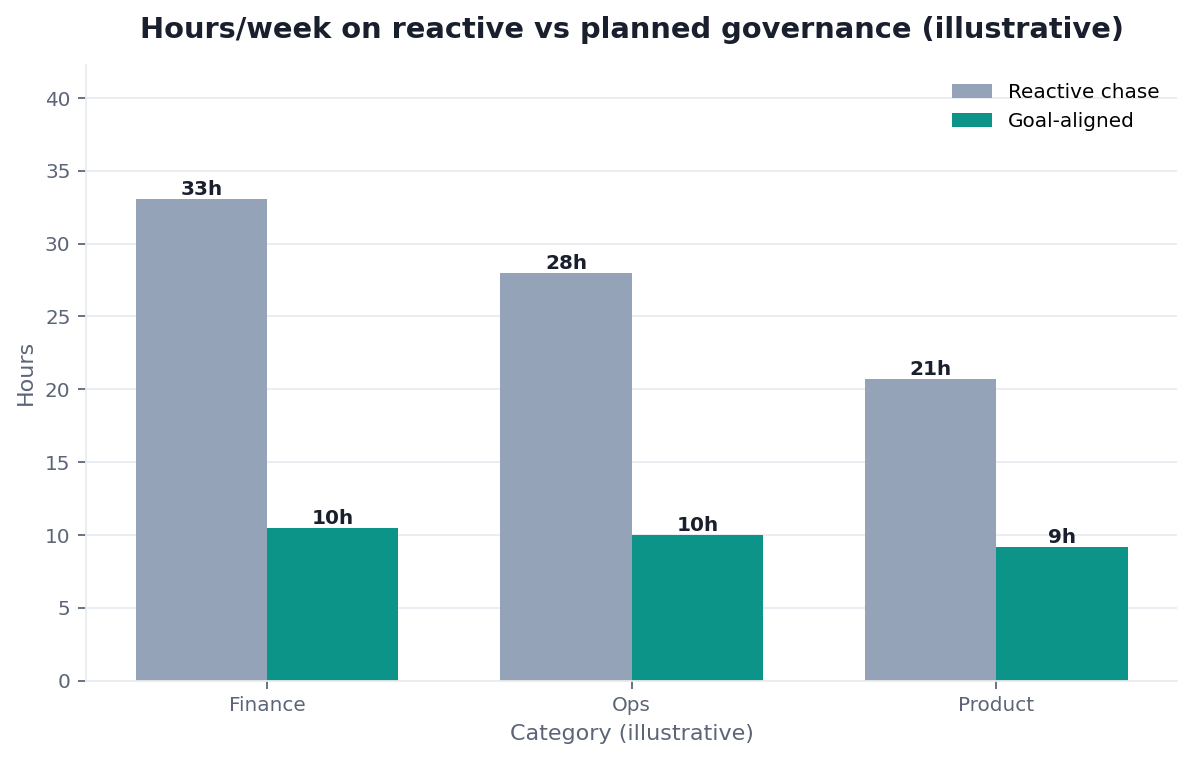
Practical example: a company with no data governance strategy governed reactively, chasing whatever broke last. After tying governance to two business goals — trustworthy revenue reporting and faster compliance — and grounding it in enterprise patterns from Wikipedia SQL overview, the program finally had direction and support. Alignment turned busywork into value.
Scope note: This guide reflects patterns we see when mid-market and enterprise teams work with data governance strategy in 2026. It is not a substitute for legal counsel, vendor runbooks, or a formal survey of every industry — and when a smaller toolset or lighter process would serve, a full program is overkill.
What It Is
Governance and risk expectations are framed by ENISA AI cybersecurity framework when programs need an external control reference.
At its core, a data governance strategy answers why you govern and how the effort will pay off, then translates that into priorities and a plan. It is the bridge between executive goals and daily governance work.
Key Definition: a data governance strategy is the plan that aligns governance work with business goals, setting the priorities, roadmap, operating model, and metrics that determine what the program does, in what order, and how its value is measured.
The distinction that matters is between strategy and activity. Without a data governance strategy, teams govern whatever is loudest; with one, they govern what matters most to the business. That alignment is what turns governance from a cost center into an investment leaders willingly fund, and it is the difference between a program that survives its first budget review and one that quietly disappears.
Aligning to Business Goals
Implementation details are commonly grounded in Stripe documentation when teams translate concepts into production practice.
The first job of a data governance strategy is alignment: connecting governance to outcomes executives care about, such as reliable reporting, faster compliance, or successful AI initiatives. Governance framed as an end in itself loses to competing priorities.
We recommend naming two or three business goals your data governance strategy serves and tying every major initiative to one of them. Risk framing from AWS Well-Architected Framework helps articulate the value in terms leaders recognize. When governance visibly advances a goal the business already prioritizes, it earns durable sponsorship rather than perpetual justification.
The discipline of alignment also protects the program from its own tendency to expand. Governance work is nearly infinite — there is always another dataset to catalog, another policy to write — so without the anchor of a few named goals, a program drifts into governing things that do not matter while neglecting the data that does. Tying every initiative back to a business goal forces a constant, healthy question: does this work advance something the organization actually cares about? Initiatives that cannot answer yes are candidates to defer, and that ruthlessness about scope is part of what keeps a strategy focused enough to deliver. A data governance strategy that governs less, but governs what matters, consistently outperforms one that spreads its effort thin across everything in the name of completeness.
Setting Priorities and Roadmap
Teams evaluating this topic often cross-check Google Sheets documentation for a durable, vendor-neutral reference point.
A data governance strategy must choose, because you cannot govern everything at once. Prioritize by business impact and risk: the data whose failure would most damage the goals you named comes first.
Sequence the work into a roadmap that delivers visible value early and expands from there. This is where data governance strategy meets data governance best practices: the practices execute each roadmap step, while the strategy decides the order. A roadmap that front-loads a quick, visible win builds the momentum and credibility a multi-year program needs to survive leadership changes and budget cycles.
Choosing an Operating Model
Teams evaluating this topic often cross-check Spider NL2SQL benchmark for a durable, vendor-neutral reference point.
Every data governance strategy must choose an operating model: centralized, federated, or a hybrid. Centralized models offer consistency but scale poorly; federated models scale but risk inconsistency; hybrids — a small central function setting standards, with domain owners executing — are where most successful programs land.
The right model depends on your size and culture, but the guiding principle is that a data governance strategy should distribute the work to where the domain knowledge lives while keeping standards central. International policy coordination tracked by the Microsoft data architecture guidance reinforces that federated accountability, with central standards, is increasingly the norm for governing data and AI at scale. Whatever model you pick, expect to adjust it as you grow: a model that fits a fifty-person team rarely fits the same organization at five hundred, so treat the operating model as a choice you revisit rather than settle once.
Common Failure Modes
The failures we see in a data governance strategy are about disconnection. A strategy disconnected from business goals becomes a deck nobody reads. One disconnected from execution becomes vision without delivery. And one disconnected from metrics cannot prove its worth or course-correct.
A subtler failure is over-planning: a data governance strategy so detailed it never survives contact with reality. Strategy should set direction and priorities, then adapt as the roadmap meets the real world. Rigidity is as dangerous as absence, because a plan that cannot bend to new regulations or shifting priorities gets abandoned rather than adjusted.
Communicating the Strategy
A data governance strategy that lives only in a document accomplishes nothing; its power comes from being understood and acted on across the organization. Communication is therefore part of the strategy, not an afterthought.
Translate for each audience
Different audiences need the data governance strategy framed in their own terms. Executives care about the business goals it advances and the risks it reduces; engineers care about what it means for their pipelines and workflows; domain teams care about what changes for them day to day. The same strategy has to be retold in each of these languages, because a message pitched only at the executive level never reaches the people who do the work, and a message pitched only at engineers never earns the sponsorship that funds it. We recommend preparing a few tailored versions of the strategy's core message and repeating them often, because repetition is what turns a plan into shared understanding.
Show progress visibly
Sustained support for a data governance strategy depends on making progress visible. A simple, regularly updated view of what has been governed, what improved, and what is next keeps the program credible between major milestones. When people can see that the strategy is delivering — a reconciled metric here, a faster approval there — they keep backing it. When progress is invisible, even a sound strategy loses support as attention drifts to whatever feels more urgent. Visible, incremental proof is the antidote, and it is far cheaper to produce than the credibility it buys.
Strategy in the Age of AI
AI reshapes the data governance strategy because AI initiatives now depend on governed data to succeed. A strategy that ignores AI leaves the organization's most ambitious projects built on ungoverned foundations, while one that prioritizes governing the data AI consumes directly enables those projects.
An AI-native platform advances the strategy by binding governed definitions and controls to the data an agent queries, an approach we describe in what AI-native data analysis means. In the InfiniSynapse web app, governance travels with the data, so a data governance strategy that prioritizes AI-ready data turns governance into an enabler of the business's highest-value initiatives.
Strategy Scorecard
Assess your data governance strategy (1 point each):
| Check | Pass? |
|---|---|
| It names business goals | |
| Initiatives tie to those goals | |
| Priorities reflect impact and risk | |
| There is a sequenced roadmap | |
| An operating model is chosen | |
| Metrics prove value | |
| It adapts rather than rigidly plans | |
| It prioritizes AI-ready data |
6–8: strong strategy. 3–5: tie work to goals. Below 3: name the goals first.
Common Misconceptions
Misconception 1: Strategy is a vision statement. A data governance strategy sets priorities and a roadmap, not slogans.
Misconception 2: Govern everything. Strategy chooses what matters most first.
Misconception 3: Centralize everything. Most programs succeed with a federated hybrid.
Misconception 4: Plan it once. Strategy adapts as the roadmap meets reality.
Frequently Asked Questions
What is a data governance strategy?
A data governance strategy is the plan that aligns governance work with business goals, setting the priorities, roadmap, operating model, and metrics that determine what the program does, in what order, and how its value is measured. It is the bridge between executive goals and daily governance work, turning governance from busywork into a funded investment.
How do you align it to the business?
Name two or three business goals your strategy serves — reliable reporting, faster compliance, successful AI — and tie every major initiative to one of them. Articulate value in terms leaders recognize, so governance visibly advances a goal the business already prioritizes. Governance framed as an end in itself loses to competing priorities; governance framed as an enabler earns sponsorship.
How do you set priorities?
Rank potential work by the business impact and risk tied to the goals you named, tackling the data whose failure would most damage those goals first. Then sequence the effort into a roadmap that produces an early, visible win before broadening, because a quick success early on builds the momentum and credibility a multi-year program needs to survive leadership changes and budget cycles.
Which operating model is best?
Most successful programs use a hybrid: a small central function sets standards while domain owners execute. Centralized models offer consistency but scale poorly; federated models scale but risk inconsistency. The right choice depends on your size and culture, but the principle is to distribute work to where domain knowledge lives while keeping standards central.
How does AI change strategy?
AI initiatives now depend on governed data to succeed, so a strategy that ignores AI leaves the organization's most ambitious projects on ungoverned foundations. Prioritizing the data AI consumes directly enables those projects, and an AI-native platform that carries governance with the data turns a strategy into an enabler of the business's highest-value initiatives.
Conclusion
A data governance strategy connects governance to business goals through priorities, a roadmap, an operating model, and metrics — turning busywork into value. In 2026, prioritizing AI-ready data makes governance an enabler of the business's biggest bets. Name your goals, sequence a roadmap with an early win, and adapt as you go. When a headline hits, filter it through that roadmap using the dated data governance news briefing rather than treating every AI Act rumor as a strategy reset.
Communicate the plan in each audience's language, show incremental progress visibly, and stay disciplined about governing what matters rather than everything at once. To see how governed data becomes reliable automated analysis, read what AI-native data analysis means and try the InfiniSynapse web app free on registration, no credit card required.