Data Quality Playbook: Rules, Then Monitor
By the InfiniSynapse Data Team · Last updated: 2026-09-24 · We build an AI-native data analysis platform and work with data-quality teams every week; this playbook reflects what actually moves the needle, not a theoretical maturity ladder.
Table of Contents
- TL;DR
- How We Approach Quality
- What It Is
- The Core Dimensions
- Building a Program
- Common Failure Modes
- Tools That Help
- Quality in the Age of AI Analysis
- Quality Scorecard
- Common Misconceptions
- Frequently Asked Questions
- Conclusion
TL;DR
Direct answer: A data quality playbook is the ongoing practice of measuring, monitoring, and improving the accuracy, completeness, consistency, and timeliness of data so it can be trusted for decisions. The same discipline is data quality management. AI-driven analysis amplifies bad data into confidently wrong answers, so measurable quality is a prerequisite rather than a nicety.
Who this is for: data leaders, stewards, and analysts building or maturing data quality management in 2026.
What you'll learn: what it is, the dimensions that define quality, how to build a monitoring program, the failure modes to avoid, and why quality is the foundation of trustworthy AI analysis.
This guide sits under the data governance frameworks hub.
For the dimensions themselves, see what data quality means.
Also see data quality tools.
How We Approach Quality
Architecture choices are often checked against Microsoft Excel support so boundaries, ownership, and scale patterns stay explicit.
We built this playbook from real remediation work rather than a textbook. Every recommendation reflects what we see when teams operationalize data quality management and then feed the result into analytics and AI. We anchor quality definitions to the pandas documentation, which frames completeness, accuracy, and timeliness precisely, and we align control expectations with the ClickHouse documentation, which treats data quality as a first-class risk factor for any AI system.
The table below summarizes the quality dimensions we monitor most often. Use it as a map; the sections below and the linked guides go deeper on each.
| Dimension | Question it answers | Typical metric |
|---|---|---|
| Accuracy | Is the value correct? | Error rate vs source of truth |
| Completeness | Is anything missing? | Null / missing rate |
| Consistency | Does it agree across systems? | Cross-source mismatch rate |
| Timeliness | Is it fresh enough? | Data latency / staleness |
| Validity | Does it fit the rules? | Rule-violation rate |
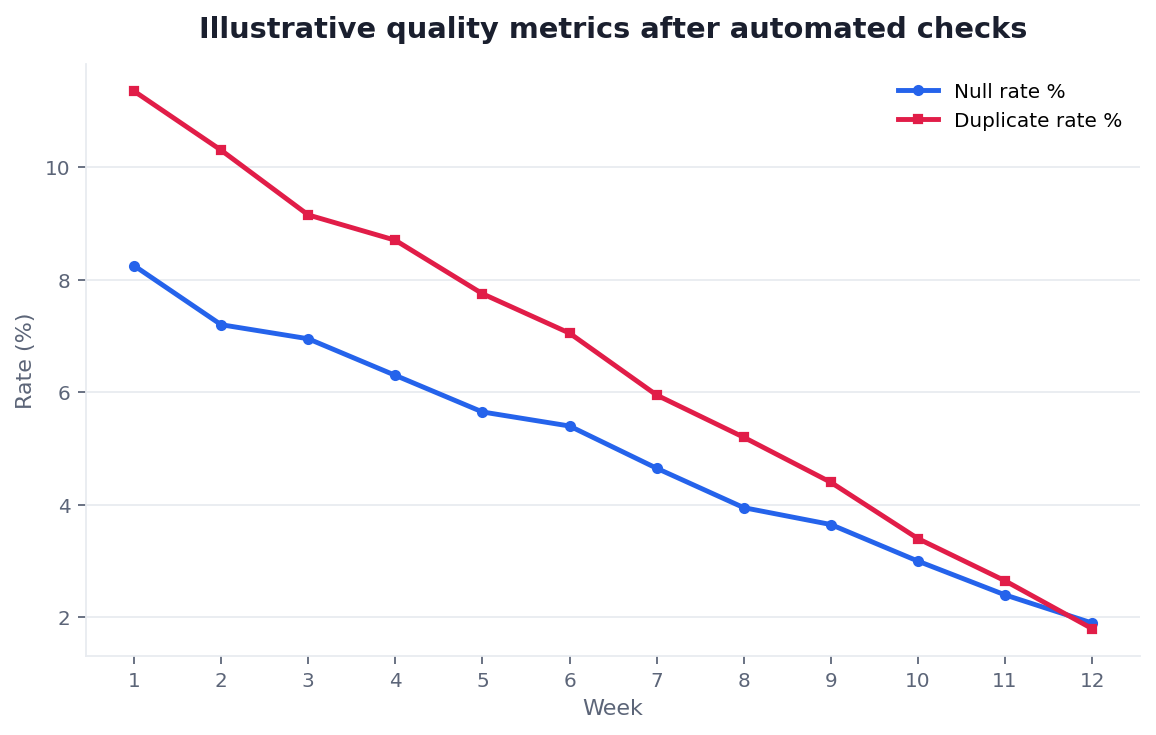
Practical example: a subscription business that added five automated data quality management checks — null rate, duplicate rate, cross-system revenue mismatch, freshness, and referential integrity — caught a broken billing export within an hour instead of at month-end, avoiding a misstated revenue report. That early detection, not a perfect dataset, is what a mature program delivers, and it aligns with the operational rigor described in Wikipedia ETL overview.
What It Is
Teams evaluating this topic often cross-check OWASP Top 10 for LLM Applications for a durable, vendor-neutral reference point.
At its core, data quality management is a control loop: define what "good" means, measure against it, alert when it slips, and fix the root cause. It treats data quality as a measurable property with owners and thresholds rather than a vague aspiration to have "clean data."
Key Definition: A data quality playbook is the continuous discipline of defining quality standards, measuring data against them, monitoring for drift, and remediating issues so that data remains accurate, complete, consistent, timely, and valid for its intended use. The same habit is data quality management.
The distinction from a one-off cleanup matters. A cleanup fixes today's problems; data quality management prevents tomorrow's by catching regressions as they happen. That shift from reactive to continuous is the single biggest lever we see, and it is what turns quality from a periodic fire drill into a dependable capability the rest of the business can rely on.
The Core Dimensions
Implementation details are commonly grounded in AWS Well-Architected Framework when teams translate concepts into production practice.
Effective data quality management rests on measurable dimensions rather than opinions, and attaching a metric to each is what makes quality auditable.
Accuracy and completeness
Accuracy asks whether a value matches reality, and completeness asks whether required values are present. These two dimensions catch the majority of everyday problems — wrong amounts, missing customers, blank required fields — and they are the easiest to automate as data quality management checks against a trusted source or an expected population.
Consistency and timeliness
Consistency asks whether the same fact agrees across systems, and timeliness asks whether data is fresh enough for the decision it supports. Cross-system disagreement is the most expensive failure we see, because two reports citing different numbers erode trust in all of them, which is why strong data governance best practices put consistency checks near the top of any data quality management program. When the same number disagrees after a transform, trace it with data lineage tracking.
Building a Program
Governance and risk expectations are framed by FTC consumer protection guidance when programs need an external control reference.
A durable program has three parts: definitions, ownership, and monitoring. Skipping any one produces a checklist nobody maintains.
Start by writing a small number of concrete rules for your most important data, assign each rule an accountable owner, and automate the measurement so drift surfaces as an alert rather than a complaint. Attach those rules at ingest — that is ISO data collection in the ISO 8000 sense. This is where data quality management connects to the wider data governance framework: quality rules are the enforceable teeth of governance policy. Standards bodies formalize this loop; the information-security controls in UK NCSC AI development guidelines map cleanly to the access and retention rules that a quality program depends on.
The pattern that works is incremental. Pick the five metrics whose failure would most embarrass the business, monitor those first, and expand only once they are reliably green. A small program that runs every day beats a comprehensive one that runs never, and it gives stewards a template to reuse as data quality management spreads to new domains.
Ownership deserves special attention because it is where most programs quietly fail. A rule without a named human is a rule nobody fixes, so we insist that every quality check names a steward who is accountable for both the threshold and the remediation. When a check fails, that person either fixes the source, adjusts the rule, or documents an accepted exception — and the audit trail of those decisions becomes the institutional memory of your data quality management effort. Over time this record is as valuable as the checks themselves, because it explains why the data looks the way it does and prevents teams from re-litigating settled questions every quarter.
Common Failure Modes
Implementation details are commonly grounded in Python documentation when teams translate concepts into production practice.
The failures we see most often are organizational, not technical. A program with no named owner drifts; rules that are too numerous get ignored; and checks that alert on everything train people to ignore alerts entirely. Alert fatigue is the silent killer of data quality management, because a monitor everyone mutes is worse than no monitor at all.
The second common failure is measuring quality in isolation from use. A dataset can be technically pristine and still useless if it does not answer the questions the business asks, so effective data quality management ties every rule to a decision it protects. Grounding those decisions in enterprise adoption patterns, as framed in NIST SP 800-53 security controls, keeps the program focused on business impact rather than vanity metrics.
Tools That Help
Software supports data quality management but does not replace the definitional work. The market spans validation libraries, monitoring platforms, and governance suites, compared across our guides to data quality tools. For more, see data quality software.
The right tool matches your scale and stack rather than the longest feature list. Whatever you choose, the tool should make it trivial to define a rule, run it on a schedule, and route a clear alert to the person who can fix the root cause — the core loop that all effective data quality management shares.
A frequent mistake is buying a heavyweight platform before the definitional work is done, which produces an expensive dashboard that measures rules nobody agreed on. We recommend the reverse order: agree on your top rules and owners first using nothing more than SQL and a scheduler, prove the loop works, and only then adopt a dedicated platform to scale it. This sequencing keeps data quality management grounded in decisions the business actually cares about, and it means the tool you eventually buy is chosen to fit a working process rather than to invent one. Teams that follow this order consistently report faster adoption and far less shelfware.
Quality in the Age of AI Analysis
The 2026 development that raises the stakes is AI-driven analysis. When an autonomous agent reads your data and produces answers, quality problems no longer sit quietly in a warehouse — they become confidently wrong conclusions delivered to decision-makers. This makes data quality management a prerequisite for trustworthy AI rather than a back-office concern.
An AI-native platform that binds business definitions to sources can honor the same quality rules a program encodes, an approach we describe in what AI-native data analysis means. In practice, the quality thresholds become guardrails the agent respects before it answers. You can see the pattern in the InfiniSynapse web app, where governed definitions travel with the data an agent queries, so strong data quality management directly improves the reliability of automated analysis.
Quality Scorecard
Assess your data quality management maturity (1 point each):
| Check | Pass? |
|---|---|
| We have written quality rules | |
| Each rule has an accountable owner | |
| Checks run automatically on a schedule | |
| Alerts route to someone who can fix them | |
| We track accuracy and completeness | |
| We monitor cross-system consistency | |
| We measure data freshness | |
| Quality is good enough for AI analysis |
6–8: strong maturity. 3–5: automate your top five checks. Below 3: start with ownership.
Common Misconceptions
Misconception 1: It is a one-time cleanup. Data quality management is a continuous control loop, not a project.
Misconception 2: More rules mean better quality. A few enforced rules beat many ignored ones.
Misconception 3: Clean data is the goal. Fit-for-use data is the goal; perfection is rarely worth the cost.
Misconception 4: Tools solve quality. Tools automate measurement; owners and definitions do the real work.
Frequently Asked Questions
Is this a Monte Carlo or Info-Tech data quality playbook?
No. Those landers are gated vendor or consulting downloads. This data quality playbook is an open operating loop: write rules, name owners, alert on drift. It is not a PDF gate, a CMDB guide, or a tag-audit course.
Is a data quality playbook the same as data quality management?
Yes. Data quality playbook on this page is the operating method for data quality management. Dimensions stay on the quality definition page; tooling stays on the buyer's guide.
What is data quality management?
Data quality management is the continuous discipline of defining quality standards, measuring data against them, monitoring for drift, and remediating issues at the root cause. It treats quality as a measurable property with owners and thresholds — across accuracy, completeness, consistency, timeliness, and validity — rather than a vague goal of having clean data.
What are the main data quality dimensions?
The core dimensions are accuracy, completeness, consistency, timeliness, and validity. Accuracy asks whether values are correct, completeness whether anything is missing, consistency whether facts agree across systems, timeliness whether data is fresh enough, and validity whether values obey defined rules. Attaching a metric to each makes quality auditable rather than subjective.
How do you measure data quality?
Measure it by writing concrete rules for your most important data and automating them on a schedule — for example, null rate, duplicate rate, cross-system mismatch rate, and freshness. Route failures as clear alerts to an accountable owner. Start with the five metrics whose failure would most damage trust, and expand once those run reliably green.
How does data quality relate to governance?
Quality rules are the enforceable teeth of a governance program. Governance defines who owns data and what the policies are; quality management measures whether those policies are being met and alerts when they are not. Together they turn governance from documentation into a measurable capability the business can actually depend on.
Why does data quality matter for AI analysis?
Because AI amplifies bad data. When an agent reads your data and produces answers, quality problems become confidently wrong conclusions delivered to decision-makers. Measurable quality thresholds become guardrails the agent respects, so a strong quality program is a prerequisite for trustworthy automated analysis rather than an optional refinement.
Conclusion
Data quality management is a continuous control loop — define, measure, alert, fix — and in 2026 it is the prerequisite for trustworthy AI analysis. Start with five metrics that matter, give each an owner, automate the monitoring, and expand from there.
To see how governed quality rules travel with data into automated analysis, read what AI-native data analysis means and try the InfiniSynapse web app free on registration, no credit card required.