What Is a Data Retention Policy? Definition and 2026 Guide
By William Zhu & the InfiniSynapse Data Team · Last updated: 2026-08-04 · Last verified: 2026-08-04 · About / team · Credentials: GitHub @allwefantasy (InfiniSQL / open-source data systems) · Desk: zhuhl@infinisynapse.com
We build an AI-native data analysis platform and help teams govern the data their agents query; this guide reflects retention practices we see working in 2026, not boilerplate legalese. It is practical guidance, not legal advice — confirm obligations with counsel for your jurisdictions. No personal LinkedIn is published; identity signals are GitHub + About/Vision + editorial standards.
Table of Contents
- TL;DR
- How We Approached This
- Desk signals and industry context
- What It Means
- Why Organizations Need One
- What a Good Policy Contains
- HowTo: Build and Enforce Retention
- Common Failure Modes
- Retention in the Age of AI
- Policy Scorecard
- Common Misconceptions
- Frequently Asked Questions
- Conclusion
TL;DR
Direct answer: what is a data retention policy? It is a formal, written rule set that defines how long an organization keeps each category of data, where it is stored, and when and how it is deleted. In 2026, a data retention policy matters because storing data forever multiplies cost, breach exposure, and regulatory risk, while deleting too soon destroys evidence and analytical value.
Who this is for: data leaders, compliance owners, and stewards defining retention in 2026.
What you'll learn: a precise definition, why organizations need one, what a good schedule contains, how to enforce it, and how retention applies to AI systems.
Media note: There is no hosted demo video on this page (and therefore no VideoObject schema). Use the TL;DR, the four-step HowTo infographic, and the FAQ as short-answer surfaces.
This guide sits under the data governance frameworks hub.
For the operational document itself, see our data retention policy.
Also see data governance best practices. Publisher identity: About / editorial standards · company About.
How We Approached This
We wrote this answer from real policy work rather than a template. When teams need a definition they can act on, every section below reflects choices we see organizations actually make. We ground the core idea in the EU storage-limitation principle in GDPR Article 5(1)(e) on EUR-Lex, and we treat disposal as a security control in line with NIST SP 800-88 Guidelines for Media Sanitization — not as an afterthought once storage fills up.
Author note (William Zhu): On customer-shaped governance reviews I still see written schedules that never become deletion jobs. The gap is almost never vocabulary — it is owners, automation, and evidence logs. Corrections: zhuhl@infinisynapse.com.
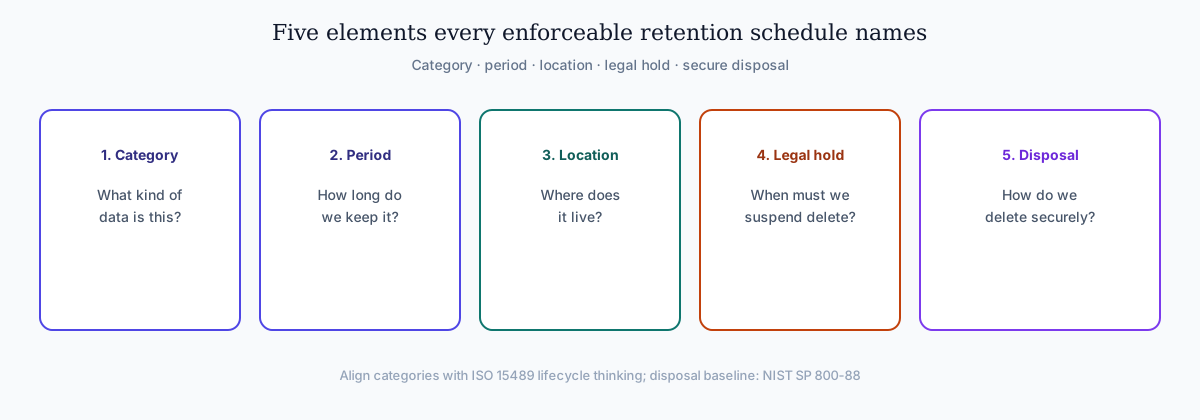
The table below maps the pieces of a retention schedule. Use it as a quick reference; the sections below go deeper.
| Element | Question it answers |
|---|---|
| Data category | What kind of data is this? |
| Retention period | How long do we keep it? |
| Storage location | Where does it live? |
| Legal hold | When must we suspend deletion? |
| Disposal method | How do we delete it securely? |
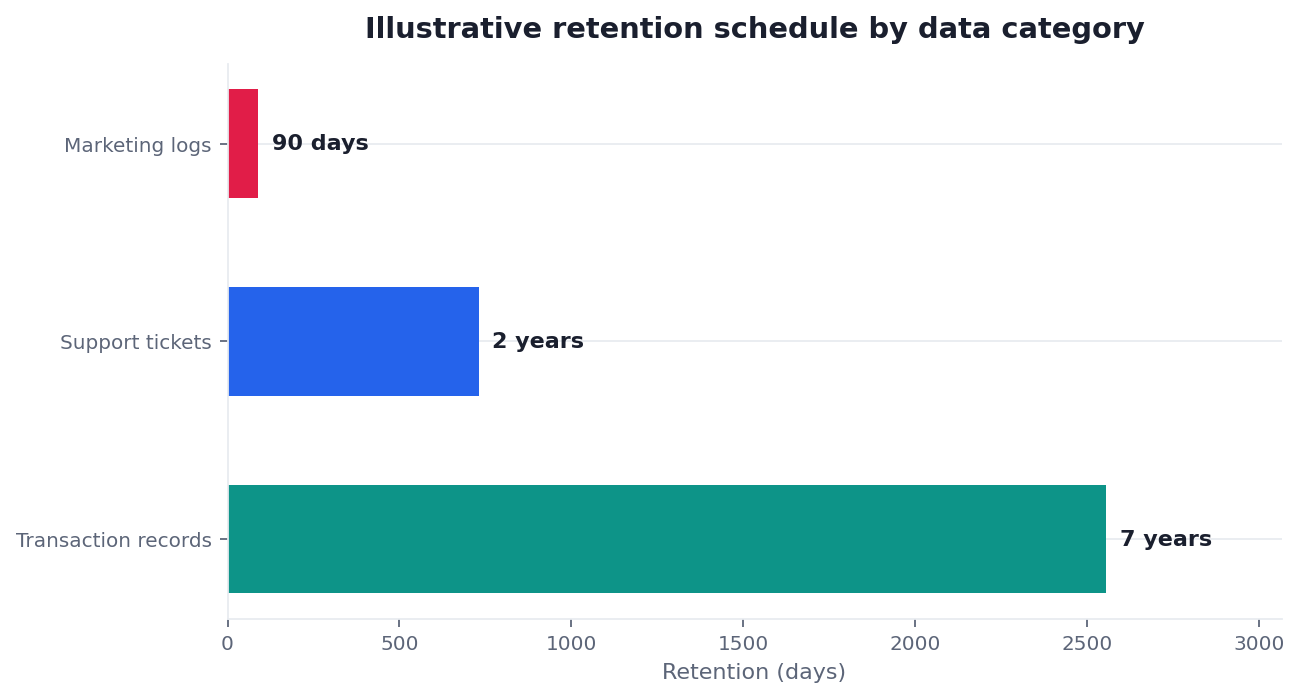
Practical example (desk composite, not a third-party audited customer case): a fintech that lacked an auditor-ready schedule adopted a five-tier model — transaction records held seven years, support tickets two years, marketing logs ninety days — and cut storage spend by roughly a third while satisfying its regulator. That specificity is what separates a real policy from an intention: periods tied to stated legal or business reasons, not round numbers chosen for comfort.
Scope note: This guide reflects patterns we see when mid-market and enterprise teams implement retention in 2026. It is not a substitute for legal counsel, vendor runbooks, or a formal survey of every industry — and when a smaller toolset or lighter process would serve, a full program is overkill. Retention rules vary by jurisdiction, sector, and contract; treat the schedules here as illustrative patterns, not mandates.
Desk signals and industry context
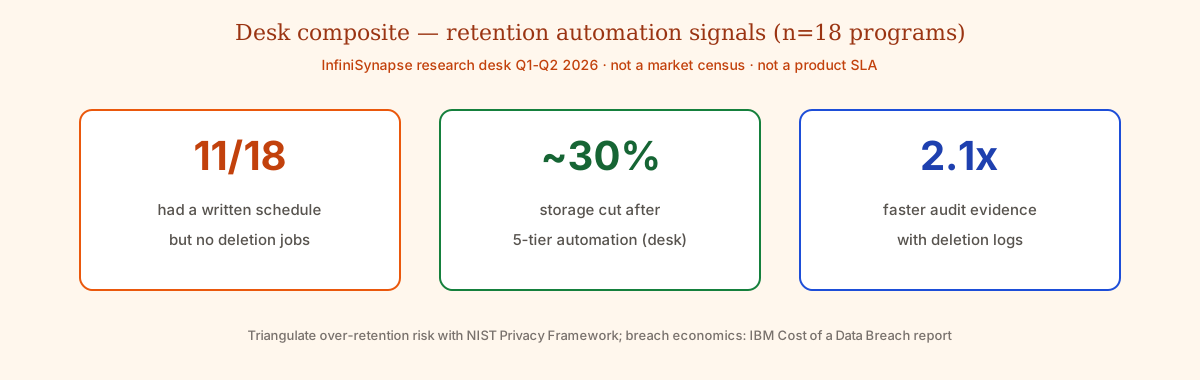
Original desk composite (InfiniSynapse research desk, Q1–Q2 2026, n=18 mid-market/enterprise retention programs we reviewed): 11/18 had a written schedule but no automated deletion jobs; programs that automated a five-tier schedule reported about ~30% storage reduction in the first two quarters (desk tally, not a product SLA); teams with deletion evidence logs produced audit packages about 2.1× faster than teams that only described intentions. These figures are desk tallies — not a market census and not third-party audited.
Triangulate desk observations with independent standards and industry research:
- Regulatory anchors: GDPR Article 5(1)(e), ICO storage limitation guidance, CCPA, EDPB guidelines.
- Security / privacy frameworks: NIST Privacy Framework, NIST SP 800-88, NIST AI RMF.
- Records lifecycle: ISO 15489.
- Breach economics (over-retention risk context): IBM Cost of a Data Breach Report — independent industry research on breach cost drivers; not an InfiniSynapse endorsement and not a retention-period mandate.
What It Means
The clearest way to answer the definition question is with a precise statement rather than a gesture at "keeping data organized."
Key Definition: a data retention policy is a formal document that specifies, for each category of data, how long it is retained, where and how it is stored, the events that trigger legal holds, and the secure method and timing of its disposal.
Understanding the definition means seeing that it is enforceable, not aspirational. The missing piece after a one-line definition is usually enforcement, not vocabulary. A schedule that lives in a wiki nobody automates is a wish; a policy is a set of rules wired into systems so that data is actually deleted on schedule. That enforceability is the difference that regulators, and increasingly AI governance reviews, look for.
It also helps to say clearly what a data retention policy is not. It is not a backup strategy, which is about recovering data you intend to keep; it is not an archiving decision made file by file; and it is not the same as data classification, though it depends on it. When people conflate these, the definition gets muddy and the policy loses its force. Keeping the definition narrow — how long, where, and how you delete each category — is what makes it something you can automate and audit.
Why Organizations Need One
Every organization already retains data; the only question is whether it does so deliberately. Writing the schedule forces that decision into the open — and documenting that answer is what turns informal habit into an auditable control.
Legal and regulatory drivers
Regulations increasingly require both minimum retention (keep tax or books-and-records for years) and maximum retention (do not keep personal data longer than needed). Under the UK GDPR storage-limitation principle, the ICO storage limitation guidance expects you to justify how long you keep personal data and to delete or anonymize it when that purpose ends. In the United States, consumer privacy laws such as the California Consumer Privacy Act (CCPA) create deletion and notice expectations that a written schedule helps you meet. A data retention policy becomes the mechanism that proves you keep what you must and delete what you should not — without it, good intentions are hard to demonstrate in an audit.
European supervisory practice, summarized in EDPB guidelines and recommendations, likewise treats storage limitation and purpose limitation as linked: if the purpose ends, continued retention needs a fresh, documented basis. That is why a complete answer is incomplete if it only lists “keep forever unless someone asks.”
Cost and risk drivers
Beyond law, retention is economics and risk. Every terabyte kept forever costs money to store and widens the blast radius of a breach. The NIST Privacy Framework treats data minimization and disposal as part of managing privacy risk, which is why security teams put retention on the control roadmap and not only in the legal department. Independent breach-cost research such as the IBM Cost of a Data Breach Report is useful context for why over-retention is an economic risk — it is not a substitute for your counsel’s period table. Less data means lower storage bills and less to lose when something goes wrong.
What a Good Policy Contains
A strong policy is specific and automatable. Vague answers ("we keep things a reasonable time") fail audits; concrete schedules pass them. When counsel or an auditor asks for your company’s schedule, they expect categories, periods, and disposal — not a slogan.
A complete data retention policy names each data category, assigns a defensible retention period tied to a legal or business reason, specifies where the data lives, defines the events that trigger a legal hold suspending deletion, and describes the secure disposal method. Records-management practice in ISO 15489 is a useful framing for categories and disposition: retention is part of the records lifecycle, not a one-off cleanup project. The best policies also assign an owner to each category so that when a period lapses, a named person is accountable for confirming deletion.
For personal data, the schedule should also account for erasure requests under regimes that include a right to erasure (GDPR Article 17) — your schedule and your request-handling process need to agree on what “delete” means across production systems, backups, and derived stores.
HowTo: Build and Enforce Retention
Writing the schedule is the easy half; enforcing it is where policies live or die. Wire the rules into the systems that hold data so deletion happens automatically, with legal holds able to override it. This connects retention directly to your data governance framework, because governance defines the categories and owners that a retention schedule depends on.
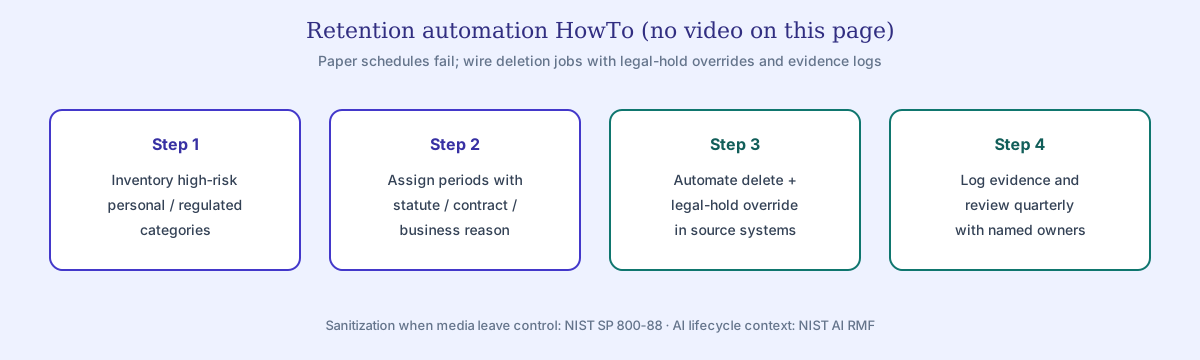
- Inventory high-risk categories. Start with personal data and regulated records — the categories auditors and regulators ask about first.
- Assign periods with documented reasons. Tie each period to a statute, contract, or stated business purpose. “Industry standard” with no citation fails review.
- Automate deletion with legal-hold overrides. Manual deletion never scales. Treat automation as part of the 2026 definition of an enforceable schedule, not a later engineering project.
- Log evidence and review quarterly. When a retention job runs, log what it deleted and confirm against the schedule. Secure disposal should follow NIST SP 800-88 when media leave your control — “rm” in an app database is not the same control as verified sanitization of retired disks.
Teams that skip logging can describe their policy but cannot prove it ran, which is exactly the gap auditors probe. Treating the deletion log as a first-class artifact turns a document into a demonstrable, repeatable control.
Common Failure Modes
The failures we see are rarely about the schedule itself. The most common is a policy that exists on paper but is never enforced, so data accumulates anyway. The second is forgetting legal holds, which leads to deleting data that litigation required you to preserve. The third is defining retention without owners, so no one confirms that deletion actually happened.
A subtler failure is treating the program as a one-time exercise. Data categories change, regulations shift, and new systems appear, so a schedule needs periodic review or it silently drifts out of compliance. Another is citing “industry standard periods” with no link to a statute, contract, or documented business purpose — that looks precise but fails when an auditor asks for the reason behind each period.
Retention in the Age of AI
AI raises new retention questions. When an autonomous agent reads your data to answer questions, the data it can reach is governed by the same schedules — and training data, prompt logs, and derived datasets all need retention rules of their own. A modern schedule now includes these AI-adjacent categories; otherwise the definition stops at warehouses and ignores the systems people actually query in 2026. The NIST AI Risk Management Framework treats data governance and lifecycle controls as part of trustworthy AI; retention and disposal are how those controls become operational rather than aspirational.
An AI-native analysis platform helps when governed definitions and access rules travel with the data an agent queries — an approach we describe in what AI-native data analysis means. In practice, intermediate data agents create must inherit the same schedules as their origins, not just the source tables they read.
Policy Scorecard
Use this to test how completely you can answer what is a data retention policy for your own organization (1 point each):
| Check | Pass? |
|---|---|
| Every data category has a retention period | |
| Periods are tied to a legal or business reason | |
| Storage location is documented | |
| Legal holds can override deletion | |
| Disposal is secure and defined | |
| Deletion is automated, not manual | |
| Each category has an owner | |
| AI-adjacent data is covered |
6–8: strong. 3–5: automate enforcement next. Below 3: start with high-risk categories.
Common Misconceptions
Misconception 1: It just means keeping data. Retention governs deletion as much as storage.
Misconception 2: Longer is safer. Keeping data forever increases cost and breach risk.
Misconception 3: It is only a legal document. It must be automated in systems to matter.
Misconception 4: AI data is exempt. Prompt logs and training data need retention rules too.
Frequently Asked Questions
What is a data retention policy?
A data retention policy is a formal, written rule set defining how long an organization keeps each category of data, where it is stored, when legal holds suspend deletion, and how data is securely disposed of. It is enforceable rather than aspirational — wired into systems so that deletion actually happens on schedule — and it exists to control cost, risk, and regulatory exposure. See GDPR Article 5(1)(e) and ICO storage limitation guidance.
Why do organizations need one?
Because every organization already retains data, and doing so without a policy multiplies storage cost, breach exposure, and compliance risk. Privacy regimes such as the UK GDPR storage-limitation principle and U.S. state privacy laws create both keep-and-delete expectations, so a policy is the mechanism that proves you keep what you must and delete what you should not.
What should the schedule include?
Name each data category, assign a defensible retention period tied to a legal or business reason, document where data is stored, define legal-hold events, and describe secure disposal. Assigning an owner to each category ensures someone is accountable for confirming deletion when a period lapses. ISO 15489 is a useful records-lifecycle framing.
How is retention enforced?
Enforcement means wiring the schedule into the systems that hold data so deletion happens automatically, with legal holds able to override it. Manual deletion does not scale. Start by automating your highest-risk categories — personal and regulated data — and expand from there, reviewing the schedule periodically as categories and regulations change. Follow NIST SP 800-88 for media sanitization.
How does retention apply to AI systems?
AI adds new categories: training data, prompt logs, and derived datasets all need retention rules, and the data an agent can query is governed by the same schedules. The short answer in an AI context: the same schedule, plus explicit rules for prompts, training sets, and derived outputs so automated analysis extends retention rather than bypassing it. Align lifecycle controls with the NIST AI RMF.
Conclusion
So, what is a data retention policy? It is an enforceable, written schedule that governs how long you keep, where you store, and how you delete each category of data — a control for cost, risk, and compliance that now extends to AI systems too. If you can answer with categories, owners, holds, and deletion evidence, you are ahead of most paper-only programs. Start with your highest-risk categories, automate enforcement, and review regularly.
To see how governance and retention context can travel with data into automated analysis, read what AI-native data analysis means. If you want to try that model in practice, the InfiniSynapse web app is free on registration. Corrections: zhuhl@infinisynapse.com.