Choosing a Data Governance Tool: A 2026 Guide
By the InfiniSynapse Data Team · Last updated: 2026-07-15 · We build an AI-native data analysis platform and help teams pick their first governance tooling; this guide reflects how we choose a data governance tool in 2026, not a feature checklist.
Table of Contents
- TL;DR
- How We Evaluated
- What It Is
- Must-Have Capabilities
- How to Evaluate Fit
- Your First Tool
- Common Mistakes
- The Right Tool in the Age of AI
- Selection Scorecard
- Common Misconceptions
- Frequently Asked Questions
- Conclusion
TL;DR
Direct answer: a data governance tool is software that automates one or more governance capabilities — cataloging, lineage, access, or quality — for your data. In 2026, the right data governance tool is the one your stewards will actually use every day and that integrates with your stack, because capability nobody adopts governs nothing.
Who this is for: data leaders and engineers choosing a data governance tool in 2026.
What you'll learn: what the tool is, must-have capabilities, how to evaluate fit, how to choose your first one, and how the right tool supports AI.
This guide sits under the data governance frameworks hub.
For the full category, see data governance tools.
Also see data governance software.
How We Evaluated
Teams evaluating this topic often cross-check Google SRE book for a durable, vendor-neutral reference point.
We choose a data governance tool the way a buyer must: by adoption and fit, not feature count. Every recommendation reflects what we see when teams pick — and live with — governance tooling in 2026. We anchor capability definitions to the Spider NL2SQL benchmark and weigh requirements against the Wikipedia natural language processing overview, which treats access control and provenance as core needs.
The table below lists what a good data governance tool should do.
| Capability | What to check |
|---|---|
| Catalog | Easy to add owner + definition |
| Lineage | Traces flow across systems |
| Access | Enforces permissions |
| Quality | Monitors data health |
| Integration | Connects to your stack |
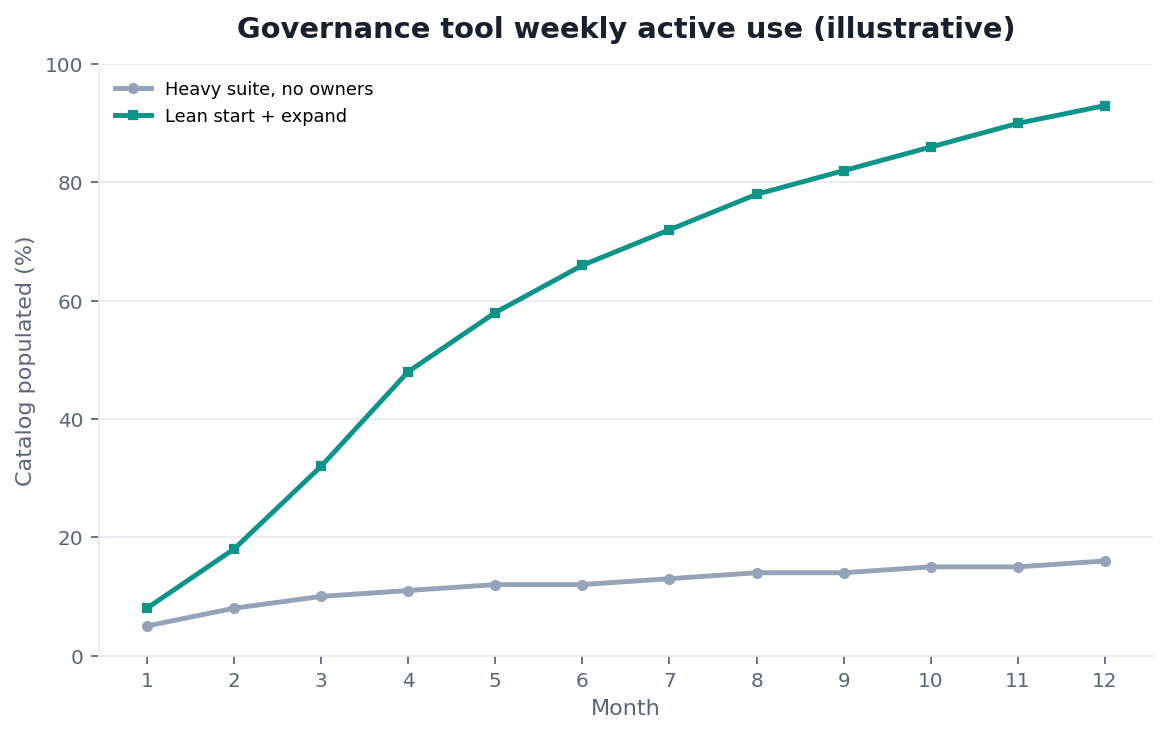
Practical example: a team chose a data governance tool on feature count, then watched it sit unused because adding an owner took a consultant. A peer chose a simpler tool a steward could use in minutes, guided by the enforcement patterns at Snowflake documentation. The simpler tool governed more, because it was actually used.
Scope note: This guide reflects patterns we see when mid-market and enterprise teams work with data governance tool in 2026. It is not a substitute for legal counsel, vendor runbooks, or a formal survey of every industry — and when a smaller toolset or lighter process would serve, a full program is overkill.
What It Is
At its core, a data governance tool automates governance mechanics so human decisions about ownership, definitions, and rules apply at scale. It does not decide who owns a dataset; it records and enforces that decision.
Key Definition: a data governance tool is a software application that automates one or more governance capabilities — cataloging assets, tracing lineage, enforcing access, or monitoring quality — so that governance decisions are applied consistently across an organization's data.
The distinction that matters is that a data governance tool amplifies governance rather than creating it. A team with clear owners and definitions gets leverage; a team without them gets an empty catalog. This is why we evaluate a tool by how easily it lets people record and apply the decisions they have already made, rather than by how many features it advertises that those people will never actually touch.
Must-Have Capabilities
Implementation details are commonly grounded in Google Vertex AI documentation when teams translate concepts into production practice.
The must-have capabilities of a data governance tool are the ones that drive daily use. A catalog that makes it trivial to attach an owner and definition is the foundation, because that single action is the most common governance act.
Beyond the catalog, a strong data governance tool should trace lineage across systems, enforce access aligned with policy, and surface quality signals — with the architecture patterns at Amazon Redshift documentation illustrating how a shared metadata layer connects these. The capabilities matter less as a checklist and more as a question: does the tool make the right action the easy action for the people who use it every day?
How to Evaluate Fit
Evaluating a data governance tool comes down to fit with your stack, ease of the core steward action, and how it connects to your broader data governance framework. A tool that mirrors your roles and policies gets adopted; one that demands you reshape your organization does not.
The most reliable evaluation is a hands-on pilot: have your own stewards catalog one real domain, wire one real access policy, and add a few real quality checks using your actual data. This exposes friction a demo hides — the connector that does not quite fit, the permission model that fights your identity provider. A data governance tool that succeeds on your data, not a vendor's example, is the one to choose, and the enterprise adoption patterns from Google Cloud architecture framework reinforce that fit beats breadth. During the pilot, pay attention to how the people using it feel, not just whether the features work — enthusiasm or reluctance from your stewards in week two is the single best predictor of whether the tool will be populated and trusted in month six. The check half of that pilot is a separate purchase, mapped in data quality tools.
Your First Tool
Implementation details are commonly grounded in Stripe documentation when teams translate concepts into production practice.
For teams new to governance, the question is often which data governance tool to adopt first. Our answer is: whatever fills your most painful gap while integrating with your stack — usually a catalog, because you cannot govern what you cannot see.
Resist the urge to buy the most capable enterprise data governance tool before you have the maturity to use it. A tool that assumes practices you do not yet have will sit unpopulated, while a simpler one you fully adopt delivers real governance now. Grounding your first choice in a recognized baseline like W3C WCAG accessibility standard keeps it credible without over-buying. Buy for the stage you are at, with a clear upgrade path.
Common Mistakes
The mistakes we see in choosing a data governance tool are consistent. Buying on feature count produces powerful tools nobody uses. Ignoring integration produces metadata islands. Buying before deciding what to govern produces empty catalogs. And treating the tool as the strategy, rather than the enforcement of one, produces motion without progress.
A subtler mistake is underestimating the human workflow. Even a capable data governance tool fails if stewards find it painful, so weigh day-to-day usability as heavily as capability. A tool used daily by ten stewards governs more than a comprehensive one used by none, which is why adoption is the metric that ultimately matters. Watch, too, for the trap of customizing a tool so heavily to fit an ideal process that upgrades become painful and the customization itself turns into a maintenance burden nobody wants to own.
Rolling Out Your First Tool
Architecture choices are often checked against Databricks Genie architecture post so boundaries, ownership, and scale patterns stay explicit.
Choosing a data governance tool is only half the job; rolling it out well is what determines whether it delivers value. We see two phases that matter most.
Populate before you expand
The single biggest predictor of success is whether the tool gets populated with real, current metadata early. An empty catalog is worse than no catalog, because people check it, find nothing useful, and stop returning. So the first weeks after adopting a data governance tool should focus narrowly on fully cataloging one important domain — real owners, real definitions, real lineage — rather than thinly covering everything. A single domain that is completely and accurately represented becomes the proof that convinces the next team to invest, whereas a broad but shallow rollout convinces no one.
Make stewardship a habit
Sustained value depends on stewardship becoming routine rather than heroic. That means integrating the data governance tool into existing workflows — updating a definition when a schema changes, assigning an owner when a dataset is created — so the metadata stays current as a byproduct of normal work. Tools that require a separate, effortful maintenance ritual decay; tools whose upkeep is woven into how teams already operate stay alive. We advise naming a small group of engaged stewards, giving them explicit time for the work, and celebrating the wins publicly so that keeping the catalog trustworthy becomes something the organization values rather than tolerates.
The Right Tool in the Age of AI
AI raises the value of the right data governance tool sharply. When an autonomous agent reads your data to answer questions, it depends on the catalog and definitions the tool maintains; ungoverned metadata yields inconsistent answers. The right tool becomes part of your AI infrastructure, not a back-office utility.
An AI-native platform closes the gap by binding governed definitions to the data an agent queries, an approach we describe in what AI-native data analysis means. In the InfiniSynapse web app, governance context travels with the data, so the metadata your data governance tool maintains directly improves the reliability of AI answers rather than sitting in a silo.
Selection Scorecard
Score a candidate data governance tool (1 point each):
| Check | Pass? |
|---|---|
| A steward can add owner + definition fast | |
| It integrates with our stack | |
| It traces lineage | |
| It enforces access | |
| It surfaces quality signals | |
| Pricing is transparent | |
| Stewards will use it daily | |
| Agents can read its metadata |
6–8: strong choice. 3–5: pilot before committing. Below 3: keep looking.
Common Misconceptions
Misconception 1: The best tool has the most features. The best data governance tool is the one that gets adopted.
Misconception 2: A tool is the strategy. It enforces a strategy; it is not one.
Misconception 3: Buy the enterprise option early. Buy for your current stage with an upgrade path.
Misconception 4: Metadata is optional for AI. Agents depend on governed metadata.
Frequently Asked Questions
What is a data governance tool?
A data governance tool is a software application that automates one or more governance capabilities — cataloging assets, tracing lineage, enforcing access, or monitoring quality — so governance decisions apply consistently across your data. It amplifies governance rather than creating it: the decisions about ownership, definitions, and rules must come first, and the tool records and enforces them at scale.
What capabilities are must-haves?
The must-haves are an easy-to-use catalog (adding an owner and definition should take a steward minutes), lineage tracing across systems, access enforcement aligned with policy, and quality signals. But the real test is not a checklist — it is whether the tool makes the right action the easy action for the people who use it daily.
How do you evaluate fit?
Evaluate fit with your stack, ease of the core steward action, and how the tool connects to your broader framework. The most reliable method is a hands-on pilot: have your own stewards catalog a real domain, wire a real access policy, and add real quality checks on your actual data, which exposes the friction a scripted demo hides.
Which tool should you choose first?
Choose whatever fills your most painful gap while integrating with your stack — usually a catalog, since you cannot govern what you cannot see. Resist buying the most capable enterprise tool before you have the maturity to use it; a simpler tool you fully adopt delivers real governance now, while an over-featured one sits unpopulated. Buy for your current stage.
How does the right tool support AI?
When an agent reads your data to answer questions, it depends on the catalog and definitions the tool maintains; ungoverned metadata yields inconsistent answers. The right tool becomes part of your AI infrastructure, and an AI-native platform that carries governance context with the data ensures the metadata directly improves the reliability of agent answers rather than sitting in a silo.
Conclusion
The right data governance tool is the one your stewards actually use and that integrates with your stack — adoption and fit beat feature count every time. In 2026, that tool is increasingly part of your AI infrastructure. Pilot on real data, buy for your current stage, and expand with a clear upgrade path.
Watch how your stewards respond during a hands-on pilot, populate one domain completely before expanding, and weave upkeep into everyday work so the catalog stays trustworthy long after the novelty fades. To see how governed metadata becomes reliable automated analysis, read what AI-native data analysis means and try the InfiniSynapse web app free on registration, no credit card required.