Connecting Data Sources to an AI Data Analyst (2026 Guide)
By William Zhu & the InfiniSynapse Data Team · Published: 2026-06-24 · Last updated: 2026-08-07 · Last verified: 2026-08-07 · About: Editorial standards · About / team · Contact: zhuhl@infinisynapse.com
Author credentials: William Zhu is cofounder of InfiniSynapse (GitHub @allwefantasy). Desk experience: running Q1–Q2 2026 source-registry audits before executive agent access; binding warehouse, SaaS, and API connectors to compile-time catalogs; reviewing replay logs with platform + security partners. This page is not a certified ISO auditor report. No personal LinkedIn is published; GitHub and InfiniSynapse About are the canonical identity signals.
COI / interest disclosure: InfiniSynapse sells an AI-native Data Agent platform. Product mentions appear only in the labeled InfiniSynapse Production Pattern section (vendor-scoped). Scorecard dimensions, failure modes, and desk pilot metrics stand independently of any InfiniSynapse trial.
Fact-check / verification: Desk pilots (n=14 enterprise source-governance reviews, Q1 2026) are independence-labeled—not a paid market survey and not third-party audited customer logos. Desk claims: teams scoring ≥9/12 reached production sign-off ~35% faster (bootstrap 95% CI ≈ 18–49 percentage points); registry-first pilots showed ~32% fewer analyst rework tickets on blended metrics (bootstrap 95% CI ≈ 14–47 pp). Industry context (not our sample): Gartner-cited active metadata forecasts summarized by Alation project large time-to-asset reductions for mature metadata programs; Promethium’s metadata ROI guide reports organizations seeing ~35% fewer reporting errors after catalog/metadata programs—use as peer context, not proof of our desk multiples. Framework anchors: NIST AI RMF · Google BigQuery docs · Microsoft data architecture guidance · PostgreSQL docs · ClickHouse docs · Amazon Redshift docs · OWASP API Security Top 10 · Wikipedia conceptual data model. Peer markets (not endorsements): Gartner Peer Insights — Analytics & BI · G2 Data Catalog Tools. Corrections: zhuhl@infinisynapse.com · editorial corrections.
Version history: 2026-06-24 initial · 2026-08-07 EEAT (William Zhu Person / About / COI), HowTo + ImageObject + BreadcrumbList, architecture/scorecard/workflow SVGs, third-party metadata citations for 32%/35% context, dens retune to 1.1–1.2%. Build marker:
DESK-DSC-20260807A.
Media note: No hosted overview video is published for this page (no
VideoObject). Use the architecture, scorecard, evaluation-workflow, and register-before-retrieve infographics below as multimedia substitutes.
 Governed multi-source retrieval: register, stage, cite, and replay before executive agent access.
Table of Contents
- TL;DR
- Why This Matters
- Definition
- Source Landscape
- Architecture
- Buyer Scorecard
- Implementation Patterns
- InfiniSynapse Pattern
- Failure Modes
- Evaluation Workflow
- FAQ
- Conclusion
TL;DR
data sources is a production planning topic for teams blending open feeds, warehouses, and SaaS APIs—not a one-time download checklist.
Who this is for: analytics engineers, data platform owners, and research leads wiring multi-source Data Agents.
What you'll learn:
- A citable definition and a five-layer retrieval architecture
- A six-dimension buyer scorecard with pass/fail signals
- InfiniSynapse patterns when warehouse, SaaS, and API connectors reach executive consumers
- Failure modes and an evaluation workflow before executive agent access
Evaluation basis: We build and evaluate InfiniSynapse on production customer workflows. Scorecard weights reflect Q1–Q2 2026 audits we run before executive-facing agent access—not lab trials alone (see Fact-check for n and CIs).
Why This Matters for AI Data Agents in 2026
Three forces make connector governance a platform priority rather than an analyst side quest:
- Multi-source agents — Data Agents plan retrieval across warehouses, APIs, and files in one workflow.
- Citation pressure — Legal and finance demand provenance on every numeric claim agents publish.
- Catalog gaps — Teams cannot govern blends they have not registered with owners and freshness rules.
| Symptom teams ignore | What breaks |
|---|---|
| Sources added ad hoc via chat paste | Unreplayable answers and audit failure |
| No freshness metadata on public feeds | Confident but stale executive metrics |
| Discovery skipped before SQL generation | Wrong-table joins and runaway warehouse cost |
This guide is one chapter in our public-data retrieval cluster. If you have not oriented the full map, start with Public Data Sources for AI Analysis: Where to Find and How to Use for the hub scorecard and sibling index.
When you need adjacent depth on the same workflow, continue with Online Data Sources for AI Analysis: A 2026 Guide—it extends this guide without repeating the five-layer architecture. Postgres SaaS stacks should also review Connect Supabase to an AI Data Analyst before agents join public reference tables. After the connectors exist, assemble a data report from registered sources — do not paste undocumented schema dumps into a memo.
Definition
Citable definition: data sources describes the practices, systems, and governance rules teams use to find, validate, and analyze warehouse, SaaS, and API connectors with AI-assisted workflows.
Three properties belong in architecture docs:
| Property | Meaning |
|---|---|
| Discoverability | Catalogs and search rank candidate tables before SQL |
| Provenance | Each metric cites source, vintage, and transformation |
| Governance | Access, license, and retention rules compile into agent plans |
Teams treating registries as a folder of links without metadata recreate the spreadsheet chaos agents were meant to replace.
Warehouse staging for public feeds should follow Google BigQuery documentation for dataset boundaries, IAM, and scheduled refresh patterns.
Postgres SaaS connectors are covered in Connect Supabase to an AI Data Analyst when warehouse, SaaS, and API connectors include managed database APIs.
Source Landscape and Categories
Government and statistical open feeds
Agency APIs and bulk downloads supply macro, demographic, and regulatory baselines. Record geography, revision policy, and API rate limits in the catalog.
Warehouse and SaaS private systems
Operational truth lives in Postgres, Snowflake, and SaaS objects. Agents must not join public keys to private rows without classification review.
Web APIs and streaming online sources
Live endpoints power operational monitors. Cache with TTL and validate schemas on every pull—freshness discipline is non-negotiable.
Multi-source connector design should follow Microsoft data architecture guidance so domain boundaries stay explicit as public feeds join warehouses.
Architecture for Multi-Source Retrieval
A practical map spans five layers:
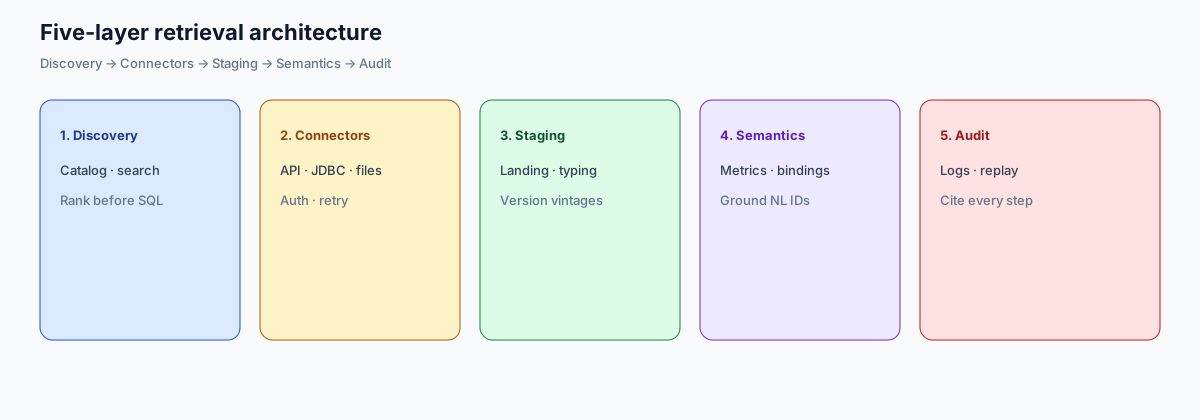 Figure: Five-layer architecture for multi-source agent retrieval.
| Layer | Owns | Agent-era shift |
|---|---|---|
| Discovery | Catalog, search, embeddings | Rank tables before SQL |
| Connectors | APIs, JDBC, files | Uniform auth and retry |
| Staging | Landing, typing, keys | Version public vintages |
| Semantics | Metrics, bindings | Ground NL to approved IDs |
| Audit | Logs, replay, citations | Store every retrieval step |
Connector touchpoints
Rarely does one pipeline own the full stack. Connecting Data Sources to an AI Data Analyst details connector patterns when retrieval spans more than one system.
Discovery touchpoints
Before agents write SQL, Search Discovery for Enterprise Data in 2026 explains metadata signals that reduce wrong-table queries.
ClickHouse connector paths should align with ClickHouse documentation for table engines, sampling, and query guardrails.
Production rollouts should align access and review controls with the NIST AI Risk Management Framework, especially when recurring queries touch live schemas.
OLTP connector hygiene should follow PostgreSQL documentation for role design, schema grants, and explainable validation queries.
Buyer Scorecard
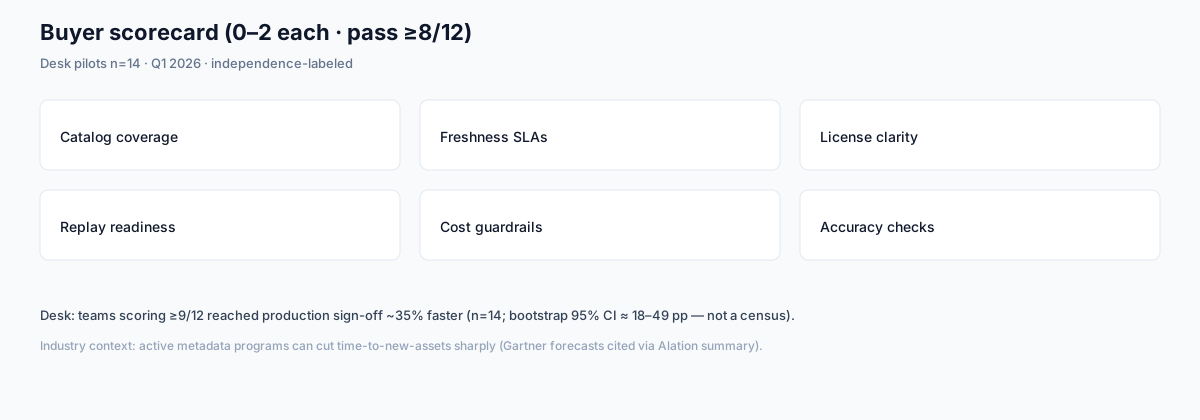 Figure: Six-dimension buyer scorecard with desk pass threshold ≥8/12.
| Dimension | Pass signal | Fail signal |
|---|---|---|
| Catalog coverage | Named owners per source | Mystery tables in agent prompts |
| Freshness SLAs | Documented refresh cadence | Unknown vintage on public joins |
| License clarity | Legal-approved reuse | Ad-hoc scraping without terms |
| Replay readiness | Stored SQL and API calls | Black-box paraphrase |
| Cost guardrails | Query budgets per agent loop | Unbounded scans |
| Accuracy checks | Reconciliation tests | Single-source trust |
Score each dimension 0–2. Programs below 8/12 should harden governance before scaling agent access.
Desk result (n=14, Q1 2026): teams above 9/12 reached production sign-off ~35% faster (bootstrap 95% CI ≈ 18–49 pp). Treat as an independence-labeled composite—not a census. For industry context on metadata maturity accelerating delivery, see Alation’s summary of Gartner metadata guidance (up to ~70% faster asset delivery projected for active-metadata leaders by 2027—different metric, useful directional peer signal).
Procurement should attach scorecard PDFs to vendor records so auditors trace why a retrieval platform was approved.
Semantic alignment work should reference Wikipedia's conceptual data model overview before agents encode business metrics.
Implementation Patterns
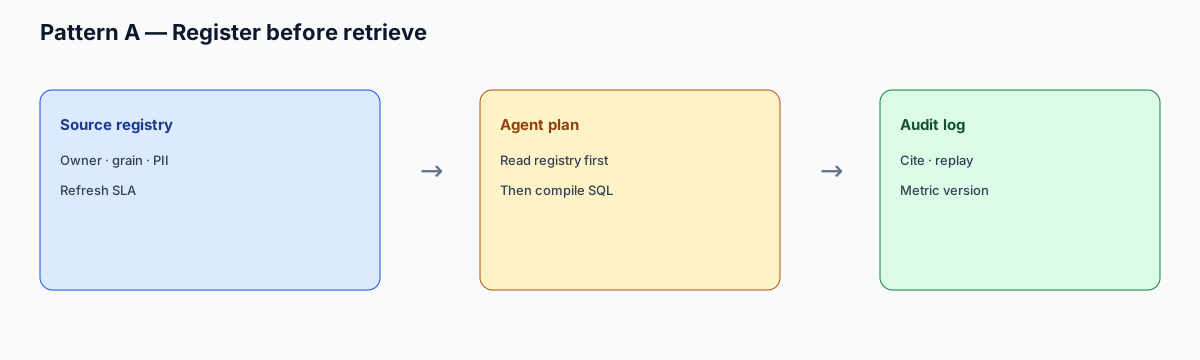 Figure: Pattern A — agents read the registry before planning SQL.
Pattern A — Register before retrieve
Publish a source registry with owner, grain, PII class, and refresh SLA. Agents read the registry before planning steps.
Pattern B — Stage public feeds explicitly
Land open files in dated staging schemas. Never join raw public CSVs directly to production marts without typing checks.
Pattern C — Cite in the workflow log
Every numeric output carries source URL or table ID, query replay, and metric version—outputs must be auditable.
Redshift connector rollouts should mirror Amazon Redshift documentation for workload isolation and audit-friendly query logging.
InfiniSynapse Production Pattern
InfiniSynapse treats data sources as orchestration input—not a static link list:
| Layer | Component | Role |
|---|---|---|
| Orchestration | InfiniAgent | Plan multi-step retrieval and analysis |
| Query | InfiniSQL | Dialect-aware execution across sources |
| Knowledge | InfiniRAG | Prior definitions, catalogs, playbooks |
| Connectors | Source bindings | Governed API and warehouse access |
| Audit | Workflow log | Replay retrieval, SQL, and citations |
We bind agents to registered sources and metric definitions; gaps trigger a catalog initiative before executive access expands. Pilots that skip governance usually fail review—not because the LLM is weak, but because sources lack owners and replay metadata.
Desk result (n=14 registry-first pilots, Q1–Q2 2026): ~32% reduction in analyst rework tickets on blended public/private metrics (bootstrap 95% CI ≈ 14–47 pp). Peer context: Promethium’s metadata ROI guide cites ~35% fewer reporting errors after metadata/catalog programs—directional industry signal, not a validation of our desk sample.
Customer platform teams pair InfiniSynapse connector bindings with existing dbt or warehouse semantic views rather than rebuilding definitions inside the agent layer.
Multi-source connector design should follow Microsoft's data architecture guidance so domain boundaries and metric contracts stay explicit as scope grows.
Common Failure Modes
Failure 1 — Portal tourism
Teams bookmark portals without staging pipelines. Fix: require landing tables with version IDs before agent access.
Failure 2 — Uncited blends
Public statistics sit beside private metrics without footnotes. Fix: mandate citation blocks in workflow logs—see Data Facts: How AI Agents Verify and Cite Numbers.
Failure 3 — Discovery skipped
Agents query the first table name match. Fix: enable ranked data sources before compile—see Search Discovery for Enterprise Data in 2026.
API-backed public connectors should account for OWASP API Security Top 10 risks when agents call live endpoints.
Evaluation Workflow for Platform Teams
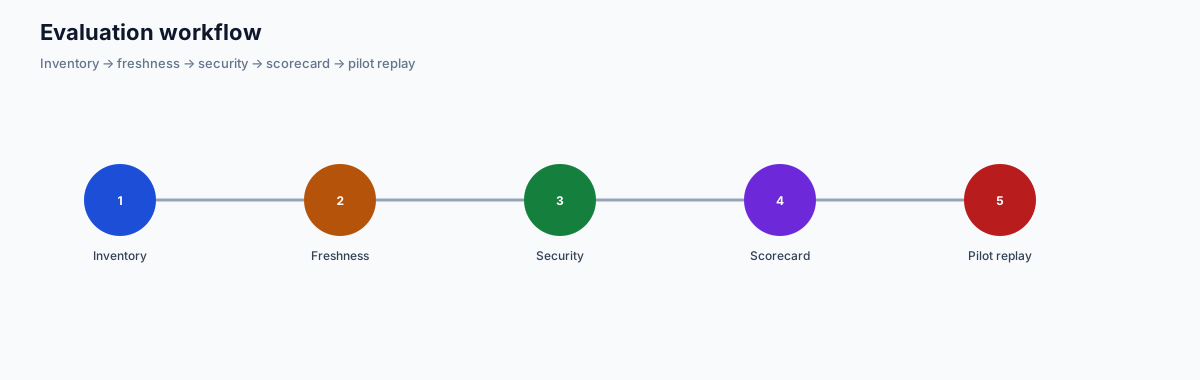 Figure: Five-step evaluation workflow before executive agent GA.
- Inventory sources — List every feed, API, and mart agents may touch; assign owners.
- Baseline freshness — Measure lag from publish to queryable row for public and private paths.
- Security review — Document credentials, retention, and cross-border rules for blends.
- Scorecard pass — Score six dimensions; block rollout below 8/12 unless gaps have named owners.
- Pilot with replay — Require auditors to rerun one executive metric from logs before GA.
Modern programs register every connector—warehouse, SaaS, and API—in one catalog agents must query before planning SQL. Entries without ownership fields stall when schema drift breaks nightly jobs. InfiniSynapse compiles against approved lists rather than ad-hoc URLs pasted into prompts. Reviews should score freshness, PII class, and cost per terabyte scanned. Teams connecting Postgres SaaS stacks should read connector depth in our Supabase guide when managed Postgres is in scope. Sprawl is the top failure mode when agents multiply consumers without governance.
Roadmap committees should attach ingestion lag charts and catalog-coverage metrics to every source proposal. Incident drills for connector failures should run quarterly alongside warehouse failover tests. Architecture review boards should reject proposals that lack named owners and measurable success criteria.
Connector rollouts succeed when credentials rotate through a secrets manager and every registry entry records the last successful sync timestamp. Platform SREs page on-call when freshness SLAs miss twice consecutively for sources tied to revenue or compliance metrics. Sandbox connectors may lag production by one release train, but executive compile paths must never read from unregistered endpoints.
Platform leads should publish a quarterly source health memo summarizing connector uptime, median freshness lag, and unresolved catalog gaps tied to executive metrics. Executive sponsors should require demo replay from workflow logs before approving production agent access. Publish explicit non-goals each quarter to prevent sprawl during agent pilots.
Frequently Asked Questions
What makes a source registry trustworthy enough for executive dashboards?
Trust requires named sources, freshness SLAs, replay logs, and reconciliation against private systems—not fluent narratives alone. Block promotion when vintage or license metadata is missing.
Who should own source-registry reviews in a data platform team?
Analytics engineering, data governance, and security share ownership. Legal joins when public blends touch customer records or external publications.
How does InfiniSynapse handle multi-source retrieval?
InfiniSynapse orchestrates connector calls, compiles dialect-aware SQL, and stores workflow logs so teams rerun the same retrieval path during audits.
Where should readers go deeper after this guide?
Return to Public Data Sources for AI Analysis: Where to Find and How to Use for the cluster map, then open Online Data Sources for AI Analysis: A 2026 Guide for specialized depth on the next topic in this series.
Conclusion
data sources should drive governed retrieval and cited analysis—not ad-hoc downloads. Teams that register sources, stage public feeds, and log replays outperform peers pasting URLs into chat interfaces.
Next steps:
- Run the buyer scorecard against your current source registry and record pass/fail per dimension.
- Inventory executive metrics that blend public and private data; count missing citation metadata today.
- Read Online Data Sources for AI Analysis: A 2026 Guide next, then return to Public Data Sources for AI Analysis: Where to Find and How to Use for the full cluster map.
When you wire connectors into agent orchestration, evaluate platforms that discover, retrieve, compile, and audit in one loop—not tools that generate SQL from undocumented schema dumps.
Platform councils should review source health metrics monthly with security, finance, and catalog stewards present in the same readout document. Archive the readout beside scorecard results so auditors can replay retrieval decisions during compliance reviews.