Public Data: Definition, Sources & Safe Use
By the InfiniSynapse Data Team · Last updated: 2026-09-24 · We build data-analysis systems and use public datasets only after checking publisher, license, methodology, vintage, and citation requirements.
Disclosure: This guide distinguishes open datasets from commercial public-record search services. InfiniSynapse does not provide people, property, phone, vehicle, or background-record searches. Portal and policy details were checked against the linked sources on 2026-09-24 and can change.
Table of Contents
- TL;DR
- What Is Public Data?
- Public Data, Open Data, and Public Records
- Types of Public Data
- Where to Find Public Data
- How to Access Public Data
- How to Validate a Dataset
- Privacy, Licensing, and Safe Reuse
- Worked Example
- FAQ
TL;DR
Direct answer: Public data is information made available for public access or use by governments, institutions, companies, or other publishers. Public access does not automatically grant unrestricted reuse: users must still check the license, privacy risk, methodology, coverage, revisions, and publication date.
- Start with the authoritative publisher rather than a copied dataset or search result.
- Distinguish access from permission. “Publicly visible,” “public record,” and “openly licensed” are not interchangeable.
- Preserve the source URL, dataset identifier, access date, release or vintage, license, filters, and transformation steps.
- Validate geography, time, grain, units, missingness, revisions, and collection method before combining datasets.
- Use the downloadable public data validation checklist to record the evidence.
What Is Public Data?
Public data is data that a publisher makes available to members of the public through a portal, file, API, report, register, or other access mechanism. The publisher may be a government agency, statistical office, university, nonprofit, standards body, company, or court.
The phrase is broader and less legally precise than “open data.” Some publishers use public data to mean information anyone can access. Others use it for government-held information, public records, or datasets released under reuse terms. Always read the dataset-level license and documentation instead of assuming that the label settles access, reuse, attribution, or privacy.
The Open Definition sets a stronger bar for open data: people must be free to access, use, modify, and share it, subject at most to measures preserving provenance and openness. A dataset can therefore be publicly viewable without satisfying the open-data definition.
Public Data, Open Data, and Public Records
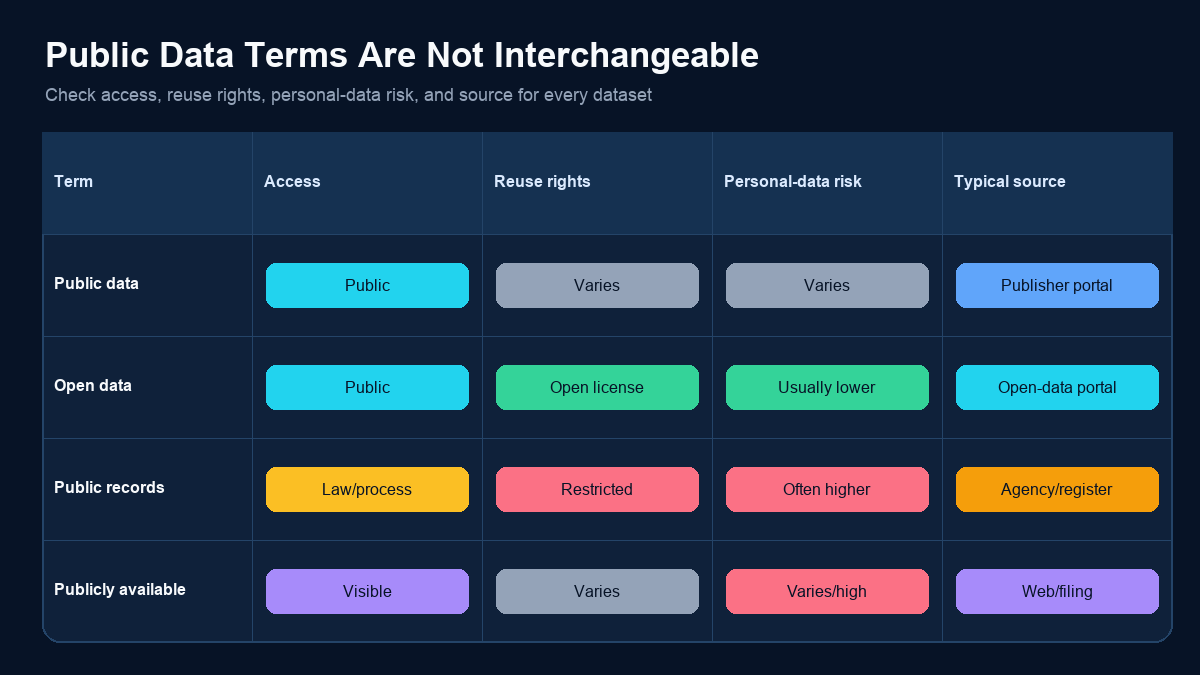
Search results mix four related concepts. Separating them prevents licensing errors and the wrong kind of source selection.
Public data
An umbrella term for data available to the public. Access methods and reuse rights vary by publisher and dataset. Examples include downloadable economic tables, public dashboards, regulatory filings, court registers, and documented APIs.
Open data
Data released under terms that permit reuse and redistribution. Open data should include a clear license or public-domain statement. The U.S. Data.gov portal aggregates government datasets, but each catalog entry still needs publisher, resource, and license review.
Public records
Records that a government body makes accessible under applicable law, such as property, court, licensing, or election records. Commercial services may aggregate people, property, phone, vehicle, voter, or offender records. Availability does not remove purpose restrictions, accuracy concerns, correction rights, or privacy risk.
Publicly available information
Information visible on websites, filings, directories, publications, or social platforms. It may be copyrighted, personal, incomplete, taken out of context, or restricted by terms of service. Our publicly available information guide covers that broader category.
Types of Public Data
The right source depends on the question, not on which portal is easiest to search.
Government and administrative data
Budgets, contracts, permits, inspections, transport, schools, service delivery, and administrative boundaries. Check whether the release is raw administrative data, an aggregate report, or a catalog pointer.
Official statistics
Population, labor, prices, trade, health, education, and national accounts. Statistical releases usually include methodology, revisions, seasonal adjustment, and confidence information that must travel with the values.
Geospatial and environmental data
Boundaries, addresses, land use, elevation, weather, emissions, water, and environmental monitoring. Coordinate reference systems, spatial resolution, observation time, and coverage gaps are essential metadata.
Research data
Survey responses, experimental outputs, replication files, and institutional repositories. Review consent, anonymization, codebooks, sample design, citation requirements, and repository versioning.
Regulatory and company disclosures
Corporate filings, procurement notices, environmental disclosures, enforcement actions, and licensed-professional registers. A filing reports what was submitted under a particular regime; it is not automatically a complete operational dataset.
Public-record search data
People, property, court, phone, vehicle, voter, and licensing records may appear through government registers or commercial aggregators. These records create higher identity, fairness, freshness, and correction risks than an aggregate economic dataset.
Where to Find Public Data
Start from the organization responsible for producing or administering the data. Aggregators are useful for discovery, but an authoritative source is better evidence for methodology and updates.
| Source | Best for | Access | What to verify |
|---|---|---|---|
| Data.gov | U.S. federal, state, and local catalog discovery | Catalog pages, files, APIs | Publishing agency, resource URL, update date, license |
| DATA.GOV.HK | Hong Kong public-sector datasets | Files, APIs, catalog | Department, update frequency, API limits, language and geography |
| data.gov.my | Malaysian government data | Catalog, download, programmatic access | Agency, release date, field definitions, reuse terms |
| Data Commons | Exploring connected demographic, economic, health, and place statistics | Browser, API, graph concepts | Original source, statistical variable, date, place, provenance |
| World Bank Open Data | Cross-country development indicators | Download, API | Indicator definition, country coverage, revisions, units |
| U.S. Census Data API | U.S. demographic and economic datasets | API | Dataset/year, geography hierarchy, variable concept, margins of error |
For a single portal reliability example, see how to evaluate Data USA. For a wider acquisition workflow, use how to get data for analysis.
How to Access Public Data
The access method changes the evidence you need to preserve.
Downloaded files
CSV, JSON, spreadsheet, Parquet, shapefile, and archive downloads are easy to save but easy to detach from context. Store the landing page, original filename, checksum, access time, release date, license, and unmodified raw copy.
APIs
APIs improve repeatability but introduce pagination, rate limits, parameters, schema changes, and revision behavior. Record the endpoint, request parameters, response status, retrieval time, page count, row count, and any server-provided version.
Public warehouses and query services
Some publishers or cloud platforms expose datasets through SQL or graph interfaces. Save the exact query, project or dataset identifier, snapshot or observation time, bytes/rows returned, and documented source lineage.
Dashboards and reports
A dashboard may display a number without exposing the underlying row set. Look for download controls, methodology, notes, definitions, and source tables. A screenshot is not a reusable dataset and may omit filters or revision status.
Our online data sources guide covers connector and API mechanics. The data facts guide focuses on preserving evidence for individual numerical claims.
How to Validate a Public Dataset
Use the same gate before analysis, publication, model training, or joining a public source to private records.
The validation checklist
- Publisher — Is the organization authoritative for this subject?
- Dataset identity — Is there a stable title, identifier, and landing page?
- License — Are access, modification, redistribution, commercial use, and attribution addressed?
- Methodology — How was the data collected, sampled, modeled, or administratively generated?
- Grain — What does one row represent?
- Coverage — Which people, places, events, and periods are included or excluded?
- Vintage and revisions — When was it observed, released, and last revised?
- Units and definitions — Are measures, currency, prices, rates, and denominators explicit?
- Missingness and suppression — Are blanks, confidential cells, estimates, and quality flags distinguishable?
- Provenance — Can another reviewer reproduce the retrieval and transformations?
Do not collapse these checks into a single “trusted” score. A dataset can have an authoritative publisher and still be stale, geographically incomplete, or unsuitable for an individual-level decision.
Privacy, Licensing, and Safe Reuse
Public access is not a waiver of responsibility.
- License: A page without a clear reuse license may permit reading but not republication or commercial redistribution.
- Personal information: Public records can identify people. Combining sources can increase sensitivity or enable re-identification.
- Purpose: Laws and terms may restrict screening, eligibility, credit, employment, housing, or other consequential uses.
- Accuracy: Administrative records can be delayed, duplicated, contested, or corrected after an aggregator copied them.
- Bias: Collection practices may undercount groups, reflect enforcement patterns, or encode changing definitions.
- Security: Joining public keys with private customer records can reveal relationships not present in either source alone.
- Citation: Attribute the publisher and dataset, not merely the portal or aggregator that helped discover it.
When the task concerns an identifiable person, legal right, or consequential decision, involve privacy, legal, and domain reviewers before retrieval—not after publication.
Worked Example: From Portal to Citable Analysis
Suppose an analyst needs a regional unemployment series for a planning memo. The workflow is reproducible without claiming that one portal is universally best.
- Search an official statistics portal or Data.gov catalog for the relevant labor series.
- Open the publishing agency's dataset page rather than downloading a third-party mirror.
- Record the dataset identifier, release date, observation period, geography, units, seasonal-adjustment status, methodology, and license.
- Retrieve the file or API response and preserve the raw artifact plus a checksum.
- Confirm that one row's grain matches the intended region and period.
- Inspect missing, suppressed, preliminary, and revised values before calculating changes.
- Save the query or transformation and reconcile at least one value against the publisher's displayed release.
- Cite the publisher, dataset, table or series, vintage, access date, and retrieval URL in the memo.
This example provides the task-completion asset: a reviewer can repeat the same steps and compare the same evidence. It does not fabricate a benchmark, success rate, or customer outcome.
Frequently Asked Questions
Is public data free?
Often, but not always. A dataset may be free to view or download while imposing attribution, redistribution, commercial-use, API-volume, or account requirements. Check the dataset-level terms.
Is all public data open data?
No. Open data carries permissions for use, modification, and sharing. Some publicly accessible information has unclear or restrictive reuse terms, so public access alone is insufficient.
Are public records public data?
Public records are one category of public data, governed by record-specific laws and access procedures. They may contain personal information and require stronger accuracy, purpose, correction, and privacy controls.
Can public data contain personal information?
Yes. Court, property, licensing, voter, and other records can identify people. Even aggregated datasets can become identifying when combined with other sources or very small groups.
How should public data be cited?
Cite the original publisher, dataset title, stable identifier or table, release or vintage, relevant filters, access date, and URL. Preserve the retrieval request and transformation steps when the result supports a material claim.
Conclusion
Public data is useful because it can make research, services, applications, and accountability more accessible. Its value depends on disciplined source selection: authoritative publisher, explicit reuse terms, documented method, known vintage, suitable grain, privacy review, and reproducible citation.
Use portals and aggregators for discovery. Use the original publisher and dataset documentation for evidence. Keep public-record search as a distinct, higher-risk branch rather than treating every accessible record as an open dataset.