On this page本文目录
What Is Data Mapping?什么是数据映射?
This focused article is part of the complete data integration guide; use the pillar guide to compare related concepts, methods, and implementation decisions across the full topic.
本文是完整的数据集成指南内容集群中的专题文章;如需比较完整主题下的相关概念、方法与实施决策,请返回基石指南。
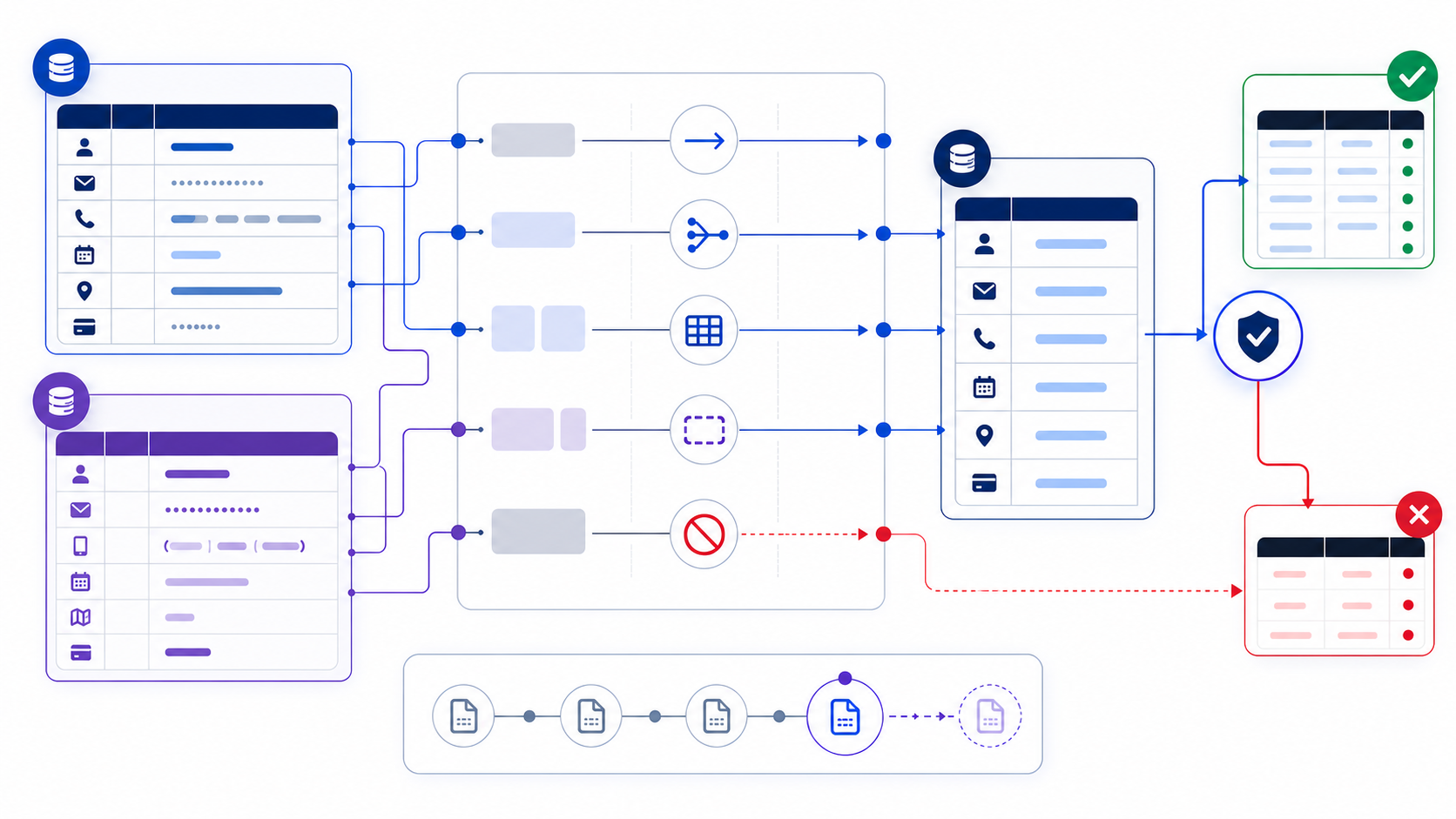
Data mapping is the documented relationship between source data elements and target data elements, including the rules needed to preserve meaning when values move or are reshaped. A complete map says not only “source A goes to target B,” but also how types, formats, identifiers, code values, nulls, defaults, combinations, splits, filters, and rejected records behave.
数据映射是源数据元素与目标数据元素之间的成文关系,并包含数据移动或重塑时保留含义所需的规则。完整映射不只写“源A进入目标B”,还要说明类型、格式、标识符、代码值、空值、默认值、合并、拆分、过滤和拒绝记录如何处理。
A field map can be a reviewed spreadsheet, a configuration file, a visual canvas, SQL, or code. The format matters less than whether the specification is explicit, versioned, testable, and owned. The mapping becomes useful when another person can reproduce the intended target without relying on the original designer's memory.
字段映射可以表现为经过评审的电子表格、配置文件、可视化画布、SQL或代码。形式不如规范是否明确、可版本化、可测试且有负责人重要。当其他人无需依赖原设计者的记忆,也能复现预期目标时,映射才真正有用。
Data mapping is commonly used inside data integration, migration, synchronization, API mediation, analytics modeling, and system consolidation. It is a specification step, not proof that the movement succeeded: execution, observability, reconciliation, security, and rollback remain separate responsibilities.
数据映射常用于数据集成、迁移、同步、API中介、分析建模和系统整合。它是一项规范工作,不代表移动已经成功;执行、可观测性、对账、安全和回滚仍是独立责任。
When Data Mapping Matters—and When It Is Not Enough何时需要数据映射,何时仅靠映射不够
Teams search for data mapping when two systems describe the same business fact differently. A source may store a country name while the target expects an ISO-style code; two name fields may become one display field; a local timestamp may need a defined timezone conversion; or several source statuses may collapse into a controlled target vocabulary. Without an explicit map, these choices hide inside scripts and become difficult to review.
当两个系统以不同方式描述同一业务事实时,团队需要数据映射。源系统可能保存国家名称,而目标需要标准代码;两个姓名字段可能合并为一个显示字段;本地时间戳需要明确时区转换;多个源状态也可能归并到受控目标词表。如果没有明确映射,这些决定会隐藏在脚本中,难以评审。
Migration, source onboarding, API payload translation, warehouse loading, application synchronization, master-data harmonization, and controlled report feeds all need source-to-target mapping.
迁移、数据源接入、API载荷翻译、数仓装载、应用同步、主数据协调和受控报表供数都需要源到目标映射。
A mapping cannot choose the right business definition, repair unknown source defects, authorize access, prove lineage, size infrastructure, schedule cutover, or guarantee downstream adoption.
映射不能替你选择正确业务定义,也不能自动修复未知源缺陷、授权访问、证明血缘、规划基础设施、安排切换或保证下游采用。
Do not use a field correspondence table as a substitute for a data model or privacy inventory. A model defines the target structure and relationships; a privacy record of processing activities answers a different governance question. Mapping begins after the relevant source and target meanings are sufficiently understood.
不要把字段对应表当作数据模型或隐私处理活动清单。数据模型定义目标结构与关系;隐私处理记录回答不同的治理问题。只有在源与目标含义得到充分理解后,映射工作才应开始。
What a Source-to-Target Mapping Document Must Contain源到目标数据映射文档必须包含什么
A data mapping document is an executable agreement between domain owners, source owners, target designers, engineers, testers, security reviewers, and operators. Each row should be precise enough to implement and precise enough to reject an incorrect implementation.
数据映射文档是业务域负责人、源系统负责人、目标设计者、工程师、测试人员、安全审核人员和运维人员之间可执行的约定。每一行都应足够精确,既能指导实现,也能判定错误实现。
| Element要素 | Record记录内容 | Why it matters重要原因 |
|---|---|---|
| Source源 | System, object, field path, type, timezone, sensitivity, sample shape系统、对象、字段路径、类型、时区、敏感性、样例形态 | Prevents mapping a label without its real context避免脱离真实上下文只映射字段名称 |
| Target目标 | Object, field path, definition, type, required state, key role对象、字段路径、定义、类型、必填状态、键角色 | Defines the acceptance contract定义验收契约 |
| Rule规则 | Direct copy, expression, lookup, join, split, merge, default, filter, reject直接复制、表达式、查找、连接、拆分、合并、默认、过滤、拒绝 | Makes transformation behavior reviewable使转换行为可以评审 |
| Exceptions异常 | Null policy, invalid values, duplicates, unmatched references, error destination空值策略、无效值、重复值、未匹配引用、错误去向 | Stops silent loss and accidental defaults阻止静默丢失和意外默认值 |
| Evidence证据 | Fixture, expected output, reconciliation query, owner, approval, version测试数据、预期输出、对账查询、负责人、批准、版本 | Supports repeatable verification and change control支持可重复验证和变更控制 |
Add direction and cardinality. A mapping from source to target is not automatically reversible, and one-to-one, many-to-one, one-to-many, and conditional mappings have different loss and duplication risks. Record any precedence rule when multiple sources can populate the same target.
还要记录方向和基数。源到目标映射并不自动可逆;一对一、多对一、一对多和条件映射具有不同的丢失与重复风险。当多个源都可以填充同一目标时,必须记录优先级规则。
Data Mapping Rules: Direct, Derived, Lookup, and Exception Paths数据映射规则:直接、派生、查找与异常路径
Most mapping rows fit a small set of patterns, but their details must be explicit. A visual line between fields is only a candidate relationship until the type, direction, condition, and failure behavior are defined.
大多数映射行都属于少数几类模式,但细节必须明确。字段之间的一条可视化连线只是候选关系,只有定义类型、方向、条件和失败行为后才构成可靠映射。
| Pattern模式 | Example behavior示例行为 | Required decision必须决定 |
|---|---|---|
| Direct直接 | Copy a stable identifier without changing it不改变地复制稳定标识符 | Type, length, uniqueness, leading-zero preservation类型、长度、唯一性、前导零保留 |
| Rename or cast重命名或类型转换 | Convert a numeric string to an integer target把数字字符串转换为整数目标 | Invalid input and overflow behavior无效输入与溢出行为 |
| Merge or split合并或拆分 | Combine two name fields or split a composite code合并两个姓名字段或拆分复合代码 | Delimiter, order, escaping, reversibility分隔符、顺序、转义、可逆性 |
| Lookup查找 | Map source country names to governed target codes把源国家名称映射到受治理的目标代码 | Reference version, unmatched value, effective date参考表版本、未匹配值、生效日期 |
| Conditional条件 | Choose a source field by record subtype根据记录子类型选择源字段 | Precedence, mutually exclusive cases, fallback优先级、互斥条件、回退 |
| Filter or reject过滤或拒绝 | Exclude test records or quarantine invalid keys排除测试记录或隔离无效键 | Audit trail, error owner, replay process审计记录、错误负责人、重放流程 |
Defaults deserve special caution. A default can keep a pipeline running while silently changing meaning. Use it only when the business owner accepts the interpretation, and distinguish “unknown,” “not supplied,” “not applicable,” and a real zero or empty value.
默认值需要特别谨慎。默认值可以让流水线继续运行,却可能悄悄改变含义。只有业务负责人接受该解释时才应使用,并且要区分“未知”“未提供”“不适用”以及真实的零值或空值。
How to Do Data Mapping Step by Step如何逐步完成数据映射
- Define the target task and acceptance criteria. Name the migration, integration, API, report, or synchronization outcome; identify consumers, freshness, allowed loss, and rollback needs.定义目标任务与验收标准。明确迁移、集成、API、报表或同步结果,以及使用者、时效、允许损失和回滚需求。
- Inventory authoritative sources and target contracts. Capture schemas, nested paths, keys, types, formats, code sets, timezones, sensitivity, owners, and sample records. Profile values rather than trusting declarations alone.盘点权威源和目标契约。记录Schema、嵌套路径、键、类型、格式、代码集、时区、敏感性、负责人和样例记录,并实际剖析值,不只相信声明。
- Agree on business meaning before names. Confirm that similarly named fields represent the same entity, event, unit, grain, and effective time. Escalate ambiguous definitions instead of guessing.先对齐业务含义,再匹配名称。确认相似名称表示同一实体、事件、单位、粒度和生效时间;遇到歧义要升级决策,不要猜测。
- Draft source-to-target correspondences. Record direction, cardinality, transformation, lookup, default, null, rejection, precedence, and sensitivity behavior for every target field.起草源到目标对应。为每个目标字段记录方向、基数、转换、查找、默认值、空值、拒绝、优先级和敏感数据行为。
- Create representative and adversarial fixtures. Include normal values, nulls, duplicates, boundary lengths, invalid dates, unknown codes, unicode, leading zeros, late-arriving records, and conflicting source values where relevant.创建代表性和刁钻测试数据。按需包含正常值、空值、重复值、边界长度、无效日期、未知代码、Unicode、前导零、迟到记录和源冲突值。
- Review with domain, engineering, testing, security, and operations. Resolve open decisions and make one named owner accountable for each rule and exception path.与业务域、工程、测试、安全和运维共同评审。解决未决事项,并为每条规则和异常路径指定一名明确负责人。
- Implement from the versioned specification. Keep code or configuration traceable to mapping identifiers; avoid logic that exists only in an orchestration screen or private notebook.依据版本化规范实现。让代码或配置能够追溯到映射标识,避免逻辑只存在于编排界面或私人笔记中。
- Validate, reconcile, release, and monitor. Compare expected and actual outputs, reconcile counts and business totals, review rejects, obtain approval, retain rollback evidence, and alert on schema drift or exception-rate change.验证、对账、发布并监控。比较预期与实际输出,对账数量和业务总额,审查拒绝记录,取得批准,保留回滚证据,并监控Schema漂移或异常率变化。
Data Mapping Example: Customer Records to an Analytics Target数据映射示例:客户记录进入分析目标
This is a hypothetical example, not an InfiniSynapse customer case. Suppose an operational application exports customer records while an analytics target expects a governed customer table. The map must preserve identity, create a display value, standardize country representation, and define timestamp semantics.
这是一个假设示例,不是InfiniSynapse客户案例。假设某业务应用导出客户记录,而分析目标需要受治理的客户表。映射必须保留身份、创建显示值、标准化国家表示,并定义时间戳语义。
| Source源字段 | Target目标字段 | Rule规则 | Validation验证 |
|---|---|---|---|
| customer_id | customer_key | Trim surrounding spaces; keep as string; preserve leading zeros; reject blank去除两端空格;保持字符串;保留前导零;空白则拒绝 | Required and unique within source scope在源范围内必填且唯一 |
| given_name + family_name | display_name | Normalize surrounding whitespace; join non-null parts with one space规范两端空格;用一个空格连接非空部分 | Expected output fixtures for missing components and unicode针对缺失组成部分和Unicode准备预期输出 |
| country_name | country_code | Lookup through an approved, versioned reference table; quarantine unmatched values通过批准且版本化的参考表查找;隔离未匹配值 | Target value must exist in the governed code set目标值必须存在于受治理代码集中 |
| created_local | created_at_utc | Parse using the declared source timezone, reject nonexistent local times, convert to UTC按声明的源时区解析,拒绝不存在的本地时间,再转换为UTC | Known daylight-saving boundary fixtures使用已知夏令时边界测试数据 |
The example intentionally avoids invented throughput or accuracy claims. Its quality depends on agreed definitions and tests. If the source cannot establish a timezone or distinguish a missing family name from an empty value, the correct result may be an exception requiring remediation—not a guessed transformation.
该示例有意不虚构吞吐量或准确率。映射质量取决于约定的定义和测试。如果源无法确定时区,或无法区分缺失姓氏与真实空值,正确结果可能是需要修复的异常,而不是猜测性转换。
Data Mapping vs Transformation, Modeling, Lineage, and Schema Work数据映射与转换、建模、血缘及Schema工作的区别
Related disciplines share artifacts but answer different questions. Keeping the boundaries clear prevents one spreadsheet or diagram from being treated as evidence for work it never performed.
相关工作会共享部分产物,但回答的问题不同。明确边界可以防止把一张表格或图误当作它从未完成的工作的证据。
| Discipline工作 | Primary question主要问题 | Relationship to data mapping与数据映射的关系 |
|---|---|---|
| Data mapping数据映射 | Which source element populates which target, under what rule?哪个源元素按什么规则填充哪个目标? | The correspondence and rule specification对应关系与规则规范 |
| Data transformation数据转换 | How are values, structures, types, formats, or grain changed?值、结构、类型、格式或粒度如何改变? | Executes rules referenced by the map执行映射引用的规则 |
| Data modeling数据建模 | What entities, attributes, relationships, and constraints should exist?应该存在哪些实体、属性、关系和约束? | Creates structures that the map connects创建映射所连接的结构 |
| Data lineage数据血缘 | Where did data come from, what happened, and where is it used?数据来自哪里、经历了什么、在哪里使用? | Records evidence around implemented mappings and runs记录已实施映射及运行周围的证据 |
| Schema mappingSchema映射 | How do schema-level structures and formal constraints correspond?Schema级结构与形式约束如何对应? | A more formal structural subset; covered by a separate planned page更形式化的结构子集;由后续独立页面覆盖 |
| Semantic mapping语义映射 | How do concepts and vocabularies align in meaning?概念与词汇在含义上如何对齐? | Focuses on meaning and controlled concepts; covered separately聚焦含义与受控概念;由独立页面覆盖 |
Data integration and migration are broader delivery processes. They use mappings but also require connectivity, orchestration, security, incremental behavior, cutover, recovery, monitoring, and operating ownership. Data aggregation may be one mapped transformation, but a field map does not necessarily change grain.
数据集成和迁移是更广的交付过程。它们使用映射,但还需要连接、编排、安全、增量行为、切换、恢复、监控和运维责任。数据聚合可以是某条映射转换,但字段映射不一定改变粒度。
How to Use a Data Mapping Template Without Creating a Dead Spreadsheet如何使用数据映射模板而不产生失效表格
A spreadsheet is often the fastest review surface because domain experts can comment on each field. It becomes dangerous when it is detached from implementation, versions, and tests. Give every mapping row a stable identifier, link it to the implemented rule and fixture, and store the approved artifact with the code or release evidence.
电子表格常是最快的评审界面,因为业务专家可以逐字段评论。但当它与实现、版本和测试脱节时就会变得危险。应给每条映射行稳定标识,将其关联到实现规则和测试数据,并把批准版本与代码或发布证据一起保存。
Add status, decision owner, reviewer, approval date, open question, sensitivity, and change reason. “TBD” must have an owner and deadline rather than becoming an accidental rule.
增加状态、决策负责人、审核人、批准日期、未决问题、敏感性和变更原因。“待定”必须有负责人和期限,不能意外变成规则。
Where practical, export or generate configuration from the reviewed source of truth, or automatically compare implementation identifiers with mapping rows. Manual duplication invites drift.
在可行时从已评审的单一事实源导出或生成配置,或自动比较实现标识与映射行。手工重复录入容易漂移。
Choose the authoring format by risk and team workflow. A simple file-to-file import may need a reviewed table and tests. Nested events, conditional arrays, multiple code sets, or regulated transformations may need a declarative configuration, formal schema, executable fixtures, peer review, and signed release evidence.
应根据风险和团队流程选择编写形式。简单的文件导入可能只需评审表和测试;嵌套事件、条件数组、多套代码集或受监管转换,则可能需要声明式配置、正式Schema、可执行测试数据、同行评审和签署的发布证据。
How to Validate Data Mapping Before and After Release如何在发布前后验证数据映射
Validation must answer two questions: did every rule behave as specified, and did the target preserve the business meaning required by consumers? A successful job status proves neither. Test at field, record, relationship, aggregate, and operational levels.
验证必须回答两个问题:每条规则是否按规范运行,以及目标是否保留使用者所需的业务含义。作业状态成功不能证明任何一个。应在字段、记录、关系、汇总和运维层面测试。
Check types, formats, lengths, allowed values, null handling, timezone conversions, leading zeros, unicode, precision, rounding, and lookup versions.
检查类型、格式、长度、允许值、空值行为、时区转换、前导零、Unicode、精度、舍入和查找表版本。
Reconcile selected, written, rejected, duplicated, updated, and deleted records. Verify uniqueness, idempotence, late arrivals, and expected merge behavior.
对账选中、写入、拒绝、重复、更新和删除记录;验证唯一性、幂等性、迟到记录和预期合并行为。
Test reference integrity, parent-child counts, one-to-many expansion, many-to-one collapse, orphan handling, and conditional routing.
测试引用完整性、父子数量、一对多展开、多对一归并、孤儿记录处理和条件路由。
Compare approved totals and distributions, inspect exceptions, repeat a run safely, test rollback, and monitor drift, latency, and reject patterns.
比较批准的总额和分布,审查异常,安全重复运行,测试回滚,并监控漂移、延迟和拒绝模式。
Use independent reconciliation queries where possible. If the same flawed expression produces both the target and its check, the test may confirm itself. Retain representative fixtures and expected outputs as regression tests for every mapping version.
尽可能使用独立对账查询。如果同一个错误表达式同时产生目标与检查结果,测试可能会自证正确。每个映射版本都应保留代表性测试数据和预期输出,形成回归测试。
Govern Data Mapping as a Versioned Contract把数据映射作为版本化契约治理
Mappings change when source schemas drift, business definitions change, code sets are revised, target constraints tighten, or a new source gains precedence. Record the reason, affected consumers, compatibility expectation, effective time, migration path, approver, and rollback plan. A mapping document without version history describes only an unknown moment.
当源Schema漂移、业务定义变化、代码集修订、目标约束收紧或新数据源获得更高优先级时,映射会发生变化。应记录原因、受影响使用者、兼容性预期、生效时间、迁移路径、批准人和回滚计划。没有版本历史的映射文档只描述一个未知时刻。
Apply least privilege to source access and test fixtures. A mapping worksheet can expose field names, sensitive classifications, identifiers, lookup values, or production samples. Use representative synthetic or masked fixtures when real values are unnecessary, and keep sensitive-data handling explicit in both the map and execution environment.
对源访问和测试数据应用最小权限。映射表可能暴露字段名、敏感分类、标识符、查找值或生产样例。无需真实值时,应使用有代表性的合成或脱敏数据,并在映射与执行环境中明确敏感数据处理方式。
Change gate: do not approve a mapping update only because a preview looks plausible. Require affected fixtures, reconciliation, downstream compatibility review, exception-path verification, lineage update, and rollback evidence.
变更闸门:不要仅因预览看起来合理就批准映射更新。必须提供受影响测试数据、对账、下游兼容性评审、异常路径验证、血缘更新和回滚证据。
Common Data Mapping Failures and How to Prevent Them常见数据映射失败及预防方法
Similar labels hide different units, grain, entity scope, or effective time. Compare definitions and values before accepting a match.
相似名称可能隐藏不同单位、粒度、实体范围或生效时间。接受匹配前必须比较定义和值。
Unknown codes become a valid-looking category, destroying evidence of source defects. Quarantine or label uncertainty explicitly.
未知代码被变成看似有效的类别,源缺陷证据随之消失。应隔离或明确标记不确定性。
Many source records collapse without a deterministic winner, or one record expands unexpectedly. State keys, ordering, and deduplication policy.
多条源记录在没有确定胜出规则时被归并,或一条记录意外展开。必须定义键、顺序和去重策略。
Code mappings change without an effective date or version. Store the reference version used by each run and test unmatched values.
代码映射变化却没有生效日期或版本。应记录每次运行使用的参考版本并测试未匹配值。
The reviewed document and deployed logic evolve separately. Link stable row identifiers to implementation and compare them in release checks.
已评审文档与部署逻辑分别演进。应把稳定行标识关联到实现,并在发布检查中比较。
Normal examples pass while nulls, boundaries, timezone transitions, duplicates, and late records fail. Treat adversarial fixtures as required evidence.
正常样例通过,但空值、边界、时区切换、重复和迟到记录失败。应把刁钻测试数据视为必需证据。
Automated suggestions can accelerate discovery, but similarity is not approval. A person or governed rule must confirm meaning, especially for sensitive fields, financial measures, regulatory codes, and mappings that merge or discard information.
自动建议可以加速发现,但相似度不等于批准。含义仍需由人员或受治理规则确认,尤其是敏感字段、财务指标、监管代码以及会合并或丢弃信息的映射。
Use InfiniSynapse to Compare Approved Source and Target Data使用InfiniSynapse比较获准的源与目标数据
InfiniSynapse's public product language describes joint analysis across supported sources such as databases and files. That makes the web app relevant after a proposed map and test cases exist: analysts can inspect approved connected source and target data, ask focused questions, compare samples or summaries, and investigate discrepancies with supporting evidence.
InfiniSynapse公开产品语言描述了对数据库和文件等受支持来源的联合分析。因此,在拟定映射和测试案例已经存在后,可以使用Web App检查获准连接的源与目标数据,提出聚焦问题,比较样例或汇总,并结合证据调查差异。
Prepare read-only connections or approved files, source and target definitions, stable keys, the mapping version, representative fixtures, expected outputs, exception rules, and independent reconciliation questions. Keep sensitive fields out of the session unless access is explicitly authorized.
请准备只读连接或获准文件、源与目标定义、稳定键、映射版本、代表性测试数据、预期输出、异常规则和独立对账问题。除非已明确授权,否则不要把敏感字段带入分析会话。
InfiniSynapse should not be described as automatically authoring source-to-target maps, applying production transformations, migrating data, enforcing target constraints, approving semantic matches, versioning contracts, or deploying pipelines. Those remain engineering, domain, security, and governance responsibilities. Use the app as an analysis surface, then retain approved mapping and execution artifacts in their systems of record.
不应把InfiniSynapse描述成会自动编写源到目标映射、执行生产转换、迁移数据、强制目标约束、批准语义匹配、管理契约版本或部署流水线。这些仍属于工程、业务域、安全与治理责任。可以把应用作为分析界面,再把批准的映射与执行产物保存在各自事实系统中。
Bring the mapping version, stable keys, expected fixtures, exception policy, and read-only access. Use InfiniSynapse to explore differences and support reconciliation; implement and deploy the mapping in the responsible data system.
请准备映射版本、稳定键、预期测试数据、异常策略和只读访问。使用InfiniSynapse探索差异并支持对账;映射的实现与部署仍应在负责的数据系统中完成。
Analyze approved connected data分析获准的已连接数据Data Mapping FAQ数据映射常见问题
What is data mapping?
什么是数据映射?
Data mapping is the documented relationship between source data elements and target data elements, including the rules needed to rename, convert, combine, split, default, filter, or reject values so the target preserves the intended meaning.
数据映射是源数据元素与目标数据元素之间的成文关系,并包含重命名、转换、合并、拆分、设置默认值、过滤或拒绝数据所需的规则,使目标结果保留预期含义。
What should a data mapping document include?
数据映射文档应该包含什么?
A useful mapping document records source and target paths, business definitions, data types, transformation and lookup rules, null and default behavior, keys, cardinality, validation tests, ownership, version, and unresolved decisions.
可用的映射文档应记录源路径和目标路径、业务定义、数据类型、转换与查找规则、空值和默认值行为、键、基数、验证测试、负责人、版本以及尚未解决的决定。
What is the difference between data mapping and data transformation?
数据映射和数据转换有什么区别?
Data mapping specifies where each source element goes and which rule applies. Data transformation is the execution that changes the value, structure, type, format, or grain according to that specification.
数据映射规定每个源元素去往何处以及应用哪条规则;数据转换则按照该规范实际改变值、结构、类型、格式或粒度。
How do you validate data mapping?
如何验证数据映射?
Validate mappings with representative and adversarial fixtures, field-level assertions, row and key reconciliation, null and duplicate checks, reference integrity, rejected-record review, business totals, lineage evidence, and repeatable regression tests.
应使用有代表性和故意刁钻的测试数据、字段级断言、行数与键对账、空值和重复值检查、引用完整性、拒绝记录审查、业务总额、血缘证据以及可重复回归测试来验证映射。
Authoritative Sources and Next Steps权威来源与下一步
Official documentation shows that real mapping mechanisms combine correspondence with explicit transformation and validation behavior. Google Cloud documents visual and scripted source-to-target variable mapping; AWS DMS separates selection, transformation, and table settings; W3C R2RML formalizes relational-to-RDF mapping; and JSON Schema documents structural validation keywords. Use the specification for the mechanism you actually deploy.
官方文档表明,真实映射机制会把对应关系与明确的转换、验证行为结合起来。Google Cloud记录了可视化和脚本化的源到目标变量映射;AWS DMS区分选择、转换与表设置;W3C R2RML形式化了关系数据到RDF的映射;JSON Schema则说明结构验证关键字。应使用与你实际部署机制一致的规范。
- Google Cloud data mapping overviewGoogle Cloud数据映射概览
- AWS DMS table mapping and transformation rulesAWS DMS表映射与转换规则
- W3C R2RML mapping language RecommendationW3C R2RML映射语言推荐标准
- JSON Schema type and validation referenceJSON Schema类型与验证参考
- InfiniSynapse guide to identifying data sourcesInfiniSynapse数据源识别指南
- InfiniSynapse guide to data quality checksInfiniSynapse数据质量检查指南
- InfiniSynapse guide to data lineageInfiniSynapse数据血缘指南