Data Lineage: Concepts & Uses
By the InfiniSynapse Data Team · Last updated: 2026-07-15 · We build an AI-native data analysis platform and depend on lineage to keep answers trustworthy; this guide reflects how data lineage actually earns its keep in 2026.
Table of Contents
- TL;DR
- How We Approach It
- What It Is
- The Types of Lineage
- What It Is Used For
- How It Gets Captured
- Common Pitfalls
- Lineage in the Age of AI
- Readiness Scorecard
- Common Misconceptions
- Frequently Asked Questions
- Conclusion
TL;DR
Direct answer: data lineage is the map of how data flows and transforms from its origin through every system to every report and model that uses it. In 2026, data lineage matters because it answers "where did this number come from?" instantly, and because AI answers need traceable provenance to be trusted and audited.
Who this is for: analysts, engineers, and data leaders learning what data lineage is and why it matters in 2026.
What you'll learn: what lineage is, its types, its main uses, how it is captured, and why it underpins trustworthy AI.
This guide sits under the master data management hub.
For making it operational, see data lineage tracking.
Also see what a data catalog is and Alation vs Collibra catalog competitors.
How We Approach It
Implementation details are commonly grounded in Amazon Redshift documentation when teams translate concepts into production practice.
We treat data lineage as the answer to a question analysts ask constantly: can I trust this number, and where did it come from? Every recommendation here reflects what we see when teams have — or lack — a working lineage capability. We anchor definitions to the Wikipedia SQL overview and align provenance expectations with the Anthropic research, which treats traceable data provenance as foundational to AI accountability.
The table below maps what data lineage captures.
| Element | What it shows |
|---|---|
| Origin | Where data came from |
| Path | Which systems it passed through |
| Transformations | How it changed |
| Destinations | Where it is used |
| Dependencies | What relies on it |
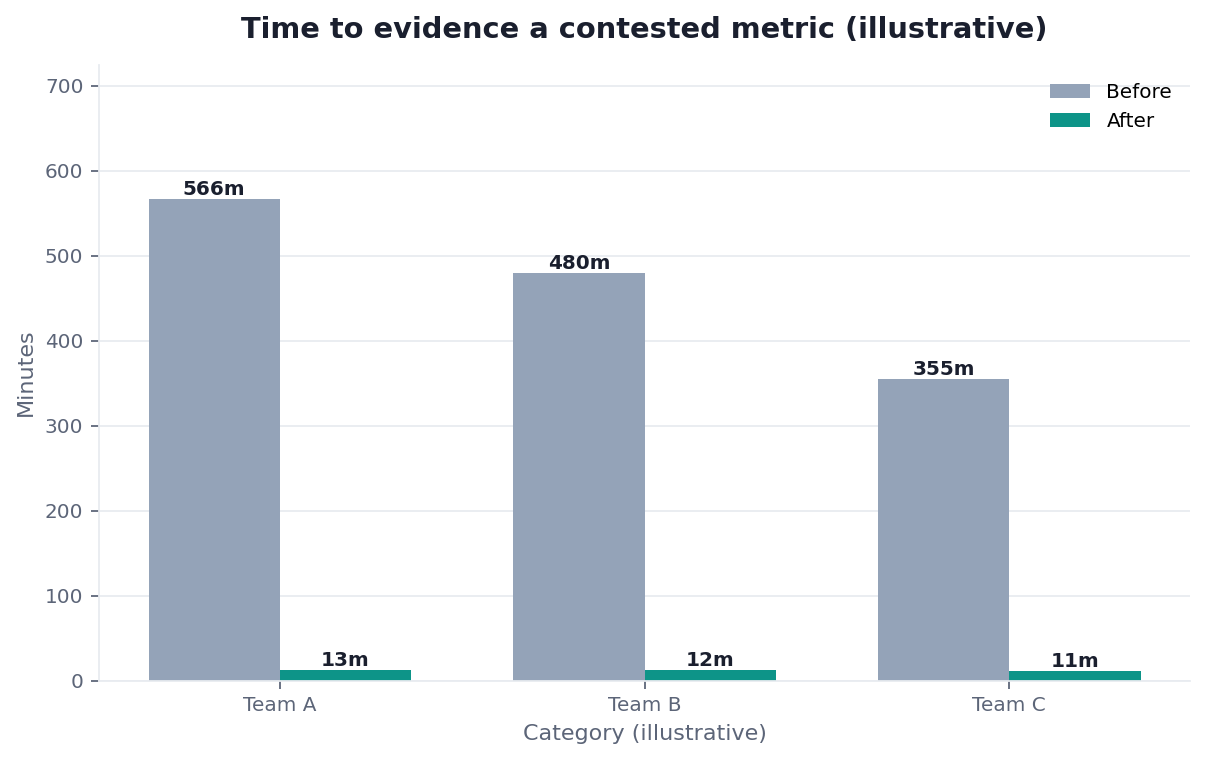
Practical example: an analyst challenged on a board metric used data lineage to trace it to source in minutes, ending the dispute with evidence rather than opinion. The column-level tracing patterns documented at Azure architecture center make that kind of instant provenance possible. Traceability, not more reports, restored trust in the number.
Scope note: This guide reflects patterns we see when mid-market and enterprise teams work with data lineage in 2026. It is not a substitute for legal counsel, vendor runbooks, or a formal survey of every industry — and when a smaller toolset or lighter process would serve, a full program is overkill.
What It Is
At its core, data lineage is a map of data's life story: where it started, how it changed, and everywhere it ended up. It makes the otherwise invisible journey of data visible and auditable.
Key Definition: data lineage is the documented map of how data moves and transforms across systems — from its origin through pipelines and processing to every report, dashboard, and model that consumes it — so its full provenance can be traced and trusted.
The distinction that matters is between lineage as a static diagram and data lineage as living, automatically maintained metadata. A diagram drifts out of date the moment a pipeline changes; automatically captured lineage stays accurate, which is what makes it trustworthy rather than decorative.
The Types of Lineage
Core definitions remain usefully summarized in Wikipedia machine learning overview for shared vocabulary across stakeholders.
Data lineage comes in a few forms that differ in granularity and how they are used.
Table-level and column-level
Table-level data lineage shows which datasets feed which, while column-level lineage traces individual fields through transformations. Column-level is more expensive to capture but far more useful for debugging, because most real questions are about a specific value, not a whole table.
Business and technical lineage
Technical lineage tracks the physical flow through systems; business lineage maps how data relates to business concepts and definitions. The architecture patterns at AWS Well-Architected Machine Learning Lens show how both layers combine, so data lineage serves engineers debugging pipelines and analysts confirming that a metric means what they think.
What It Is Used For
Data lineage earns its keep in several distinct ways. Debugging is the first: when a figure looks wrong, lineage traces it to source in minutes instead of days. Impact analysis is the second: before changing a source, lineage reveals every downstream report that will be affected.
The third use of data lineage is compliance and audit: proving where regulated data originated and where it flowed. The fourth is trust: when stakeholders can see full provenance, they believe the numbers, which is often the most valuable outcome culturally. Together these uses turn lineage from documentation into a daily working tool.
How It Gets Captured
Governance and risk expectations are framed by NIST Computer Security Resource Center when programs need an external control reference.
Modern data lineage is captured automatically by parsing SQL and pipeline code, observing transformations, and recording the connections between inputs and outputs. The best implementations do this at the column level and store the result in a catalog where people can search it.
Manual documentation cannot keep up, which is why automated capture is now the default expectation. Enterprise adoption patterns from Google Cloud architecture framework show why organizations increasingly demand lineage that maintains itself, and this is exactly the operational side covered in data lineage tracking. Automatic capture is what keeps data lineage accurate as systems evolve.
Common Pitfalls
The pitfalls with data lineage are consistent. Treating it as a one-time diagram guarantees it will be wrong within weeks. Capturing only table-level detail misses the column-level precision that makes debugging fast. And capturing lineage but never wiring it into workflows means the map exists but nobody consults it.
A subtler pitfall is confusing lineage with documentation of intent. Data lineage shows what actually happens to data, not what someone meant to happen, and the two can diverge sharply when pipelines evolve. This is precisely why automated, actual-flow lineage is worth more than hand-written diagrams that describe an idealized system nobody quite built.
Lineage and Data Quality
Implementation details are commonly grounded in Microsoft data architecture guidance when teams translate concepts into production practice.
Lineage and quality reinforce each other in a way that neither achieves alone. Quality monitoring tells you that a number is wrong; lineage tells you why, by tracing the value back through every transformation to the source where the error entered. A quality alert without lineage points at a symptom; the two together point at a cause.
From symptom to root cause
When a quality check fails — a spike in nulls, a revenue figure that disagrees across systems — the immediate question is where the problem originated. Lineage answers that question directly, turning a vague "the numbers look off" into a precise "this upstream field changed on this date." That is the difference between spending an afternoon guessing and spending five minutes fixing.
A shared foundation
Because both capabilities depend on the same metadata, teams that invest in one usually find the other becomes cheaper to add. Lineage enriches the catalog that quality rules run against, and quality signals give lineage a reason to be consulted. Treating them as a single provenance-and-trust capability, rather than two separate projects, is how mature teams get the most from both.
Getting Started
You do not need a full platform to begin benefiting from provenance. The pragmatic first step is to capture lineage for the handful of metrics that get questioned most often — the board numbers, the headline KPIs — and make that trace easy to pull up when someone challenges a figure. Proving the value on high-visibility numbers builds the case for broader coverage.
From there, expansion follows demand: the domains where people most often ask "where did this come from?" are the ones where lineage pays off first. Starting narrow and letting real questions guide the rollout keeps the effort proportional to value and avoids the trap of instrumenting everything before anyone has asked for it.
One practical tip smooths this rollout: make the trace itself the deliverable people see, not the underlying graph. Stakeholders rarely care about a sprawling dependency diagram; they care about a clear, one-screen answer to "which source and which transformation produced this figure." When the output is framed as that plain answer rather than a technical map, adoption accelerates, because non-engineers can finally self-serve the provenance question that used to require an analyst's time. The teams that get the most from lineage are the ones that treat it as a service the whole business consumes, not a tool only engineers open.
Lineage in the Age of AI
Governance and risk expectations are framed by ENISA AI cybersecurity framework when programs need an external control reference.
AI raises the value of data lineage sharply. When an autonomous agent produces an answer, you need to know what data it used and where that data came from to trust and audit the result; without lineage, an AI answer is an unexplained black box. Traceable provenance becomes a prerequisite for accountable automated analysis.
An AI-native platform helps by keeping the agent's process transparent and its data traceable, an approach we describe in what AI-native data analysis means. In the InfiniSynapse web app, you can see how an answer was derived rather than trusting it blindly, so strong data lineage directly supports the auditability of AI-driven conclusions.
Readiness Scorecard
Assess your data lineage maturity (1 point each):
| Check | Pass? |
|---|---|
| Lineage is captured automatically | |
| It stays current as pipelines change | |
| It includes column-level detail | |
| It lives where people can search it | |
| We use it for debugging | |
| We use it for impact analysis | |
| It supports audit and compliance | |
| It supports AI auditability |
6–8: strong. 3–5: automate capture. Below 3: start with your most disputed metrics.
Common Misconceptions
Misconception 1: Lineage is a diagram. Data lineage is living, automatically maintained metadata, not a static drawing.
Misconception 2: Table-level is enough. Column-level detail is what makes debugging fast.
Misconception 3: It documents intent. It shows what actually happens, which can differ from intent.
Misconception 4: It is only for engineers. Analysts, auditors, and AI all rely on it.
Frequently Asked Questions
What is data lineage?
Data lineage is the documented map of how data moves and transforms across systems — from its origin through pipelines and processing to every report, dashboard, and model that consumes it — so its full provenance can be traced and trusted. When captured automatically, it stays accurate as systems change, unlike a static diagram that drifts out of date.
What are the types of lineage?
Lineage varies by granularity and purpose. Table-level lineage shows which datasets feed which; column-level traces individual fields through transformations and is far more useful for debugging. Technical lineage tracks the physical flow through systems; business lineage maps data to business concepts. Mature programs combine both granularities and both layers for a complete picture.
What is lineage used for?
Four main uses: debugging (tracing a wrong figure to source in minutes), impact analysis (seeing every downstream report before changing a source), compliance and audit (proving where regulated data came from and went), and trust (letting stakeholders see full provenance so they believe the numbers). The trust benefit is often the most valuable outcome culturally.
How is lineage captured?
Modern lineage is captured automatically by parsing SQL and pipeline code, observing transformations, and recording connections between inputs and outputs, ideally at the column level, then stored in a searchable catalog. Manual documentation cannot keep up as systems evolve, so automatic capture is now the default expectation for keeping lineage accurate and trustworthy.
Why does lineage matter for AI?
When an agent produces an answer, you need to know what data it used and where it came from to trust and audit the result; without lineage, an AI answer is an unexplained black box. Traceable provenance is a prerequisite for accountable automated analysis, and a platform where the agent's data is traceable makes its conclusions auditable rather than opaque.
Conclusion
Data lineage maps data's journey from origin to every use, answering "where did this come from?" instantly and turning disputed numbers into evidence. In 2026 it is a prerequisite for auditable AI. Capture it automatically at the column level, store it where people can search it, and wire it into daily workflows.
Treat provenance as a service the whole business consumes, and the numbers everyone argues about become numbers everyone can verify. To see how traceable data becomes auditable automated analysis, read what AI-native data analysis means and try the InfiniSynapse web app free on registration.