What Is a Data Catalog?
By the InfiniSynapse Data Team · Last updated: 2026-07-15 · We build an AI-native data analysis platform and rely on catalog metadata to keep answers grounded; this guide reflects what a data catalog really does in 2026, not a glossary entry.
Table of Contents
- TL;DR
- How We Approach It
- What It Is
- What It Contains
- What It Is Used For
- How One Stays Useful
- Common Pitfalls
- The Catalog in the Age of AI
- Readiness Scorecard
- Common Misconceptions
- Frequently Asked Questions
- Conclusion
TL;DR
Direct answer: a data catalog is an organized, searchable inventory of an organization's data that records what each dataset means, who owns it, and where it came from. In 2026, a data catalog matters because people and AI agents alike need to find and trust data quickly, and a catalog is what makes scattered data discoverable and understandable.
Who this is for: analysts, stewards, and data leaders learning what a data catalog is and why it matters in 2026.
What you'll learn: what a catalog is, what it contains, its main uses, how it stays useful, and why it underpins trustworthy AI.
This guide sits under the master data management hub.
For the software category—including Alation vs Collibra and competitor shortlists—see Alation vs Collibra: catalog competitors.
Also see data lineage.
How We Approach It
Implementation details are commonly grounded in Databricks documentation when teams translate concepts into production practice.
We treat a data catalog as the answer to a question every analyst asks: what data do we have, what does it mean, and can I trust it? Every recommendation here reflects what we see when organizations have — or lack — a working catalog. We anchor definitions to the MariaDB documentation and weigh catalog design against the reference architectures at Databricks Genie architecture post, which show how catalog metadata drives discovery and governance.
The table below maps what a data catalog records.
| Element | What it captures |
|---|---|
| Datasets | What data exists |
| Definitions | What each field means |
| Ownership | Who is accountable |
| Lineage | Where data came from |
| Quality | How trustworthy it is |
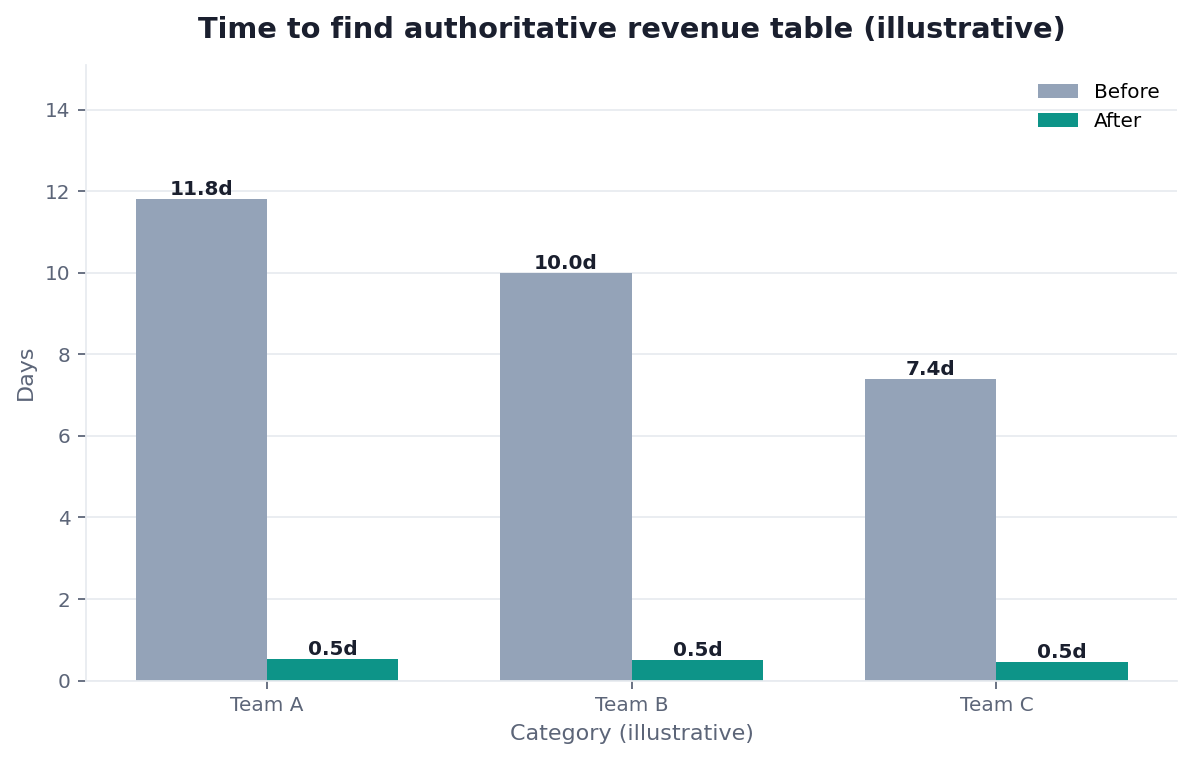
Practical example: a new analyst spent two weeks discovering which of five "revenue" tables was authoritative. After a data catalog recorded definitions and ownership — following metadata patterns like those in Redis documentation — that answer took one search. Findability, not more data, made the analyst productive.
Scope note: This guide reflects patterns we see when mid-market and enterprise teams work with data catalog in 2026. It is not a substitute for legal counsel, vendor runbooks, or a formal survey of every industry — and when a smaller toolset or lighter process would serve, a full program is overkill.
What It Is
At its core, a data catalog is an organized inventory that makes an organization's data discoverable and understandable. It answers what data exists, what it means, who owns it, and where it came from, all in one searchable place.
Key Definition: a data catalog is a searchable, organized inventory of an organization's data assets that captures their metadata — meaning, ownership, lineage, and quality — so people and systems can find, understand, and trust the data they need.
The distinction that matters is that a data catalog is about understanding, not just listing. A bare list of table names is not a catalog; a catalog adds the context — definitions, ownership, lineage — that turns a name into something a person can actually use and trust. That context is the whole point.
What It Contains
Governance and risk expectations are framed by UK NCSC AI development guidelines when programs need an external control reference.
A useful data catalog contains more than an index of datasets; it captures the context that makes data usable.
Technical and business metadata
Technical metadata describes the data's structure — tables, columns, types — while business metadata describes its meaning: what "active customer" means, which revenue figure is authoritative. A strong data catalog holds both, so an engineer and a business analyst can each find what they need in language they understand.
Ownership, lineage, and quality
Beyond definitions, a data catalog records who owns each dataset, where it came from, and how trustworthy it is. The reliability framing in NIST SP 800-53 security controls shows why these three signals matter most: they answer the "can I trust this?" question that findability alone cannot.
What It Is Used For
A data catalog earns its keep in several ways. Discovery is the first: analysts find the right dataset in seconds instead of asking around for days. Understanding is the second: definitions and lineage explain what a field means and where it came from, so it is used correctly.
The third use of a data catalog is governance: it is where ownership, access rules, and sensitivity classifications live, making policy enforceable rather than aspirational. The fourth is trust: when people can see a dataset's definition, owner, and lineage, they believe the numbers built from it. Enterprise adoption patterns from AWS Well-Architected Framework show why these uses now sit at the center of a modern data platform rather than at its edges. Together they turn a catalog from an inventory into a daily working tool.
How One Stays Useful
Teams evaluating this topic often cross-check MongoDB documentation for a durable, vendor-neutral reference point.
A data catalog stays useful only if it stays current, which is why automated population matters more than any single feature. A catalog maintained by hand drifts out of date and, worse, misleads the people who trust it.
The reliable pattern is to populate one important domain completely — real owners, definitions, and lineage — and keep it fresh automatically, rather than thinly covering everything. This is where a data catalog connects to data lineage, because lineage is often the feature that makes a catalog indispensable: it answers "where did this number come from?" without a manual investigation. Depth in one domain that stays current beats broad coverage that decays.
Common Pitfalls
The pitfalls with a data catalog are consistent. Relying on manual entry produces a catalog that drifts out of date and loses trust. Cataloging only technical metadata leaves business users unable to understand what data means. And treating the catalog as a compliance artifact rather than a daily tool produces something people fill in but never consult.
A subtler pitfall is neglecting search quality. A data catalog only delivers value when people can find what they need quickly, so poor search quietly kills adoption no matter how complete the metadata is. We weigh everyday findability as heavily as completeness, because a catalog nobody searches is a catalog nobody trusts, and an untrusted catalog is quickly abandoned.
How It Differs From Related Tools
Teams evaluating this topic often cross-check Shopify ecommerce analytics for a durable, vendor-neutral reference point.
People often confuse a data catalog with neighboring tools, and clarifying the boundaries prevents wasted effort. A catalog is not a database — it does not store your data, it describes it. It is not a business intelligence tool — it does not visualize data, it helps you find and understand it. And it is not a governance suite by itself, though it is often where governance metadata lives.
Catalog versus data dictionary
A data dictionary documents the structure and meaning of fields, and in that sense it is a subset of what a modern catalog does. A catalog goes further by adding discovery, search, lineage, ownership, and quality signals across the whole estate, rather than documenting one system's schema. If a dictionary answers "what does this column mean," a catalog also answers "where is the data I need, who owns it, and can I trust it."
Why the distinctions matter
Confusing these tools leads teams to expect the wrong thing — to be surprised that a catalog does not store data, or that a BI tool does not help them discover unfamiliar datasets. Understanding that a catalog is the connective, descriptive layer over your data helps you position it correctly in the stack and set realistic expectations for what it will and will not do.
Getting Started
You do not need to catalog everything to start benefiting. The pragmatic first step is to fully document your most-used data — the tables analysts query daily — with real owners, clear definitions, and lineage, and to keep that documentation current automatically. A small, trustworthy, well-searched catalog beats a sprawling one that nobody believes.
From there, expansion follows demand: the datasets people most often struggle to find or trust are the ones a catalog should cover next. Letting real questions guide the rollout keeps the effort proportional to value and builds the adoption that makes a catalog self-sustaining, because each well-documented domain proves the catalog's worth to the next team that needs it.
The Catalog in the Age of AI
Governance and risk expectations are framed by CISA AI security guidance when programs need an external control reference.
AI sharply raises the value of a data catalog. When an autonomous agent reads your data to answer questions, it relies on catalog metadata to understand what each field means and where it came from; without governed metadata, the agent produces inconsistent or wrong answers. The catalog becomes part of your AI infrastructure, not a back-office utility.
An AI-native platform closes the gap by binding governed definitions and lineage to the data an agent queries, an approach we describe in what AI-native data analysis means. In the InfiniSynapse web app, business definitions travel with the data as a semantic layer, so the metadata your data catalog maintains directly improves the reliability of AI answers rather than sitting in a silo.
Readiness Scorecard
Assess your data catalog maturity (1 point each):
| Check | Pass? |
|---|---|
| It is populated automatically | |
| It holds both technical and business metadata | |
| Datasets have named owners | |
| It records lineage | |
| It shows quality signals | |
| Search is fast and accurate | |
| People use it daily | |
| Agents can read its metadata |
6–8: strong catalog. 3–5: automate and deepen one domain. Below 3: start with your most-used data.
Common Misconceptions
Misconception 1: A catalog is a list of tables. A data catalog adds meaning, ownership, and lineage that a list lacks.
Misconception 2: Technical metadata is enough. Business meaning is what makes data usable.
Misconception 3: Populate it once. A catalog must stay continuously current.
Misconception 4: It is only for humans. AI agents rely on catalog metadata too.
Frequently Asked Questions
What is a data catalog?
A data catalog is a searchable, organized inventory of an organization's data assets that captures their metadata — meaning, ownership, lineage, and quality — so people and systems can find, understand, and trust the data they need. It differs from a bare list of table names by adding the context that turns a name into something usable and trustworthy.
What does it contain?
It contains technical metadata (structure — tables, columns, types), business metadata (meaning — what "active customer" means, which revenue figure is authoritative), ownership (who is accountable), lineage (where data came from), and quality signals (how trustworthy it is). Holding both technical and business metadata lets engineers and analysts each find what they need in language they understand.
What is it used for?
Four main uses: discovery (finding the right dataset in seconds), understanding (definitions and lineage explain what data means and where it came from), governance (ownership, access rules, and sensitivity classifications live there), and trust (visible definition, owner, and lineage make people believe the numbers). Together these turn an inventory into a daily working tool.
How does a catalog stay useful?
It stays useful only if it stays current, which is why automated population matters more than any single feature. A catalog maintained by hand drifts out of date and misleads the people who trust it. The reliable pattern is to populate one important domain completely and keep it fresh automatically, rather than thinly covering everything and letting it decay.
Why does a catalog matter for AI?
When an agent reads your data to answer questions, it relies on catalog metadata to understand what each field means and where it came from; without governed metadata, it produces inconsistent or wrong answers. The catalog becomes part of your AI infrastructure, and an AI-native platform that carries definitions with the data ensures the metadata directly improves the reliability of agent answers.
Conclusion
A data catalog is a searchable inventory that records what your data means, who owns it, and where it came from — turning scattered data into something people and AI can find and trust. In 2026 it is increasingly part of your AI infrastructure. Populate it automatically, capture business meaning, deepen one domain, and keep it current.
To see how governed definitions and lineage travel with data into automated analysis, read what AI-native data analysis means and try the InfiniSynapse web app free on registration.