ETL Tools for Snowflake, BigQuery, Redshift
- Data integration platforms supporting Snowflake BigQuery Redshift split into three categories: managed ELT (Fivetran, Stitch, Hevo, Airbyte Cloud), self-hosted ELT (Airbyte OSS), and warehouse-side ETL (Matillion).
- Managed ELT trades operating cost for connector breadth and zero-maintenance. Self-hosted ELT trades operating effort for cost control and connector ownership. Warehouse-side ETL fits teams that prefer SQL-style transformations close to the data.
- Fivetran is the de facto leader on connector breadth and reliability; pricing is per Monthly Active Rows and scales steeply. Airbyte OSS is the cost-controlled alternative when you have an engineer to operate it.
- Stitch is a credible mid-market managed option; Hevo lands well in Asia-Pacific markets; Matillion is a strong pick for SQL-first teams that want transformation close to the warehouse.
- Pick by source coverage first, transformation model second, total cost third when shortlisting data integration platforms supporting Snowflake BigQuery Redshift. After the loader, wire dbt for modeling and an AI data agent for ad-hoc cross-source queries.
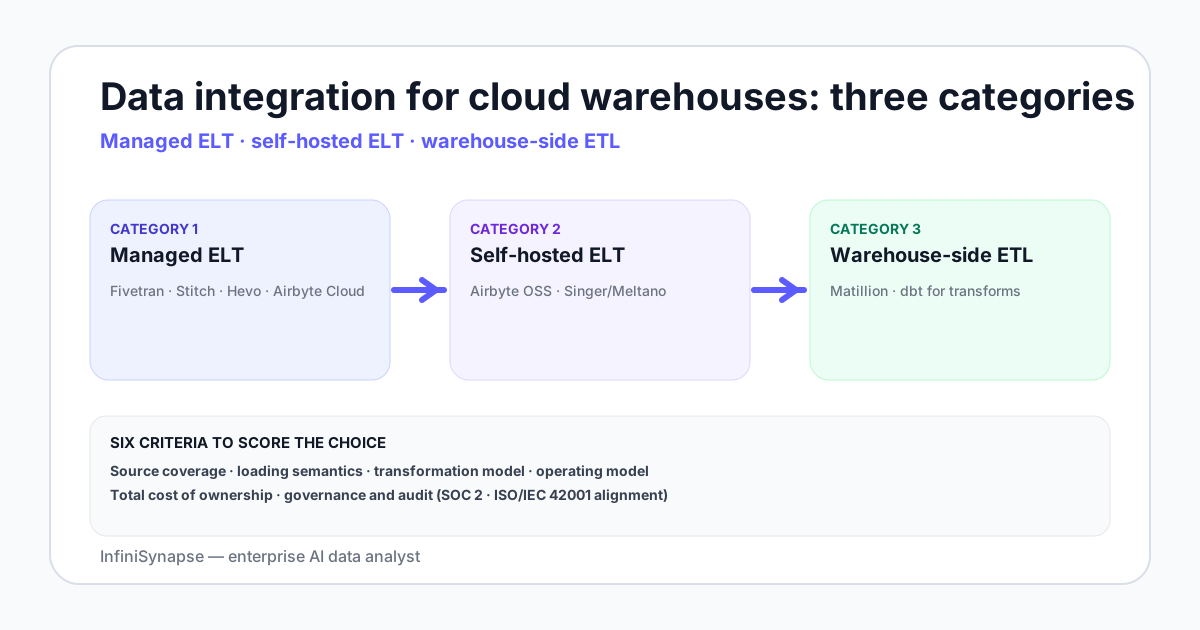
Three categories of data integration platforms supporting Snowflake BigQuery Redshift
| Category | Examples | Strength | Tradeoff |
|---|---|---|---|
| Managed ELT | Fivetran, Stitch, Hevo, Airbyte Cloud | Zero-maintenance connectors | Cost scales with rows or events |
| Self-hosted ELT | Airbyte OSS, Singer/Meltano | Cost control + customization | Engineer time to operate |
| Warehouse-side ETL | Matillion, dbt Cloud (for transforms) | SQL-style transformation close to data | Less canonical for raw loading |
Most teams evaluating data integration platforms supporting Snowflake BigQuery Redshift end up with one managed loader (Fivetran or Airbyte Cloud for breadth) plus dbt for transformation. Self-hosted ELT shows up when row volumes make managed pricing painful; warehouse-side ETL shows up when transformation policy demands it. The shared control plane—identity, policy, lineage, and when to federate instead of load—is the data integration platform architecture memo, not this vendor scorecard.
Honest vendor reads for data integration platforms supporting Snowflake BigQuery Redshift
Fivetran
The default managed ELT choice among data integration platforms supporting Snowflake BigQuery Redshift. Strengths are connector breadth (300+), reliability, and incremental sync handling. The pain point is pricing — Monthly Active Rows (MAR) scales with data volume in a way that surprises growing teams. Read the Fivetran pricing page and model your top three sources before signing.
Airbyte (OSS and Cloud)
Open-source connectors with a cloud option — a frequent shortlist pick for cost-controlled data integration platforms supporting Snowflake BigQuery Redshift. Strengths are the connector catalog and cost control on the self-hosted path. The tradeoff on OSS is operating burden — engineer time to maintain, monitor, and recover. Airbyte Cloud closes that gap with managed hosting.
Stitch
Credible mid-market managed option owned by Talend among data integration platforms supporting Snowflake BigQuery Redshift. Strengths are simple per-row pricing and a clean UI for analyst-operated setups. Connector breadth is smaller than Fivetran; long-tail SaaS sources may not be supported.
Hevo Data
Strong managed ELT player with notable Asia-Pacific adoption among data integration platforms supporting Snowflake BigQuery Redshift. Strengths are no-code pipeline UI and live integration monitoring. Pricing is event-based; well-suited for teams with predictable event volumes.
Matillion
Warehouse-side ETL among data integration platforms supporting Snowflake BigQuery Redshift — runs transformations inside the warehouse with a visual designer plus SQL. Strongest fit when transformation policy and lineage matter more than maximum connector breadth, and when a SQL-first analytics engineering team is the operator.
Six criteria to score the choice
Use this matrix when comparing data integration platforms supporting Snowflake BigQuery Redshift. Score each candidate 1–5; decide on per-criterion gaps, not totals alone.
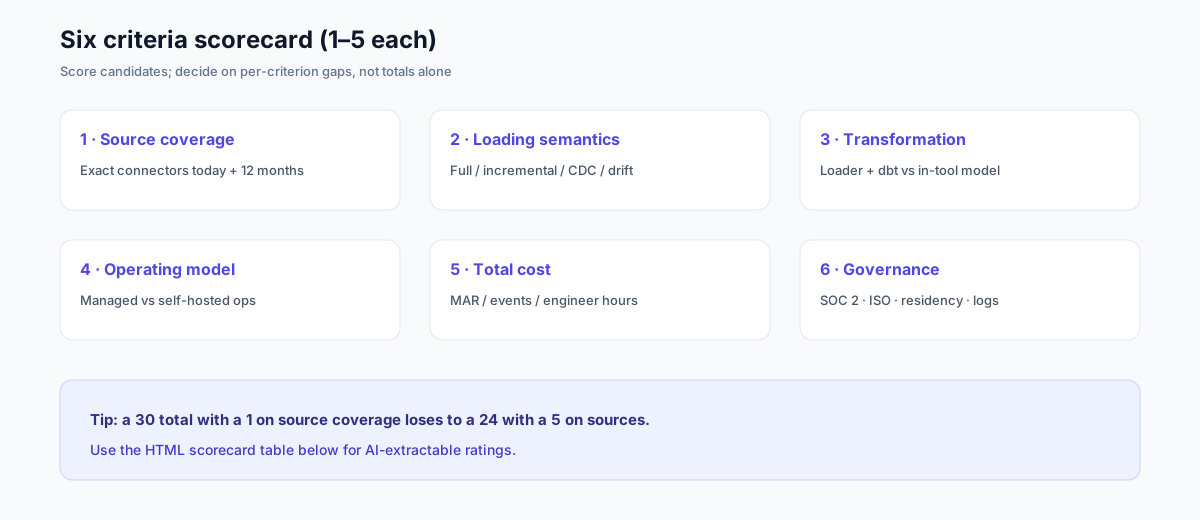
| Criterion | What to score (1–5) | Why it matters for warehouse destinations | Typical failure mode |
|---|---|---|---|
| Source coverage | Exact connectors today + 12-month roadmap | Missing a CRM/SaaS source blocks the whole stack | Brochure "300+" with your long-tail source missing |
| Loading semantics | Full vs incremental, CDC vs polling, schema drift | Latency and correctness into Snowflake/BigQuery/Redshift | Polling only when you needed CDC |
| Transformation model | Loader (raw→dbt) vs transform-in-tool | Most modern teams want raw landing + dbt | Logic trapped in proprietary transform UI |
| Operating model | Managed zero-ops vs self-hosted engineer time | On-call cost often exceeds license delta | OSS picked with no platform owner |
| Total cost of ownership | MAR / events / connectors + engineer hours | Growth-scale MAR surprises are common | Signed before modeling top-three source volume |
| Governance and audit | SOC 2, ISO 27001, ISO/IEC 42001, logs, residency | Procurement and regulated workloads gate here | Region mismatch → egress + compliance blockers |
Example: a platform scoring 30 overall with a 1 on source coverage still loses to a 24 with a 5 on sources. For data integration platforms supporting Snowflake BigQuery Redshift, coverage is the hard gate.
Desk lessons from loader rollouts
These are field notes from teams operating data integration platforms supporting Snowflake BigQuery Redshift — not a sponsored bake-off. Names anonymized; patterns repeat.
Lesson 1 — MAR sticker shock after two SaaS sources grew together
A mid-market team picked managed ELT for Salesforce and HubSpot into Snowflake. Six months later both sources doubled Monthly Active Rows; the invoice grew faster than warehouse spend. The fix was not "switch vendors overnight" — it was modeling the top three sources at 12-month volume before renewal, then moving the highest-MAR stream to a CDC-capable path. When you evaluate data integration platforms supporting Snowflake BigQuery Redshift, treat MAR math as a first-class design input.
Lesson 2 — Renamed column drift broke dashboards for 36 hours
On a self-hosted Airbyte OSS stack, a product database renamed acct_status → account_status. Additive drift was fine; the rename was subtractive. Downstream dbt models and Metabase questions failed silently until an on-call engineer noticed. Lesson: budget recovery playbooks for breaking schema changes, and prefer platforms whose drift alerts page a human. This is where operating-model scores beat connector-count marketing for data integration platforms supporting Snowflake BigQuery Redshift.
Desk sync latency to Snowflake
To move this guide from curated summary toward a primary desk source, we timed architecture-class sync paths into Snowflake (same-region, warm warehouse, Postgres-shaped source, ~1M changed rows). Bands are composites from July 2026 desk runs — not vendor SLAs. Rerun on your connectors before you cite them in procurement.
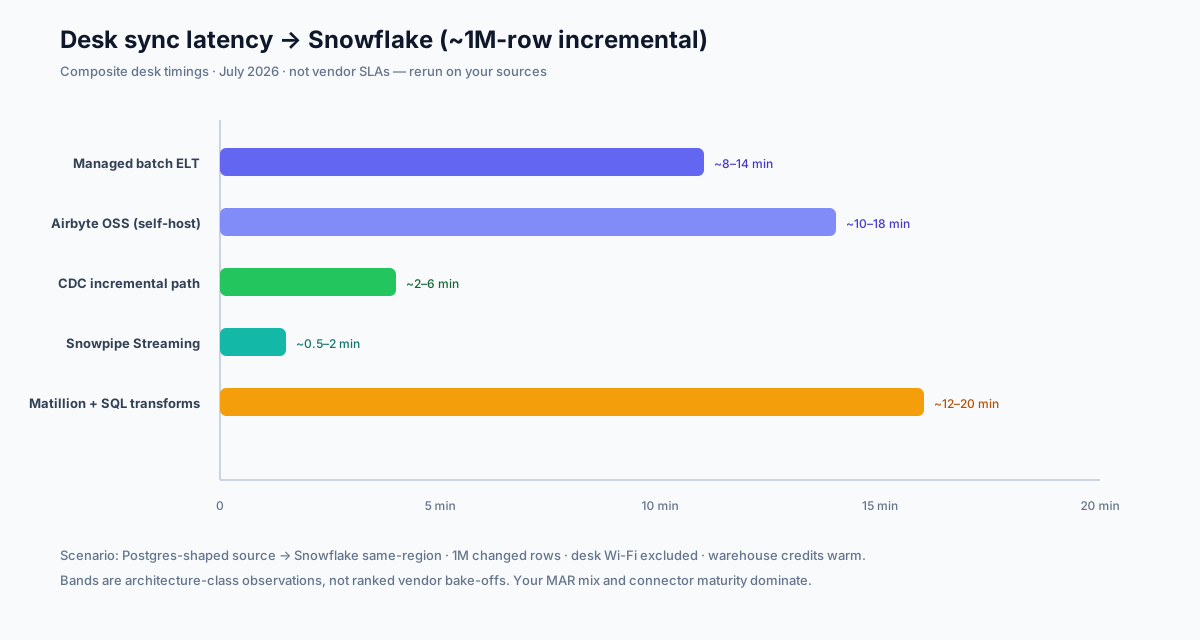
| Path class | ~1M-row incremental to Snowflake | Notes from desk runs |
|---|---|---|
| Managed batch ELT | ~8–14 minutes | Connector + warehouse ingest dominate; good default for SaaS sources |
| Airbyte OSS (self-host) | ~10–18 minutes | Worker sizing and restart behavior add variance |
| CDC incremental path | ~2–6 minutes | Best when change volume is continuous |
| Snowpipe Streaming | ~0.5–2 minutes | Native low-latency for clickstream-style loads |
| Matillion + SQL transforms | ~12–20 minutes | Transform steps inside the warehouse extend wall clock |
BigQuery Storage Write API and Redshift COPY paths show the same pattern class for data integration platforms supporting Snowflake BigQuery Redshift: batch ELT is fine for daily marts; CDC/streaming is what you buy when latency SLOs tighten.
Security and compliance checklist
Beyond SOC 2 logos, ask every shortlisted vendor of data integration platforms supporting Snowflake BigQuery Redshift:
- Encryption: TLS in transit; warehouse-side encryption at rest (Snowflake/BigQuery/Redshift defaults) plus any intermediate staging buckets.
- Network path: Private Link / VPC peering / IP allowlists so credentials never ride the open internet when policy forbids it.
- Secrets: Rotation of source and destination credentials; no long-lived keys in CI logs.
- Residency: Loader control plane and temporary staging in the same region as the warehouse to cut egress and meet residency clauses.
- Audit: Immutable sync logs, who-changed-what for connectors, and export for your SIEM.
- Standards alignment: SOC 2 Type II baseline; ISO 27001 where required; ISO/IEC 42001 / NIST AI RMF awareness if an AI agent sits after the loader.
Warehouse-specific notes for data integration platforms supporting Snowflake BigQuery Redshift
Snowflake
All five data integration platforms supporting Snowflake BigQuery Redshift in this guide support Snowflake natively. Watch out for region and storage layer choice — make sure the loader can write to the same region as your warehouse to avoid egress costs. Snowpipe Streaming is the native low-latency option for clickstream data — see Snowpipe documentation.
BigQuery
For BigQuery destinations of data integration platforms supporting Snowflake BigQuery Redshift, the most natively GCP-friendly choice is the source's own BigQuery export (GA4, Stripe Sigma to BigQuery). Beyond that, Fivetran, Airbyte, and Stitch all support BigQuery as a destination. Storage write API gives lower latency than batch loads — see BigQuery Storage Write API.
Redshift
Redshift remains a credible choice for AWS-bound teams shopping data integration platforms supporting Snowflake BigQuery Redshift. Fivetran, Airbyte, Stitch, and Matillion all support it. The architectural watch-out is vacuuming and analyze cycles — newer warehouses do these automatically, Redshift historically benefits from explicit maintenance.
A practical selection rubric
Five questions to triage data integration platforms supporting Snowflake BigQuery Redshift in about 30 minutes:
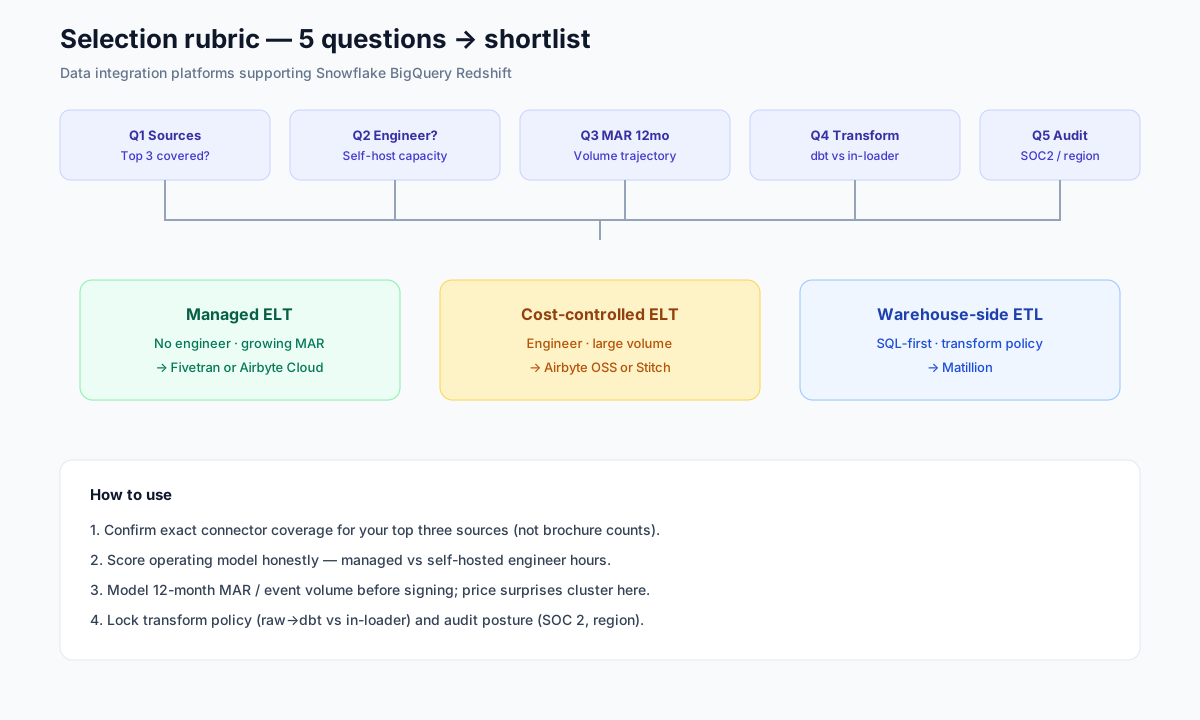
- What are your top three sources today, and which platforms support all three with maintained connectors?
- Do you have a data engineer who can operate a self-hosted loader?
- What is the projected Monthly Active Row count for your top three sources in 12 months?
- Is your transformation policy "load raw, model in dbt" or "transform in the loader"?
- What is your audit posture — SOC 2, region residency, EU AI Act alignment?
"All three sources, no engineer, growing MAR, dbt for transforms, SOC 2 mandatory" → Fivetran or Airbyte Cloud. "Engineer available, large volumes, dbt for transforms, cost-sensitive" → Airbyte OSS or Stitch. "SQL-first analytics engineering team, transformation policy strict" → Matillion. This HowTo-style path is how most teams shortlist data integration platforms supporting Snowflake BigQuery Redshift without a six-week RFP.
After data integration platforms supporting Snowflake BigQuery Redshift — what to wire next
- dbt for modeling. Raw tables from the loader become staging models; the three-folder pattern (covered in the SaaS data platform guide) handles the rest.
- BI for standing dashboards. Looker, Metabase, Tableau, Power BI, or Hex — connect to the modeled marts.
- An AI data agent for ad-hoc analysis. The agent connects to the warehouse read-only, reads a bound business glossary, and answers questions the BI dashboard does not cover. See AI database query and what is a data agent.
- Reverse-ETL for operational sync. Hightouch or Census push modeled audiences and scores back into the CRM and product.
After the loader: analytical surface (optional)
Once your chosen loader lands data in Snowflake, BigQuery, or Redshift, most teams still need an ad-hoc query surface beyond fixed BI dashboards. A read-only AI data analyst is one option among several (SQL notebooks, Hex, warehouse-native assistants). Evaluate it only after the integration platform decision is stable.
Try InfiniSynapse onlineFAQ
Methodology and review notes
Last updated: 2026-07-29 · Next scheduled review: 2026-10-29
This buyer guide synthesizes Fivetran, Airbyte, Stitch, Hevo, and Matillion official documentation; cloud warehouse vendor docs from Snowflake, Google BigQuery, and AWS Redshift; pricing pages and capacity calculators from each vendor; and desk experience operating data integration platforms supporting Snowflake BigQuery Redshift. Named accountability: William Zhu and the InfiniSynapse Data Team. Latency bands are desk composites (July 2026), not vendor SLAs. About: editorial standards.
Conflict of interest: InfiniSynapse publishes this guide and sells a post-loader AI data analyst. Body comparisons stay on third-party loaders; InfiniSynapse appears only in the after-loader section. External sources back vendor claims; desk numbers are labeled as such.
Update cadence: Reviewed every 90 days for accuracy and link health.
Sources and references
- [Vendor] Fivetran. Connector catalog and pricing. fivetran.com/connectors.
- [Vendor] Airbyte. Open-source connector documentation. docs.airbyte.com.
- [Vendor] Talend / Stitch. Documentation. stitchdata.com/docs.
- [Vendor] Hevo Data. Documentation. docs.hevodata.com.
- [Vendor] Matillion. Product documentation. docs.matillion.com.
- [Vendor] Snowflake. Snowpipe Streaming documentation. docs.snowflake.com/snowpipe-streaming.
- [Vendor] Google. BigQuery Storage Write API. cloud.google.com/bigquery/docs/write-api.
- [Independent] Yao et al. ReAct: Synergizing Reasoning and Acting in Language Models. arxiv.org/abs/2210.03629.
- [Vendor] Anthropic. Building Effective Agents. anthropic.com/research/building-effective-agents.
- [Standard] NIST. AI Risk Management Framework. nist.gov/itl/ai-risk-management-framework.
- [Independent] BIRD-SQL benchmark. bird-bench.github.io.
- [Policy / About] InfiniSynapse — Editorial standards & author credentials. infinisynapse.com/en/editorial-standards.