SaaS Data Platform in 2026: Architecture, Stack, Tradeoffs
- A SaaS data platform in 2026 has six source classes (product DB, payments, product analytics, CRM, support, marketing), an ELT loader, a warehouse, a dbt layer, and three serving surfaces — BI, reverse-ETL, and an AI data agent.
- ELT (extract-load-transform) beats ETL for most SaaS stacks because the warehouse compute is now cheap enough to land raw data and model in dbt.
- Snowflake, BigQuery, and Databricks are the dominant warehouse choices in 2026; for early-stage SaaS, a managed Postgres warehouse like Neon or Supabase is a credible starting point.
- dbt models organize into three folders — staging (clean and rename), intermediate (join and pre-aggregate), and marts (the questions the business asks). Each folder has its own job.
- The serving layer includes BI for standing dashboards, reverse-ETL to push enriched audiences back into operational tools, and an AI data agent for ad-hoc analysis that does not fit a dashboard.
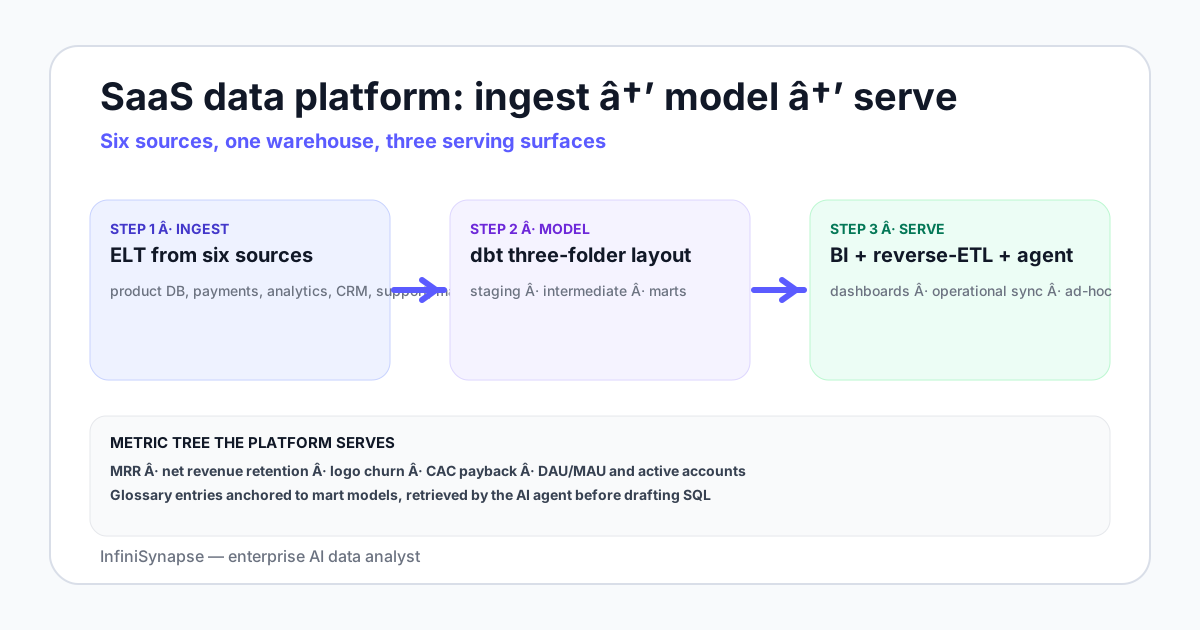
The six source classes a SaaS company pulls from
- Product database. Postgres, MySQL, or whatever the application runs on. Users, accounts, plans, usage events.
- Payments. Stripe (most common), Chargebee, or a billing-aware payments vendor. Subscriptions, invoices, charges, refunds.
- Product analytics. Segment plus a downstream like Amplitude, Mixpanel, or PostHog; or directly to the warehouse via Snowplow or Rudderstack.
- CRM. HubSpot or Salesforce. Companies, contacts, opportunities, deal stages, owner assignments.
- Customer support. Zendesk, Intercom, or Front. Tickets, conversations, response times, CSAT.
- Marketing. Ad platforms, email and lifecycle vendors (Customer.io, Klaviyo, Iterable), social and content tools.
The six classes cover 95% of a typical SaaS schema. Edge sources (a billing exception system, a finance ERP, a contracts vault) land in the warehouse via a manual export or a custom connector when they show up.
ELT vs ETL — which one for a SaaS stack in 2026
The architectural decision in 2026 is mostly settled: ELT wins for SaaS stacks. The warehouse compute is now cheap enough to land raw data, model it inside the warehouse, and skip the transform-in-flight machinery ETL pipelines used to need.
| Step | ETL (legacy) | ELT (modern SaaS default) |
|---|---|---|
| Extract | Same | Same — connector pulls from source |
| Transform | Inside the pipeline tool | Inside the warehouse, via dbt |
| Load | Pre-modeled data into the warehouse | Raw data into the warehouse, then model |
| Best for | Tightly bounded sources, regulated transforms | Most SaaS use cases — flexible modeling, easier debugging |
Vendors in this category include Fivetran, Airbyte, Stitch, Hevo, and the source's own warehouse-export feature (e.g., Stripe Data Pipeline to Snowflake). For the shared operating model, use the data integration platform architecture memo. For vendor-by-vendor warehouse loaders, use the Fivetran / Airbyte scorecard for Snowflake, BigQuery, and Redshift.
Warehouse choice for a SaaS data platform
| Warehouse | Best fit | Tradeoff |
|---|---|---|
| Snowflake | Mid-market and enterprise SaaS, mixed data scale | Operating cost grows fast without governance |
| BigQuery | GCP-resident teams, GA4 BigQuery export native | Schema management and IAM model take learning |
| Databricks SQL | SaaS teams with heavy ML and lakehouse needs | Higher learning curve for a pure analytics team |
| Managed Postgres (Neon, Supabase, Aurora) | Early-stage SaaS, < 100GB warehouse | Eventually outgrown when concurrency and partitioning matter |
| Redshift | AWS-bound teams with long-running data engineering | Newer warehouses now win head-to-head benchmarks on most SaaS workloads |
The early-stage answer for a SaaS data team is rarely Snowflake on day one. Start with a managed Postgres data warehouse, model in dbt, and promote to a column-store warehouse when concurrency or scan size demands it.
The dbt model layer — three folders, three jobs
The conventional dbt model layout in 2026 has three folders, each with a different job:
- staging — one model per source table. Clean, rename, cast types. No joins. The contract is "this is the canonical shape of a single source's data."
- intermediate — joins and pre-aggregations that are reused across marts. Not exposed to BI. The contract is "this is the canonical join shape across sources."
- marts — the questions the business asks. One model per business concept (mart_mrr, mart_active_customers, mart_account_health). These are the tables BI and the AI agent point at.
Tests live alongside the models — unique key tests on staging, not-null tests on intermediate, accepted-values tests on marts. The dbt docs walk the canonical pattern.
Serving — BI, reverse-ETL, and the AI data agent
Three serving surfaces share the mart layer:
- BI. Looker, Metabase, Tableau, Power BI, or Hex/Mode for analyst notebooks. The job is standing dashboards on agreed metrics — MRR, churn cohorts, payback period, NRR.
- Reverse-ETL. Hightouch, Census, or built-in operational sync. The job is pushing enriched audiences and account scores back into the CRM, customer.io, and the product itself.
- AI data agent. InfiniSynapse or a peer connected to the warehouse with read-only role and a bound business glossary. The job is the ad-hoc question the dashboard cannot answer — anomaly investigation, cross-source reconciliation, new-question onboarding.
The three are complementary. A BI dashboard answers "what is happening". Reverse-ETL acts on what is happening. The agent investigates why what is happening is happening. See AI-native data platform for the deeper framing. Storefront teams run the same ingest → model → serve shape with orders and AOV instead of MRR — that sibling contract is the ecommerce data platform section of the analytics playbook.
The SaaS metrics that drive the schema
| Metric | Definition | Source tables |
|---|---|---|
| MRR | Sum of recurring subscription value per month | Stripe subscriptions + invoices, product DB plan table |
| Net revenue retention | (Starting MRR + Expansion - Churn - Contraction) / Starting MRR | Stripe MRR by cohort |
| Logo churn rate | Customers lost / starting customers, by month | Product DB + Stripe |
| CAC payback period | CAC / (ARPU × gross margin) | Marketing spend + Stripe MRR + product DB |
| DAU/MAU and active accounts | Unique accounts active in window | Product analytics + product DB |
The metric definitions become the canonical entries in the bound business glossary. The agent retrieves these before drafting SQL, which is how it stays aligned with the dbt mart definitions across analyst sessions.
Ask an open-ended question across your SaaS data warehouse
Connect Snowflake, BigQuery, Postgres, or another warehouse read-only. Seed a SaaS business glossary — what counts as an active account, which plan transitions count as expansion. Then ask one question the dashboard does not answer and watch the plan, SQL, and verification step return.
Try InfiniSynapse onlineFAQ
Methodology and review notes
Last updated: 2026-06-28 · Next scheduled review: 2026-09-28
This architecture guide synthesizes dbt analytics engineering documentation, Snowflake and BigQuery vendor architecture references, Stripe and Segment integration docs, public SaaS benchmark reports from OpenView and ChartMogul, and field experience across SaaS data teams at stages from seed to growth. The six-source list, three-folder dbt layout, and three-serving-surface pattern reflect observed practice rather than vendor positioning.
Conflict of interest: InfiniSynapse publishes this guide and sells an enterprise AI data analyst. To reduce bias, the page leads with the topic itself, treats InfiniSynapse as one option among many, and links to external sources for every numeric claim.
Update cadence: Reviewed every 90 days for accuracy and link health.
Sources and references
- [Vendor] dbt Labs. Analytics engineering guide. docs.getdbt.com.
- [Vendor] Snowflake. Architecture documentation. docs.snowflake.com.
- [Vendor] Google. BigQuery architecture reference. cloud.google.com/bigquery/docs.
- [Vendor] Stripe. Data Pipeline for Snowflake. stripe.com/docs/stripe-data.
- [Independent] OpenView Partners. SaaS benchmarks report. openviewpartners.com.
- [Independent] Yao et al. ReAct: Synergizing Reasoning and Acting in Language Models. arxiv.org/abs/2210.03629.
- [Vendor] Anthropic. Building Effective Agents. anthropic.com/research/building-effective-agents.
- [Standard] NIST. AI Risk Management Framework. nist.gov/itl/ai-risk-management-framework.
- [Independent] BIRD-SQL benchmark. bird-bench.github.io.