Data Platform Architecture: Map, Then Host (2026)
By William Zhu & the InfiniSynapse Data Team · Published: 2026-09-02 · Last updated: 2026-09-03 · Last verified: 2026-09-03 · Next review: 2026-12-02 · Editorial standards · Corrections
Author credentials: William Zhu, Cofounder of InfiniSynapse. Public identity: GitHub @allwefantasy. Profile and review roles: editorial standards. This page is signed by a named person, not an anonymous editorial org. No personal LinkedIn is published. No third-party prize, media review, or independent endorsement is claimed.
Table of Contents
- TL;DR
- What data platform architecture hosts beside the database
- A three-layer frame: database, runtime, app
- Another warehouse, another app, or a runtime
- Landscape: stores, runtimes, and shells
- How to map the runtime before you buy a store
- Desk sample: first-party three-layer protocol
- Scorecard: add a warehouse or host the job
- Failure modes
- Frequently Asked Questions
- Conclusion
TL;DR
Direct answer: Data platform architecture for agents is a runtime with isolation and resume, sitting beside the database. Adding another warehouse does not host the Decision Job. Draw database versus runtime versus app. Put state, artifacts, and the veto on the runtime. The database keeps facts. The app keeps screens.
We review these patterns at the InfiniSynapse desk on sanitized composites. Figures on this page are illustrative, not customer uplifts.
What you'll learn:
- Why data platform architecture is a runtime first, a store second
- Which layer owns state, SQL, UI, and secrets
- A mapping sequence that stops a warehouse purchase from pretending to be a host
- When to keep the database you have
- How this map sits under the data infrastructure hub
What data platform architecture hosts beside the database
Key Definition: Data platform architecture for agents is the placement of a hosted runtime—identity, isolation, resume, quota—beside the database that holds facts. The runtime hosts the Decision Job. The database does not. A new warehouse slide is not data platform architecture. It is a store purchase. The consumption layer those agents use is an ai native data platform.
Teams still draw data platform architecture as boxes labeled lake, warehouse, and BI. That drawing answers “where do facts rest.” It does not answer “who hosts the work after the question is asked.”
Independent published context (retrieved 2026-09-02). Compare each source, then stop. The NIST AI Risk Management Framework, the AWS Machine Learning Lens, and the FTC home page did not run this fixture.
| Cited source | What it owns | What tonight still needs |
|---|---|---|
| NIST AI RMF | AI as a system with owners | A store without a runtime is not a system |
| AWS Machine Learning Lens | Workload identity, isolation, recovery | That bar when the worker is a model |
| FTC | Scrutiny of automated-decision claims | Who hosted the job, not a warehouse diagram |
| Google BigQuery | Store-and-query surface | Point the runtime at it; speed is not a platform |
| Python docs | A notebook that looks like all three layers | A notebook is a view factory, not the map |
| NIST Cybersecurity Framework | Who may touch which layer | Who opens a job as an audit object |
Use that system lens for data platform architecture. A store without a runtime is not a system for an agent job. Data platform architecture for agents inherits the Lens bar even when the worker is a model.
Runtime is not a synonym for database
A database answers queries. A runtime hosts a job that may stall, retry, and write files. Data platform architecture must keep those verbs on different objects. If you collapse them, resume becomes a query log and isolation becomes a shared role.
The FTC (table above) is a reminder that automated decisions attract scrutiny. Data platform architecture that cannot show who hosted the job will not survive that scrutiny with a warehouse diagram.
Why another warehouse does not host the job
A warehouse can be the correct next store and still leave data platform architecture unfinished. The Decision Job still needs an id, a checkpoint, and a veto. Those are runtime objects.
Analyze a database without ETL is the source-binding lesson: point at what you already authorize. This page is the placement lesson: the bind is not the host. Data platform architecture needs both. The funding order for that store is the enterprise data platform strategy: which layer this quarter, who owns it, and what gets retired.
A three-layer frame: database, runtime, app
Draw three layers before you add a box. That drawing is a map you can defend.
| Layer | Owns | Does not own | Acceptance signal |
|---|---|---|---|
| Database | Facts, grants, query engines | Job identity, resume, veto | A killed agent job is not a dropped table |
| Runtime | Job id, events, views, artifacts, quota | Domain copy, final business action | The same id reopens after a tab close |
| App | Screens, domain rules, the human action | Secrets, checkpoints, deny lists | A theme change does not move the trail |
Google BigQuery (table above) is a store-and-query surface. Point the runtime at BigQuery. Do not call the project a finished platform because the query was fast.
What each layer must refuse
The database must refuse to be the job log. The runtime must refuse to be the product UI. The app must refuse to store secrets. Data platform architecture is those three refusals written down.
Python documentation (table above) shows how a notebook can look like all three layers. A notebook can be a view factory. It is not the three-layer map.
Choose the three-layer frame if more than one app will share facts and jobs. Choose a single-process script if you are still proving a question and you accept that you will throw the script away.
The definition page on what is data infrastructure lists runtime, isolation, resume, and quota. This page places those objects beside the database. Definition without placement is a slogan. This page is the placement.
Another warehouse, another app, or a runtime
Teams pick the wrong next box. The runtime column is the one that hosts the job.
| Next box people buy | What it actually is | Choose it if | Reject it if |
|---|---|---|---|
| Another warehouse | Facts at rest | You lack a durable grain | You think the purchase hosts the job |
| Another BI app | A screen on facts | People need a known dashboard | You need resume of an agent job |
| Another chat | A paragraph API | The question is disposable | You need isolation or a veto |
| A hosted runtime | Job identity beside the database | Unrelated apps must reuse one kernel | You only have a weekend prototype |
Choose the warehouse if the missing object is a fact. Choose the BI app if the missing object is a known screen. Choose the chat if the sitting ends the question. Choose a runtime when data platform architecture is the actual review question.
Data management still matters for catalogs, retention, and owners of tables. That page does not replace this one. Table ownership is not job hosting. Name both owners.
NIST’s Cybersecurity Framework (table above) is the control language for who may touch which layer. If your data platform architecture cannot say who opens a job, you do not have an audit object.
Landscape: stores, runtimes, and shells
The 2026 landscape still sells stores as platforms. Data platform architecture for agents is a runtime sitting beside those stores.
- Operational databases. Source systems. Bind them. Do not copy them into the app.
- Warehouse and lake. Facts at rest. Necessary. Not sufficient.
- Agent runtime. The missing box on most slides. This is the missing box in this pillar.
- App shells. Generated or hand-built. Clients of the runtime.
If the product already exists and you only need a slot, stay with embed an AI data analyst. The embed is an app-layer client. It does not move the runtime into the iframe.
Apps keep the final action
Pattern note, not a review: a mole-style research desk and a ProjectValueLab-style valuation desk can share one runtime and one warehouse. Each app keeps domain rules and the final action. The shared pair is the runtime-plus-database, not the skin.
Do not add a second warehouse because the first one “does not feel like a platform.” Feeling is not a layer in data platform architecture.
How to map the runtime before you buy a store
Use this sequence when a review asks for data platform architecture and someone has already booked a warehouse demo.
- Draw database versus runtime versus app. Empty boxes are allowed. Acceptance: every object has one layer.
- List last Friday’s agent demo as a Decision Job. Name input, sources, and artifact. Acceptance: a second person can reject the job.
- Point at where state lives today. Id, events, files. Acceptance: if they live in the chat, the runtime box is empty.
- Point at where secrets live. Acceptance: if they live in the page, isolation is empty.
- Refuse a store purchase as the fill-in. If the empty box is runtime, another lake does not complete the map.
- Only then score a store. Buy a warehouse if the missing object is a fact. Acceptance: the runtime box is already named.
If you fail step 3, stop the tour. The map is still a slide.
A one-page map you can keep
Write four lines: who owns state, who owns SQL, who owns UI, who owns secrets. That page is a more honest data platform architecture map than a twelve-box vendor deck.
Desk sample: first-party three-layer protocol
Cite this data platform architecture protocol. Do not cite a customer percentage, an 8 / 42 / 88 figure, or the chart bars as a study.
First-party method log (replayable):
| Field | Record |
|---|---|
| Operator | InfiniSynapse Data Team; William Zhu, public as GitHub @allwefantasy |
| First run | 2026-09-02 |
| Replay / last verified | 2026-09-03 |
| Input | One authorized, sanitized weekly units pack; no secrets |
| Paths compared | Second-warehouse slide vs three-layer map with a Decision Job |
| Layers scored | 3 (database, runtime, app) |
| Scorecard rows | 5 |
| Acceptance | Runtime box named; job id survives a kill; app keeps the veto |
| Fail | Second warehouse added; query faster; no job id; state in the chat |
We mapped database versus runtime versus app on last Friday’s demo, marked the empty runtime box, then hosted the same question as a Decision Job on the first warehouse. The 2026-09-03 replay used the same fail. That is a first-line data platform architecture replay, not a customer case. That is what data platform architecture looks like when the runtime is a layer, not a slogan. GitHub @allwefantasy is a public artifact, not a prize. Review: editorial standards.
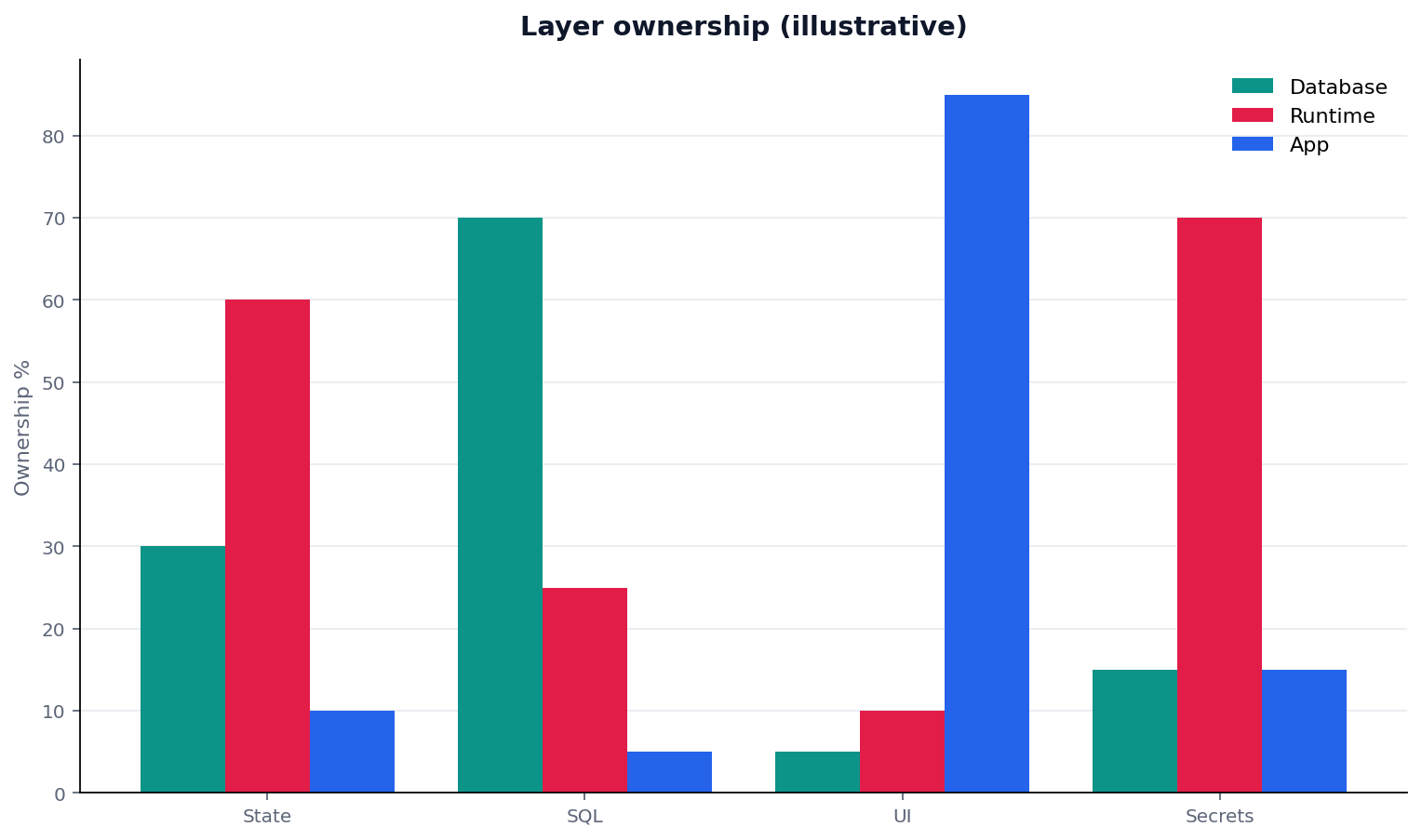
Figure. Teaching schematic. Not a measured study. Source: the protocol table above.
A teaching sketch used 8 sources, 42 views, and 88 edges. Those figures are not a benchmark. Quote the protocol, not the bars.
Scorecard: add a warehouse or host the job
Score the last architecture review. Data platform architecture is the “host the job” column when the gap is a runtime.
| Signal | Add a warehouse | Add another app | Host the runtime |
|---|---|---|---|
| Missing object is a fact table | Yes | No | No |
| Missing object is a job id | No | No | Yes |
| Secrets live in the page | A store will not fix this | An app will not fix this | Isolation on the runtime |
| You cannot resume after a kill | No | No | Yes |
| People want a known dashboard | Maybe later | Yes, as a client | The runtime still sits beside the database |
Add a warehouse if the facts are missing. Add an app if the screen is missing. Host the runtime when data platform architecture is the actual gap.
Building data infrastructure scores the cost of queues, resume, and audit. Read it after the map exists. Building without a map is how data platform architecture becomes a second warehouse.
Failure modes
Placement failures look like purchases.
Treating the database as the runtime
Query logs are not resume. Roles are not tenant walls for agent jobs. Data platform architecture that collapses those objects will fail the first kill test.
Treating the app as the runtime
A generated screen that stores checkpoints will be copied. The next app forks the trail. Data platform architecture puts state on the runtime, not in the page.
Buying a store to fill an empty runtime box
A new lake can be correct for facts and still leave the job without an id. Data platform architecture names the empty box before the purchase.
Those three failures are why this page exists. The hub on data infrastructure hosts the Decision Job. This page places the host beside the database.
Map the runtime before you add another warehouse
Draw database vs runtime vs app. Put state and artifacts on the runtime. This check uses only sources you authorize.
Commercial association: You do not need the workspace to complete the educational diagnosis on this page.
Open InfiniSynapseHow this page is sourced. William Zhu is cofounder of InfiniSynapse, public as GitHub @allwefantasy. Company self-description, not independent authority. No third-party prize is claimed. No personal LinkedIn is published. Evaluation basis: We evaluate (hands-on) by mapping database vs runtime vs app before anyone adds another warehouse. Protocol dated 2026-09-02, replayed 2026-09-03. Reviewed internally by analytics engineering · data platform · LLM security · editor. Editorial standards · corrections · publishing principles · About · Privacy · Terms. Contact zhuhl@infinisynapse.com. COI: InfiniSynapse sells an AI-native Data Agent; the banner is a commercial association. The educational diagnosis does not require it. Fact-check: NIST AI RMF, AWS Machine Learning Lens, FTC, Google BigQuery, Python docs, and NIST Cybersecurity Framework as cited. Figures 8 / 42 / 88 are a teaching sketch. No external organization audited this page.
Frequently Asked Questions
Is a warehouse the same as this runtime?
Bottom line: No. A warehouse stores facts. Data platform architecture for agents places a runtime beside that store to host the Decision Job.
Can I skip the runtime if the database is fast?
Bottom line: No. Speed does not host identity or resume. Data platform architecture still needs the middle layer.
Does a generated app count as architecture?
Bottom line: It counts as the app layer. Data platform architecture still needs database and runtime boxes that the app does not own.
Do I need a new store before I draw the map?
Bottom line: No. Draw first. Buy a store only if the missing object is a fact. Data platform architecture starts with placement.
How do I test the map this week?
Bottom line: Kill last Friday’s job. If it cannot resume from the same id, the runtime box in your data platform architecture is empty.
What on this page is citable?
Bottom line: Cite the data platform architecture protocol table, the three-layer frame, and the six-source comparison. Do not cite the chart bars or the 8 / 42 / 88 sketch as measured results.
Conclusion
Data platform architecture for agents is a runtime with isolation and resume, sitting beside the database. Adding another warehouse does not host the job. Draw three layers. Put state on the runtime. Keep facts on the database. Keep screens on the app.
InfiniSynapse describes itself on About. Privacy and Terms apply. If you later use the workspace, open InfiniSynapse only with authorized, sanitized inputs.