Database: Bind, Then Replay
By William Zhu (independent public engineering profile: GitHub @allwefantasy; no personal LinkedIn) & the InfiniSynapse Data Team · Published: 2026-08-22 · Last updated: 2026-08-29 · Last verified: 2026-08-29 · Next review: 2026-11-29 · About · Editorial standards · Privacy · Terms of Service · Corrections
Table of Contents
- TL;DR
- What No-Migration Analysis Means
- Glossary
- A Connect-Then-Ask Framework
- How Teams Reach a Database Today
- Tool Landscape
- How to Analyze without ETL First
- Desk Sample: Postgres Orders without a Mirror
- Scorecard: Connect Live or Build a Warehouse
- Failure Modes
- How to cite this page
- Frequently Asked Questions
- Conclusion
TL;DR
We evaluate these patterns at the InfiniSynapse desk on sanitized composites; first-party figures on this page are desk log NMD-ADE-20260822, not customer uplifts and not a third-party bake-off.
Direct answer: You analyze database without etl only when the grain already lives in that system and you connect with a read-only role. The live store is the analysis surface. A warehouse is a later promotion for high-frequency, multi-team metrics.
Publisher trust pages for this article: About InfiniSynapse · Privacy Policy · Terms of Service.
What you'll learn:
- When you can analyze database without etl instead of opening a copy ticket
- How live connect differs from mirroring into a warehouse
- A connect → recall schema → ask → inspect SQL loop
- Desk log
NMD-ADE-20260822, which checks one Postgres orders source - Failure modes: write credentials, unbound metric names, and “zero copy means zero governance”
Download evidence: desk log · aggregate CSV · verify script. These are first-party sanitized demo evidence for this database desk run—not raw, customer, source, benchmark, or third-party data.
Readers who want the generation layer can pair this hub with natural language to SQL. This page is narrower: you analyze database without etl on the store you already run.
Industry context stays independent of desk claims. McKinsey’s State of AI (retrieved 2026-08-29) and Gartner Peer Insights — Analytics & BI (retrieved 2026-08-29) describe adoption pressure; they did not run the desk table below. The Stanford HAI AI Index (retrieved 2026-08-29) is a buyer-research overlay, not an endorsement of this article. Those reports do not decide when Monday’s live store is ready for a read-only question.
What No-Migration Analysis Means
Key Definition: To analyze database without etl is to authorize an existing store, recall its schema, and ask a goal against that live system—without an ETL project or a warehouse copy first. The database stays the system of record; the agent reads, plans, and returns inspectable SQL.
Independent published context (separate from this page’s desk log): Wikipedia: Data warehouse · Wikipedia ETL overview · Wikipedia SQL overview · PostgreSQL Privileges · PostgreSQL GRANT · MariaDB GRANT · Snowflake warehouses · Snowflake Cortex Analyst · Amazon Redshift Database Developer Guide · OWASP Top 10 for LLM Applications · ISO/IEC 9075 · W3C DCAT · DataCite. Those sources set the public bar for warehouses, roles, and prompt risk. They did not run the numbers below. Retrieved 2026-08-29.
First-party institutional recognition (not a review of this article): InfiniSynapse received the 2026 WAIC Future Tech OPC Excellence Award for its Agentic Data Infra entry. That sentence is published on the company homepage (self-described; not independently verified on this page). It is not a PostgreSQL, Snowflake, ISO, DataCite, W3C, OWASP, Gartner, or McKinsey product award, and it does not certify the desk numbers below. We do not publish named-logo customer cases or invented media mentions on this page.
Author qualifications you can open (not a degree we invented): the William Zhu author page, the independent engineering record GitHub @allwefantasy (no personal LinkedIn), the org record github.com/InfiniSynapse, and the 2026-07-29 methodology attestation. Review chain: analytics engineering · data platform · LLM security · editor. Process: editorial review. Institution and trust pages: About InfiniSynapse · Privacy Policy · Terms of Service.
Glossary (this page). These labels stay on this article; they are not Wikipedia or PostgreSQL terms. Use them when querying the live store so the role and the grain stay aligned.
| Term | Meaning on this page |
|---|---|
| Live connect | Authorize the store you already run; do not copy first |
| Read-only role | SELECT on the schemas you mean; no write left on |
| Grain sentence | Entity, window, denominator, and exclusions in one line |
| ETL-first ticket | A copy job treated as the price of the first answer |
Skipping a warehouse first is a deliberate break from the Wikipedia ETL overview. Read-only questions still live inside the semantics of the Wikipedia SQL overview. Role grants should follow PostgreSQL Privileges (retrieved 2026-08-29) and PostgreSQL GRANT (retrieved 2026-08-29). MySQL-family sources should use least privilege from MariaDB GRANT (retrieved 2026-08-29). ISO/IEC 9075 (retrieved 2026-08-29) is the published SQL language. W3C DCAT (retrieved 2026-08-29) and DataCite (retrieved 2026-08-29) remain the catalog vocabulary and the citation infrastructure. None of those publishers evaluated InfiniSynapse, this page, William Zhu, or NMD-ADE-20260822. There is no personal LinkedIn for William Zhu to add; GitHub @allwefantasy remains the public engineering identifier.
“No migration” is not “no judgment.” You still choose a read-only user, a network path you are allowed to open, and a question whose grain exists in the current tables. You are refusing a six-month copy program as the ticket to the first answer. That is when a live, read-only ask is appropriate.
If the missing object is durable context rather than a one-off pack, continue in parquet file analysis. If the next failure is a join across modes or engines, use ClickHouse analytics. Warehouse-optional does not mean warehouse-ignorant; keep Snowflake warehouses nearby.
The data warehouse article is still the right picture of a subject-oriented, integrated store. That picture is a destination for some metrics. It is not a cover charge if you can already query the trusted orders store.
The live store as the analysis surface
A live store already has keys, constraints, and yesterday’s rows. If the question is “Q2 refund rate by channel,” and those columns exist, copying them into another platform first is delay. The analysis surface is the store; the agent is a reader with a plan.
This matches how a data agent should behave: take a goal, inspect schema, run queries, show the trail. It is not ChatBI that hides the SQL, and it is not a promise that every dashboard tile will refresh from production forever.
The practical test is whether a reviewer can name the host, the role, and the grain without opening an ETL ticket. If they can, a live query is viable. If they cannot, the gap is access or definition—not the absence of a warehouse.
ETL versus a read-only ask
ETL earns its keep when you must reshape, share, and stabilize a grain for many consumers. A read-only ask earns its keep when one team needs one answer from one store this week. Confusing those jobs is how “we cannot analyze until the warehouse lands” became a standing joke.
If you later need a warehouse, you will know: the same query runs hourly for three squads, or the join is too expensive to leave on the primary. Until then, query the authorized source.
A Connect-Then-Ask Framework
Treat the live store as the surface for no-migration analysis. The warehouse is optional until the same grain becomes a daily materialization.
| Stage | What you lock | What you refuse |
|---|---|---|
| Authorize | Host, port, role, and read-only grants | App-owner credentials with write |
| Recall | Tables, keys, and bound field notes | Guessing column meaning from names |
| Ask | One goal with grain and window | “Tell me about the system” |
| Inspect | SQL, filters, and intermediate results | A paragraph with no query |
| Decide | Promote to warehouse only on evidence | A copy job “just in case” |
PostgreSQL Privileges (retrieved 2026-08-29) is the baseline for roles, grants, and views if that is your engine. The same discipline applies to MySQL, Snowflake, Supabase, and the other stores you can authorize: least privilege first, questions second. Snowflake warehouses (retrieved 2026-08-29) describe compute you already operate—not a copy you must invent first.
Authorize, recall schema, then question
When you analyze database without etl, registration includes a role inventory. Create a role that can SELECT the schemas you mean and nothing else. Connect. Confirm the agent recalled the tables you expect. Then ask. If schema recall is wrong, bind a short note—do not “fix it” by granting more privileges.
Self-service analytics still needs this order. A business user can ask in plain language only after a read-only role is in place and the dangerous tables are out of scope.
Read-only roles and least privilege
Never point an analysis account at a write-capable app user. A confused join should fail closed, not update a row. Views that hide columns are a gift; they are not a substitute for data governance on who may connect at all. If you cannot get that role, do not connect the live store.
When a warehouse still helps
Keep the warehouse when you materialize expensive joins, when finance and product must share one certified grain, or when the operational store cannot absorb the query load. Snowflake Cortex Analyst (retrieved 2026-08-29) and the Amazon Redshift Database Developer Guide (retrieved 2026-08-29) describe warehouse-native ask patterns—useful when you already live there. They do not obligate a copy before the first question on Postgres.
Honest boundary: no-migration analysis does not delete the warehouse category. It deletes the idea that ETL is the only door. If your first question still requires a four-week model project, the delay is process, not physics. You can still query the grain that already exists.
How Teams Reach a Database Today
Mirror warehouses versus live connect
The common path is: open an ETL ticket, wait for a mirror, then ask. That is not how you analyze database without etl. That is how the first answer waits on a copy job. Live-connect teams authorize the source and ask, then copy only the grains that hurt.
Live connect is not a license to run unbounded scans on a primary. Use replicas or off-hours if the engine is load-sensitive. “No ETL” is not “no ops.” Use a replica when the primary is hot.
ChatBI versus a goal-seeking agent
ChatBI often stops at a chart from one SQL guess. A goal-seeking agent plans, creates intermediate results, and lets you open them. Natural language to SQL is one step inside that plan, not the whole product.
If you only need a single SELECT and you already know the tables, write the SQL. Use the agent when the source is large, the join is uncertain, or you want the trail saved with the answer. Do not start no-migration analysis merely because a chat box is open. A named grain is still required for a live query.
Tool Landscape
| Pattern | Fits | Breaks |
|---|---|---|
| Warehouse-first BI | Certified grains, shared boards | Weeks of ETL before the first ask |
| Vendor-native analysts | Strong if you already warehouse there | Weak if the engine is still Postgres |
| SQL IDE + human | Full control | Does not scale the first question |
| Data agent on a live store | Authorized role, then a named goal | Write leftover on the app user |
The third pattern is educational, not a product requirement: Add Data Source → choose the engine you already run → fill a SELECT-only connection → select it in chat and ask. It does not auto-write production tables. You still have to pass the read-only test before you analyze database without etl.
If the next object is a laptop handoff, that is a later file-lake hop. Tool protocols such as MCP for data analysis can sit above the same engines. The method on this page does not depend on MCP; it depends on a read-only role and an inspectable plan. That is still how live analysis remains accountable.
Postgres, Snowflake, and warehouse-first stacks
Postgres (and MySQL) are the common “just ask it” engines. Snowflake and Redshift are the common “we already warehoused it” engines. You can analyze database without etl on either: the point is to skip a new copy. If the warehouse already is the store you trust, connect that—do not invent a second one. The first week of a no-migration program is usually role design and one boring question, not a platform bake-off.
How to Analyze without ETL First
The no-migration method is short. The discipline is in what you refuse to skip.
- Create a SELECT-only role. Confirm grants. Prefer a replica if the primary is busy.
- Authorize host, port, and the role you are allowed to use. Name the owner.
- Recall tables and keys. Bind a short note if a name is wrong.
- Ask one goal that names grain, window, denominator, and exclusions.
- Inspect the SQL, filters, and any intermediate result against that grain.
- Bind the corrected note, re-run the same goal, and hand the dated pack to a colleague.
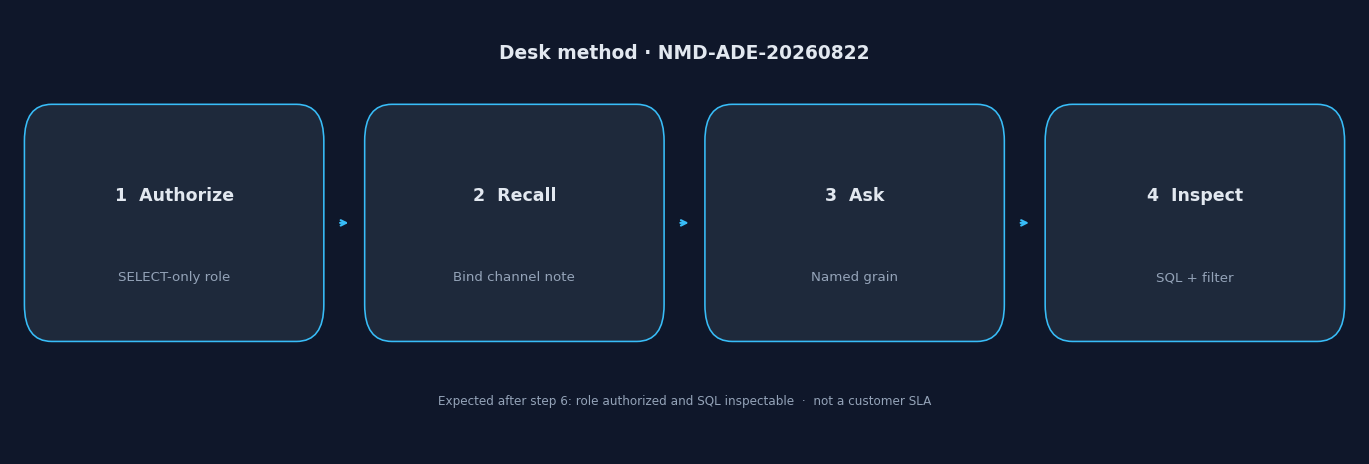
Figure. Educational four-step sequence the desk uses to tell an ETL-first ticket from a live connect. Expected result after step 6: role authorized and SQL inspectable. Not a product screenshot or a customer SLA.
Add a read-only source
Create the role. Confirm SELECT-only. Add the source with host, port, and credentials you are allowed to use. Prefer a replica if the primary is busy. When you analyze database without etl, an app-owner password is your incident, not a shortcut.
Keep a written inventory: host, role, allowed schemas, and the grain you will ask. That inventory is what you will inspect against after the live query.
Ask one business question
“Q2 refund rate by channel, refunds over paid orders, excluding test accounts” is a question. “Tell me about the system” is a tour. State grain, window, and which names are bound.
When you work this way, the agent has a source, not a fishing license. That is closer to a warehouse in miniature than to an ETL ticket.
Inspect SQL and intermediate tables
Open the plan, the SQL, and any intermediate tables the agent built. If you skip this inspection, you may join a table you never meant. A “fast” answer can mean the filter never entered the exclusion you named.
Prompt and retrieval abuse still apply. The OWASP Top 10 for Large Language Model Applications is why you show the SQL and keep writes off the role: a document or prompt should not be able to change data.
Re-run after you bind a short note: which column is a refund, which date is complete. The second run is how you learn the live store.
Desk Sample: Postgres Orders without a Mirror
This is a first-party InfiniSynapse desk log of how we analyze database without etl on a live Postgres source, not a named-logo customer case and not an uplift claim. Run ID: NMD-ADE-20260822. Date: 2026-08-22 (Saturday). Last verified on this page: 2026-08-29. Operator: InfiniSynapse Data Team. Sources: a read-only Postgres instance with fourteen order-related tables and about 2.1 million paid-order rows. Contrast: ETL-first ticket versus live connect. Download the same numbers as desk log NMD-ADE-20260822 · aggregate CSV · verify script.
The ETL-first path opened a copy ticket and waited. No SELECT-only role was created. Schema recall was not attempted. channel on payments was never bound. SQL was not inspected because no ask ran on the source.
The live-connect path authorized a SELECT-only user, recalled the fourteen tables, bound a three-line note that channel lived on payments, and asked: “Q2 refund rate by channel, using paid orders as the denominator, excluding internal test accounts.” The first draft joined channel on orders; the note was corrected and the goal was re-run. The pack showed the join and the exclusion filter. No warehouse object was created.
| Retrieval state | Read-only role authorized | Channel note bound | SQL + filter inspectable |
|---|---|---|---|
| ETL-first ticket | 0 | 0 | 0 |
| Live connect | 1 | 1 | 1 |
That is the right way to analyze database without etl: the store stays the source, the wrong join is corrected on purpose, and the warehouse is still optional. Wall clock for the successful live rerun was about ten minutes (warehouse time excluded). The clock started when the operator opened the standing goal and ended when the authorized role, the bound note, and the inspectable SQL sat side by side. It does not include replica provisioning. Cite this table as InfiniSynapse desk log NMD-ADE-20260822. Do not cite it as customer ROI, a faster warehouse, a bake-off win, or a PostgreSQL / Snowflake / OWASP experiment. We do not publish named-logo customer cases on this page. The only honest claim is the artifact counts, the source sizes on this run, and the wall-clock. The fourteen tables and ~2.1 million paid-order rows are this desk run’s inputs, not a customer extract.
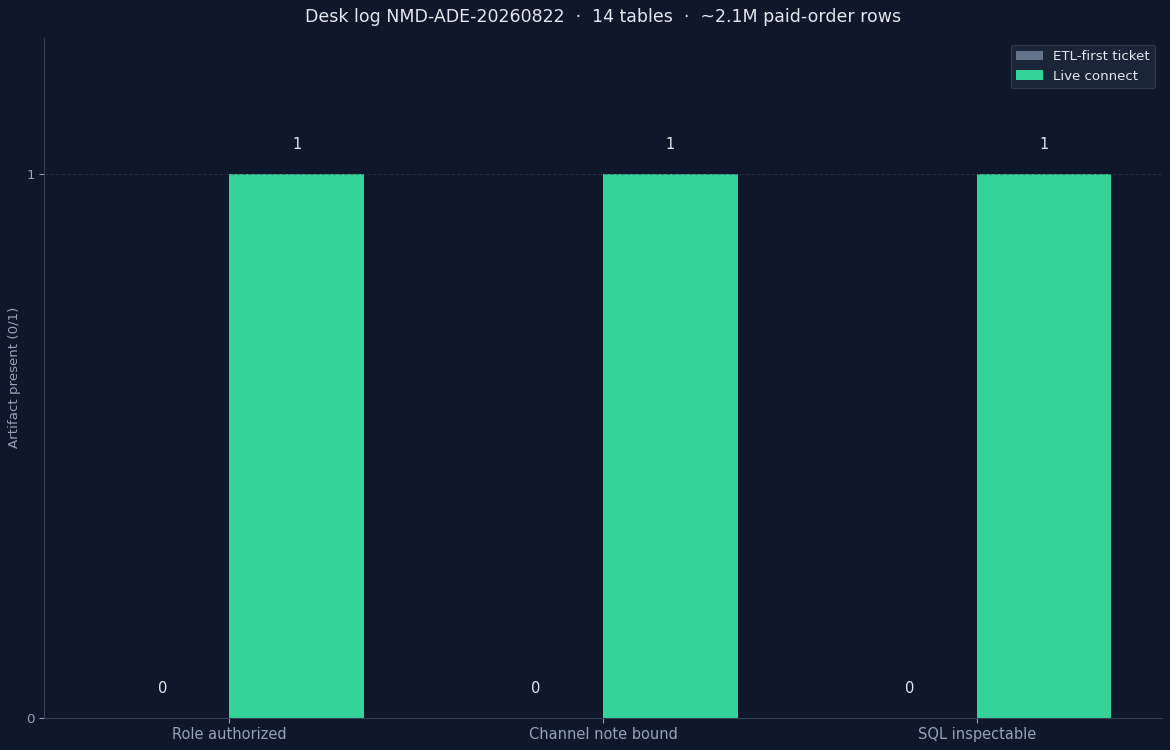
Figure. InfiniSynapse desk log NMD-ADE-20260822: ETL-first ticket left 0 / 0 / 0; live connect left 1 / 1 / 1. Published context: the independent sources linked in the body. Not a customer experiment, SLA, or official benchmark.
| Evidence class | What you can cite | What you cannot claim |
|---|---|---|
| Desk log on this page | Artifact counts 0/0/0 → 1/1/1, 14 tables + ~2.1M paid-order rows on this run, ~10 min wall-clock, downloadable log · CSV · verify | Customer uplift %, vendor bake-off win, named-logo case |
| Independently hosted published docs | PostgreSQL Privileges, Snowflake warehouses, OWASP Top 10 for LLM Applications (retrieved 2026-08-29) | That those publishers ran this desk log |
| Independent method notes | W3C DCAT, DataCite, ISO/IEC 9075 (retrieved 2026-08-29) | That W3C, DataCite, or ISO certified this page |
| Homepage recognition | 2026 WAIC Future Tech OPC Excellence Award as published on the company homepage (self-described; not independently verified here) | That WAIC, PostgreSQL, or Gartner scored this article |
Scorecard: Connect Live or Build a Warehouse
| Signal | Analyze database without etl | Build or use a warehouse |
|---|---|---|
| Grain already in current tables | Yes | Optional |
| One team, low query frequency | Yes | Not yet |
| Certified metric shared across orgs | No | Yes |
| Primary cannot take the scan | Replica, then maybe warehouse | Yes if still hot |
| You lack a read-only role | Do not connect | Do not copy with write users either |
| Joins are stable and hourly | Maybe | Yes |
If you cannot get read-only access, you do not have a no-migration problem. You have an access problem. Do not use an app-owner account for analysis.
The scorecard is an educational rubric for analyze database without etl, not a vendor ranking. Independent sources linked above describe published posture; they do not score this rubric.
Failure Modes
Write credentials on an analysis account
The failure is silent until someone runs a generated statement that writes. Fix: dedicated read-only role, revoke first, connect second. Only then analyze database without etl.
Unbound metric names
“Revenue” on the orders schema might be gross, net, or recognized. The agent will pick a friendly column. Fix: bind the definition, re-ask, compare SQL. If you skip the bind, you did not analyze database without etl—you guessed.
Assuming zero-copy equals zero governance
Skipping ETL does not skip access reviews, logging, or retention. A live store is still in scope for data governance. Fix: treat the analysis role like any other production-adjacent credential. Governance is why you analyze database without etl with a dedicated role, not the app user.
Before you open an ETL ticket so someone can “finally analyze,” check three things: whether the grain already lives in a store you can read, whether a SELECT-only role exists, and whether you can state one question whose answer would change a decision this week. Those three checks decide if you analyze database without etl or you wait on access.
The eleven cluster guides under this hub keep one object each. Open the row that matches the next missing file after you analyze database without etl on the first store.
| Cluster guide | Open it when |
|---|---|
| PostgreSQL AI without a warehouse copy | Host, port, and a read-only role are the whole first step |
| Connect Snowflake to an AI Analyst | Authorize the account you already operate; skip the copy |
| Connect MySQL without Migration | A traditional MySQL box can answer before a warehouse exists |
| Zero-Config Federated Analysis: What to Accept | Federation is accepted when two sources share one trail |
| Read-Only Database Access for AI Analysis | Write grants are a failure, not a feature |
| When You Still Need a Warehouse | High-frequency materialization is still a warehouse job |
| What Is a Database You Can Ask without ETL | A database is a live, read-only source, not a project |
| SQL Database Access for an AI Analyst | SQL access is a role and a trail, not a dump |
| Relational Database Analysis without a Mirror | Relations are enough; a copy is a later choice |
| Database Schema Notes an Agent Can Retrieve | Schema is usable when notes are bound to it |
| Cloud Database: Authorize, Do Not Recreate | Cloud still means read-only and inspectable SQL |
Route the same diagnosis to the live guide that owns the next object. Each row is a single hop, not a reading dump.
| Live guide | Open it when |
|---|---|
| parquet file analysis | the source is a file directory, not a warehouse |
| ClickHouse analytics | the engine is ClickHouse |
| MongoDB analytics | the source is a document store |
| natural language to SQL | the failure is a legal join with the wrong filter |
| data management | the source estate is the unsolved object |
| data knowledge base | definitions live in memos, not only in columns |
Connect a read-only database and ask one question
Add the engine you already run, use a SELECT-only role, select that source, and ask one goal that names grain and window. This check uses only sources you authorize.
Commercial association: You do not need the workspace to complete the educational diagnosis on this page.
Open InfiniSynapseHow this page is sourced. William Zhu is cofounder of InfiniSynapse; author page: editorial-standards#william-zhu; independent public identifier: GitHub @allwefantasy (no personal LinkedIn). Institution: About InfiniSynapse. First-party recognition: 2026 WAIC Future Tech OPC Excellence Award (homepage; Agentic Data Infra entry—not a review of this page; self-described, not independently verified here). Trust pages: Privacy · publishing terms · NIST Privacy Framework. Desk methodology note: 2026-07-29 attestation. Downloadable first-party run: desk log
NMD-ADE-20260822. Reviewed by analytics engineering · data platform · LLM security · editor. Editorial standards · corrections · Contact zhuhl@infinisynapse.com. Company About. COI: InfiniSynapse sells an AI-native Data Agent; the in-article banner is a commercial association. Fact-check: PostgreSQL Privileges · PostgreSQL GRANT · MariaDB GRANT · Snowflake warehouses · Snowflake Cortex Analyst · Amazon Redshift Database Developer Guide · Wikipedia: Data warehouse · Wikipedia ETL overview · Wikipedia SQL overview · OWASP Top 10 for LLM Applications · ISO/IEC 9075 · W3C DCAT · DataCite · Stanford HAI AI Index · McKinsey State of AI · Gartner Peer Insights — Analytics & BI. First-party numbers on this page are desk logNMD-ADE-20260822only.
How to cite this page
Page: Zhu, W., & InfiniSynapse Data Team. (2026). Database: Bind, Then Replay. InfiniSynapse
Run: InfiniSynapse Data Team. (2026). Desk log NMD-ADE-20260822 (sanitized composite)
Neither is an audit. Cite those published artifact counts when you quote database figures from this first-party sanitized desk run. As of 2026-08-29, no independent evaluation, media citation, or reproduction of the ticket-versus-live contrast exists. ISO/IEC 9075, DataCite, and W3C DCAT stay citable as published files. They do not replace this first-party desk log. Keep that limit visible here now for later readers of this pack and for later reviewers of the same first-party artifacts on this desk run as of this retrieval date. Do not invent a published score. Send contradictions to zhuhl@infinisynapse.com.
Frequently Asked Questions
Can I analyze database without etl?
Bottom line: Yes, when the grain already lives in that store and you connect read-only. ETL is for reshaping and sharing, not for permission to ask.
Which engines can I connect first?
Bottom line: Start with the store you already trust—often Postgres, MySQL, Snowflake, or Supabase. The method is the same: read-only role, one question, inspect SQL. That is how you analyze database without etl on any of them.
When do I still need a warehouse?
Bottom line: When many teams need a certified grain on a schedule, or the operational store cannot bear the load. A warehouse is a promotion, not the first door. You can still analyze database without etl for the grain that already exists.
Is this the same as ChatBI?
Bottom line: No. ChatBI often hides the query. When you analyze database without etl, you need a plan and SQL you can open on the same source.
What if schema recall is wrong?
Bottom line: Bind a short field note and re-run. Do not grant more privileges to paper over a wrong table. If the note is missing, stop and analyze database without etl again after the bind.
Do PostgreSQL, Snowflake, or OWASP certify this desk connect test?
Bottom line: No. PostgreSQL Privileges, Snowflake warehouses, and the OWASP Top 10 for LLM Applications describe published posture, not this analyze database without etl desk table.
Did PostgreSQL, DataCite, or a news outlet recognize this page?
Bottom line: No. PostgreSQL Privileges and DataCite publish grants and citation infrastructure. They did not evaluate InfiniSynapse. There is no media citation of this database page, and there is no personal LinkedIn to add.
Conclusion
A live store is a valid analysis surface when the grain already lives there. Authorize a read-only role, recall the schema, ask one goal, and inspect the SQL before you fund a warehouse. When you analyze database without etl this way, the store is the source—not a ticket queue. The warehouse is a promotion after the grain is shared and hourly.
The educational diagnosis on this page does not require a workspace. You can finish the same checks on paper before you analyze database without etl in any product.