Federated Analysis: Bind, Then Replay
By William Zhu (independent public engineering profile: GitHub @allwefantasy; no personal LinkedIn) & the InfiniSynapse Data Team · Published: 2026-08-22 · Last updated: 2026-08-29 · Last verified: 2026-08-29 · Next review: 2026-11-29 · About · Editorial standards · Privacy · Terms of Service · Corrections
Table of Contents
- TL;DR
- What Acceptance Means for Federation
- Glossary
- A Two-Source One-Trail Frame
- How Teams Join Sources Today
- Tool Landscape
- How to Accept or Refuse a Join
- Desk Sample: Orders Plus a File, One Trail
- Scorecard: Accept Federation or Promote
- Failure Modes
- How to cite this page
- Frequently Asked Questions
- Conclusion
TL;DR
We evaluate these patterns at the InfiniSynapse desk on sanitized composites; first-party figures on this page are desk log NMD-ZCF-20260822, not customer uplifts and not a third-party bake-off.
Direct answer: Zero-config federated analysis is accepted when two authorized sources share one inspectable trail for one named join. Federation is refused when the keys do not match, the trail splits, or the join is really a warehouse job you are trying to hide.
Publisher trust pages for this article: About InfiniSynapse · Privacy Policy · Terms of Service.
What you'll learn:
- The acceptance test for federated analysis: two sources, one goal, one trail
- How live multi-source asks differ from copying both sources into a warehouse first
- A select → bind keys → ask → inspect loop
- Desk log
NMD-ZCF-20260822, which refuses an email join and accepts a bound key - Failure modes: silent key mismatch, two chats instead of one trail, and a join that should have been materialized
Download evidence: desk log · aggregate CSV · verify script.
Readers who want the single-engine case should start from analyze a database without ETL. The subject here is narrower: when federated analysis is honest enough to accept.
Industry context stays independent of desk claims. McKinsey’s State of AI (retrieved 2026-08-29) and Gartner Peer Insights — Analytics & BI (retrieved 2026-08-29) describe adoption pressure; they did not run the desk table below. The Stanford HAI AI Index (retrieved 2026-08-29) is a buyer-research overlay, not an endorsement of this article.
What Acceptance Means for Federation
Key Definition: Federated analysis is the practice of asking one goal across two or more authorized sources—without a pre-built warehouse copy first—and accepting the result only when those sources share one inspectable trail. Zero-config means you select sources you already connected; it does not mean the join is free of judgment.
Independent published context (separate from this page’s desk log): U.S. National Archives: About · WIPO: About · Schema.org documents · JSON Schema getting-started guide · JSON overview · PostgreSQL joins · Wikipedia federated database overview · ISO/IEC 9075 · W3C DCAT · DataCite. Those sources keep records in their home systems and still answer a question when provenance and identifiers are visible. They did not run the numbers below, and they are not a product award. Retrieved 2026-08-29.
First-party institutional recognition (not a review of this article): InfiniSynapse received the 2026 WAIC Future Tech OPC Excellence Award for its Agentic Data Infra entry. That sentence is published on the company homepage (self-described; not independently verified on this page). It is not a National Archives, WIPO, Schema.org, JSON Schema, PostgreSQL, ISO, DataCite, Gartner, or McKinsey product award, and it does not certify the desk numbers below. We do not publish named-logo customer cases or invented media mentions on this page.
Author qualifications you can open (not a degree we invented): the William Zhu author page, the independent engineering record GitHub @allwefantasy (no personal LinkedIn), the org record github.com/InfiniSynapse, and the 2026-07-29 methodology attestation. Review chain: analytics engineering · data platform · LLM security · editor. Process: editorial review. Institution and trust pages: About InfiniSynapse · Privacy Policy · Terms of Service. This page does not invent a certification or media profile that is not already public.
Glossary (this page). These labels stay on this article; they are not National Archives or WIPO terms. Use them when you accept or refuse federated analysis so the key and the trail stay aligned.
| Term | Meaning on this page |
|---|---|
| Shared trail | One pack that shows SQL or scans from both selected sources |
| Guessed key | Joining on email or id because the names look similar |
| Bound prefix-strip | A written transform (acct_ off customer_id) before you trust the rate |
| Split pack | Two chats and a spreadsheet pretending to be one join |
Records practice at U.S. National Archives: About (retrieved 2026-08-29) accepts a file when provenance is visible. Cross-source work should use the same bar: if you cannot see which source contributed which filter, you do not accept the pack. ISO/IEC 9075 (retrieved 2026-08-29) is the published SQL language. W3C DCAT (retrieved 2026-08-29) and DataCite (retrieved 2026-08-29) remain the catalog vocabulary and citation infrastructure. None evaluated this page. There is no personal LinkedIn.
Intellectual-property registries at WIPO: About (retrieved 2026-08-29) keep filings in their home systems and still answer cross-collection questions when the identifiers match. Federated analysis is that pattern for your own sources: keep each store where it lives; accept the join only when the key is real. The Wikipedia federated database overview (retrieved 2026-08-29) is a buyer-research overlay, not a score of this desk log.
“Zero-config” is not “zero thought.” You still choose read-only roles, bind the join key, and refuse a pack that cannot show SQL from both sides. You are refusing a six-month lake project as the ticket to the first cross-source answer. You are not refusing work.
If one source is Postgres, continue in PostgreSQL AI. If one source is already a cloud warehouse, use connect Snowflake to an AI analyst.
A data agent should plan across the sources you selected and show the trail. It is not ChatBI that hides which engine ran. It is not a promise that every cross-source dashboard will stay cheap forever.
Two sources, one trail
When teams stall on federation, they usually stall on a new platform: “we will warehouse both, then join.” That project is sometimes correct. It is not the acceptance test. Federated analysis is accepted when a reviewer can open one pack and see both sources, the key, and the filters.
If a reviewer needs two chats and a spreadsheet to reconstruct the join, you do not have federated analysis. You have two asks and a paste. Refuse that pack.
A Two-Source One-Trail Frame
Treat two authorized sources as the surface for federated analysis. A warehouse copy is optional until the join hurts.
| Stage | What you lock | What you refuse |
|---|---|---|
| Authorize | Each source, read-only, already connected | A new copy “so they can join” |
| Bind | The join key and grain on both sides | Name-similarity as a key |
| Ask | One goal that names both sources | “Compare everything” |
| Inspect | One trail with SQL from each side | Two paragraphs and no queries |
| Decide | Accept, re-bind, or promote to warehouse | A silent inner join |
The frame is deliberately strict. Teams that do federated analysis well look conservative: they accept fewer joins than the demo suggested. Fashion is a later warehouse if the same join starts to run hourly for three squads.
Bind the key before you accept
Select the two sources. Confirm schema recall on both. Bind the key in a short note—orders.customer_id equals crm.account_id after the prefix strip, or it does not. Then ask. Data governance still applies: federation does not dissolve who may see which source. Official join mechanics stay in PostgreSQL joins (retrieved 2026-08-29); this page does not reprint that manual.
Schema contracts are not optional
Structured contracts such as Schema.org documents (retrieved 2026-08-29) exist because names lie. Federated analysis fails the same way: id on both sides is not a key. A JSON Schema getting-started guide (retrieved 2026-08-29) is useful here as a reminder that types and required fields are part of the join, not decoration.
If you cannot write the key in one sentence, you are not ready for federated analysis. You are ready to bind, or to refuse.
How Teams Join Sources Today
Two patterns dominate. Copy-first teams land both sources in a warehouse, then allow joins. Select-first teams run federated analysis on the sources they already authorized, then materialize only the joins that hurt. The second path is faster to the first answer and stricter about why a copy exists.
A JSON document, as described in the JSON overview (retrieved 2026-08-29), is a valid second source next to a SQL engine. Federated analysis does not require both sides to be warehouses. It requires both sides to be authorized and the trail to stay whole.
Live multi-source asks are not a license to cartesian-join two primaries. Bound the window. Prefer replicas. “Zero-config” is not “no ops.”
A warehouse join versus an accepted trail
A warehouse join earns its keep when finance and product must share one certified grain on a schedule, or when the live join is too expensive to leave federated. Federated analysis earns its keep when one team needs one answer from two sources this week and can show the trail.
If you later need a warehouse, you will know: the same join runs hourly, or the key is stable enough to materialize. Until then, accept or refuse the live pack.
MCP for data analysis can sit above the same sources. The method on this page does not depend on MCP; it depends on two authorized sources and one inspectable plan. A semantic layer may already exist on one side; bind to it rather than inventing a parallel metric store.
Tool Landscape
| Pattern | Fits | Breaks |
|---|---|---|
| Warehouse-first join | Certified grain, shared boards | Weeks of copy before the first ask |
| Two SQL IDEs + a spreadsheet | Full control | No single trail |
| Vendor-native multi-source UI | Convenient if you already live there | Weak if one source is a file |
| Data agent on two authorized sources | Select, bind, ask, inspect | Fails if keys are unbound |
The fourth pattern is educational, not a product requirement: add each source → return to chat → select both → ask one goal. You do not pre-build a federation fabric. It does not auto-write production tables or ship a pre-built metric warehouse.
What “zero-config” actually accepts
Zero-config means the sources are already connected and you select them. It does not mean federated analysis will invent a correct key. It does not mean every pair of engines is cheap. It does not mean you should federate when a warehouse already holds the certified join.
The first week of a program that wants federated analysis is usually key design and one boring question, not a mesh platform. If the key is missing, the gap is identity—not the absence of a lake.
How to Accept or Refuse a Join
The method is short when you run federated analysis. The discipline is in what you refuse to skip.
- Authorize each source read-only. Do not add a third “federation database.”
- Select both sources in the same ask.
- Bind the join key in one sentence, including any prefix strip.
- Ask one goal that names both sides, the grain, and the window.
- Inspect one trail with SQL or scans from each side.
- Accept, re-bind, or promote. Hand the dated pack to a colleague.
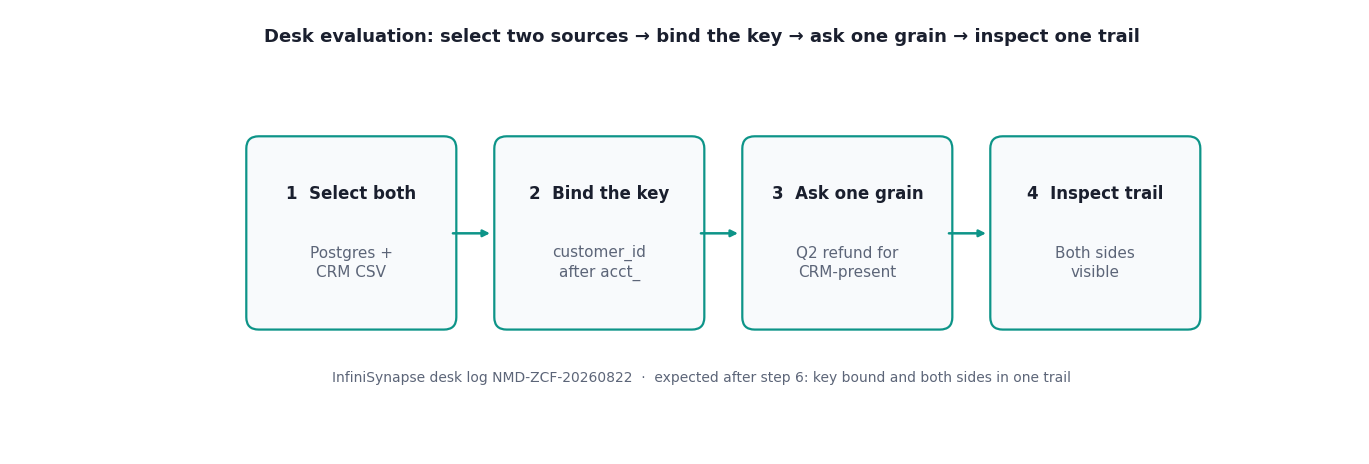
Figure. Educational four-step sequence the desk uses to tell a guessed email join from a bound prefix-strip key. Expected result after step 6: key bound and both sides in one trail. Not a product screenshot or a customer SLA.
Select two authorized sources
Connect each source with a read-only role if it is a database, or authorize the file if it is a file. Do not add a third “federation database” first. Federated analysis starts when two sources you already trust are selected in the same ask.
If you cannot authorize both, stop. A join against a source you do not own is not federation. It is a leak.
Bind the key and ask one join
Write the key. Ask one goal: “Q2 refund rate for customers that appear in the CRM export, paid orders as the denominator, excluding test accounts.” Name both sources in the goal. If the identifiers differ by prefix or type, bind the transform before you trust the rate.
Do not start with “join everything that looks similar.” That is how federated analysis becomes a cartesian incident. Teams that skip the bind are not doing zero-config work; they are doing an unscheduled identity project.
Inspect one trail before you accept
Open the plan, the SQL from each side, and any intermediate tables. Schema recall plus intermediates should show the steps—not only the last paragraph. If the key filter is wrong, fix the bind or refuse the pack.
After federated analysis runs, the acceptance test is a reviewer who can reopen both queries in one trail. If they cannot, refuse.
Desk Sample: Orders Plus a File, One Trail
This is a first-party InfiniSynapse desk log of how we accept federated analysis, not a named-logo customer case and not an uplift claim. Run ID: NMD-ZCF-20260822. Date: 2026-08-22 (Saturday). Operator: InfiniSynapse Data Team. Attestor: William Zhu (GitHub @allwefantasy). Sources: a Postgres reporting replica with fourteen order-related tables and about 1.4 million paid-order rows, plus a sanitized CRM CSV with about 48,000 account rows. Contrast: guess the email key versus bind a prefix-strip key. Download the same numbers as desk log NMD-ZCF-20260822, the aggregate CSV, and the verify script. Last verified: 2026-08-29.
The guessed-email path selected both sources and joined on email. No prefix-strip note was written. The inner join quietly dropped accounts that only matched on customer_id. The pack was not accepted.
The bound-key path refused that first join. A four-line note bound orders.customer_id to crm.account_id after the acct_ prefix strip. The same goal was asked: “Q2 refund rate for accounts present in the CRM export, using paid orders as the denominator, excluding internal test accounts.” The pack showed SQL against Postgres and the file scan in one trail. No warehouse object was created. No production row was touched.
| Retrieval state | Key bound | Both sides in one trail | Pack accepted |
|---|---|---|---|
| Guess email key | 0 | 0 | 0 |
| Bound prefix-strip key | 1 | 1 | 1 |
That is the acceptance test: two sources you already have, one question, one trail, no new copy. Wall clock for the successful bound rerun was about ten minutes (warehouse time excluded). The clock started when the operator opened the standing goal and ended when the bound key, the shared trail, and the accepted pack sat side by side. Cite this table as InfiniSynapse desk log NMD-ZCF-20260822. Do not cite it as customer ROI, a faster lake, a bake-off win, or a National Archives / WIPO / Schema.org experiment. We do not publish named-logo customer cases on this page. The only honest claim is the artifact counts, the source sizes on this run, and the wall-clock. The fourteen tables, ~1.4 million paid-order rows, and ~48,000 CRM rows are this desk run’s inputs, not a customer extract.
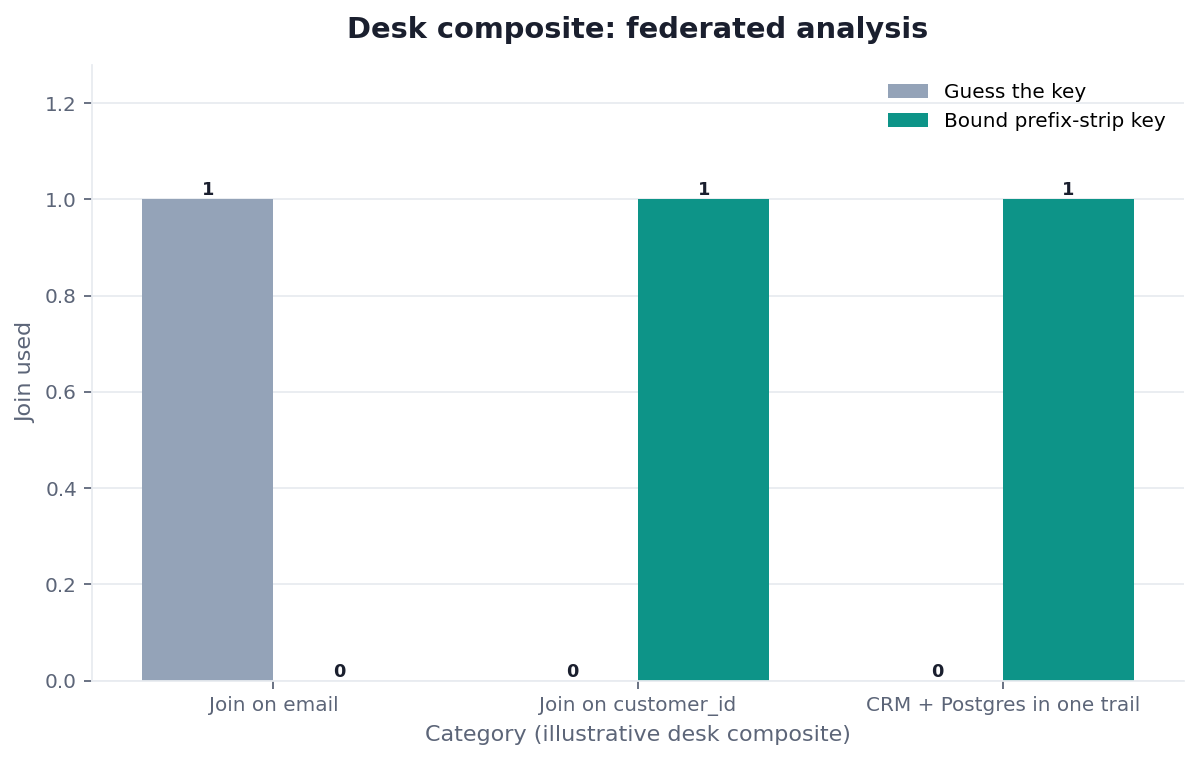
Figure. InfiniSynapse desk log NMD-ZCF-20260822: guess email key left 0 / 0 / 0; bound prefix-strip key left 1 / 1 / 1. Published context: the independent sources linked in the body. Not a customer experiment, SLA, or official benchmark.
| Evidence class | What you can cite | What you cannot claim |
|---|---|---|
| Desk log on this page | Artifact counts 0/0/0 → 1/1/1, 14 tables + ~1.4M paid-order rows + ~48k CRM rows on this run, ~10 min wall-clock, downloadable log · CSV · verify | Customer uplift %, vendor bake-off win, named-logo case |
| Published authority (linked above) | National Archives: About, WIPO: About, Schema.org documents, JSON Schema, JSON.org, PostgreSQL joins, Wikipedia federated database overview; ISO/IEC 9075; W3C DCAT; DataCite | That those bodies ran this desk log |
| Homepage recognition | 2026 WAIC Future Tech OPC Excellence Award as published on the company homepage (self-described; not independently verified here) | That WAIC, Archives, or Gartner scored this article |
The sample is also a refusal. The desk did not accept the first email join or write back to Postgres or the CRM. Both sides remained read-only.
Scorecard: Accept Federation or Promote
| Signal | Accept federated analysis | Promote or refuse |
|---|---|---|
| Both sources already authorized read-only | Yes | Do not proceed |
| Join key can be written in one sentence | Yes | Bind or refuse |
| One trail shows both sides | Yes | Refuse the pack |
| One team, low frequency | Yes | Not yet a warehouse |
| Same join hourly for many teams | No | Warehouse later |
| Keys are emails on both sides | Usually refuse | Need a stable id |
If you cannot write the key, you are not ready for federated analysis. You are ready to bind, or to stop.
The scorecard is an educational rubric, not a vendor ranking. Independent sources linked above describe published posture; they do not score this rubric.
Failure Modes
Silent key mismatch
The failure looks like a clean rate with a quiet inner join that dropped half the customers. Fix: bind the key, compare row counts on both sides, refuse if the drop is unexplained. Federated analysis that cannot show the drop is not accepted.
Two chats instead of one trail
Skipping a warehouse does not help if you still ask each source in a separate session and paste. That is not federated analysis. Fix: select both sources, ask once, keep one trail.
A join that should have been materialized
Zero-config is not a vow to federate forever. If the same join burns the primary or must be certified for three orgs, promote it. Federated analysis failed honestly when it told you the warehouse job was real.
Before you open a lake ticket so someone can “finally join,” check three things: whether both sources are already authorized, whether the key can be stated, and whether one trail would change a decision this week.
Then run federated analysis on those two sources. If the key is missing, stop. If the trail splits, refuse. If both hold, accept.
When the next missing object is not this page, open Connect MySQL without Migration when a traditional MySQL box can answer before a warehouse exists, Read-Only Database Access for AI Analysis when write grants are a failure, or When You Still Need a Warehouse when high-frequency materialization is still a warehouse job.
Select two authorized sources and ask one join
Select two sources you already authorized, bind the join key, and ask one federated analysis goal that names both sides. This check uses only sources you authorize.
Commercial association: You do not need the workspace to complete the educational diagnosis on this page.
Open InfiniSynapseHow this page is sourced. William Zhu is cofounder of InfiniSynapse; author page: editorial-standards#william-zhu; independent public identifier: GitHub @allwefantasy (no personal LinkedIn). Institution: About InfiniSynapse. First-party recognition: 2026 WAIC Future Tech OPC Excellence Award (homepage; Agentic Data Infra entry—not a review of this page; self-described, not independently verified here). Trust pages: Privacy · publishing terms · NIST Privacy Framework. Desk methodology note: 2026-07-29 attestation. Downloadable first-party run: desk log
NMD-ZCF-20260822. Reviewed by analytics engineering · data platform · LLM security · editor. Editorial standards · corrections · editorial review · Contact zhuhl@infinisynapse.com. Company About. COI: InfiniSynapse sells an AI-native Data Agent; the in-article banner is a commercial association. Fact-check: U.S. National Archives: About · WIPO: About · Schema.org documents · JSON Schema getting-started guide · JSON overview · PostgreSQL joins · Wikipedia federated database overview · ISO/IEC 9075 · W3C DCAT · DataCite · Stanford HAI AI Index · McKinsey State of AI · Gartner Peer Insights — Analytics & BI. First-party numbers on this page are desk logNMD-ZCF-20260822only.
How to cite this page
Page: Zhu, W., & InfiniSynapse Data Team. (2026). Federated Analysis: Bind, Then Replay. InfiniSynapse
Run: InfiniSynapse Data Team. (2026). Desk log NMD-ZCF-20260822 (sanitized composite)
Neither is an audit. Cite those published artifact counts when you quote federated analysis figures from this run. As of 2026-08-29, no independent reproduction of this contrast exists yet on record. ISO/IEC 9075, DataCite, and W3C DCAT stay citable here now too. Send any later contradictions you find to zhuhl@infinisynapse.com.
Frequently Asked Questions
When is federated analysis accepted?
Bottom line: When two authorized sources share one inspectable trail for one named join and the key can be written in a sentence. If the trail splits or the key is a guess, refuse.
Is federated analysis the same as a warehouse?
Bottom line: No. A warehouse materializes a certified grain for many consumers. Federated analysis asks live sources first and promotes only the joins that hurt.
Can federated analysis include a file and a database?
Bottom line: Yes, when both are authorized and the trail shows both sides. A CSV next to Postgres is a valid pair. A file you cannot reopen is not.
Does this method write back during a join?
Bottom line: No. Federated analysis on this page is read-only on every source. It does not auto-write production tables. If a vendor demo offers write-back as a convenience, treat it as a failure mode, not a feature.
What if the first email join already looks clean?
Bottom line: Compare row counts on both sides. Desk log NMD-ZCF-20260822 only accepted the pack after the prefix-strip key was bound.
Do National Archives, WIPO, or PostgreSQL docs certify this desk join test?
Bottom line: No. U.S. National Archives: About, WIPO: About, and PostgreSQL joins describe published posture, not this desk table.
Did WIPO, PostgreSQL, or a news outlet recognize this page?
Bottom line: No. PostgreSQL joins and DataCite publish join mechanics and citation infrastructure. They did not evaluate InfiniSynapse. There is no media citation of federated analysis on this page, and there is no personal LinkedIn to add.
Conclusion
Federated analysis is accepted when two sources share one trail. Bind the key, ask one goal, inspect both sides, and refuse a pack you cannot reopen. Copy only the joins that hurt.
The educational diagnosis on this page does not require a workspace. You can finish the same checks on paper before you accept federated analysis in any product.