ClickHouse Analytics: Review Agent SQL Safely
By William Zhu & the InfiniSynapse Data Team · Published: 2026-08-22 · Last updated: 2026-08-31 · Last verified: 2026-08-31 · Next review: 2026-11-30 · Editorial standards · Corrections
Table of Contents
- TL;DR
- Evidence Boundary
- What ClickHouse analytics means for static review
- Practical Static Replay
- Review rules
- Independent Validation
- Sources and Limited Claims
- Failure modes
- How to Cite This Pack
- Frequently Asked Questions
- Conclusion
TL;DR
Static, non-executing ClickHouse SQL review pack. It uses synthetic DDL, one accepted query candidate, one rejected candidate, deterministic lint rules, expected JSON, and a standard-library Python verifier. No database connection, parser, SQL execution, query result, plan, runtime, scan, cost, pruning, freshness, or customer evidence is involved.
Direct answer: Use the pack to review agent-written ClickHouse SQL before execution. It can establish that a candidate is a single read-only
SELECT, uses explicit projections, includes lower and upperevent_timebounds, and groups the requested aggregate. It cannot establish server compatibility, authorization, semantic correctness, performance, or actual data access.
The accepted fixture is narrow: event counts grouped by event_name over a closed-open synthetic time window. The rejected fixture contains SELECT * and omits a bounded window. Here, rejecting SELECT * is a page policy for this ClickHouse exercise; SELECT * is not generally invalid ClickHouse syntax.
Evidence Boundary
ClickHouse evidence is limited to nine downloadable files and this explanation. The SQL files were not sent to a ClickHouse server. The verifier does not import a database driver, access a socket, invoke a client, use a subprocess, or make a network request. Its checks are conservative text rules, not dialect parsing or conformance testing.
The synthetic table is called synthetic_product_events. Its DDL is marked DO NOT EXECUTE and shows a MergeTree example to provide a stable column contract. It does not assert compatibility with any ClickHouse version, deployment, setting, storage policy, or schema. Names and timestamps are invented. There are no event values or outputs.
The presence of a lower and upper event_time predicate records bounded-window intent. It does not prove partition pruning, primary-index pruning, a PREWHERE choice, bytes read, cost, latency, or performance. Those claims require table-specific evidence such as the actual DDL and settings, EXPLAIN, analyzer output, and—after authorized execution—system.query_log. Direct sources explain those mechanisms without claiming that this pack exercised them.
| Review question | Static evidence can answer | Static evidence cannot answer |
|---|---|---|
| Statement shape | One candidate; one semicolon-terminated read-only SELECT | Full parser or **ClickHouse** acceptance |
| Projection | Explicit selected expression; no SELECT star under this policy | Column existence on a real table |
| Window | Both lower and upper event_time text predicates appear | Part or primary-index pruning |
| Aggregation | COUNT and GROUP BY event_name appear | Correct result or business meaning |
| Safety screen | Mutation keywords and multiple statements are rejected | Privileges, row policies, settings, or sandboxing |
What ClickHouse analytics means for an AI agent
Key Definition: On this page, ClickHouse analytics means a pre-execution review of SQL text intended for the database. “Accepted” means only that the candidate passes the disclosed local lint policy. It does not mean approved to run, valid for a real schema, independently validated, or safe under every ClickHouse configuration.
Official introductory context describes ClickHouse as a column-oriented SQL database for online analytical processing: Introduction (retrieved 2026-09-04). MergeTree, partitions, and primary indexes (each retrieved 2026-09-04) describe separate table-design and data-skipping concepts. A time predicate alone proves none of them were used effectively.
The legacy contextual references remain available: generic ClickHouse documentation, Wikipedia ClickHouse overview, column-oriented DBMS overview, and OLAP overview. They provide background only and did not validate this pack.
The following adjacent references are also context only: PostgreSQL documentation, Microsoft Azure data architecture guide, OWASP Top 10 for LLM Applications, Amazon Redshift documentation, and Looker documentation. No cross-engine join, warehouse comparison, product test, or security audit was performed. When the table already lives in ClickHouse, large-scale analysis is the how-to map for bounded scans; this page stays on engine-native review.
Practical Static Replay
Download all nine files into one directory:
synthetic-product-events-DDL-CHA-20260831.sql— syntheticMergeTreeexample, prominently marked DO NOT EXECUTE.accepted-bounded-aggregate-CHA-20260831.sql— one candidate with explicit output, two time bounds,COUNT, andGROUP BY event_name.rejected-select-star-CHA-20260831.sql— policy failure withSELECT *and no lower or upper bound.expected-lint-output-CHA-20260831.json— deterministic expected verdicts, rule IDs, and disclaimer.clickhouse-sql-review-rules-CHA-20260831.md— the human-readable rule contract.assumption-register-CHA-20260831.csv— assumptions, status, and evidence needed to resolve them.external-source-check-CHA-20260831.md— claim-to-source map and retrieval date.independent-reproduction-protocol-CHA-20260831.md— clean-room replay instructions and independence criteria.verify-CHA-20260831.py— offline standard-library verifier.
Run python3 verify-CHA-20260831.py from that directory. A successful replay prints the scope disclaimer and a deterministic PASS after checking the required file set, expected hashes, fixture identities, exactly one candidate statement per fixture, read-only shape, mutation exclusions, explicit projection, both bounds, aggregate, and grouping. It also checks that the rejected fixture produces the disclosed failures.
The script does not claim that regexes understand the complete ClickHouse grammar. It strips comments and quoted strings for a narrow statement count, then evaluates only the fixture contract. Warning fields in expected JSON remain visible even when the deterministic comparison passes.
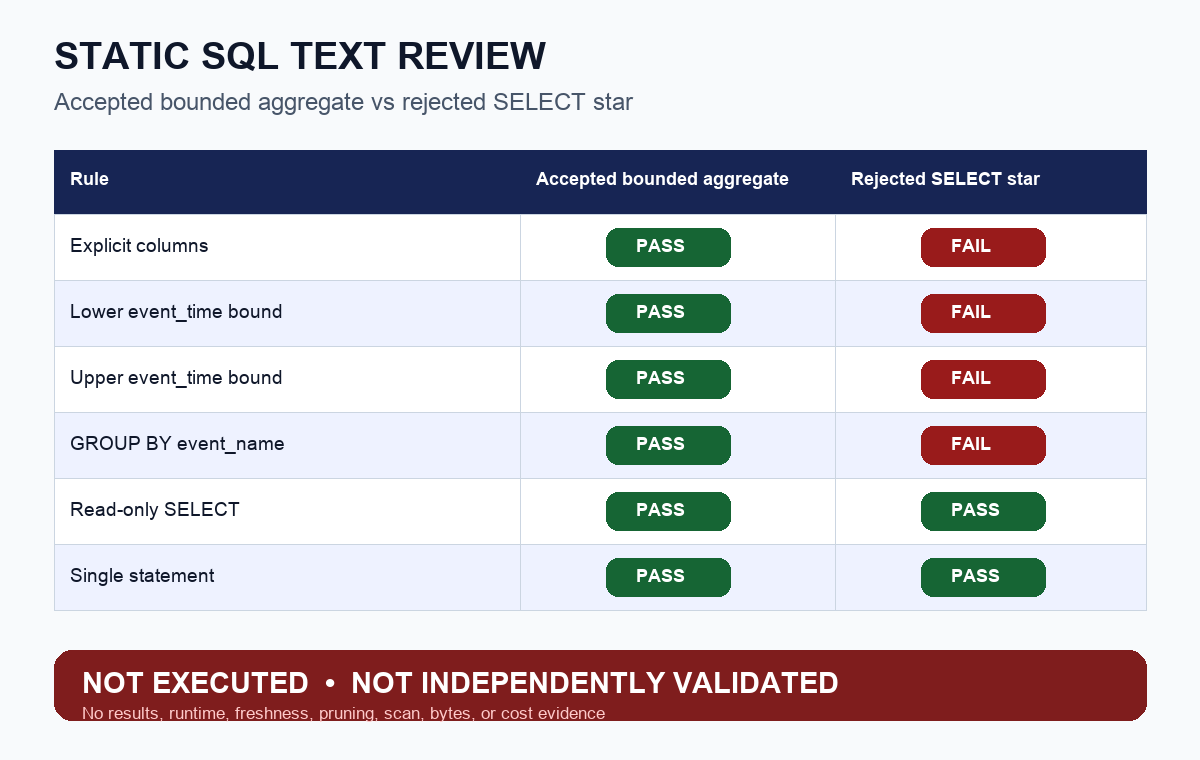
Figure. Two-dimensional static lint matrix. SQL text only; not executed and not independently validated. It contains no event values, runtime, freshness, bytes, scan, or cost evidence.
Review rules
One candidate and one read-only statement
Each candidate fixture must contain exactly one semicolon-terminated statement after comments and quoted literals are excluded from the narrow count. The first token must be SELECT. Mutation and administration terms such as INSERT, UPDATE, DELETE, ALTER, DROP, TRUNCATE, CREATE, GRANT, REVOKE, ATTACH, DETACH, OPTIMIZE, SYSTEM, and KILL trigger rejection.
This is a lint boundary, not a ClickHouse security boundary. Real controls require least-privilege grants and deployment-specific configuration. See access rights, CREATE ROLE, and CREATE ROW POLICY (retrieved 2026-09-04). This pack did not create or test a user, role, grant, or policy.
Explicit projection and bounded time intent
The accepted ClickHouse candidate names event_name and count() AS event_count; it does not select every source column. The linter rejects a top-level SELECT * under this page policy because a reviewer requested explicit output. That policy should not be misreported as a ClickHouse language rule.
Both event_time >= ... and event_time < ... must appear. The half-open form avoids overlapping adjacent fixture windows. Yet text presence says nothing about actual partition expressions, sort order, primary-index conditions, data distribution, settings, or optimizer behavior.
PREWHERE (retrieved 2026-09-04) explains an optimization that can reduce unnecessary column reads. The accepted fixture uses WHERE, not PREWHERE, and this review makes no recommendation that a manual PREWHERE would be better. That choice needs query- and table-specific evidence.
Aggregate and grouping contract
The accepted candidate must include count() and GROUP BY event_name. This confirms the requested text shape only. It cannot prove that event_name exists, that timestamps use the intended timezone, that duplicate events are handled correctly, or that the aggregate answers a stakeholder’s metric definition.
The synthetic DDL offers event_id, event_name, event_time, and account_id as a stable ClickHouse vocabulary. It includes a partition and ordering example so reviewers can discuss intent, but it is not a production recommendation. Do not execute it.
Independent Validation
Independent validation requires a reviewer who did not author the fixtures or expected output to obtain the published pack, verify the file identities, inspect the rules, and reproduce the verdict in a clean local directory. The protocol asks that reviewer to record operating system, Python version, UTC time, command, exit status, stdout, and file hashes. The reviewer must disclose any changed file.
Running the script internally is reproducibility, not independence. William Zhu, the InfiniSynapse Data Team, editorial reviewers, and anyone working under the same publishing process are not independent reviewers for this artifact. At publication time, no outside reviewer had supplied an attestation. Therefore the chart and expected output say NOT INDEPENDENTLY VALIDATED.
Independent static reproduction would still not become a third-party audit, ClickHouse test, security assessment, or performance benchmark. A stronger validation stage would require an authorized owner to substitute the real schema, inspect settings and permissions, use server-native parsing and planning, review EXPLAIN and query analysis with the analyzer, and, only after approved execution, examine system.query_log (all retrieved 2026-09-04).
Sources and Limited Claims
Direct official sources were selected for the exact mechanisms discussed:
- Introduction (retrieved 2026-09-04): high-level database description.
- MergeTree (retrieved 2026-09-04): engine parameters and data organization.
- Partitions and primary indexes (retrieved 2026-09-04): separate pruning and indexing concepts.
- PREWHERE, EXPLAIN, and analyzer execution (retrieved 2026-09-04): mechanisms needed for query-specific analysis.
system.query_log(retrieved 2026-09-04): post-execution query information when configured.- Access rights, roles, and row policies (retrieved 2026-09-04): authorization concepts not tested here.
- Query-level settings and query complexity restrictions (retrieved 2026-09-04): operational controls that static SQL text cannot verify.
Source checks establish that the linked pages discuss these ClickHouse concepts. They do not endorse this lint policy or attest to the fixtures. Documentation can change after retrieval. The external source checklist records titles, URLs, retrieval date, relevance, and the limited claim supported.
For broader architecture only, retain the Azure guide, Redshift documentation, PostgreSQL documentation, OWASP project, and Looker documentation. None provides evidence that this candidate ran or that one architecture is preferable here.
Failure modes
Treating a predicate as proof of pruning
A bounded timestamp predicate captures reviewer intent. Partition pruning depends on the table’s partition expression and query relationship; primary-index effectiveness depends on ordering and conditions. Only table-specific plan and execution evidence can support claims about skipped parts, granules, or bytes.
Treating SELECT star as invalid SQL
The rejected fixture fails a deliberately stricter ClickHouse policy. Saying that ClickHouse rejects SELECT * would be false. Another review context may permit it. Here it is rejected to keep the output contract explicit.
Treating lint success as authorization
A PASS cannot show that a user has only SELECT, that row policies apply, that settings cap resource use, or that the statement is appropriate for production. Access rights, roles, policies, query-level settings, and complexity controls must be assessed in the ClickHouse environment.
Treating a synthetic schema as a real table
The DDL is a ClickHouse review aid. It contains no customer, product, operational, or warehouse evidence. Its column names, partition expression, order key, comments, and engine clause must not be presented as observed infrastructure.
How to Cite This Pack
You may cite the pack as: “InfiniSynapse, ClickHouse Analytics: Review Agent SQL Safely, static SQL text review pack, version 2026-08-31, https://infinisynapse.com/en/blog/clickhouse-analytics.”
Describe what was reproduced: file hashes, deterministic static rules, fixture verdicts, Python version, date, and any deviations. Link the article and the independent reproduction protocol. If you ran only the included verifier, use “reproduced the published static lint result,” not “validated the query.”
Do not call this a third-party audit, independent validation, parser test, database test, benchmark, security review, production review, or ClickHouse performance study. Do not claim results, pruning, scans, costs, freshness, permissions, or compatibility. Internal editorial review does not alter that boundary.
Cluster guides retained for navigation: Connect ClickHouse to an AI Analyst; Real-Time OLAP Analysis vs a Cached Board; Event Analytics in ClickHouse; ClickHouse vs Warehouse for AI Questions; OLAP SQL for Agents; ClickHouse Dashboard from One Question; What Is ClickHouse for an AI Data Agent; ClickHouse Database; ClickHouse Materialized View; Managed ClickHouse; ClickHouse Use Cases.
Related links retained for context: AI dashboard generator; analyze a database without ETL; large-dataset analysis with AI; MongoDB analytics; dashboards; data visualization; semantic layer; chat with your data; MCP for data analysis.
Review SQL text before any execution decision
Download the static pack, inspect every rule, and reproduce its deterministic verdict offline. No InfiniSynapse account or database connection is required.
Commercial association: InfiniSynapse publishes this educational artifact and sells an AI-native Data Agent. The pack does not test that product.
Open InfiniSynapseDisclosure and accountability. William Zhu is cofounder of InfiniSynapse (GitHub @allwefantasy); no personal LinkedIn is published. Internal analytics engineering, data platform, LLM security, and editorial review is not independent validation. See About, Privacy, Terms, editorial standards, corrections, and publishing principles. Contact zhuhl@infinisynapse.com. Company About.
Frequently Asked Questions
Was the SQL executed against ClickHouse?
Bottom line: No. The pack is a static text review with no database connection, client, network request, parser conformance test, result, plan, or performance evidence.
Does the time window prove partition pruning?
Bottom line: No. It records bounded-window intent. The real DDL, partition expression, ordering, settings, EXPLAIN, analyzer output, and authorized execution evidence are needed for table-specific conclusions.
Is SELECT star invalid?
Bottom line: No. Its rejection is this page’s explicit-projection policy, not a ClickHouse syntax rule.
What does a verifier PASS mean?
Bottom line: The required files and expected hashes match, and the two fixture texts produce the disclosed deterministic lint verdicts. PASS does not authorize execution or establish semantic correctness.
Is this independently validated?
Bottom line: No independent attestation was available at publication. Internal reviewers are not independent. The protocol explains how an outside reviewer can reproduce the limited static result.
Conclusion
Safe ClickHouse analytics review starts by narrowing the claim. This pack can verify a small set of visible SQL-text properties before execution: one read-only candidate, explicit output, bounded event_time, aggregation, grouping, and no listed mutation terms. It cannot verify the ClickHouse data, plan, permissions, cost, or outcome. Use the downloadable evidence as a transparent first gate, then require table-specific native evidence before making operational claims.