Has ClickHouse: Name the Host First
By William Zhu & the InfiniSynapse Data Team · Published: 2026-08-22 · Last updated: 2026-10-02 · Last verified: 2026-08-31 · Next review: 2026-11-30 · Editorial standards · Corrections
Table of Contents
- TL;DR
- What is ClickHouse when an agent asks
- Evidence Boundary
- A framework for asking the engine in place
- Methods: ask in place vs copy first
- Tool landscape around the engine
- Implementation steps
- Desk sample: one event grain left in ClickHouse (illustrative)
- Scorecard: in-place OLAP vs encyclopedia answer
- Practical Static Replay
- Sources and Limited Claims
- Failure modes
- Frequently Asked Questions
- Conclusion
TL;DR
Direct answer: Has ClickHouse means the cluster you already ingest into. Name the host, the SELECT grant, and the grain before you copy events to a warehouse. What is clickhouse for an AI data agent is still that same OLAP. This static pack is HOLD / NOT READY FOR CONNECTION: no host, grant, query, or hop was observed. Replay the authored identity rows, scoped
SELECTtext, accepted draft, and two policy rejects offline. The verifier proves file agreement only.
The phrase what is clickhouse is the object under review. If a file cannot show host, grant, and grain, reject the number. This is not a customer study, SLA, or third-party audit.
What is ClickHouse when an agent asks
Key Definition: In this guide, what is clickhouse means naming the OLAP source you query in place: event tables stay in the engine, a read-only user pushes filters down, and the opened SQL is the proof. A definition that stops at “column store” is a textbook. A definition that ends at a task artifact is an analysis contract.
The parent method is ClickHouse analytics. This page is only the identity of the source. If you cannot say which cluster holds events and which user cannot write, you have not answered what is clickhouse for a planner. You have recited a product category.
An agent is closer to what is a data agent than to a human console bookmark. It plans a goal, emits dialect SQL, and leaves a trail you can reopen. That is why what is clickhouse here is an object you authorize, not a paragraph you memorize.
Public agencies already publish tables you query where they live. The US Forest Service (retrieved 2026-09-04) is an independent reminder that operational data can sit at the source. Treat your event cluster the same way: ask it. Do not photocopy it into a mart so a chatbot has “SQL.”
ClickHouse’s own intro and what is OLAP pages (retrieved 2026-09-04) describe the product class. They do not inspect this fixture.
Evidence Boundary
This is a synthetic, static, NON-CONNECTING identity fixture (WIC-20260831). No ClickHouse host, TLS path, database, user, grant, query, query log, warehouse copy, task, board, or production workflow was observed.
The package does not claim that anyone created a SELECT-only user, denied INSERT, finished in minutes, opened generated SQL, or skipped a warehouse copy. To operationalize what is clickhouse, each claim needs environment evidence.
Do not prove a negative grant by attempting writes on production. First review SHOW CREATE USER, SHOW GRANTS FINAL, system.grants, role grants, and row policies. Any later negative test needs separate authorization and isolation.
A framework for asking the engine in place
Write four objects before you debate vendors. Teams that skip them still type what is clickhouse into a search bar, then start a warehouse ticket.
| Object | In-place signal | Encyclopedia signal | Fixture state |
|---|---|---|---|
| Engine | Named host, database, and event table | “It is a fast column store” | HELD |
| Grant | SELECT only, reviewed from grant snapshots | Admin “for the demo” | scoped text only |
| Question | One 24-hour window and one grain | “Explain ClickHouse to the team” | authored draft |
| Proof | SQL opened in the task | A slide with a logo | HELD |
The engine you already ingest into
What is clickhouse on this desk is the cluster the on-call already feeds. MergeTree, partitions, and SETTINGS belong in the vendor docs; they are not the first meeting. The first meeting is: do events already land here, and can a planner reach them without a copy?
ClickHouse MergeTree (retrieved 2026-09-04) describes the engine family. It does not name this fixture’s host.
The same intro already linked above is the boundary, not a second article. ClickHouse fits large batch writes and read-heavy aggregations. It is a poor fit for row-by-row updates, single-row key lookups, and full transactions. Those limits do not replace the host, the grant, or the grain.
If freshness is the fight after you name the engine, continue in real-time OLAP analysis. Near-real-time is an ingest property. The definition is how the agent reaches that ingest.
The EPA data catalog (retrieved 2026-09-04) is an independent example of asking a publisher in place. Your product events are not public, but the habit is the same: the source is the object, not a derived file you invented for the agent.
The grant and the first grain
A definition that omits the user is incomplete. What is clickhouse for an agent includes a login that cannot INSERT, ALTER, or DROP. Review the grant snapshot. Do not store a production write attempt as proof.
The first grain is one dated question: last 24 hours versus the prior 24 hours, top event_name by count. If you cannot name that grain, what is clickhouse is still a glossary. Bind a short note for timestamp, partition, and enum, then ask. InfiniSynapse can keep that note beside the source. It will not invent a metric warehouse, and it will not write back.
Methods: ask in place vs copy first
Two methods show up when someone asks what is clickhouse in a buying meeting. Only one treats the engine as the analytic surface.
| ID | Candidate | Outcome | Why |
|---|---|---|---|
WIC-Q1-IDENTITY | host, database, table | HOLD / NOT READY | all identity fields HELD |
WIC-Q2-GRANT | scoped SELECT text | QUALIFIED FOR STATIC REVIEW | policy text; DO NOT EXECUTE |
WIC-Q3-HOP-FIRST | hop before first ask | REJECTED AS UNSUPPORTED | hop is not a definition requirement |
WIC-Q4-WRITE-PROBE | INSERT to prove deny | REJECTED AS UNSUPPORTED | do not test writes on production |
Ask the cluster you already operate
Authorize the host. Bind the enum. Ask a dated question. Open SQL. That is the method. It matches chat with your data more than it matches an extract that copies yesterday into a warehouse and calls the copy “connected.”
InfiniSynapse can leave inspectable SQL in a task. That surface is not evidence this pack connected, and it is not a first-class-source proof. If a product needs a copy before it can answer what is clickhouse, it is selling a pipeline. What is clickhouse on that path is a mart.
When the first question is a funnel, keep reading event analytics in ClickHouse after a real user exists. Do not design the funnel before the user can SELECT.
When a warehouse hop still belongs later
Copy when finance needs a locked grain, when dimensions live only in a relational store, or when you must join a certified book that is not in ClickHouse. That hop is a platform decision. It is not a prerequisite for answering what is clickhouse.
If the next failure is a join across engines, use analyze a database without ETL. Federate on a shared id after you aggregate events. Do not flatten every event row into Postgres so the agent “has SQL.” The agent can query the OLAP dialect.
The OSTI Data Explorer (retrieved 2026-09-04) is an independent reminder that catalogs point at sources; they do not replace them. A warehouse catalog can sit beside ClickHouse. It should not become a tollbooth on the first event question.
Tool landscape around the engine
The engine is ClickHouse. Everything else is a secret store, a runbook, a neighbor, or a paper. None of those objects replace the read-only user.
Secrets, notes, and the task trail
Store the password in a secret manager, not in chat and not in this pack. Write a five-line runbook: host, port, database, user, grant-review command. Bind a one-page note for the timestamp column and the event enum. Then ask. Open the statement in the task workspace, including https://app.infinisynapse.com/tasks when you need the same trail the team will audit. That URL is a product trail example, not evidence a task ran.
Data governance still applies: who may see which database, how long parts live, and what “internal” means. Answering what is clickhouse does not waive those rules. It makes them a grant.
ClickHouse access rights (retrieved 2026-09-04) document users and roles. They do not prove this fixture’s principal.
Literature that is not your cluster
ACM’s publications index (retrieved 2026-09-04) is independent computer-science literature. It will not tell you your partition key. Nature (retrieved 2026-09-04) is independent scientific publishing. It will not inspect your SQL. Use both as contrast: a paper describes a class of systems; your task describes this week’s events.
Self-service analytics can still start from a business question. The engine underneath that question, when events already live in ClickHouse, is the object what is clickhouse names. Do not hide what is clickhouse behind a semantic extract that froze yesterday.
To connect ClickHouse to AI is the login after the definition. Do not skip the login because the slide already said “column store.”
Implementation steps
These steps replay the identity pack offline.
- Open
identity-register-WIC-20260831.csvand confirm every sensitive field isHELD. - Compare the accepted scoped grant with the rejected admin grant as policy text. Do not execute.
- Reconcile
identity-decision-register-WIC-20260831.csv: Q3–Q4 rejected; Q1 held; Q2 static-only. - Read the assumption register and held-evidence list. Leave cluster facts unresolved.
- Run
python3 verify-WIC-20260831.pyfrom the downloads directory.
A passing local check does not authorize what is clickhouse on any cluster. It reports deterministic file agreement among the authored downloads only.
For a later authorized review, collect owner approval, the published host and interface, TLS evidence, SHOW CREATE USER and SHOW GRANTS FINAL, one bounded question, and—only after authorized execution—the opened statement plus a query identifier. Until those exist, keep HOLD on what is clickhouse.
Desk sample: one event grain left in ClickHouse (illustrative)
Static fixture, not a latency SLA and not a customer experiment. Source: an authored product-event identity row plus a scoped SELECT comment. Goal text: answer what is clickhouse as an in-place source, then rank event names for a 24-hour window.
The accepted draft names event_time and explicit columns. The lint register rejects a hop-first ticket and rejects an INSERT probe. What is clickhouse is static-ready where host, grant, and grain are named, and held where they are not.
| Evidence class | What you can cite | What you cannot claim |
|---|---|---|
| Static pack on this page | Identity rows, grant text, inspectable SQL | Customer uplift %, minutes, denied INSERT |
| Published authority (linked) | Independent catalogs and journals | That those sources ran this fixture |
Labels stay illustrative and are not a measured cluster result. Published context: Forest Service, EPA data, OSTI Data Explorer, ACM publications, Nature, and ClickHouse docs retrieved 2026-09-04.
Scorecard: in-place OLAP vs encyclopedia answer
| Decision | Prefer in-place ask | Prefer wait or copy |
|---|---|---|
| Events already land here | Ask the engine, inspect SQL | Only a laptop demo exists |
| User | SELECT-only, grant snapshot stored | Shared admin, password in chat |
| Question | One window, one grain | “What is ClickHouse?” as a slide |
| Output | Task SQL, then a memo | A tile nobody can replay |
| Copy | Optional after the first ask works | Required before anyone may ask |
Prefer this reading of what is clickhouse when the on-call already trusts the cluster and you can name the four objects. Wait when the only path is an admin user or a personal tunnel. Running a warehouse beside ClickHouse is normal. Forcing a copy “so AI understands what is clickhouse” is the expensive habit.
Practical Static Replay
Replay what is clickhouse as a file comparison: freeze WIC-20260831, confirm held identity fields, confirm the accepted grant is SELECT only, confirm Q3–Q4 are policy rejects, then keep verifier output and hashes.
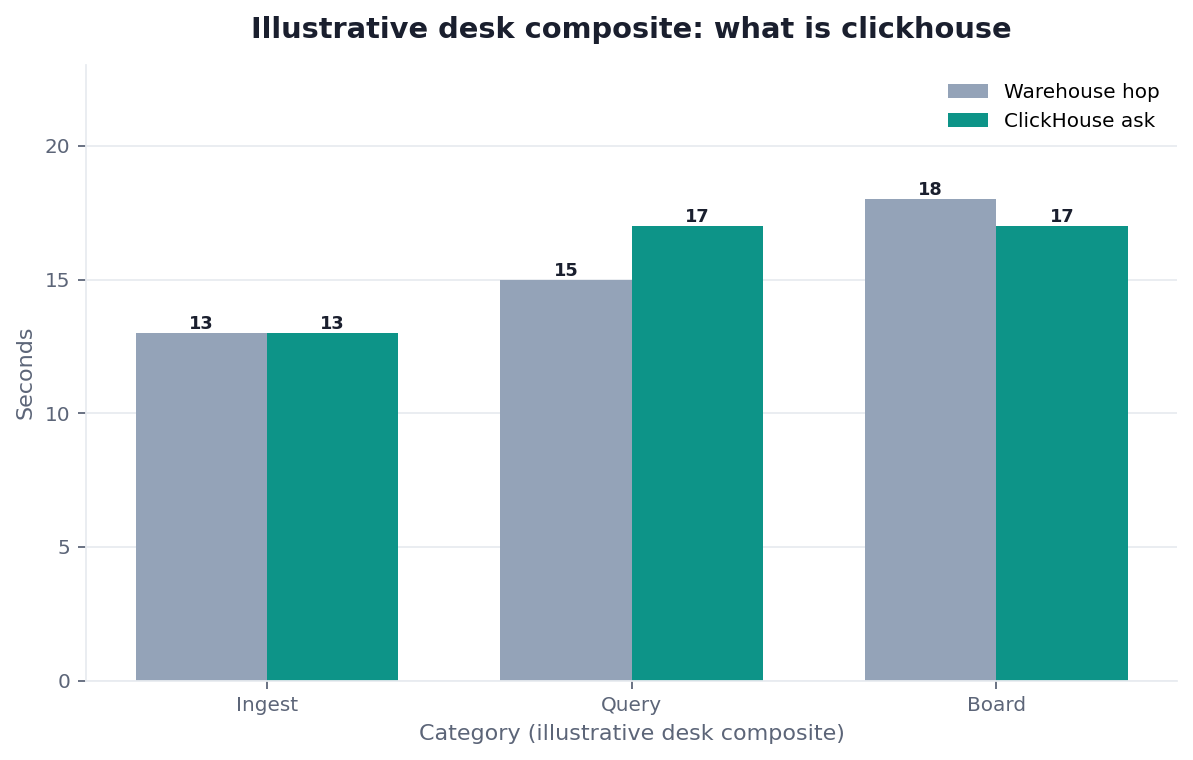
Figure. STATIC FIXTURE / NOT CONNECTED / NOT INDEPENDENTLY VALIDATED. Authored identity and policy labels only; no runtime or customer result.
Passing this replay means the what is clickhouse files agree. It does not prove reachability, grants, parser validity, or production suitability. Record Python version, operating system, hashes, HOLD output, and any deviation. A second internal rerun shows repeatability, not independence.
Sources and Limited Claims
Direct official sources were retrieved on 2026-08-31. ClickHouse intro, OLAP explainer, MergeTree, and access-rights pages resolved HTTP 200. They describe the product class, engines, and grants. They do not validate this fixture. Re-check those URLs later.
Original third-party pages are retained: US Forest Service, EPA data, OSTI Data Explorer, ACM publications, and Nature. None audited what is clickhouse on this page. Some hosts returned 403 or were unreachable; keep the original URLs.
Internal review is not independent validation. A qualified reviewer would need owner approval, live host and TLS evidence, grant snapshots, one authorized statement, and versions. Until then this pack is not a third-party audit, certification, benchmark, or customer case. If a reviewer only reran Python, say so.
How to cite. InfiniSynapse, Has ClickHouse: Name the Host First, WIC-20260831, HOLD / NOT READY FOR CONNECTION, not independently validated. Name the downloaded files used.
Downloads:
- Identity register
- Accepted scoped grant
- Rejected admin grant
- Accepted query
- Decision register
- Expected readiness
- Review rules
- Held evidence
- Assumptions
- Source check
- Reproduction protocol
- Verifier
Failure modes
A fluent paragraph is not a source. The engine will still scan whatever you grant. Write what is clickhouse as host, grant, and grain, or stop. This pack did not run it.
Copying events so the agent “has a warehouse”
Has ClickHouse means the cluster already holds the events. A copy so the agent “has a warehouse” invents a second grain and a second clock. If you copy before the first SELECT, you are no longer asking the engine you defined. You are briefing a mart.
Treating ClickHouse as a glossary term
If the meeting ends with “it is a fast OLAP database” and no host, you have not answered what is clickhouse for an agent. Write the host next, or stop claiming you are ready to ask.
Admin users and missing predicates
An admin in the connector is an incident waiting for a prompt. A question without a date is a SELECT * waiting for a wide table. Either failure means you have not operationalized what is clickhouse.
Before you spend cluster time, write the host, the database, the read-only user, and the single 24-hour question. If you cannot name those four, you are still in a glossary. If you can, inspect SQL text—do not start a warehouse project.
| Live guide | Open it when |
|---|---|
| ClickHouse analytics | you need the parent method for events that stay in the engine |
| Connect ClickHouse to AI | the missing object is the login, not the definition |
| Real-time OLAP analysis | freshness is the fight after you name the engine |
Review host, grant, and grain before any hop
Lock the host, SELECT scope, and one dated grain, then reject a warehouse hop as the first required step. This check uses only sources you authorize.
Commercial association: You do not need the workspace to complete the educational diagnosis on this page.
Open InfiniSynapseHow this page is sourced. William Zhu is cofounder of InfiniSynapse (GitHub @allwefantasy); InfiniSynapse on GitHub. Company self-description, not independent authority. Reviewed internally by analytics engineering · data platform · LLM security · editor. Editorial standards · corrections · publishing principles · About · Privacy · Terms · Contact zhuhl@infinisynapse.com. Company About. COI: InfiniSynapse sells an AI-native Data Agent; the banner is a commercial association. Fact-check: clickhouse.com · fs.usda.gov · epa.gov · osti.gov · acm.org · nature.com. No external organization audited it.
Frequently Asked Questions
What does it mean that a stack has ClickHouse?
Bottom line: Has ClickHouse means the cluster you already ingest into. Name the host, the SELECT grant, and the grain before you copy events to a warehouse.
Is ClickHouse just a fast column store?
Bottom line: As a textbook, yes. As what is clickhouse for an AI data agent, no: it is the OLAP you authorize read-only and query in place, with SQL you can open.
Do I need a warehouse before I can ask ClickHouse?
Bottom line: No. If events already live in the engine, answer what is clickhouse by connecting that engine. A warehouse copy is for certified grains and deep modeled joins, not for the first 24-hour rank.
What does the agent need besides the host?
Bottom line: A SELECT-only user, a bound note for time and event names, and one dated question. Without those, what is clickhouse stays a slogan.
How do I prove the first answer came from ClickHouse?
Bottom line: Open the task and read the statement. If you cannot reopen the SQL, you cannot brief the room, and you have not finished what is clickhouse.
Conclusion
What is clickhouse for an AI data agent is an in-place OLAP contract: events stay where ingest already put them, the user cannot write, and the statement is inspectable. Keep the glossary for onboarding. Keep what is clickhouse as host, grant, and grain for the first honest question.
A warehouse remains useful for certified, slow-changing books. It is not a tollbooth on the definition. InfiniSynapse describes itself on About. Privacy and Terms apply. If you later use the workspace, open InfiniSynapse only with authorized, sanitized inputs.