Chat With Your Data — How AI Data Agents Make It Reliable
By William Zhu & the InfiniSynapse Data Team · Last updated: 2026-08-04 · Last verified: 2026-08-04 · About / team · Credentials: GitHub @allwefantasy (InfiniSQL / open-source data systems) · Desk: zhuhl@infinisynapse.com
We build InfiniSynapse, an AI-native Data Agent platform. This guide reflects how we help teams move from chat demos to governed, repeatable analytics. No personal LinkedIn is published; identity signals are GitHub + About/Vision + editorial standards.
Table of Contents
- TL;DR
- Why Conversational Data Access Matters Now
- Definition
- Desk Pilot: Day 1 vs Day 21 Accuracy
- Chat UI vs Data Agent Architecture
- Reliability Scorecard
- Grounding Patterns That Work
- Memory and Session Continuity
- Governance and Audit Requirements
- Common Failure Modes
- InfiniSynapse Production Pattern
- 30-Day Pilot Checklist
- FAQ
- Conclusion
TL;DR
When you chat with your data, reliability comes from grounding, execution control, and audit—not from a prettier chat box. AI Data Agents add multi-step planning, dialect-aware SQL, and memory so recurring questions do not reset every session.
Who this is for: analytics leads, RevOps owners, and engineers evaluating conversational access to warehouses, spreadsheets, and operational databases.
What you'll learn:
- A citable definition for production use
- Why chat-only copilots stall after week three
- A six-dimension reliability scorecard
- When to choose Data Agents over upload-and-ask tools
- Desk composite Day 1 vs Day 21 accuracy signals
Media note: There is no hosted demo video on this page (and therefore no VideoObject schema). Use the architecture SVG, Day 1 vs Day 21 chart, the 30-day HowTo diagram, and the FAQ as short-answer surfaces.
Editorial vs commercial: Scorecards, failure modes, and desk composites below are editorial. Mentions of the InfiniSynapse product are labeled (commercial) and are not the reliability scorecard itself.
Enterprise metric contracts should follow Microsoft data architecture guidance so domain boundaries stay explicit as conversational query volume grows.
Teams scoping platform strategy should read AI for Data Analysis: The Complete 2026 Guide before committing budget to a chat UI alone.
Publisher identity: About / editorial standards · company About.
Evaluation basis: We build and evaluate InfiniSynapse on production-shaped workflows. Governance, adoption, and security context is cited inline—triangulate with independent review markets and standards below, not a self-citation loop alone.
Why Conversational Data Access Matters Now
Three forces drive the shift from dashboard-only BI to conversational analytics:
- Question latency — Executives want answers in the standup, not after a ticket queue.
- Analyst bottleneck — SQL-capable staff cannot scale to every ad-hoc slice.
- Agentic expectations — Users trained on ChatGPT expect natural-language access to warehouses the same way they chat with documents.
The move from dashboard-first BI to augmented workflows—described in IBM's augmented analytics overview—frames how teams should evaluate tooling when natural-language access touches production schemas.
Adoption benchmarks in the Stanford HAI AI Index track the same shift from pilot demos to governed analytics loops we see when teams first connect live warehouses to conversational interfaces.
When chat demos look successful
Early pilots feel fast: connect a warehouse, ask three questions, screenshot the charts. Stakeholders approve budget. The gap appears when the same executive asks last month's definition of "active customer" and gets a different SQL shape.
When reliability becomes the blocker
Finance, security, and data engineering ask for query logs, metric lineage, and role-based access. Chat UIs that only store transcripts fail review. That is when teams map requirements to Data Agent architecture—see What Is a Data Agent? Definition, Architecture, and Examples.
Analytics engineering usually owns connectors and schema documentation. Security owns access reviews. Business sponsors own metric definitions. When no one owns all three, pilots on demo schemas never reach production trust.
Author note (William Zhu): On customer-shaped reviews I still see day-one demos that look accurate while week-three Monday KPI packs drift because nothing locked the metric contract. Corrections: zhuhl@infinisynapse.com.
Definition
Citable definition: To chat with your data means submitting business questions in natural language and receiving answers computed from connected sources—with enough transparency that a reviewer can validate SQL, assumptions, and access boundaries.
The definition has four properties teams should enforce in procurement:
| Property | Meaning |
|---|---|
| Connected sources | Answers come from live systems, not stale exports |
| Executable logic | The system runs SQL or equivalent, not guesswork |
| Reviewable output | Query text and filters are visible |
| Repeatability | Approved definitions persist across sessions |
That capability is not synonymous with "upload a CSV to a general LLM." Upload tools excel at exploration; production teams need connectors, governance, and memory when questions recur every Monday.
For role-level deployment patterns, pair this guide with AI Data Analyst: Role, Tools, and How Teams Deploy One in 2026.
BI copilots often answer inside pre-built semantic models. Data Agents orchestrate across connectors when the business question spans systems. Choose based on data topology, not demo fluency alone.
Independent buyer-review surfaces (not a substitute for your pilot): G2 analytics & BI platforms and Gartner Peer Insights for Analytics and BI. We do not reproduce paywalled scores here.
Desk Pilot: Day 1 vs Day 21 Accuracy
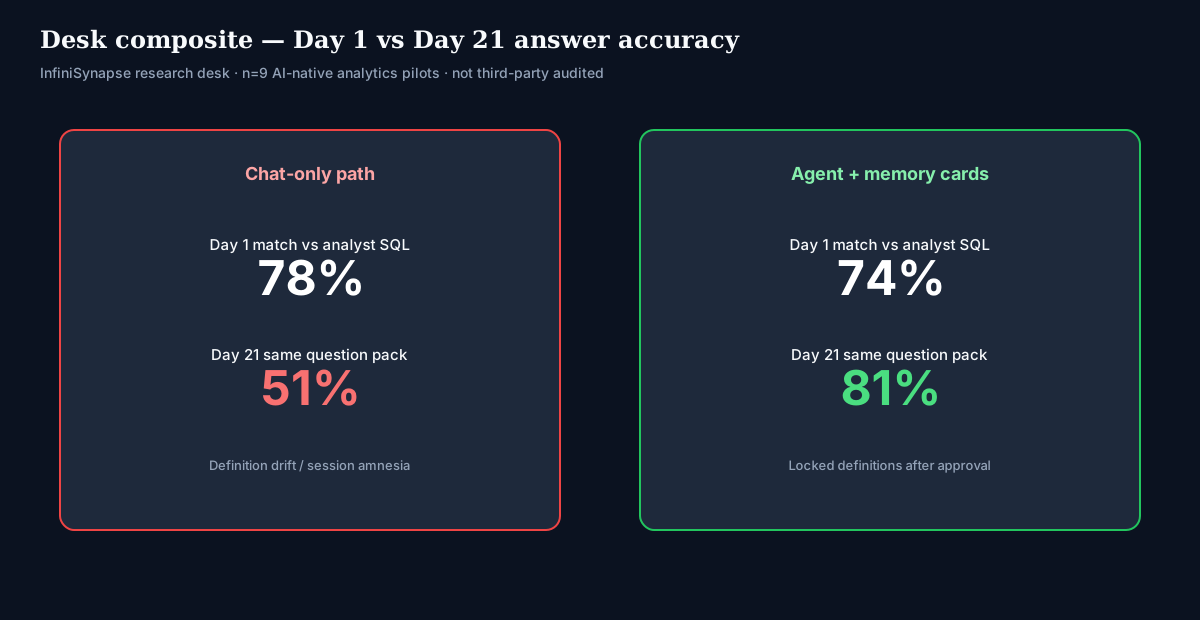
Original desk composite (InfiniSynapse research desk, Q1–Q2 2026, n=9 AI-native analytics pilots we reviewed). Same fixed question pack scored against analyst-written SQL baselines on day 1 and day 21. These are desk tallies—not a market census and not third-party audited customer case studies.
| Path | Day 1 match vs analyst SQL | Day 21 match (same pack) | Primary failure |
|---|---|---|---|
| Chat-only copilot | ~78% | ~51% | Definition drift / session amnesia |
| Agent + memory cards | ~74% | ~81% | Locked definitions after approval |
Claim → how measured → what you cannot independently verify
| Claim | How measured | What you cannot verify here |
|---|---|---|
| Chat-only ~78% → ~51% | Desk scoring of identical question packs vs analyst SQL | Your schema messiness and steward coverage |
| Agent+memory ~74% → ~81% | Same pack after locking definition cards | Exact model / warehouse dialect mix |
| n=9 | Pilots we reviewed in Q1–Q2 2026 | Not a Gartner/G2 survey sample |
Triangulate with Stanford HAI AI Index adoption context and your own day-1 / day-21 rerun before treating percentages as destiny.
Chat UI vs Data Agent Architecture
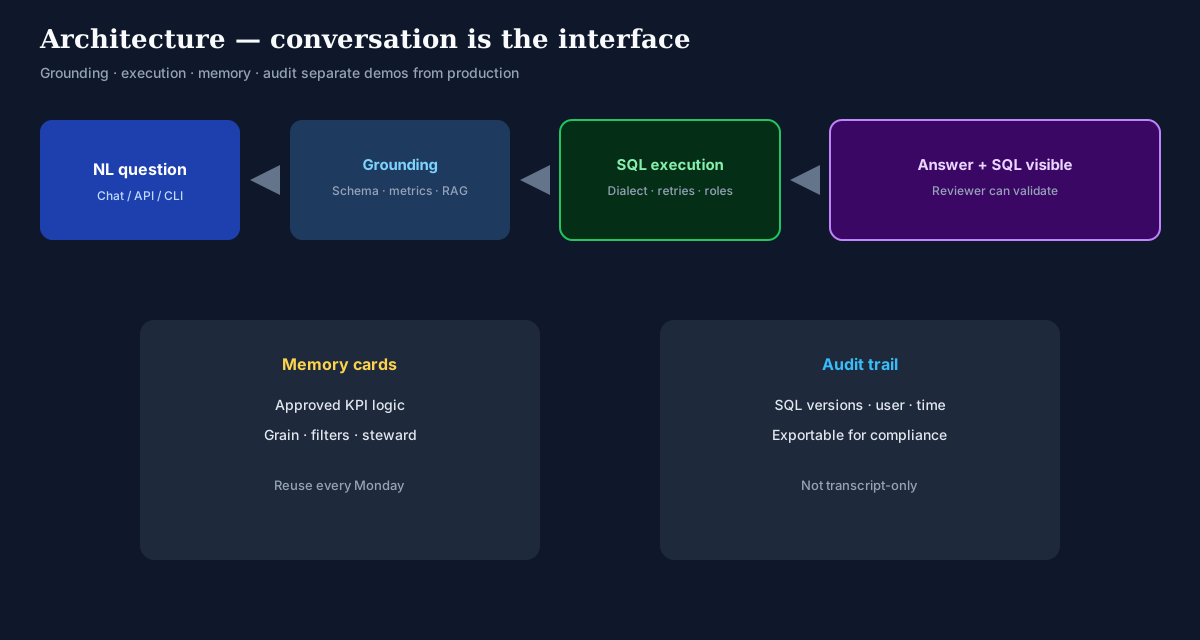
| Layer | Chat-only copilot | AI Data Agent |
|---|---|---|
| Planning | Single-turn prompt | Multi-step goal execution |
| Grounding | Schema dump or RAG snippets | Metrics + schema + memory cards |
| Execution | Optional or sandboxed | Dialect-aware SQL with retries |
| Audit | Chat transcript | Task timeline + SQL versions |
| Memory | Session-only | Distilled definitions across runs |
Why the UI is not the product
Teams often buy a conversational interface when they need an orchestration layer. The interface matters for adoption; the execution contract matters for trust. Chat vs an AI agent for data analysis is the same split: the thread is a door, the pack is the archive. Copilots embedded in BI tools answer well inside curated semantic models. They struggle when the question spans CRM exports, warehouse facts, and spreadsheet assumptions in one goal.
Where general LLM chat fits
ChatGPT-style upload flows remain excellent for one-off file exploration with low governance requirements. Keep them in sandbox environments. When stakeholders ask "show me the query" before a board slide, graduate to agents with explicit execution history.
Executives may prefer Slack or email; analysts prefer notebooks. Platforms that let every role use the same governed backend reduce duplicate logic and shadow SQL.
Reliability Scorecard
Use this scorecard when any vendor claims you can safely chat with your data on production systems:
| Dimension | Pass signal | Fail signal |
|---|---|---|
| Grounding | Shows schema or metric version used | Black-box answer only |
| SQL transparency | Generated query visible and editable | Paraphrase without code |
| Access control | Role enforced at compile time | Post-hoc filtering |
| Memory | Prior definitions reusable | Every session starts cold |
| Self-correction | Retries on failed joins | User must re-prompt manually |
| Audit trail | Exportable logs for compliance | Transcript-only history |
Score each dimension 0–2. Platforms below 8/12 usually require heavy custom engineering before executives trust recurring answers.
Production rollouts should align access and review controls with the NIST AI Risk Management Framework, especially when conversational access touches live schemas.
How we score pilots in practice
We run identical question sets on day one and day twenty-one. If accuracy drops or definitions drift without schema changes, memory and grounding—not model upgrades—usually need attention first. That method produced the desk composite above.
Grounding Patterns That Work
AI analytics fails when grounding stops at table names. Production teams combine three layers:
Schema grounding
Agents retrieve relevant tables, columns, and join paths.
Metric grounding
Business nouns map to approved definitions. Without metric contracts, two users asking about "revenue" receive incompatible totals. Semantic layers and metric catalogs reduce that drift.
Context grounding
Prior successful runs, playbooks, and analyst notes inform the next question. Compare memory depth in Data Agent Memory: Why Recurring Analytics Needs Durable Context.
Memory and Session Continuity
Weekly business reviews reuse KPI definitions. Tools that store only chat transcripts force analysts to re-approve filters every session. Durable memory cards—distilled after a successful run—cut rework and stabilize executive metrics.
| Memory type | What it stores | Best for |
|---|---|---|
| Transcript | Raw chat turns | Debugging tone, not metrics |
| Session context | Last N turns | Short exploratory threads |
| Definition cards | Approved logic + grain | Recurring reporting |
| Workflow memory | Multi-step playbooks | Complex diagnostics |
When your team returns to the same KPI pack every Monday, prioritize definition cards over longer context windows. Long context is expensive; approved logic is precise.
Memory governance rules
Store who approved a definition, when, and against which schema version. Without versioning, memory becomes liability when columns rename overnight.
Governance and Audit Requirements
Minimum governance pack
- Identity — SSO and role mapping to warehouse grants
- Query logging — Immutable record of SQL, user, timestamp
- Approval workflow — Optional analyst sign-off before external sharing
- Retention policy — Align chat and query logs with ISO-style controls; regulated rollouts often anchor access reviews to ISO/IEC 27001 when credentials and audit logs are in scope.
Teams that skip these controls usually pause rollouts after the first security review—not because NL access is wrong, but because evidence is missing.
Payments analytics should follow Stripe documentation for event models, reconciliation fields, and reporting grains.
Common Failure Modes
Failure 1 — Demo schema only: Pilots run on clean sample data; production joins fail silently. Fix: Test on messy, real schemas in week one.
Failure 2 — No metric owner: Agents invent filters. Fix: Assign metric stewards before scaling users.
Failure 3 — Transcript as audit: Compliance asks for SQL lineage; chat logs are insufficient. Fix: Require task-level execution traces.
Failure 4 — Session amnesia: Executives re-explain definitions weekly. Fix: Persist approved logic as memory cards after first successful answer.
Failure 5 — Chat without execution: Model narrates an answer without running code. Fix: Mandate executable validation for numeric claims.
Observability should follow OpenTelemetry documentation. GCP boundaries: Google Cloud architecture framework. Security pubs: NIST CSRC. Document stores: MongoDB docs. Streaming feeds: Apache Kafka documentation.
InfiniSynapse Production Pattern
(Commercial disclosure) InfiniSynapse sells an AI-native Data Agent platform. We are a vendor in this space—not a neutral lab ranking chat UIs.
InfiniSynapse treats conversational access as one entry point into a Data Agent stack:
| Component | Role |
|---|---|
| InfiniAgent | Plan multi-step analysis from a natural-language goal |
| InfiniSQL | Generate and execute dialect-aware SQL with retries |
| InfiniRAG | Ground on docs, schema, and prior definitions — bound multimodal RAG, not a chat attachment |
| Memory cards | Reuse approved KPI logic across sessions |
| Audit log | Replay SQL, sources, and assumptions |
Analysts can work in the web app while engineers trigger the same workflows via API—multi-entry parity matters when executives do not live inside a BI workspace.
(Commercial) Try the InfiniSynapse web app on a sandbox schema before comparing output with chat-only copilots on the same weekly KPI pack. Evaluate against the scorecard above, not marketing alone. For peer-review context, see G2 and Gartner Peer Insights.
30-Day Pilot Checklist
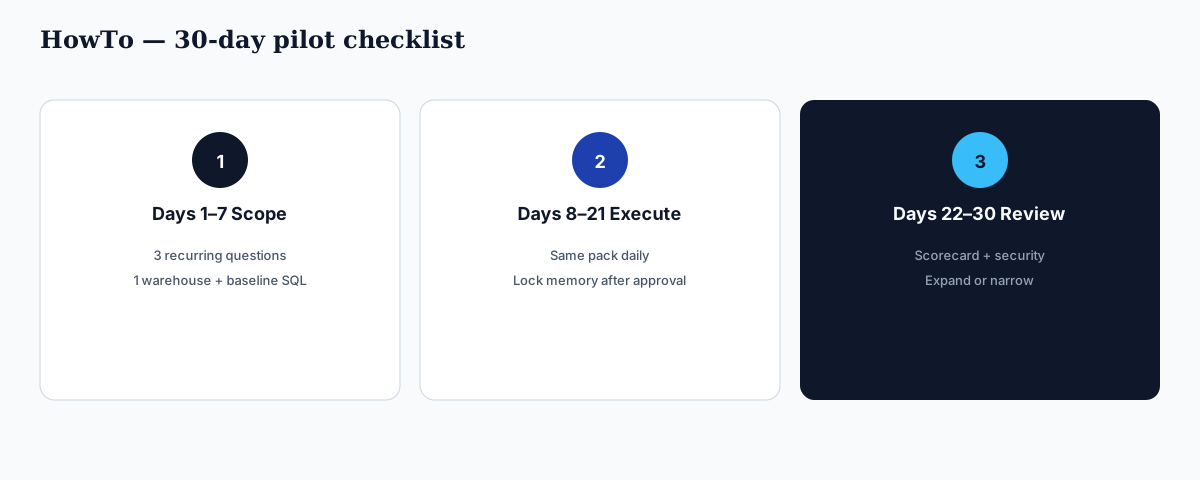
Days 1–7 — Scope
- Pick one domain (e.g., revenue) and three recurring questions executives already ask.
- Connect one warehouse and one operational source if the real question spans systems.
- Baseline analyst-written SQL for each question.
Days 8–21 — Execute
- Run the same questions through your chosen path daily when you chat with your data in pilot.
- Log failures: wrong grain, missing joins, access errors.
- Lock definitions in memory after first analyst-approved answer.
Days 22–30 — Review
- Score the reliability scorecard with security and finance stakeholders.
- Compare time-to-answer vs analyst queue—and rerun the Day 1 pack on Day 21.
- Decide: expand connectors, add semantic layer, or narrow scope.
Document pilot outcomes in a one-page memo: questions tested, pass rate vs analyst SQL, security findings, and memory adoption. Sponsors use that evidence to fund phase two—or to narrow scope before buying more seats.
Change-management leads should schedule analyst workshops covering one successful replay and one controlled failure before widening scope.
Procurement teams should score vendors on tenth-run reliability after a minor schema change—not on the kickoff demo alone.
Reviewers approve faster when each recommendation cites source tables, filter windows, and the analyst who signed the metric contract.
Frequently Asked Questions
Is conversational warehouse access safe in production?
Yes, when access controls, query logging, and reviewer workflows are in place before broad rollout. Sandbox-first pilots that skip governance usually stall at security review.
How is this different from ChatGPT with a file upload?
Upload flows excel at exploratory analysis on static files. Production chat with your data requires live connectors, SQL transparency, and memory for recurring metrics—not just conversational polish.
Do I need a semantic layer first?
Not for narrow pilots on curated marts. Yes when multiple teams query the same executive nouns or when agents must enforce grain across departments.
Can business users query data without SQL skills?
That is the goal. Reliable systems still expose SQL for analysts who need to verify joins and filters before numbers reach leadership slides.
What should we measure in a pilot?
Track answer accuracy vs analyst baselines, time-to-first-correct answer, Day 1 vs Day 21 drift, rework rate after week three, and audit completeness—not just user satisfaction scores.
How should commercial product links be read?
Links marked (commercial) point to InfiniSynapse products we sell. They are optional patterns; the scorecard and desk method stand on their own.
Conclusion
Teams that chat with your data reliably in 2026 treat conversation as an interface, not the architecture. Grounding, execution, memory, and audit separate production-grade Data Agents from demo copilots.
Next steps:
- Run the reliability scorecard on your current stack.
- Read AI for Data Analysis: The Complete 2026 Guide for platform-wide context.
- Deep-dive What Is a Data Agent? and Data Agent Memory before procurement.
When executives ask the same KPI questions every week, invest in memory and audit—not another chat skin on raw schema dumps.