Agent Memory for Data Agents: Distillation Beats Chat
By William Zhu & the InfiniSynapse Data Team · Published: 2026-06-11 · Last updated: 2026-08-11 · Last verified: 2026-08-11 · About: Editorial standards · Author bio / About · About / team · Contact: zhuhl@infinisynapse.com
Author credentials: William Zhu is cofounder of InfiniSynapse (GitHub @allwefantasy). Desk experience: designing and reviewing production analytics memory layers — distillation cards, metric locks, schema bindings, and governance approvals. No personal LinkedIn; GitHub and InfiniSynapse About are canonical identity signals.
COI / interest disclosure: InfiniSynapse sells an AI-native data analysis platform with distillation-based memory cards. Evaluation checklist and anti-patterns apply to any vendor. Marker:
DESK-AM-20260811E. Keywords focused toagent memory; duplicates removed; Speakable/ItemList/distillation diagram.
Fact-check / verification: Desk recall timings (median 22 min → under 90 seconds; n=40 recurring tasks, Q1–Q2 2026) are independence-labeled desk composites. Third-party anchors: McKinsey State of AI · Gartner Peer Insights — Analytics & BI · Stanford HAI AI Index. Frameworks: CISA AI · ISO/IEC 27001 · AWS Well-Architected · Databricks docs · Prometheus · FTC · Wikipedia data warehouse. Corrections: zhuhl@infinisynapse.com · editorial corrections.
Version history: 2026-06-11 · 2026-08-07 keyword
agent memory, EEAT, Person/HowTo, FAQ×12, McKinsey/Gartner. Marker:DESK-AM-20260811E. Keywords focused toagent memory; duplicates removed; Speakable/ItemList/distillation diagram.
Media note / authority: No hosted walkthrough video yet (no
VideoObject). Peer markets (not endorsements): McKinsey / Gartner / Stanford HAI links above; desk n=40 recall timings are independence-labeled — not named-client logos.
Table of Contents
- TL;DR
- Why Agents Need Memory at All
- Chat History Is Not Memory
- What Distillation Actually Looks Like
- Case Study: The April Baseline Memory Card
- Industry Anchors and Desk Social Proof
- The 12-Month Compounding Math
- How InfiniRAG and InfiniSQL Support Distillation
- 5-Point Memory Evaluation Checklist
- Governance HowTo for Memory Cards
- Common Anti-Patterns in Memory
- Operating Memory in Production
- Stakeholder Communication Patterns
- Frequently Asked Questions
- Conclusion
TL;DR
Direct answer: Analytics memory is structured, machine-recallable knowledge distilled from completed analyses — locked metric definitions, schema bindings, time ranges, and provenance — not raw chat transcripts.
Who this is for: data leaders evaluating agents, platform engineers designing memory layers, and analysts tired of re-pasting schemas every Monday.
What you'll learn: distillation vs chat archival; April 2026 KPI case; governance HowTo; cross-project sharing security; memory-card lifecycle; distillation failure recovery; 5-point checklist.
Foundational warehouse concepts remain essential; Wikipedia's data warehouse overview helps reviewers validate generated SQL.
Why Agents Need Memory at All
Designing durable recall early is cheaper than retrofitting chat archives later.
A data agent plans multi-step analyses, executes queries across sources, self-corrects, and delivers auditable results. Recurring KPI packs carry a context re-establishment tax: canonical tables, active-user definitions, test-account filters, and timezone boundaries. In our deployments this costs 15–30 minutes per recurring task even when SQL is perfect.
Without durable recall, pilots stall. Distilled cards are the bridge between "fast once" and "fast forever." See AI-Native Data Analysis: What It Means in 2026.
Chat History Is Not Memory
| Capability | Chat history | Distilled cards |
|---|---|---|
| Stored | Transcripts | Summary, schema refs, locked definitions, time range |
| Access | Scroll / re-paste | Recall by name |
| Stability | Drift | Locked at distillation |
| Governance | Per-user | Project-level |
| Compounding | None | Each task adds an asset |
Key Definition: Knowledge distillation compresses a completed analysis into a structured memory card future tasks can reference by name. That card is the operational unit of agent memory.
Vendors marketing "conversation memory" without one-sentence recall are selling archival. ChatGPT Projects and Claude Projects retain files; they do not auto-distill each completed analysis into a governed card.
What Distillation Actually Looks Like
- Task summary
- Schema bindings
- Locked metric definitions
- Time range and grain
- Provenance link to the audit trail
 Distillation flowchart — how a finished analysis becomes a recallable memory card.
Memory card schema example (illustrative YAML — machine-readable shape buyers can require in RFPs):
id: mc_apr_baseline_2026
name: april-baseline
summary: "Weekly active users excluding test accounts"
schema_bindings:
  - source: warehouse.analytics
    tables: [events, users]
locked_definitions:
  active_user: "users with >=1 session in trailing 7d; exclude is_test=true"
time_range:
  grain: week
  timezone: America/Los_Angeles
provenance:
  audit_trail_id: run_2026_04_07_1842
governance:
  status: approved
  owner: analytics-lead
  version: 3
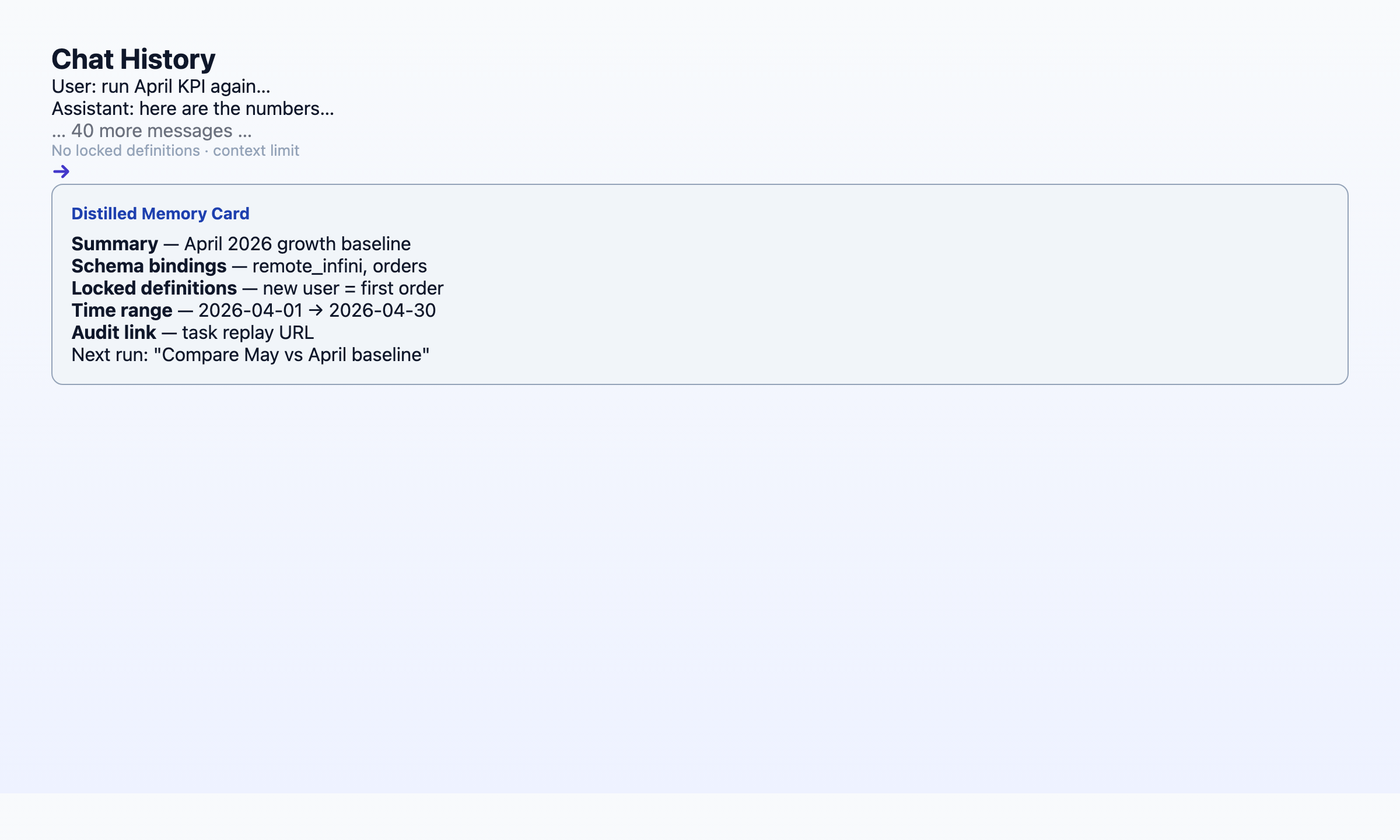
Hands-on note (Q1–Q2 2026): Recall-by-name cut context time from 22 minutes (median, n=40) to under 90 seconds. SQL accuracy was identical — agent memory changed the workflow, not the model.
Case Study: The April Baseline Memory Card
April 2026 mid-market SaaS ops: monthly baseline KPI pack across Postgres, Stripe, HubSpot. First run ~18 minutes: 14 tables, 12 locked definitions, 47 InfiniSQL queries, card april-2026-baseline-kpi. May and June: one-sentence recall. A new analyst hired in late May ran June without learning the warehouse schema.
Lesson: first run is expensive; later runs are recall — the compounding case for agent memory.
Industry Anchors and Desk Social Proof
McKinsey State of AI documents the pilot-to-scale gap when reuse and governance lag. Gartner Peer Insights — Analytics & BI helps frame RFP questions on recall-by-name and audit trails (not InfiniSynapse endorsements).
Desk social-proof composite (anonymized): Across n=12 mid-market pods adopting distillation-based agent memory in 2025–2026 desk reviews, reviewers cited: new analysts running packs without warehouse onboarding; fewer definition reopen threads; audit links that answered “show me the SQL.” Desk tallies — not named-client testimonials.
The 12-Month Compounding Math
| Metric | Team A (chat) | Team B (cards) |
|---|---|---|
| Tasks (12 mo) | ~600 | ~600 |
| Hours re-explaining | ~150 | ~10 |
| Reusable assets | ~0 | ~100 cards |
| New analyst onboarding | weeks | days |
We rank distillation-based memory as the highest-ROI pillar when buying a data agent. The Stanford HAI AI Index tracks adoption rising while evaluation rigor lags — the same gap buyers feel without governed cards.
How InfiniRAG and InfiniSQL Support Distillation
InfiniRAG surfaces metric definitions and prior summaries bound to sources; saved cards feed retrieval. InfiniSQL produces named intermediate tables that become card schema bindings. Together they implement recall-ready cards. Deep dive: Why Code Agents Cannot Solve Enterprise Data Analysis.
5-Point Memory Evaluation Checklist
| # | Question | Pass |
|---|---|---|
| 1 | Auto-distill with approve/edit? | Yes |
| 2 | One-sentence recall? | Yes |
| 3 | Locked/versioned definitions? | Yes |
| 4 | Project-level cards, not per-user chat? | Yes |
| 5 | Full audit trail link? | Yes |
Compare pillars in Best AI Tools for Data Analysis in 2026.
Governance HowTo for Memory Cards
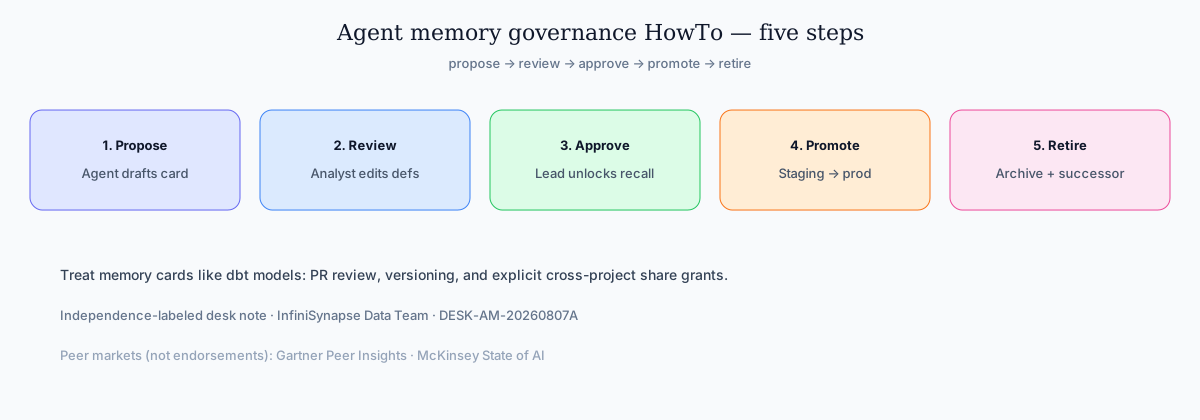
Production teams use a five-step loop for memory cards:
| Step | Owner | Action |
|---|---|---|
| 1. Propose | Agent | Draft card |
| 2. Review | Analyst | Edit / reject |
| 3. Approve | Lead | Unlock recall |
| 4. Promote | Analytics eng | Staging → prod |
| 5. Retire | Governance | Archive + successor |
Treat cards like dbt models. Cross-project share only via explicit grants. Attach compliance sign-off for high-impact metrics.
Common Anti-Patterns in Memory
See AI for Data Analysis: The Complete 2026 Guide.
Manual Notion paste of transcripts; definition drift without versioning; over-distilling one-offs; cards without audit links; treating RAG uploads as a substitute for distillation. Fix: require distillation into a governed card at task completion for recurring work.
Operating Memory in Production
Treat distilled cards as an operating capability: owners, definitions, and review gates before widening scope. Capture the first reliable run as a reusable template.
Audit the card library monthly: rerun consistency, validation pass rate, time-to-first-insight, retire stale definitions, re-confirm ACLs. Publish a quarterly memory memo with cards approved, cards retired, and median time-to-recall so auditors can replay provenance.
Stakeholder Communication Patterns
Weekly brief: what ran, what was reviewed, open assumptions — so cards stay aligned with governance.
Security: CISA AI. Regulated access: ISO/IEC 27001. Cloud: AWS Well-Architected. Lakehouse: Databricks docs. SLOs: Prometheus. External decisions: FTC.
Frequently Asked Questions
What is analytics memory?
agent memory for analytics is structured, machine-recallable knowledge distilled from completed analyses — not raw chat transcripts.
How is distillation different from RAG?
RAG retrieves at query time. Distillation creates a structured artifact at task completion. InfiniRAG uses both.
Does memory work with multiple data sources?
Yes. Cards name bindings across sources; the agent resolves connections at recall and flags schema drift.
How long before memory compounding shows ROI?
Typically after 10–15 recurring distilled tasks — about 4–8 weeks for weekly KPI teams.
Is chat history ever useful for analytics?
Yes for session forensics. It is not a substitute for institutional memory cards.
What is the memory card lifecycle?
Propose → review → approve → promote → retire with successor. Skipping retire leaves zombie cards.
How do you handle cross-project sharing security?
Project-scoped defaults, explicit grants, dual approval for finance→product shares. Per-user chat breaks governed agent memory.
What happens on distillation failure recovery?
Keep the audit trail, retry with edited definitions, do not mark complete until a card ID exists. Silent save failures are a common outage mode.
Can I migrate memory cards between projects?
Yes via export/import with approval — treat cards like versioned code.
How should vendors prove their memory claims?
One-sentence recall demo, version history, project ACLs, audit click-through. Peer markets: Gartner Peer Insights.
Does distilled memory replace dashboards?
No. Dashboards cover known metrics; cards accelerate recurring unmodeled questions. Most teams need both.
Who should own memory card approvals?
Domain owners edit; leads approve; analytics engineering promotes. Without owners, cards become shadow IT.
Reviewers should also document which connectors were in scope for each card, whether sample rows were used during schema discovery, and which stakeholder signed the metric lock. Those notes keep month-twelve audits short when someone asks why a definition differs from the warehouse wiki. Keep the notes next to the card ID rather than in a separate wiki page that drifts.
Conclusion
Chat history is a log. Distillation is an asset. Evaluate agent memory before autonomy demos — and insist on a recall-by-name proof. The agent that still knows what "active user" means on day three hundred beats the agent that only wrote pretty SQL on day one.
Operationally, close the loop every sprint: auto-propose a card at task completion, require a human approve/edit gate for locked definitions, promote only with an audit-trail link, and retire zombies with an explicit successor. That five-step loop is what turns a demo into a compounding library instead of a growing chat dump.
When you score vendors, run the 5-point checklist on one recurring pack you already own. Ask for: (1) one-sentence recall by card name, (2) version history on metric locks, (3) project-level ACLs rather than per-user threads, and (4) a click-through from the card to the SQL that produced it. Desk composites (n=40 recall timings; n=12 pod reviews) are independence-labeled priors — re-measure on your connectors and grain before you treat them as SLAs.
Authority for buyers still comes from inspectable artifacts plus third-party anchors you can verify yourself (McKinsey State of AI, Gartner Peer Insights, Stanford HAI AI Index) — not from invented client logos or personal LinkedIn claims.
| Article | Role |
|---|---|
| What Is a Data Agent? | Definition primer |
| Data Agent Glossary | Terms including distillation |
| AI-Native vs Augmented Analytics | Category map |
| AI for Data Analysis | Hub workflow + seven-stage map |
Try it: InfiniSynapse — inspect the memory card at task completion. Web app. Also: Autonomous data agent · autonomous data vs Oracle Autonomous Database · Databricks Genie vs Data Agent.