Event Analytics in ClickHouse: Verify Rank and Funnel
By William Zhu & the InfiniSynapse Data Team · Published: 2026-08-22 · Last updated: 2026-08-31 · Last verified: 2026-08-31 · Next review: 2026-11-30 · Editorial standards · Corrections
Table of Contents
- TL;DR
- Evidence Boundary
- What event analytics in ClickHouse means
- Reproduction Method
- Implementation steps
- A framework for funnels that stay put
- Methods: engine funnel vs copied grain
- Tool landscape around event tables
- Rank contract
- Funnel contract
- SQL draft and production evidence
- Chart and expected output
- Practical Static Replay
- Desk sample: a 24-hour event-name rank
- Independent Validation
- Sources and Limited Claims
- Placement decisions
- Scorecard: stay in ClickHouse vs change grain
- Failure modes
- How to Cite
- Frequently Asked Questions
- Conclusion
TL;DR
This event analytics in ClickHouse package starts with 39 authored, row-level synthetic events. A standard-library Python verifier reads those events and an alias map, assigns them to two exact half-open UTC windows, excludes internal rows, computes a ranked period comparison, and evaluates a precisely defined three-step funnel.
Direct answer: Reproduce event analytics in ClickHouse logic offline before adapting it to a database. The fixture yields deterministic rank and funnel files without connecting to ClickHouse. Its SQL is a review draft only. A passing verifier establishes file agreement under the published contract—not dialect compatibility, execution, permissions, pruning, speed, freshness, business validity, or production behavior.
The computed numbers are synthetic fixture results. They are not customer statistics, product telemetry, a benchmark, an SLA, or evidence that any ClickHouse query ran. No outside party independently validated this pack.
Evidence Boundary
The evidence for event analytics in ClickHouse is limited to the downloadable CSV, JSON, SQL, Markdown, Python, and PNG files. The verifier performs local file reads and deterministic calculations only. It makes no network request, opens no database driver, executes no SQL or subprocess, and performs no dialect or query-plan check.
| The fixture establishes | The fixture does not establish |
|---|---|
| CSV schema, unique IDs, UTC parsing, boolean values, and exact boundary coverage | Completeness or lineage of a real event source |
| Alias normalization with an identity policy for unknown names | That aliases were discovered, approved, or current in an organization |
| Half-open assignment, internal exclusion, counts, outer-period comparison, deltas, and sort order | Query execution, time-predicate correctness for a deployed type, or partition pruning |
| Strict ordered-funnel behavior under the JSON contract | Equivalence to ClickHouse windowFunnel for any deployed version |
| Agreement between expected files, chart labels, and local computation | Performance, customer impact, production readiness, or independent validation |
This boundary also rules out claims about an actual product table, a day partition, a bound enum, a read-only principal, effective grants, on-call trust, generated memos, task artifacts, warehouse copies, or minutes to completion. Those require separate evidence.
What event analytics in ClickHouse means
Key Definition: Here, event analytics in ClickHouse means a candidate rank-and-funnel calculation described by an explicit event schema, UTC windows, alias policy, exclusions, aggregation grain, and ordering rules. The downloadable fixture demonstrates those rules offline; it does not show that ClickHouse stored or processed the events.
The raw fixture fields are event_id, event_time_utc, user_id, event_name, and is_internal. Timestamps use ISO 8601 Z. Event IDs must be unique. Internal values are exactly 0 or 1. The alias map makes normalization reviewable: signup_clicked and signup_cta_clicked become signup_intent; view_item becomes view_product; cart_added becomes add_to_cart. An unknown name remains unchanged.
Boundary events occur exactly at 2026-08-29T00:00:00Z, 2026-08-30T00:00:00Z, and 2026-08-31T00:00:00Z. The final boundary is excluded. Rows outside the periods and internal rows prove that inclusion is a rule, not a label. That is the narrow lesson of event analytics in ClickHouse here.
This event analytics in ClickHouse definition is a calculation contract, not a placement rule and not a warehouse-copy mandate.
The ClickHouse analytics parent guide provides broader context. Exploratory data analysis, semantic layers, and data visualization are related practices, but none validates this fixture.
Reproduction Method
Download these eleven event analytics in ClickHouse artifacts into one directory:
synthetic-events-EAICH-20260831.csv— authored row-level events.event-alias-map-EAICH-20260831.csv— explicit normalization map.analysis-contract-EAICH-20260831.json— windows, rank, funnel, and evidence rules.expected-rank-EAICH-20260831.csv— exact ranked output.expected-funnel-EAICH-20260831.json— exact stage counts and rates.non-executing-clickhouse-sql-EAICH-20260831.sql— adaptation draft, not an executed query.assumption-register-EAICH-20260831.csv— declared and held assumptions.source-and-boundary-notes-EAICH-20260831.md— claim and production-evidence limits.external-source-check-EAICH-20260831.md— resolved URLs, retrieval date, status, and bounded use.independent-reproduction-protocol-EAICH-20260831.md— clean-room procedure.verify-EAICH-20260831.py— standard-library offline verifier.
Run python3 verify-EAICH-20260831.py. Successful event analytics in ClickHouse reproduction prints the scope warning, row totals, rank-row count, funnel denominator, each stage count and rate, expected-file equality, and PASS. The script validates schemas, required fields, unique IDs, strict Z timestamps, boolean values, exact windows and boundaries, alias-map uniqueness, identity fallback, deterministic calculations, and narrow SQL text.
Implementation steps
Review event analytics in ClickHouse from hashed files, not a live connector: confirm 39 unique IDs and Z timestamps, confirm the authored alias map, confirm half-open UTC windows and the three boundary instants, recompute rank and funnel, read the SQL draft without executing it, then retain the verifier PASS line.
Rank contract
The prior interval is [2026-08-29T00:00:00Z, 2026-08-30T00:00:00Z). The current interval is [2026-08-30T00:00:00Z, 2026-08-31T00:00:00Z). For each period, event analytics in ClickHouse first applies the half-open predicate, removes is_internal=1, and maps raw names to canonical names.
Counts use canonical_event_name as their grain. The output takes the union of names present in either period, equivalent to an outer period join with absent counts set to zero. It then computes signed_delta = current_count - prior_count and absolute_delta = abs(signed_delta). Sorting is absolute_delta descending, then canonical name ascending. No percentage appears because the rank contract defines no percentage denominator.
The expected rank contains six canonical names. add_to_cart is 2 prior and 7 current, for +5; signup_intent is 2 and 4, for +2; view_product is 3 and 6, for +3; purchase is 1 and 4, for +3; help_opened is 1 and 2, for +1; and refund_requested is 0 and 1, for +1. The published CSV—not this prose—is authoritative, and the verifier catches drift.
Funnel contract
The event analytics in ClickHouse funnel uses only the current 24-hour analysis window. Its ordered steps are view_product -> add_to_cart -> purchase; identity is user_id; the denominator is distinct eligible users reaching step 1.
Timestamps must be strictly increasing between accepted steps. An event at the same timestamp as the prior accepted step cannot advance the sequence. Rows are sorted by timestamp and then event ID. Repeated or out-of-order steps are scanned chronologically; the earliest event that advances the next required step is retained. There is no duration cap beyond the current half-open window.
Five users reach view_product, four reach add_to_cart after step 1, and three then reach purchase. Rates are stage users divided by five and serialized to four decimals: 1.0000, 0.8000, and 0.6000. User u6 exercises the strict timestamp rule: a same-time cart event does not advance, while a later repeated cart event does. These are synthetic event analytics in ClickHouse fixture statistics only.
SQL draft and production evidence
The SQL file sketches name normalization, UTC predicates, internal exclusion, grouping, deltas, deterministic ordering, and a funnel candidate. It is marked DO NOT EXECUTE. The Python verifier only checks warnings and required conceptual text, rejects SELECT * and mutation or administration keywords, and never claims to parse SQL.
ClickHouse’s GROUP BY and date-time functions document mechanisms. uniqExact documents exact distinct counting and its memory trade-off. windowFunnel documents a parametric funnel function. Those pages do not prove this event analytics in ClickHouse draft is compatible or semantically equivalent.
A real result requires retained evidence: SHOW CREATE TABLE; relevant system.tables columns, engine, partition key, and sorting key; alias owner and version; exact query and hash; query ID; effective grants; system.query_log evidence when configured; input snapshot and checksum; timezone and window; output and checksum; source-result reconciliation; and independent reproduction.
A bounded predicate alone does not prove part or granule skipping. ClickHouse’s partitioning guidance describes partitioning primarily as a data-management technique, with workload-dependent performance effects. Data-type guidance is schema context. Neither supplies plan or performance evidence for this pack. Until that evidence exists, treat every event analytics in ClickHouse number on this page as fixture output only.
Chart and expected output
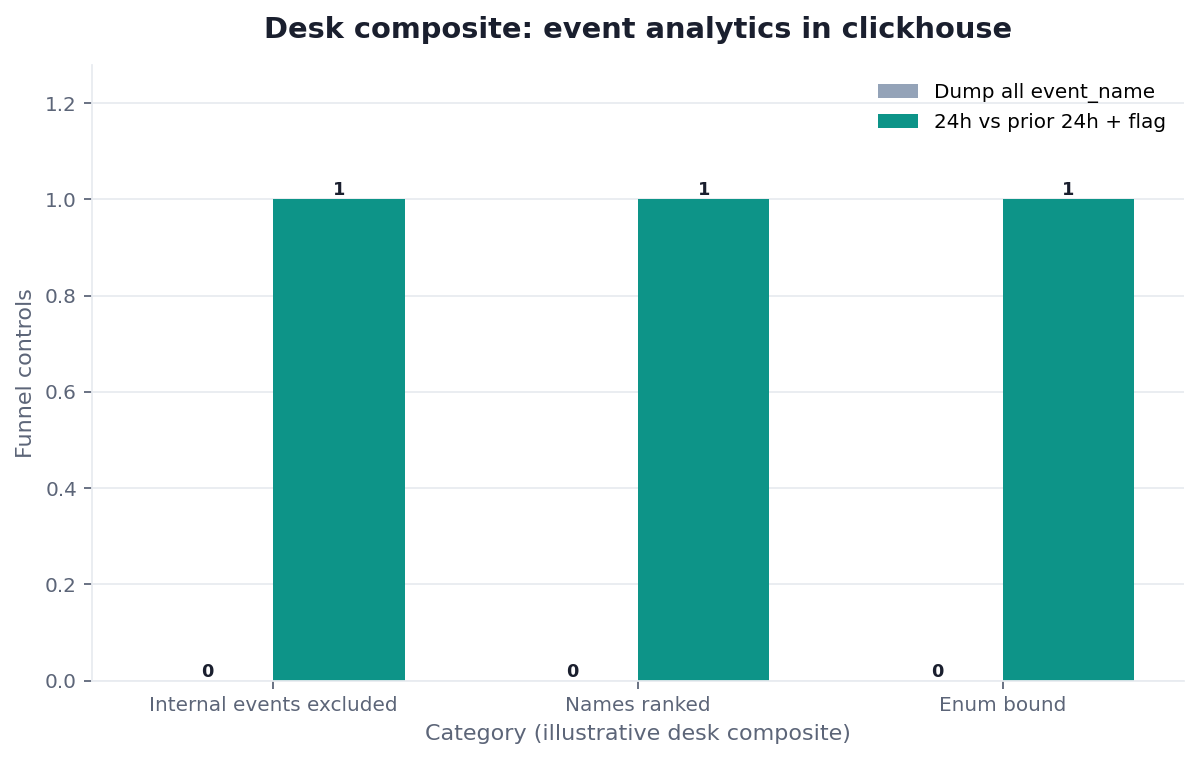
Figure. SYNTHETIC FIXTURE · OFFLINE COMPUTATION · NOT CLICKHOUSE EXECUTION · NOT INDEPENDENTLY VALIDATED. Values come directly from the expected rank CSV and expected funnel JSON.
The upper panel shows prior and current canonical-event counts with signed deltas. The lower panel shows stage-user counts and rates with denominator n=5. The generator reads the computed objects used to write the expected files; the verifier independently reconstructs those files from raw CSV. This keeps event analytics in ClickHouse chart values tied to declared arithmetic, without implying runtime or production measurement.
Practical Static Replay
Replay event analytics in ClickHouse locally: record file hashes, inspect the 39 rows, apply aliases, assign half-open UTC windows, drop internal rows, rebuild rank and funnel, then run python3 verify-EAICH-20260831.py. A match proves internal consistency only. It does not prove that a cluster accepted the draft or that a production event analytics in ClickHouse result exists.
Independent Validation
An independent event analytics in ClickHouse reproduction requires a person who did not author this pack or article. That reviewer should record initial hashes, inspect the contract and synthetic rows, run the verifier in a clean local directory, independently implement the arithmetic, compare expected files, inspect the PNG, and publish environment, output, deviations, and conflicts.
An internal rerun of event analytics in ClickHouse demonstrates repeatability, not independence. No external attestation was available at publication. Even a successful outside replay would validate only the fixture transformation. It would not be a third-party audit, ClickHouse execution, SQL certification, security assessment, benchmark, customer statistic, or production validation. Record the Python version, operating system, file hashes, exact PASS line, and any deviation from the published expected files. If a later contract change alters windows, aliases, exclusions, or funnel rules, treat the prior result as superseded.
Sources and Limited Claims
All eight ClickHouse sources above were retrieved or attempted on 2026-08-31; resolved URLs, status, and bounded use are recorded in the source check. The system.tables page timed out during the editorial fetch, so its URL is retained for direct review rather than represented as successfully inspected. Generic or vendor documentation is context only; nobody outside InfiniSynapse validated this event analytics in ClickHouse pack.
Historical links retained from the earlier page remain context: Stripe documentation, Microsoft’s Azure Architecture data guide, the EU European approach to artificial intelligence, BigQuery documentation, and Redshift documentation. They neither supplied the data nor reviewed the method.
Related internal guides—connect ClickHouse to AI, real-time OLAP analysis, ClickHouse versus warehouse, OLAP SQL for agents, ClickHouse dashboard, and large-dataset analysis—do not validate these results.
Placement decisions
Event analytics in ClickHouse need not remain on that engine. Warehouses also process event data. Choosing placement requires evidence about the authoritative source, required grain, governance, joins, freshness, access, and observed cost and performance. The answer may be ClickHouse, a warehouse, another analytical system, or a governed combination.
This fixture therefore does not recommend “keeping funnels there until the grain changes.” It demonstrates deterministic event analytics in ClickHouse logic that can be adapted only after a team confirms source authority and deployment constraints. Storage placement and calculation semantics are separate decisions. A provisional keep-in-place reading can change when authority, grain, clock, join cardinality, governance, or measured economics change; write those revisit conditions before treating the fixture as placement advice.
Failure modes
Treating aliases as discovered facts
The map is authored. Calling it discovered, bound, approved, or complete would turn a fixture assumption into a real-world claim. Production event analytics in ClickHouse needs an owner, version, approval trail, and reconciliation.
Treating a predicate as execution evidence
The SQL text contains exact bounds, but no server parsed or ran it. A predicate does not establish the deployed column type, timezone conversion, partition pruning, rows read, latency, or result.
Relaxing funnel ordering silently
Allowing equal timestamps changes u6. Changing repeat handling, identity, steps, denominator, or maximum duration also changes meaning. Version those choices before comparing event analytics in ClickHouse outputs.
Calling PASS a production validation
PASS means local files agree under Python rules. It says nothing about grants, schema, source quality, SQL behavior, operational readiness, customer outcomes, or a production system.
How to Cite
Suggested citation: “InfiniSynapse, Event Analytics in ClickHouse: Verify Rank and Funnel, synthetic offline fixture pack EAICH-20260831, https://infinisynapse.com/en/blog/event-analytics-in-clickhouse.”
State the fixture ID, input and contract hashes, Python version, run date, exact PASS output, expected-file equality, and deviations. Say “reproduced the published synthetic event analytics in ClickHouse fixture” only if you actually reran it.
Do not describe the pack as a third-party audit, independent validation, customer statistic, benchmark, ClickHouse result, production validation, or proof of performance, security, permissions, pruning, or compatibility.
Reproduce the synthetic fixture locally
Download the eleven files, inspect the contract and authored events, then run the offline verifier. No account or database connection is required.
Commercial association: InfiniSynapse publishes this educational pack and sells an AI-native Data Agent. The fixture does not test that product.
Open InfiniSynapseDisclosure and accountability. William Zhu is cofounder of InfiniSynapse (GitHub @allwefantasy); InfiniSynapse on GitHub. This is an about-the-author description, not a claim of named external review or production experience. Internal editorial roles are not independent validators: analytics engineering, data platform, LLM security, and editor. See About, Privacy, Terms, publishing principles, conflict policy, and company About. Contact zhuhl@infinisynapse.com.
Frequently Asked Questions
Did this fixture run a ClickHouse query?
Bottom line: No. The event analytics in ClickHouse SQL is non-executing draft text. Python computes all numeric results from the synthetic CSV.
How are unknown event names handled?
Bottom line: Identity mapping. A raw name absent from the alias CSV remains unchanged. A production policy may instead reject unknown names, but that is not this contract.
What exactly is the funnel denominator?
Bottom line: Five distinct eligible current-window users reach view_product. Every stage rate divides its stage-user count by those five users.
Does windowFunnel reproduce the Python result?
Bottom line: This page makes no equivalence claim. Review the deployed ClickHouse version, timestamp types, modes, repeated-step behavior, and ties before adapting the draft.
Is the pack independently validated?
Bottom line: No. It is internally reproducible and includes an independent protocol, but no outside reviewer attested to the event analytics in ClickHouse result.
Conclusion
Defensible event analytics in ClickHouse starts by separating calculation evidence from database evidence. This package proves only that 39 synthetic rows, a disclosed alias map, two half-open UTC periods, and a strict funnel contract deterministically produce the published expected files and chart.
Use that narrow result to test an implementation. Before making a real-world claim, add authoritative source, schema, grants, exact query, execution log when available, snapshots, checksums, reconciliation, and independent reproduction evidence. InfiniSynapse is optional and did not generate or validate this fixture.