ClickHouse vs Warehouse: Audit Placement Evidence
By William Zhu & the InfiniSynapse Data Team · Published: 2026-08-22 · Last updated: 2026-08-31 · Last verified: 2026-08-31 · Next review: 2026-11-30 · Editorial standards · Corrections
Table of Contents
- TL;DR
- What the engine label cannot decide
- Evidence Boundary
- Decision Method
- Four synthetic question profiles
- Cross-store options require separate evaluation
- Implementation steps
- Practical Static Replay
- Independent Validation
- Sources and Limited Claims
- Failure modes
- Frequently Asked Questions
- Conclusion
TL;DR
Direct answer: A clickhouse vs warehouse decision cannot be made from the engine label. Start with the authoritative source and owner, question and output grain, freshness clock, update semantics, governance status, query and join shape, movement and egress, effective access, operations and recovery, measured target-environment cost and performance, and reproducibility. This package is a static, synthetic, non-executing decision fixture—not a benchmark, compatibility test, or placement verdict for your systems.
The fixture applies that method to four authored profiles. Q1 is KEEP AT DECLARED EVENT SOURCE / CLICKHOUSE CANDIDATE only because its synthetic profile declares current authority at events_platform.events and no cross-domain join. Q2 is KEEP AT DECLARED GOVERNED SOURCE / WAREHOUSE CANDIDATE because its profile declares approval at finance_warehouse.recognized_revenue_monthly; certification evidence is held, so the record does not call the object certified fact. Q3 is NEEDS EVIDENCE / HOLD. Q4’s “AI needs one store” requirement is REJECTED AS UNSUPPORTED REQUIREMENT unless specific constraints and evidence are supplied.
These are provisional policy outcomes. Clickhouse vs warehouse has no universal winner: ClickHouse can support analytical workloads, warehouses can support event data, and either may be unsuitable for a specific authorized environment.
What the engine label cannot decide
Key Definition: Here, clickhouse vs warehouse means an architecture placement review that reconciles source authority, ownership, grain, clocks, update semantics, governance, query shape, joins, movement, access, operations, measured economics, and reproducibility. It does not mean that events inherently belong in ClickHouse or governed reporting inherently belongs in a warehouse.
The ClickHouse analytics guide is broader context. The semantic layer and what is data management guides discuss definitions and ownership. None supplies evidence for this fixture or decides clickhouse vs warehouse placement. If the event source is already hosted, run a hosted ClickHouse review before treating a hop as required.
“Certified book” is an organizational governance status supported by owner approval, controls, lineage, reconciliation, and current certification evidence. It is not an automatic property of warehouse storage. Likewise, an event table is not automatically truth. A source can be incomplete, delayed, duplicated, mutable, unauthorized, or downstream of another authority.
IBM’s augmented analytics page is generic analytics context. ISO/IEC 27001 and CISA’s AI page are security context. Gartner Peer Insights is buyer-review context. These original references are retained, but none proves a store placement, fixture outcome, product behavior, customer result, or production suitability.
Evidence Boundary
This clickhouse vs warehouse package is a deterministic authored fixture. It did not connect to ClickHouse, PostgreSQL, a warehouse, InfiniSynapse, or any customer system. It did not inspect an actual table, partition, catalog, grant, query, task, result, clock, copy, federation path, snapshot, bill, incident, recovery test, or product connection. No SQL was executed.
The source names and profiles are synthetic. The SQL file contains non-executing sketches and makes no parser, dialect, product, engine, compatibility, or conformance claim. There are no measured rows, runtimes, costs, performance comparisons, TCO findings, customer outcomes, SLAs, production experience, or named external reviews. “Candidate” does not mean recommended or approved.
For a real clickhouse vs warehouse decision, collect:
- source-of-record owner, approval scope, lineage, and current governance evidence;
- exact
SHOW CREATEoutput, applicablesystem.tablesrows, or warehouse catalog metadata; - effective grants, inherited roles, row policies, masking rules, and access context;
- exact query text,
query_id, andsystem.query_logevidence where configured and retained; - input snapshots, bounded clocks, timezones, update semantics, checksums, and result reconciliation;
- join keys, cardinality observations, unmatched-key handling, and cross-source reconciliation;
- movement volume, egress, retention, encryption, and data-residency consequences;
- authorized
EXPLAIN, runtime, resource, and cost observations in the target environment; - operations, ownership, failure handling, backup, restore, and recovery evidence;
- an attributable independent reproduction with scope, versions, deviations, and artifacts.
Official documentation can describe documented capabilities and evidence surfaces. It cannot establish what exists or happened in an unobserved clickhouse vs warehouse environment.
Decision Method
The criteria matrix records PRESENT, HELD, or NOT APPLICABLE; it uses no numeric weights. A clickhouse vs warehouse reviewer must not convert missing evidence into a favorable score.
| Criterion | Question | Required evidence |
|---|---|---|
| Authority and ownership | Which object is declared authoritative, by whom, for what output? | owner approval, lineage, catalog |
| Input and output grain | What does one input and output row mean? | definitions, keys, reconciliation |
| Freshness clock | Fresh relative to which clock and boundary? | source, ingestion, report clocks |
| Update semantics | Append, correction, late arrival, merge, or close? | DDL/catalog and observed behavior |
| Governance | Is approval current and scoped? | certification or control record |
| Query and joins | Which filters, aggregates, dimensions, and cardinalities apply? | exact query, explain, join evidence |
| Movement and egress | What moves, where, how often, and at what volume? | transfer plan and measured volume |
| Access | What can the effective principal read or change? | grants, roles, policies, tests |
| Operations and recovery | Who operates and restores the path? | runbooks and recovery exercise |
| Cost and performance | What is observed under the target workload? | authorized measurements and bills |
| Reproducibility | Can another reviewer replay the evidence? | snapshots, hashes, versions, protocol |
The result can be provisional only when the authored profile declares an authority and the decision merely keeps the question at that declared source while critical environment evidence remains held. A cross-store question remains held until options are compared using actual constraints.
A provisional clickhouse vs warehouse outcome must also name falsification and revisit conditions: changed authority, grain, clock, controls, cardinality, movement, recovery, or measured economics should reopen the architecture review.
Four synthetic question profiles
Q1: 24-hour event-name rank
CVWAI-Q1-EVENT-RANK asks for a rank by event name over a declared 24-hour window. Its source is the synthetic events_platform.events. The profile declares current authority there and declares no cross-domain join. Therefore the clickhouse vs warehouse policy outcome is KEEP AT DECLARED EVENT SOURCE / CLICKHOUSE CANDIDATE.
That outcome is provisional. A clickhouse vs warehouse review for Q1 still needs actual source metadata, owner approval, access, data quality, clock semantics, exact query, query log, performance, cost, and recovery evidence. The record does not assert a physical day partition, time predicate execution, result, runtime, or that ClickHouse is the best engine.
Q2: monthly recognized-revenue report
CVWAI-Q2-REVENUE asks for a monthly recognized-revenue report from synthetic finance_warehouse.recognized_revenue_monthly. The profile declares approval at that source. The clickhouse vs warehouse outcome is KEEP AT DECLARED GOVERNED SOURCE / WAREHOUSE CANDIDATE.
This does not call the table a certified book or its values financial truth. The Q2 clickhouse vs warehouse review holds current certification, owner sign-off, accounting policy, close status, lineage, reconciliation, effective grants, and target-environment measurements. The candidate label follows the profile’s declared governance location, not an inherent warehouse property.
Q3: customer-segment × event join
CVWAI-Q3-CROSS-STORE-JOIN spans synthetic stores. Authority, join keys, cardinality, freshness, data movement, egress, privacy, access, recovery, runtime, and cost evidence are unresolved. Its clickhouse vs warehouse result is NEEDS EVIDENCE / HOLD.
No option is selected. For Q3, the clickhouse vs warehouse review keeps query-time federation, aggregate-then-join, scheduled snapshot or copy, and an upstream model as separate candidates with different clocks, controls, failure modes, and cost surfaces. Aggregate-first can be useful, but it does not always preserve the required grain or semantics.
Q4: “AI needs one store”
CVWAI-Q4-ONE-STORE is REJECTED AS UNSUPPORTED REQUIREMENT. This clickhouse vs warehouse label is a policy result, not a claim that consolidation is technically impossible. A single-store constraint may become reviewable if a requester supplies specific compatibility, latency, governance, residency, operational, or economic requirements and evidence.
Rejecting the unsupported premise prevents clickhouse vs warehouse from becoming a logo contest. It does not promise federation, multi-source product support, no-copy behavior, or first-class connections.
Cross-store options require separate evaluation
Query-time federation
In a cross-store clickhouse vs warehouse review, evaluate connector semantics, predicate and projection pushdown, credentials, network boundaries, concurrency, failure handling, observability, and measured target behavior. ClickHouse documents a PostgreSQL table function; PostgreSQL documents postgres_fdw. Those pages describe their respective interfaces, not this synthetic join or universal interoperability.
Aggregate-then-join
For the aggregate clickhouse vs warehouse option, test whether aggregation preserves required dimensions, late updates, distinct semantics, and reconciliation. Do not assume reduced rows make clickhouse vs warehouse obvious. A smaller transfer can still be wrong.
Scheduled snapshot or copy
For the snapshot clickhouse vs warehouse option, define the snapshot clock, change capture, retries, lineage, checksum, retention, residency, egress, deletion, recovery, and ownership. A copy is an operated data product, not a neutral shortcut. A cluster that already holds the events is has clickhouse.
Upstream model
For the upstream-model clickhouse vs warehouse option, evaluate whether a governed model can own shared keys and definitions without duplicating authority. Require consumer contracts, backfill behavior, versioning, and recovery. No option in this fixture was executed or chosen.
Implementation steps
1. Read the architecture decision record
Start with architecture-decision-record-CVWAI-20260831.md. Confirm that scope, non-goals, profiles, criteria, options, and outcomes match the clickhouse vs warehouse question being reviewed.
2. Reconcile profiles, criteria, and held evidence
Match every ID across the profile, criteria, evidence, held-field, assumption, option, and expected-decision files. Missing evidence must remain held; do not silently infer it from an engine name.
3. Inspect query sketches as text
non-executing-query-sketches-CVWAI-20260831.sql is marked DO NOT EXECUTE. It contains no INSERT, CREATE, or COPY. It is not a semantic SQL test and reports no results.
4. Run the offline verifier
Run python3 verify-CVWAI-20260831.py from the downloads directory. It uses only the Python standard library and local files. It validates artifact names, IDs, criteria, options, outcomes, held fields, disclaimers, and forbidden execution language.
Practical Static Replay
Replay means comparing authored files, not replaying a database query:
- freeze the package version;
- compare the four profile rows with expected decisions;
- verify Q1 and Q2 remain provisional;
- verify Q3 has no selected option;
- verify Q4 is a policy rejection, not a technical impossibility;
- retain verifier output and hashes with the reviewed package.
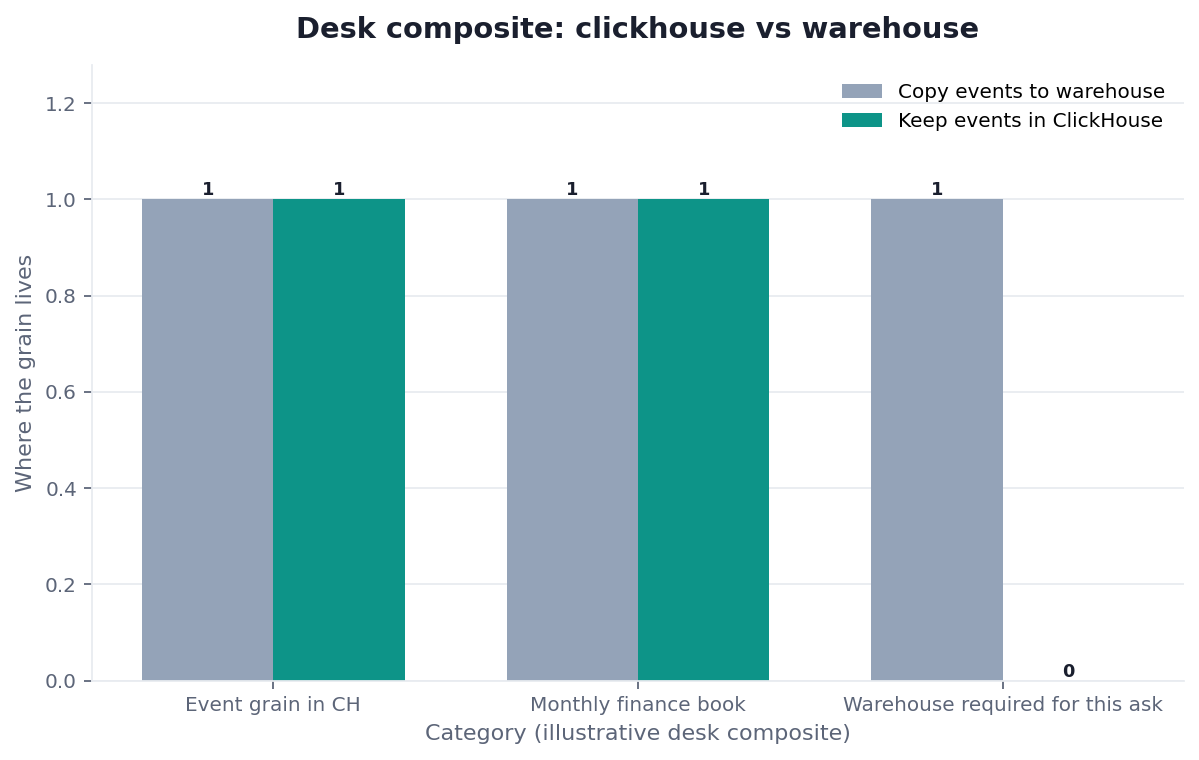
Figure. STATIC FIXTURE / NOT EXECUTED / NOT INDEPENDENTLY VALIDATED. Four authored profiles and policy outcomes; no measured values, runtime, cost, performance, customer result, or production validation.
Passing the static replay means the clickhouse vs warehouse files agree. It does not approve execution, validate SQL, prove access, or select architecture for a real environment.
Independent Validation
Internal editorial or technical review is not independent validation. An independent clickhouse vs warehouse reviewer would need authorized source metadata, grants, query and query-log artifacts, snapshots and checksums, clock definitions, join reconciliation, movement observations, target-environment measurements, and recovery evidence.
The reviewer should declare independence, conflicts, scope, versions, sampling, deviations, and unresolved limitations. Until then, this clickhouse vs warehouse fixture remains not independently validated.
Sources and Limited Claims
Sources were retrieved on 2026-08-31. ClickHouse system.tables, system.query_log, and PostgreSQL table-function pages resolved during the check. PostgreSQL postgres_fdw and privileges pages resolved. The requested ClickHouse data-warehousing and real-time-analytics URLs returned 404; they are recorded but not relied on. Direct NIST requests failed with an HTTP/2 transport error in this environment; NIST SP 800-207 and SP 800-53 Rev. 5 remain access-context references only and do not prove placement.
The general PostgreSQL documentation remains an original reference. PostgreSQL postgres_fdw describes foreign-data-wrapper behavior, while privileges describes privilege concepts. ClickHouse system.tables and system.query_log describe evidence surfaces, subject to version and configuration. The ClickHouse PostgreSQL table function documents an interface. None proves this fixture, an actual join, or a production result.
NIST SP 800-207 supplies zero-trust access context. NIST SP 800-53 Rev. 5 supplies AC-6 least-privilege context. Security controls constrain access; they do not answer clickhouse vs warehouse placement.
How to Cite
Cite this page as: “InfiniSynapse, ClickHouse vs Warehouse: Audit Placement Evidence, static non-executing architecture decision fixture, version 2026-08-31, not independently validated.” Identify the downloaded files reviewed. Do not call it a third-party audit, certification, benchmark, compatibility test, customer case, SLA, or production validation.
Downloads:
- Architecture decision record
- Synthetic question profiles
- Placement criteria
- Evidence requirements
- Option register
- Non-executing query sketches
- Expected decisions
- Held evidence fields
- Assumption register
- External source check
- Independent reproduction protocol
- Offline verifier
Failure modes
Treating engine category as authority
Events do not inherently belong in ClickHouse, and reports do not become governed because they reside in a warehouse. Clickhouse vs warehouse begins with evidence of authority and scope.
Turning held evidence into a score
Numeric weights can conceal unknowns. This package uses explicit states and provisional outcomes. Held cost or performance evidence is not a tie and not zero.
Selecting federation before observing the join
Cross-store joins require cardinality, clock, access, network, movement, and reconciliation evidence. “Aggregate first” is an option, not a universal rule.
Calling static consistency validation
The verifier checks authored consistency only. It cannot prove SQL semantics, engine compatibility, data correctness, grants, execution, or clickhouse vs warehouse suitability.
Internal navigation remains context only: connect ClickHouse to AI, real-time OLAP analysis, event analytics in ClickHouse, OLAP SQL for agents, ClickHouse dashboard, self-service analytics, and analyze a database without ETL.
Audit placement evidence before choosing
Record authority, grain, clocks, governance, joins, access, operations, and held evidence before selecting a store. This check uses only sources you authorize.
Commercial association: You do not need the workspace to complete the educational diagnosis on this page.
Open InfiniSynapseHow this page is sourced. William Zhu is cofounder of InfiniSynapse (GitHub @allwefantasy); this is a company self-description, not independent authority. Reviewed internally by analytics engineering · data platform · LLM security · editor. Editorial standards · corrections · publishing principles · About · Privacy · Terms · Contact zhuhl@infinisynapse.com. COI: InfiniSynapse sells an AI-native Data Agent; the banner is a commercial association. No external organization audited, certified, benchmarked, or endorsed this fixture.
Frequently Asked Questions
Does ClickHouse always win for event questions?
Bottom line: No. Clickhouse vs warehouse depends on authority, grain, clocks, governance, query shape, access, operations, and measured target behavior. Warehouses can support event data.
Is a warehouse table automatically certified?
Bottom line: No. Certification is an organizational governance status requiring current evidence. Storage location does not confer approval.
Did this fixture execute the four questions?
Bottom line: No. All profiles, sources, sketches, and outcomes are synthetic and non-executing. No result, runtime, cost, grant, or product behavior was observed.
Which option did Q3 select?
Bottom line: None. Q3 is held. Federation, aggregate-then-join, scheduled copy, and upstream modeling require separate evidence.
Does the verifier validate SQL or compatibility?
Bottom line: No. It checks deterministic local file consistency and is not a semantic SQL parser, engine test, or conformance suite.
Conclusion
A defensible clickhouse vs warehouse decision starts from evidence, not engine stereotypes. Q1 and Q2 are provisional keep-at-declared-source candidates, Q3 is held, and Q4’s unsupported one-store premise is rejected by policy. None is a production recommendation.
Use the fixture to expose held fields and structure an authorized review. Then collect source ownership, metadata, grants, exact queries, snapshots, clocks, reconciliation, movement, measurements, and recovery evidence in the target environment. If you choose to use the commercial workspace, open InfiniSynapse only with authorized, sanitized inputs and retain your own evidence trail.