Managed ClickHouse Platform for Developers: Hold
By William Zhu & the InfiniSynapse Data Team · Published: 2026-08-22 · Last updated: 2026-09-24 · Last verified: 2026-08-31 · Next review: 2026-11-30 · Editorial standards · Corrections
Table of Contents
- TL;DR
- What managed ClickHouse changes—and what it does not
- Evidence Boundary
- A framework for hosted vs hopped
- What a managed ClickHouse platform for developers still has to prove
- Methods: ask the managed instance vs hop to a warehouse
- Tool landscape around a hosted cluster
- Implementation steps
- Desk sample: hosted host, same SELECT-only user
- Scorecard: connect managed vs copy because it is hosted
- Practical Static Replay
- Independent Validation
- Sources and Limited Claims
- Failure modes
- Frequently Asked Questions
- Conclusion
TL;DR
Direct answer: A managed clickhouse platform for developers changes who operates disks, backups, and the published endpoint. Query scope, grain, and any warehouse copy still need a separate review. This static pack is HOLD / NOT READY FOR CONNECTION because endpoint, TLS verification, principal, effective grants, source metadata, and observed evidence are unavailable. It did not connect, execute SQL, inspect secrets, or validate a vendor or product.
Use the downloads to replay an authored gate offline. Every coordinate is HELD. The accepted grant is editorial text marked DO NOT EXECUTE. Passing the verifier proves only that local files agree.
A hosted logo is not a read-only proof. A hop “because it is managed clickhouse” is a policy rejection unless separate constraints and evidence are supplied.
What managed ClickHouse changes—and what it does not
Key Definition: Here, managed clickhouse means a vendor-hosted, operator-hosted, or internally hosted ClickHouse service whose operator may own patching, backups, and the published endpoint. A managed clickhouse platform for developers is that same hosted surface when a team ships APIs or agents against a published host. Analysis still requires an approved transport path, a named database, an effective principal, and reviewable evidence. Hosting is an operations choice. It is not a new grain and not a warehouse ticket.
ClickHouse’s Cloud getting-started and public Cloud pages describe a hosted product surface. They do not inspect this fixture, prove a deployment, or decide whether a question should stay on events. The parent ClickHouse analytics guide is broader context only.
Connect ClickHouse to AI remains the login-readiness neighbor. TLS, database name, and effective-grant review do not relax on managed clickhouse because a console has a vendor logo. IEEE Xplore is independent engineering literature and will not inspect a grant.
Evidence Boundary
This is a synthetic, static, NON-CONNECTING hosting-review fixture. No vendor hostname, port, TLS mode, certificate, CA, network path, database, principal, credential, source table, partition, user, role, grant, query, task, board, warehouse copy, federation path, SLA, backup, restore, or production workflow was observed.
The package does not claim that anyone recorded a hosted host, created a SELECT-only user, denied INSERT or DROP, bound an enum, executed a dated query, finished in minutes, avoided a copy, used a first-class source, generated a downloadable task, or federated engines. To operationalize managed clickhouse, each such claim needs attributable environment evidence.
Do not test negative privileges by attempting writes on production. First review SHOW CREATE USER, SHOW GRANTS FINAL, system.grants, system.role_grants, row policies, settings profiles, and quotas. Any residual negative test needs separate authorization, isolation, and a non-destructive design.
IEEE publications, the W3C PROV overview, FAIRsharing, and the Open Science Framework are retained as generic literature, provenance, registry, and research-hosting context. None validated this managed clickhouse pack.
A framework for hosted vs hopped
A managed clickhouse review separates operations from analysis. The matrix records PRESENT, HELD, or NOT APPLICABLE. It uses no numeric score.
| Review object | Hosting question | Analysis question | Required evidence |
|---|---|---|---|
| Endpoint | Who publishes host, port, interface? | Which path is approved for this query? | runbook, allowlist, interface docs |
| Transport | Who terminates TLS? | Was hostname and CA verified? | certificate/CA record |
| Identity | Who creates console roles? | What is the query principal? | user/role snapshots |
| Scope | Who patches the service? | What can the principal read? | SHOW GRANTS FINAL |
| Grain | Who owns ingest? | What does one output row mean? | schema and contract |
| Movement | Who bills storage? | What must be copied, if anything? | hop plan and volume |
| Recovery | Who restores backups? | Can the review be replayed? | backup/restore and hashes |
ClickHouse Cloud backups document a hosted backup capability. They do not prove that this fixture’s environment has backups, restores, or a tested recovery clock.
Shared responsibility still needs named owners
A managed clickhouse contract usually splits work: the operator may patch hosts, publish an endpoint, and offer backup products; the customer still owns data classification, principal design, query review, and any hop. Write those owners by name. If the operator owns restore and the analysis team owns grain, both must appear in the review record.
Shared responsibility does not fill held fields. If the published hostname is unknown, the managed clickhouse endpoint row stays HELD even when a console login exists for a person. If console roles are broad, that is a different control family from the query principal. Record both. Do not collapse them into “we have Cloud.”
The same split applies to billing and recovery. An invoice proves someone paid for a service. It does not prove TLS verification, least privilege, or that a 24-hour event question is authorized. Keep those claims on separate lines in the assumption register.
Hosting is operations, not a new grain
Managed clickhouse can mean ClickHouse Cloud, a specialist operator, or an internal platform team. Those models change staffing and shared responsibility. They do not invent a certified finance book and they do not make a warehouse hop mandatory.
If freshness is the fight after a real login exists, continue in real-time OLAP analysis. A vendor SLA is not a tile refresh and is not evidence collected here.
What a managed ClickHouse platform for developers still has to prove
A console or API host is the operations surface. The table maps common vendor shapes to the same review objects this pack already holds. Official pages describe their own products; they do not fill HELD fields here.
| Platform shape | Who typically operates | Developer still reviews |
|---|---|---|
| ClickHouse Cloud | Vendor-hosted service | Published host, TLS, query principal, SHOW GRANTS FINAL |
| Tinybird | Hosted ClickHouse for app APIs | Endpoint and scoped reads before ingest APIs |
| Altinity | Operator or BYOC | Same grant and hop rules on any cloud |
| DoubleCloud | Managed on AWS or GCP | Backup owner versus analysis owner |
| Elest.io | Fully managed instance | Endpoint inventory; a price row leaves host HELD |
These rows are labels for the same gate, not a yearly ranking and not a price sheet.
Methods: ask the managed instance vs hop to a warehouse
Four authored candidates test completeness. Statuses are policy labels, not engine verdicts.
| ID | Candidate | Outcome | Why |
|---|---|---|---|
MCH-Q1-ENDPOINT | hosted endpoint inventory | HOLD / NOT READY | host, port, interface, TLS, CA, database, and principal are HELD |
MCH-Q2-GRANT | scoped SELECT text | QUALIFIED FOR STATIC REVIEW only | accepted file contains only GRANT SELECT ON analytics_events.* TO analytics_events_reader; |
MCH-Q3-HOP-HOSTED | “hop because it is hosted” | REJECTED AS UNSUPPORTED | hosting is not a hop requirement |
MCH-Q4-CERTIFIED-HOP | hop for a separately governed book | NEEDS EVIDENCE / HOLD | a hop may be valid for other reasons; those reasons are not evidenced here |
Q2 does not prove that a user exists on any managed clickhouse service. Q3 is a policy rejection, not a claim that copies are impossible. Q4 stays held because certification, lineage, clocks, and reconciliation are unavailable.
ClickHouse vs warehouse for AI is the placement neighbor. Hosting does not move that fork. AI for data analysis, self-service analytics, and analyze a database without ETL remain context. This pack makes no first-class-source, no-write, no-copy, or federation claim.
Tool landscape around a hosted cluster
The engine is still ClickHouse. The console is an operator surface. Secrets, SSO, and network policy are separate controls.
ClickHouse network ports document default interfaces, not a deployed managed clickhouse endpoint. Access rights and Cloud access management describe users, roles, and console permissions. They do not prove this fixture’s principal or console viewers.
Data governance still names who may see which database. A managed console with many viewers is not an effective grant. What is a data agent does not collapse every cloud into one hop. If the first later question is a funnel, event analytics in ClickHouse is related context after a real user exists.
Do not store secrets in this pack. Prefer a secret-manager reference and rotation owner. The https://app.infinisynapse.com/tasks URL is retained from the earlier page as a product trail example, not as evidence that a task ran.
Implementation steps
- Open
expected-readiness-MCH-20260831.jsonand confirm the overall HOLD outcome. - Review
endpoint-inventory-template-MCH-20260831.csv. Every sensitive field must remainHELD. - Compare the accepted scoped grant with the rejected admin grant as policy text. Do not execute either file.
- Reconcile the hop register: Q3 rejected, Q4 held.
- Read the assumption register and held-evidence list. Leave environment facts unresolved.
- Run
python3 verify-MCH-20260831.pyfrom the downloads directory.
A passing local check does not authorize anyone to query managed clickhouse. It reports deterministic agreement among authored files.
For a later authorized review, collect: owner approval; the published host, port, and interface; certificate, hostname, and CA evidence; SHOW CREATE USER and SHOW GRANTS FINAL; relevant grant and role-grant rows; row policies, profiles, and quotas; SHOW CREATE TABLE or catalog metadata; secret-manager reference and rotation owner; backup and restore ownership; any hop justification with clocks and volume; and, only after authorized execution, a query identifier and optional query-log row. Until those artifacts exist, managed clickhouse remains HOLD.
Practical Static Replay
Replay managed clickhouse as a file comparison: freeze the package version, confirm held endpoint fields, confirm the exact accepted grant, confirm Q3 is a policy rejection, confirm Q4 remains held, then retain verifier output and hashes.
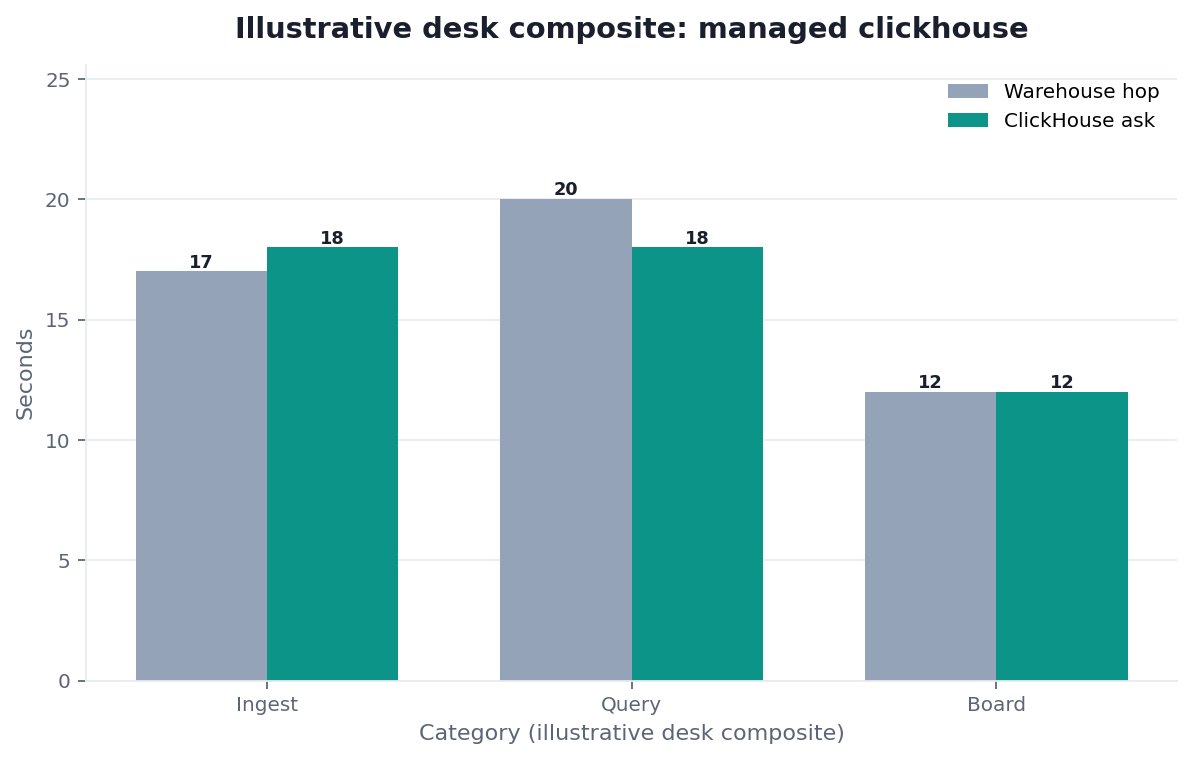
Figure. STATIC FIXTURE / NOT CONNECTED / NOT INDEPENDENTLY VALIDATED. Hosting, endpoint, TLS, identity, grants, and hop reasons are held or policy-labeled. No measured runtime, SLA, or result is shown.
Passing this replay means the managed clickhouse files agree. It does not prove reachability, grants, backups, SQL compatibility, or production suitability.
Record the Python version, operating system, file hashes, exact HOLD output, and any deviation. If a later contract changes the accepted grant, hop rule, or held-field list, treat the prior replay as superseded. A second internal rerun of managed clickhouse files shows repeatability, not independence.
Independent Validation
Internal editorial review is not independent validation. A qualified reviewer of managed clickhouse would need owner approval, the published endpoint and interface, certificate/CA/hostname evidence, identity and effective-grant snapshots, source metadata, backup/restore ownership, any hop justification, and declared versions.
Until that work occurs, this pack is not a third-party audit, certification, penetration test, benchmark, customer case, or production validation.
An independent managed clickhouse report should also state conflicts, sampling, server and client versions, and which held fields remained unresolved. If the reviewer only reran the Python files, say so. That result still does not authorize a connection. A complete managed clickhouse attestation would reconcile operator documents with customer-owned grants and would publish deviations. Partial review of a console is not enough to clear HOLD. Keep managed clickhouse language precise: hosted operations were inspected, or they were not; effective grants were snapshotted, or they were not. Do not let a screenshot of a vendor home page stand in for those objects. Date the HOLD.
Sources and Limited Claims
Direct official sources were retrieved on 2026-08-31. ClickHouse Cloud intro, Cloud marketing, backups, access rights, Cloud access management, and network-ports pages resolved. They support bounded descriptions of hosted operations, backup features, and access models. They do not validate this managed clickhouse fixture or any deployment. Re-check those URLs and your operator’s current runbook at decision time; product paths move.
How to Cite
Cite this page as: “InfiniSynapse, Managed ClickHouse Platform for Developers: Hold, static non-connecting hosting fixture, MCH-20260831, HOLD / NOT READY FOR CONNECTION, not independently validated.” Name the downloaded files used.
Downloads:
- Hosting responsibility matrix
- Endpoint inventory template
- Accepted scoped grant
- Rejected admin grant
- Hop decision register
- Expected readiness
- Hosting review rules
- Held evidence fields
- Assumption register
- External source check
- Independent reproduction protocol
- Offline verifier
Failure modes
Treating managed as a warehouse ticket
If the first project after hosting is “copy events for AI,” you have bought operations and skipped the managed clickhouse review. Hosting can sit beside a warehouse. It does not require a hop.
Shared cloud admin in the connector
SSO convenience is not an effective-grant snapshot. An admin on managed clickhouse is still an admin until SHOW GRANTS FINAL and inherited roles are reviewed.
Personal tunnels to a hosted host
A laptop path that dies when someone sleeps is not an approved endpoint. Write the operator hostname the on-call uses, or keep the managed clickhouse decision on HOLD.
Reporting a draft as observed evidence
A SQL file is not a parser result, network check, denial, runtime, SLA, or production validation.
Review hosting evidence before access
Record endpoint, TLS, principal, grants, and held evidence before treating a hosted cluster as ready. This check uses only sources you authorize.
Commercial association: You do not need the workspace to complete the educational diagnosis on this page.
Open InfiniSynapseHow this page is sourced. William Zhu is cofounder of InfiniSynapse (GitHub @allwefantasy); InfiniSynapse on GitHub. This is a company self-description, not independent authority. Reviewed internally by analytics engineering · data platform · LLM security · editor. Editorial standards · corrections · publishing principles · About · Privacy · Terms · Contact zhuhl@infinisynapse.com. Company About. COI: InfiniSynapse sells an AI-native Data Agent; the banner is a commercial association. Fact-check: ieeexplore.ieee.org · ieee.org · w3.org · FAIRsharing · osf.io. No external organization audited this fixture.
Frequently Asked Questions
Does managed ClickHouse require a warehouse before I can ask it?
Bottom line: No. Hosting is not a hop requirement. A warehouse hop needs its own grain, governance, and evidence. This managed clickhouse pack rejects hop-because-hosted as underspecified.
Is the vendor console enough access for an agent?
Bottom line: No. Console viewers are not effective query grants. Review the principal that would actually reach managed clickhouse.
How is managed different from self-hosted for analysis?
Bottom line: Operations differ: patching, backups, published endpoints, and shared responsibility. The analysis contract still needs transport, identity, scope, grain, and evidence. This fixture did not compare vendors.
What still has to be proven after a team buys hosting?
Bottom line: A managed clickhouse platform for developers still needs a published endpoint, TLS evidence, a query principal, and SHOW GRANTS FINAL. This pack stays HOLD until those exist.
Can I federate the hosted cluster with Postgres later?
Bottom line: Federation is a separate option with its own clocks, credentials, and cardinality evidence. This pack does not execute or select it. Do not flatten events because the cluster is managed clickhouse.
Conclusion
Review managed clickhouse as hosted operations plus an analysis gate. Keep endpoint, TLS, principal, grants, backups, and hop reasons in explicit states. Q1 is held, Q2 is static text only, Q3 is a policy rejection, and Q4 stays held. None is a production recommendation. A later managed clickhouse decision can change when authority, clocks, grants, or hop constraints change; write those revisit conditions before anyone treats hosting as placement advice.
For company context, InfiniSynapse describes itself on its About page. Site Privacy and Terms apply. If you later use the commercial workspace, open InfiniSynapse only with authorized, sanitized inputs.