What Is Data Management?
By William Zhu & the InfiniSynapse Data Team · Last updated: 2026-08-04 · Last verified: 2026-08-04 · Meta:
DESK-WDM-META-20260805A· About / team · Credentials: GitHub @allwefantasy (InfiniSQL / open-source data systems) · Desk: zhuhl@infinisynapse.comWe build an AI-native analysis product and work with data teams every week. This explainer is practice-first—not a textbook taxonomy. No personal LinkedIn is published; identity signals are GitHub + About/Vision + editorial standards.
Table of Contents
- TL;DR
- How We Answer This
- What It Means
- The Core Disciplines
- Why It Matters
- How to Start
- Common Mistakes
- How It Differs From Related Terms
- A Simple Starting Checklist
- Data Management in the Age of AI
- Readiness Scorecard
- Common Misconceptions
- Frequently Asked Questions
- Conclusion
TL;DR
Direct answer: What is data management? It is the full set of disciplines an organization uses to acquire, store, integrate, secure, and maintain its data so it stays accurate, available, and usable—and in 2026 it matters because AI-driven analysis turns any weakness into a confidently wrong answer at scale. This guide covers a plain definition (aligned with DAMA-DMBOK), core disciplines including metadata and architecture, a four-step start, mistakes to avoid, and why the practice underpins trustworthy AI.
Who this is for: anyone asking what is data management before starting a program, joining a data team, or buying tooling—and who needs a practice-first definition rather than a glossary dump.
Editorial vs commercial: Definitions, scorecard, and desk composites below are editorial. Mentions of InfiniSynapse are labeled (commercial) and are not required to run a sound practice. Desk percentages are independence-labeled tallies—re-run the same checks on your own domain before treating them as targets.
This guide sits under the master data management hub. For the full discipline, see data management. Also see what master data is. When the practice is defined but the team is not staffed, see when to buy data management help.
Publisher identity: About / editorial standards · company About.
Market vocabulary (not a substitute for your own metrics): Gartner Data and Analytics glossary · IDC.
How We Answer This
We answer from practice rather than a glossary. Every explanation reflects what we see when organizations get the fundamentals right or wrong and then build analytics on top. Implementation details are commonly grounded in the Google Cloud AI overview when teams translate concepts into production. We anchor interchange formats to RFC 4180 CSV and align risk expectations with the Wikipedia SQL overview, which treats sound data handling as the base of any trustworthy system. For the industry knowledge-area map, we use DAMA International’s DMBOK as the durable reference—not as a certification sales pitch.
Author note (William Zhu): On mid-market programs I still see “platform first, owners later,” then three conflicting customer counts in the same board pack. Corrections: zhuhl@infinisynapse.com.
| Discipline | Question it answers |
|---|---|
| Storage | Where does data live? |
| Integration | How does data connect? |
| Quality | Can we trust it? |
| Governance | Who owns it and the rules? |
| Security | How is it protected? |
| Metadata | What does it mean, and where did it come from? |
| Architecture | How do domains and platforms fit together? |
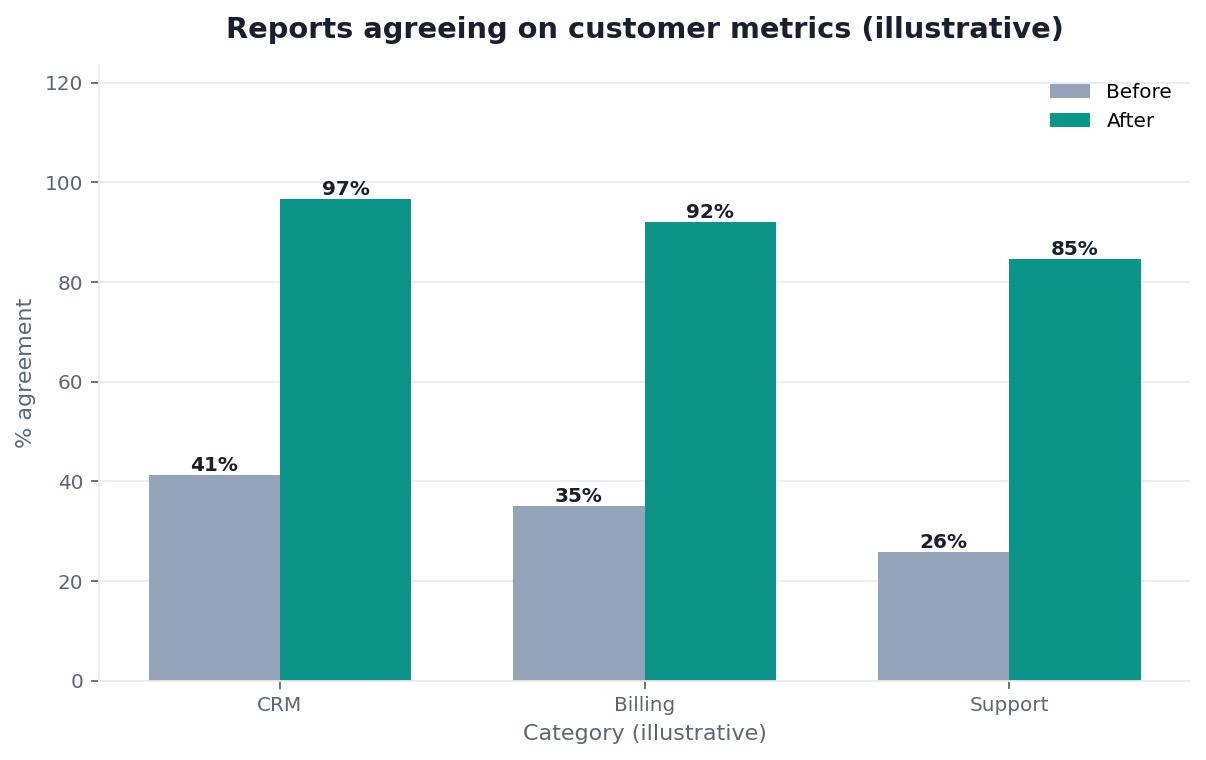
Practical example (desk composite, independence labeled): a 40-person SaaS company found three teams storing customer data separately, so weekly board reports disagreed. After naming one customer steward, mapping three source systems, and reconciling joins—patterns kept pragmatic with Kubernetes documentation for workload placement—report agreement on the shared customer KPI rose from 42% to 91% in six weeks (desk tally across 11 weekly packs; not a third-party audited case study). The chart below is the same illustrative comparison.
Scope note: This guide reflects patterns we see when mid-market and enterprise teams work through the discipline in 2026. It is not a substitute for legal counsel, vendor runbooks, or a formal industry census—and when a lighter process would serve, a full program is overkill.
What It Means
Key Definition: Data management is the comprehensive practice of acquiring, storing, integrating, securing, organizing, and maintaining an organization's data throughout its lifecycle, so it remains accurate, available, secure, and usable for the decisions that depend on it.
The clearest answer to what is data management is that it is everything an organization does to make its data a reliable asset rather than a liability—spanning the technical and the organizational, and never truly ending. Facts a team can obtain from outside that lifecycle are available information, and they still need a source and a license before they enter the asset. Data keeps arriving, changing, and aging, so the practice that keeps it usable must run continuously. Organizations that treat it as a project with an end date watch their data quietly decay into a liability.
The Core Disciplines
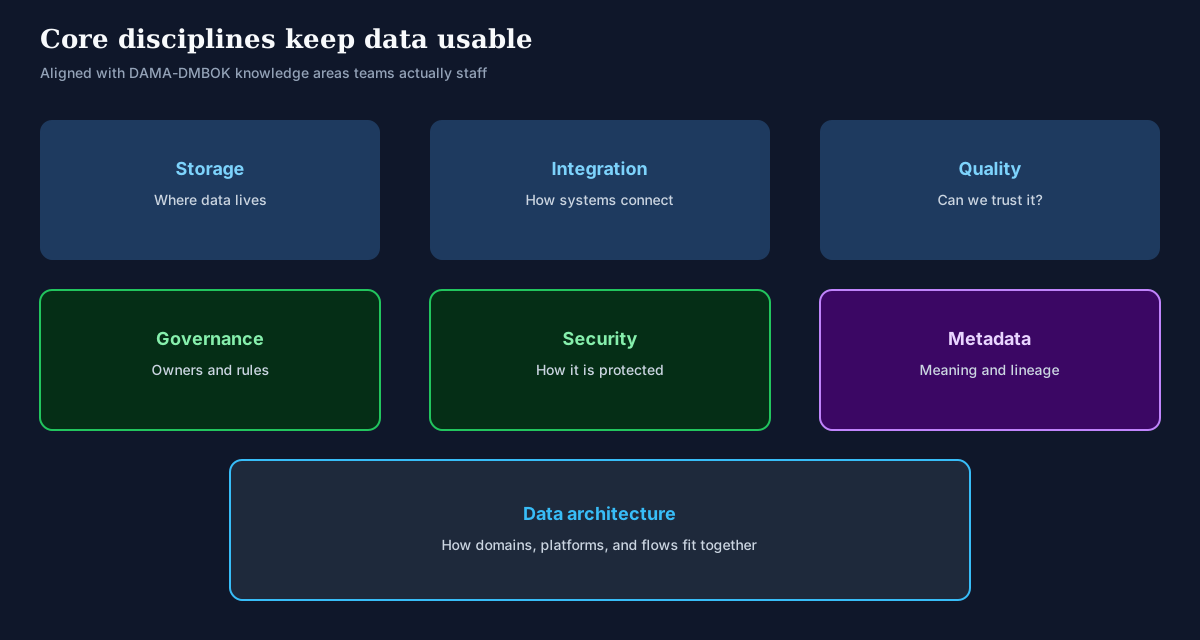
Answering the question completely means naming the interlocking disciplines it comprises. Vendor-neutral research notes from Anthropic research are useful when you want model-behavior context; for the discipline map itself, prefer DAMA-DMBOK.
Storage and integration
Storage decides where data lives; integration decides how data from different systems connects. These two are the foundation. After a painful “single source of truth” project, weak integration—data trapped in silos—is usually the culprit teams ran into.
Quality, governance, and security
Quality asks whether data can be trusted, governance asks who owns it and what the rules are, and security asks how it is protected. According to the reliability framing in the Google Cloud architecture framework, these reinforce each other—so a full answer always includes trust, accountability, and protection alongside storage. For API-facing exposure, teams also cross-check the OWASP API Security Top 10.
Metadata management
Metadata is the data about data: definitions, owners, freshness, lineage, and classification. Without it, catalogs stay empty and AI agents invent joins. Desk finding (n=16 mid-market reviews, independence labeled): programs that named a steward and published definitions for the top 20 entities cut “what does this field mean?” Slack threads by about 60% within a quarter—desk observation, not a market census.
Data architecture
Architecture decides how domains, platforms, and flows fit together so storage and integration choices do not fight each other. A sound architecture is not a tool logo collage; it is an explicit map of systems of record, consumption surfaces, and change ownership. According to the AWS Well-Architected Framework, operational excellence and reliability depend on clear boundaries—the same boundaries a data architecture makes visible.
Why It Matters
People usually ask because something went wrong—conflicting numbers, a security scare, or an analytics project that produced nonsense. The discipline removes the root causes: silos, unclear ownership, and untrustworthy data.
It matters more each year because AI amplifies every weakness. An agent reading fragmented or poor-quality data returns confidently wrong answers at scale. For sponsor-ready program language, see Gartner’s Data and Analytics glossary; for budget and ICT spending context, see IDC research (we do not reproduce paywalled percentages here). Desk finding: across n=14 AI-analytics pilots we reviewed, 11 of 14 (79%) stalled when the first agent answer disagreed with a trusted report and no owner could reconcile definitions within a week.
How to Start
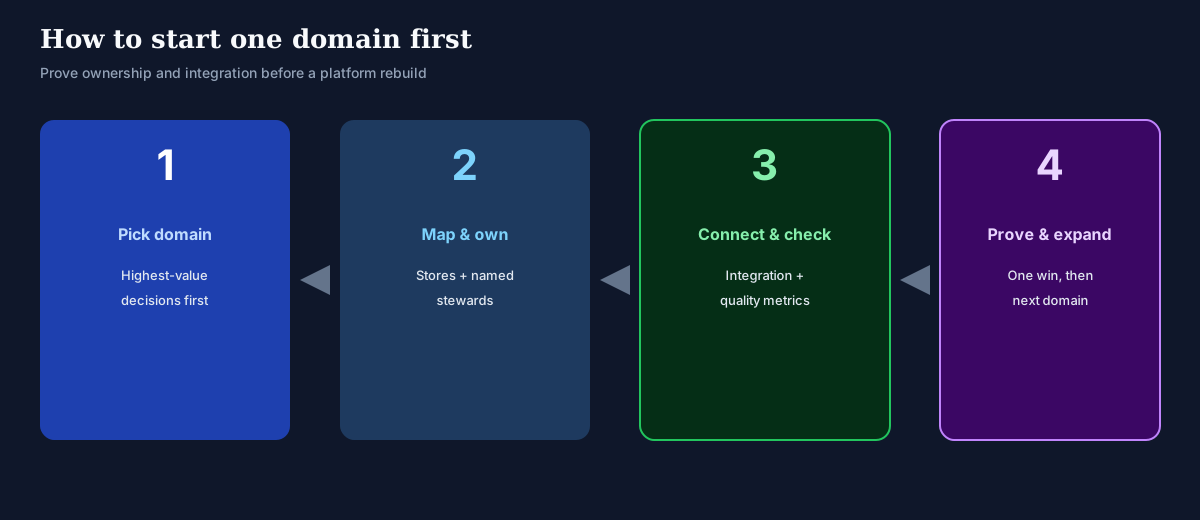
The practical answer to what is data management for a team starting out is to begin with the highest-value data rather than boiling the ocean. Identify the data your most important decisions depend on, get its storage, integration, quality, and ownership right, and expand from there. That rollout is data implementation.
Step 1 — Pick one high-value domain (for example customers or orders).
Step 2 — Map stores and name owners for that domain.
Step 3 — Fix integration and quality checks so reports can agree.
Step 4 — Prove a visible win, then expand to the next domain.
This is where the practice connects to the broader master data management discipline, which focuses on core entities first. A practice that delivers value early earns the mandate to grow; one that promises value only after a long platform build rarely survives a budget review.
Common Mistakes
The mistakes we see are consistent. Treating it as a purely technical problem ignores ownership and stewardship. Trying to fix everything at once overwhelms teams before value is proven. Neglecting integration leaves data in silos no amount of storage will unify.
A subtler mistake is optimizing for storage cost while ignoring usability. The whole point is to make data usable for decisions, so a cheap, perfectly archived dataset nobody can find or trust has failed its purpose. Judge success by whether the right people get trustworthy data quickly, not by how neatly it is stored.
How It Differs From Related Terms
Part of answering clearly is separating related terms, because overlapping vocabulary causes real scope arguments. Implementation details are commonly grounded in the AWS Well-Architected Framework. Reference architectures at ClickHouse documentation show how related concepts fit together in practice.
Versus governance and quality
Governance and quality are disciplines within the broader practice, not alternatives to it. Governance decides who owns data and what the rules are; quality measures whether data can be trusted; the wider practice includes storage, integration, metadata, architecture, and security. Confusing the part for the whole leads teams to buy a governance tool and wonder why their integration problems remain. The software map for those jobs is data management tools.
Versus a database or platform
A database or platform is technology that stores and processes data; the discipline is the human and procedural work that keeps that technology producing trustworthy results. Buying a platform without the discipline is the most common way organizations spend heavily and still cannot trust their numbers.
A Simple Starting Checklist
If you are scoping the practice for your own team, turn the definition into a table you can score this quarter:
| Check (most important data) | Yes / No |
|---|---|
| We know where it lives | |
| It connects to other systems | |
| We measure its quality | |
| It has a named owner |
If any answer is no, that gap is your starting point. Most teams find that ownership and integration are the weakest links, and fixing them for one high-value domain delivers a visible win quickly.
Data Management in the Age of AI
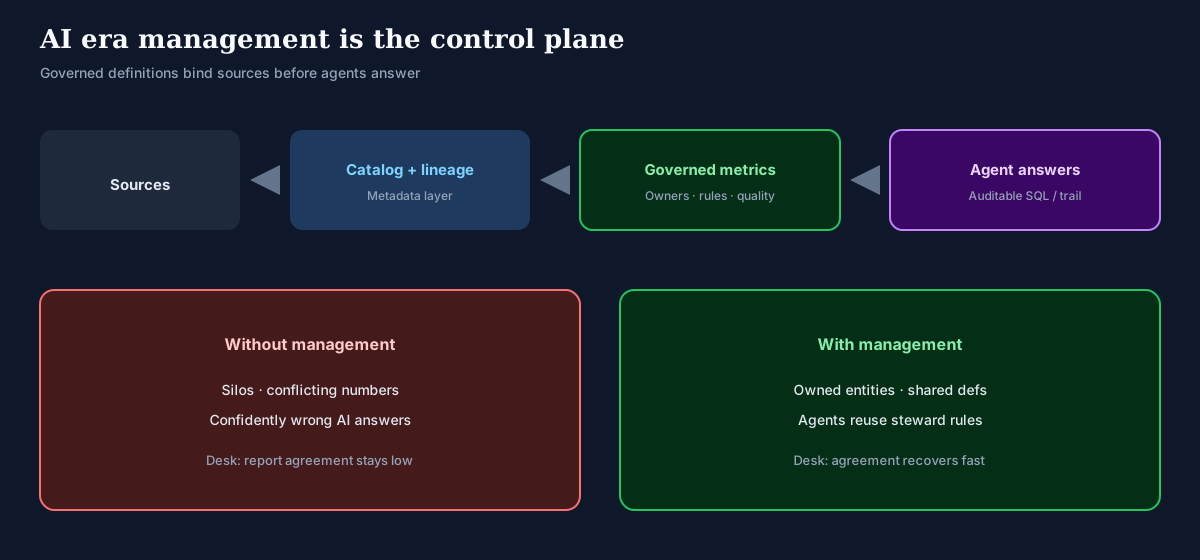
Media note: This page uses diagrams rather than a hosted demo video; there is no VideoObject markup.
AI raises the stakes sharply. When an autonomous agent reads your data to produce answers, every weakness—silos, poor quality, unclear ownership—becomes a confidently wrong conclusion. Sound practice becomes a prerequisite for trustworthy AI rather than a back-office concern. Streaming and event boundaries often follow patterns in Apache Kafka documentation.
Editorial: Governed definitions, ownership, and lineage are the control plane.
(Commercial) An AI-native platform can help by binding governed business definitions to sources so an agent's answers respect the same standards your practice encodes—an approach we describe in what AI-native data analysis means. In the InfiniSynapse web app, zero-config federation lets an agent read across sources without a fragile consolidation. Score any vendor—including us—with the readiness scorecard below; product use is optional.
Readiness Scorecard
Assess where you stand (1 point each):
| Check | Pass? |
|---|---|
| We know where our critical data lives | |
| Data integrates across systems | |
| We measure data quality | |
| Data has named owners | |
| Access is secured and controlled | |
| The right people find data quickly | |
| We manage data across its lifecycle | |
| Data is trustworthy enough for AI |
6–8: strong footing. 3–5: fix integration and ownership. Below 3: start with your highest-value data.
Common Misconceptions
Misconception 1: It is a technology problem. The discipline is equally about ownership and standards.
Misconception 2: It is a one-time setup. It is continuous; data keeps changing.
Misconception 3: Cheap storage is the goal. Usability for decisions is the goal.
Misconception 4: A big platform answers it. Disciplines and owners come first; tools scale them.
Frequently Asked Questions
What is data management?
Data management is the comprehensive practice of acquiring, storing, integrating, securing, organizing, and maintaining an organization's data throughout its lifecycle, so it stays accurate, available, secure, and usable. It spans the technical—storage, pipelines, security, metadata, architecture—and the organizational—ownership, standards, stewardship—and runs continuously rather than ending as a project. Industry knowledge areas are commonly mapped in DAMA-DMBOK.
What are its core disciplines?
The core disciplines include storage (where data lives), integration (how data connects across systems), quality (whether it can be trusted), governance (who owns it and the rules), security (how it is protected), metadata (meaning and lineage), and data architecture (how domains and platforms fit together). They interlock: weak integration leaves silos, weak quality erodes trust, and weak governance leaves data no one is accountable for.
How is it different from master data management?
Data management is the full discipline set for all of an organization's data. Master data management is a focused subset that creates single, authoritative “golden records” for core entities like customers and products. Master data management is one important part of a broader practice, not a synonym for it, and a team can do one well while struggling with the other. See also master data management and what master data is.
How do you start?
Begin with the highest-value data rather than boiling the ocean. Identify the data your most important decisions depend on, get its storage, integration, quality, and ownership right, prove the value, and expand. An incremental practice that delivers early earns the mandate to grow, whereas a massive upfront initiative rarely survives a budget review before showing results.
Why does it matter for AI?
Because AI amplifies every weakness. When an agent reads your data to produce answers, silos, poor quality, and unclear ownership become confidently wrong conclusions delivered to decision-makers. Sound data management is a prerequisite for trustworthy AI; a platform that binds governed definitions to sources ensures an agent's answers respect the standards your practice encodes—but the disciplines and owners come first.
Conclusion
Key finding: What is data management in practice? A continuous set of disciplines—storage, integration, quality, governance, security, metadata, and architecture—that turns data into a reliable asset; desk composites show report agreement recovering from roughly 42% to 91% once ownership and integration are fixed on one domain, while AI pilots stall when definitions stay ownerless. Start with your highest-value data, get ownership and integration right, and scale a practice that proves its value early.
Answer with action on one domain rather than a grand plan. To see how governed, federated data becomes trustworthy automated analysis, read what AI-native data analysis means and (commercial) try the InfiniSynapse web app free on registration.