Big Data Analysis: Verify SQL Before You Run
By William Zhu & the InfiniSynapse Data Team · Published: 2026-08-22 · Last updated: 2026-09-17 · Last verified: 2026-08-31 · Next review: 2026-11-30 · Editorial standards · Corrections
Table of Contents
- TL;DR
- What “analyze large datasets with AI” means
- Evidence Boundary
- A framework for scale without a Spark team
- Methods: warehouse-first, file-first, and agent-first
- Tool landscape for large-source analysis
- Implementation steps you can audit
- Desk sample: a 12-million-row question (illustrative)
- Worked size example: 200GB static fixture
- Cost-evidence gate
- Scorecard: when to stay put vs when to hire Spark
- Failure modes that look like “AI is slow”
- Independent Validation
- Sources and Limited Claims
- How to Cite
- Frequently Asked Questions
- Conclusion
TL;DR
Direct answer: Review a big data fixture before sending SQL to any engine. This page lets a reviewer inspect columns, a date predicate, aggregation, ranking, assumed logical inputs, and expected control results. It reports no execution, observed scan, runtime, cost, customer outcome, or SLA for big data analysis.
What you'll learn:
- How to separate SQL inspection from execution evidence
- Which assumptions belong in a reproducible big data planning fixture
- Why EXPLAIN, dry-run estimates, and observed job metrics are different evidence
- How partitions, predicate pushdown, permissions, quotas, and cancellation vary by platform
- How to reproduce the static controls with standard-library files
- A cost-evidence gate that keeps assumed, estimated, processed, scanned, and billed bytes on separate labels
The downloadable package contains assumptions, SQL text, expected arithmetic, source notes, and a verifier. It is not customer data, a benchmark, an execution plan, a warehouse dry run, a certification, or evidence that any product ran the query.
What “analyze large datasets with AI” means
Key Definition: On this page, big data analysis means reviewing a query intended for a big data engine while keeping planning evidence separate from engine evidence. A static fixture can test syntax-shaped controls and arithmetic; only the selected engine can report its plan, estimates, processed bytes, cost, runtime, permissions, and job state.
The Wikipedia big data overview provides category history, while the Stanford HAI AI Index provides broad AI context. Neither source validates this fixture, chooses a warehouse, or supports a performance claim. The AWS Well-Architected Machine Learning Lens welcome page is retained as architecture context, and the generic Google BigQuery documentation remains an engine documentation entry point. These links are contextual, not endorsements.
For adjacent categories, the Databricks Genie data-agents note describes one vendor approach, Databricks documentation documents that platform, Amazon Athena documentation covers query-in-place concepts, and AWS Glue documentation covers a managed integration category. None ran or audited this big data fixture. File-oriented readers can continue to parquet file analysis, while engine-specific readers can review ClickHouse analytics. The step-by-step how-to lives on the topic hub, how to analyze large datasets with AI; this page stays on SQL verification.
Evidence Boundary
No query was executed for this page. The big data fixture records execution_performed=false, warehouse_connected=false, dry_run_performed=false, runtime_observed=false, bytes_scanned_observed=false, sla_claimed=false, and customer_data=false. Actual runtime, actual bytes scanned, actual cost, and actual outputs are held blank. The assumed 12,000,000 source rows and 200,000,000,000 logical input bytes are transparent planning numbers, not observations.
The package makes no claim about InfiniSynapse execution, warehouse connectivity, task cancellation, reruns, timelines, artifact generation, intermediate tables, quotas, or exclusive compute. Internal editorial reviewers checked presentation and boundaries; they are not independent external validators of big data execution or product capability.
A framework for scale without a Spark team
Use three independent questions before selecting a tool. They prevent a planning exercise from drifting into a fabricated big data benchmark.
| Question | Static evidence available here | Evidence required from an engine |
|---|---|---|
| Is the query bounded? | Date predicate, explicit columns, grouped result, rank limit | Parsed plan and partition/pruning details |
| How large is the logical input? | Clearly labeled assumed rows and bytes | Catalog statistics or engine estimate |
| What did it cost and how long did it take? | Nothing; fields are held blank | Completed job metadata and billing rules |
Volume, velocity, and question shape.
Volume is one dimension. Update frequency, joins, skew, file layout, required freshness, and output grain can dominate an engine decision. An assumed row count can help a reviewer reason about a big data query shape, but it cannot establish memory use, slots, workers, shuffle volume, latency, or reliability.
Where the compute actually runs.
Compute would run in the chosen engine only after an authorized operator submits the SQL. This page does not choose that engine or connect to one. The Google SRE Book table of contents and its chapter on data-processing pipelines (retrieved 2026-09-04) provide operational context; they do not turn static review into production evidence.
Predicates, partitions, and pushdown.
The big data fixture’s predicate is order_date >= DATE '2026-06-01' AND order_date < DATE '2026-08-30'. Whether that expression enables partition pruning depends on the engine, table partitioning, types, transformations, statistics, and connector. The Parquet page index documentation (retrieved 2026-09-04) explains a file-format mechanism that may support selective reads. It does not prove pushdown for this SQL or any big data platform.
Methods: warehouse-first, file-first, and agent-first
Warehouse-first questioning.
Use catalog metadata and engine-native tools. BigQuery’s query plan explanation (retrieved 2026-09-04) describes stages and performance insights. Spark’s EXPLAIN syntax (retrieved 2026-09-04) describes logical and physical plan display. These documents show why big data plan evidence must come from the selected system.
Why a Spark team is a different job.
Spark can be appropriate for distributed transformations, but neither the assumed size nor the words big data dictate a staffing choice. Existing platform standards, workload shape, operational ownership, and downstream contracts matter. The fixture answers a narrower question: does the proposed query express the intended bounded aggregation and ranking?
Tool landscape for large-source analysis
Separate storage engines, query interfaces, orchestration, and review layers. A vendor page can describe a category; only engine-native output from your authorized environment can support engine-specific claims.
EXPLAIN, dry run, and execution.
EXPLAIN generally asks an engine to describe a plan without producing the query’s business result, though behavior and side effects are platform-specific. A dry run may validate a query and estimate bytes without executing it; BigQuery’s dry-run sample (retrieved 2026-09-04) is one implementation. Execution produces job metadata and results. Do not relabel any one as another.
BigQuery’s cost best practices (retrieved 2026-09-04) distinguishes estimates from billing-relevant outcomes. For big data, an estimate is not observed bytes, and observed bytes are not automatically final cost. Pricing model, cache behavior, reservations, editions, free tiers, and platform rules may matter.
Permissions and operational controls.
Read access, job creation, result destination, cancellation, quotas, and service limits are platform-specific. The AWS guidance on operational excellence (retrieved 2026-09-04) and quotas and constraints (retrieved 2026-09-04) offers bounded operational principles. It does not certify this method or a product.
Implementation steps you can audit
The safe sequence is review, engine-native estimate or plan where appropriate, explicit approval, then execution under the selected platform’s controls. This page completes only static review.
Authorize a read-only large source
Define a least-privilege role, data classification, allowed columns, result destination, retention, and approver before connection. Do not paste credentials or sensitive rows into a prompt. Public training data is not a substitute for your authorization model; the BigQuery public datasets overview (retrieved 2026-09-04) is only a description of that program.
State a goal, not a SQL fragment
Write the analytical intent first: rank the top five channels by assumed net contribution within the fixed date window. Define contribution as revenue - variable_cost. The SQL then becomes reviewable against the goal. For big data, explicit semantics reduce ambiguity but still do not prove performance.
Inspect SQL and expected controls
Confirm the big data fixture selects only channel, aggregated contribution, and rank; includes both date boundaries; excludes internal orders; groups by channel; and limits ranks to five. Compare the expected control output to independent arithmetic over the tiny static input rows. The verifier checks these properties without a SQL engine.
Obtain engine-native evidence
An authorized operator can next use the selected engine’s EXPLAIN, validator, or dry-run feature, if supported and approved. Save unedited output with engine, version, region, timestamp, permissions, table metadata, and command. Only after actual execution may a report fill observed output, runtime, processed bytes, and cost fields.
Desk sample: a 12-million-row question (illustrative)
This legacy heading is retained so existing links continue to resolve. The content is now an explicitly static query-planning fixture, not a desk sample, customer dataset, dry run, execution plan, or benchmark. Its assumed source has 12,000,000 rows and 200,000,000,000 logical input bytes. Those assumptions exist solely to visualize a possible plan shape.
The chart reduces assumed rows and bytes through conceptual stages: source, dated-and-policy-filtered, grouped, and top-five output. Reduction ratios are authored assumptions. They do not show actual pruning, pushdown, scans, output, runtime, or savings for big data.
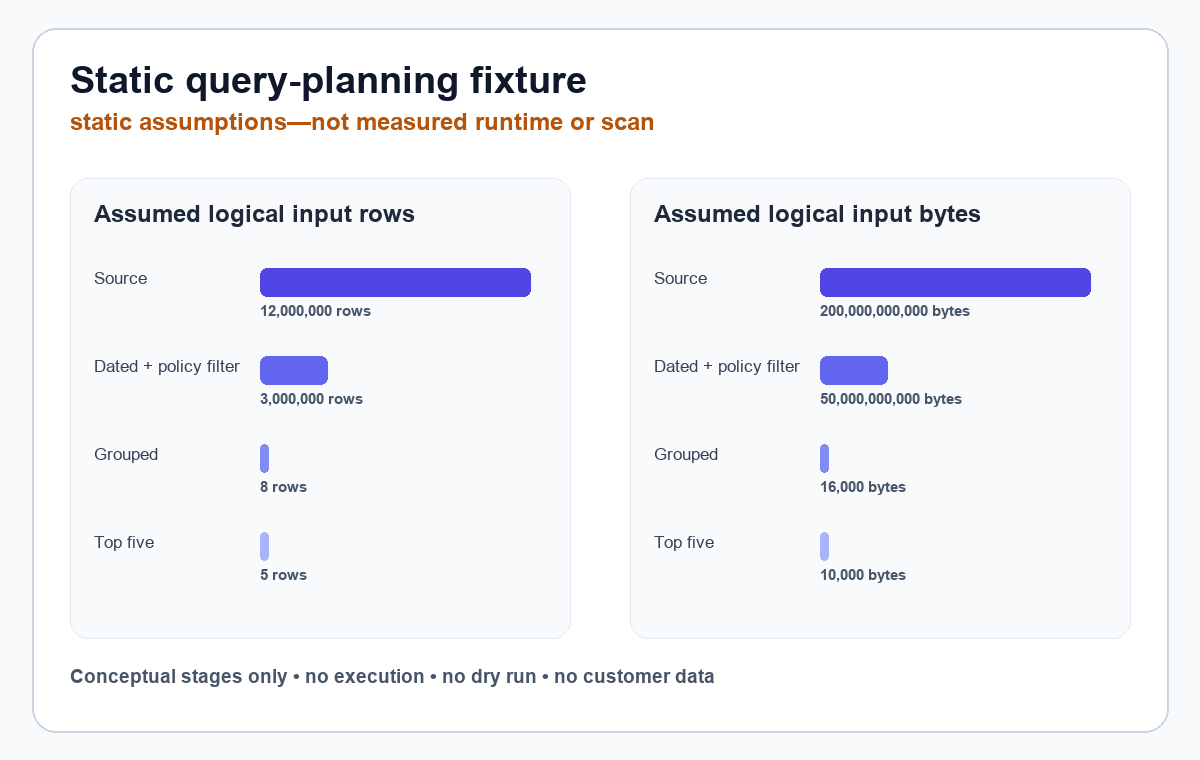
Figure. Static assumptions—not measured runtime or scan. Separate panels use rows and bytes. No query was executed.
Downloads: assumption register · static input · SQL fixture · expected output · standard-library verifier · external-source check · independent reproduction protocol.
Worked size example: 200GB static fixture
The former standalone URL /en/blog/200gb-data-analysis now 301s here. What it uniquely held is a size-labeled static fixture, not a second how-to. The pack assumes 400 daily partitions, four files per partition, and 125,000,000 bytes per file, totaling 200,000,000,000 bytes. A half-open window 2026-06-01 inclusive to 2026-07-01 exclusive selects 30 of 400 partitions and 120 of 1,600 files — 15,000,000,000 assumed bounded partition bytes. Nothing in that arithmetic is an observed scan, engine plan, benchmark, or cost.
| Stage | Assumption | What it is not |
|---|---|---|
| Full manifest | 400 partitions, 1,600 files, 200 GB | An observed storage listing |
| Date window | 30 / 400 of the manifest | Engine partition pruning |
| Selected columns | 15 GB logical allocation across six fields | A measured physical-scan cut |
| SQL | Explicit columns, half-open dates, is_internal = FALSE, top-five contribution | EXPLAIN output or billed bytes |
Reproduce the controls locally with the noindex downloads (do not execute the SQL): partition manifest · column logical bytes · SQL fixture · assumption register · verifier · reproduction protocol.
The 12-million-row fixture above and this 200GB pack answer the same review question at two grains. Use the parent method on this page; do not treat either pack as proof that any engine processed that size.
Cost-evidence gate
The former standalone URL /en/blog/ai-big-data now 301s here. What it uniquely held is a no-run byte vocabulary, not a second how-to. Billing reconciliation still lives on cost of large analysis. This gate stops before any engine contact.
| Label | What it may mean | What this pack does not have |
|---|---|---|
| Assumed logical bytes | Authored allocations a reviewer can add | Engine statistics |
| Estimated bytes | A platform dry-run or EXPLAIN facility | Any remote call |
| Processed / scanned | Job statistics after a run | A job id |
| Billed bytes | Invoice rules (minimums, cache, reservations) | A rate or a cost |
The following numbers are an illustrative desk composite, not a scan. Run ID: AIBD-20260831. Source 200,000,000,000 logical bytes; bounded window 15,000,000,000; projected selected-column allocation 6,000,000,000. SQL names channel, revenue, variable_cost, order_date, and is_internal; window is order_date >= DATE '2026-06-01' AND order_date < DATE '2026-08-30'; policy is is_internal = FALSE; output is top five channels by SUM(revenue - variable_cost). None of those tokens is pruning, billed bytes, or a price.
Reproduce locally (do not execute the SQL): assumption register · SQL fixture · column logical bytes · expected control output · verifier.
Scorecard: when to stay put vs when to hire Spark
Score evidence readiness, not the adjective big data.
| Signal | Continue static review | Escalate to platform owner |
|---|---|---|
| Semantics | Columns, dates, metric, and rank are explicit | Definitions or grain remain disputed |
| Plan evidence | Not yet claimed | Need engine-native EXPLAIN or estimate |
| Execution approval | No execution intended | Permissions, budget, or change control needed |
| Operational need | One review artifact | Recurring pipeline or downstream contract |
The big data fixture can establish internal consistency. It cannot decide between Spark, a warehouse, a lakehouse, or another engine. That decision requires workload evidence and accountable owners.
Failure modes that look like “AI is slow”
Without a run, “slow” is unsupported. Use precise failure language.
Unbounded scans and missing predicates
Static review can detect a missing date condition, but it cannot say a scan was unbounded. Even with a predicate, big data pruning depends on physical design and optimizer behavior. Ask the engine for plan or estimate evidence.
Metric drift on a large grain
A syntactically plausible query can encode the wrong metric. Lock definitions, exclusions, timezone, currency treatment, and late-arriving records. The big data fixture uses simple arithmetic so a reviewer can distinguish semantic checks from engine claims.
Treating batch duration as an SLA
An estimate, demo, or unrelated job is not an SLA. Runtime requires an executed job; an SLA requires a defined service, measurement window, exclusions, and accountable commitment. This page supplies none. It also makes no claim based on 200 GB, 80 million rows, a second run, or production experience.
Cluster context remains available in Analyze Millions of Rows and Still Open the SQL, Long-Running Analysis Job: Progress, Cancel, Rerun, Desktop vs Browser for Large Data Analysis, When Large Data Still Needs a Warehouse, and Cost of Large Analysis: Quotas You Can See. Their titles describe topics, not verified capabilities on this page. The 200GB size fixture now lives in Worked size example: 200GB static fixture on this page.
Additional category links are What Is Big Data when You Still Need a Sample Plan, Cost-evidence gate, Big Data and AI without Standing Up Spark, Big Data and Machine Learning vs an Analysis Job, and Data Science and AI as a Shared Task Trail. Related guides cover Claude Code data analysis, analyzing a database without ETL, MCP for data analysis, AI for data analysis, exploratory data analysis, what a data agent is, and natural language to SQL. These are internal context, not independent validation.
Review the query boundary before execution
Use the static files to inspect assumptions, SQL, and expected controls before selecting any engine action. This check uses only sources you authorize.
Commercial association: You do not need the workspace to complete the educational diagnosis on this page.
Open InfiniSynapseHow this page is sourced. William Zhu is cofounder of InfiniSynapse (GitHub @allwefantasy); no personal LinkedIn is published. Reviewed internally by analytics engineering · data platform · LLM security · editor. Internal review is not independent external validation. Editorial standards · corrections · publishing principles · Contact zhuhl@infinisynapse.com. COI: InfiniSynapse sells an AI-native Data Agent; the banner is a commercial association. Fact-check scope: fixture consistency and source boundaries only.
Independent Validation
An independent validator should be unaffiliated with InfiniSynapse and should reproduce the static checks from downloaded files. For engine claims, that validator must also choose an engine, document authorization, run its native planning or estimate feature, and retain raw evidence. If execution is approved, observed fields must come from the job record rather than this fixture.
The provided protocol separates static reproduction from optional engine work. Passing the verifier means the local controls agree; it does not validate optimizer behavior, performance, cost, security, big data capacity, or any vendor feature.
Sources and Limited Claims
The bounded technical sources above support only their documented topics: BigQuery plan interpretation, BigQuery dry runs and cost controls, public dataset context, AWS operational and quota guidance, Google SRE pipeline practices, Spark EXPLAIN syntax, and Parquet page indexes. Each newly added source is marked “retrieved 2026-09-04” and recorded with dateAccessed in schema.
The retained Stanford, AWS welcome, generic BigQuery, Google SRE TOC, Wikipedia, Databricks, Athena, and Glue URLs supply category context only. No source reviewed this page, reproduced its fixture, endorsed InfiniSynapse, or granted an award, credential, certification, or third-party audit.
How to Cite
Cite this page as: Zhu, William, and InfiniSynapse Data Team. “Big Data Analysis: Verify SQL Before You Run.” InfiniSynapse, verified August 31, 2026. Include the canonical URL and access date. Describe the downloadable material as a “static query-planning fixture with assumed inputs and expected control results.”
Do not cite it as a production run, customer result, benchmark, engine plan, dry run, measured scan, cost study, performance test, SLA, endorsement, or third-party audit. The internal reviewers listed above are not independent external validators.
Frequently Asked Questions
Does analyzing large datasets with AI replace a Spark team?
Bottom line: No. This fixture only supports SQL review. Platform selection requires workload requirements, big data evidence, and operational ownership; it cannot establish a big data replacement claim.
Are 200 GB, 12 million rows, or 80 million CRM rows an SLA?
Bottom line: No. The big data fixture assumes 12,000,000 rows and 200,000,000,000 logical bytes for planning only. It does not use an 80-million-row input, and none of these numbers establishes runtime, capacity, cost, or an SLA.
When do I still need a warehouse or lakehouse job?
Bottom line: When you need engine-native planning, estimates, observed outputs, or a recurring data product. Static review comes first; approved big data work supplies the evidence this page deliberately leaves blank.
Can I upload a huge file instead of connecting a warehouse?
Bottom line: File size alone is not a method. Use an authorized engine and inspect format, partitioning, statistics, permissions, and reader behavior before deciding how to analyze big data files.
How do I audit a long-running analysis job?
Bottom line: This page has no job to audit. For a real job, preserve the submitted SQL, engine plan, permissions, timestamps, status transitions, observed metrics, outputs, and billing evidence under your platform’s controls.
Conclusion
Reliable big data work begins by naming what is known. Here, the SQL text, assumptions, and expected controls are known; execution, plans, scans, runtime, cost, and actual outputs are not. Review the fixture, reproduce its arithmetic, then obtain engine-native evidence under explicit authorization. That sequence keeps a useful planning artifact from becoming a fabricated performance story. The educational materials stand alone; the optional InfiniSynapse application is not required.