What Is Big Data? Assess Workload, Evidence, and Scale
By William Zhu & the InfiniSynapse Data Team · Published: 2026-08-22 · Last updated: 2026-08-31 · Last verified: 2026-08-31 · Next review: 2026-11-30 · Editorial standards · Corrections
Table of Contents
- TL;DR
- Key definition
- Evidence boundary for what is big data
- Eleven criteria for answering what is big data
- Two static qualitative profiles for what is big data
- Practical static replay of what is big data
- Sampling and measured evidence
- Architecture assessment without a binary rule
- Independent validation of what is big data
- Sources and limited claims
- How to cite this record
- Frequently asked questions
- Conclusion
TL;DR
What is big data? It is a context-dependent workload characterized across scale, rate, heterogeneity, quality, purpose, compute, movement, latency, controls, and evidence. There is no universal byte threshold or row threshold. Size alone is not proof of big data and is not an engine or tool recommendation.
This page publishes a standards-grounded static record—not an engine run, customer result, benchmark, cost observation, or third-party audit. Its two synthetic profiles remain not_validated; both conclude requires_workload_specific_scale_assessment. Neither profile is classified as big data, and neither recommends an engine.
Key definition
Key definition: What is big data is answered operationally by documenting the workload dimensions that can exceed the capacity, timeliness, reliability, or governance envelope of the available approach. The answer depends on the decision, boundaries, controls, and reproducible evidence—not one number.
ISO/IEC 20546:2019 provides big-data concepts and terminology. NIST's Big Data Interoperability Framework adds definitions, documented use cases, and a reference architecture model. Together they support multidimensional characterization; they do not create a universal cutoff or certify this page's profiles.
The question what is big data therefore comes before architecture selection. Define the inputs, arrivals, decision, constraints, and reproducible observations. Only then can a team test whether its current approach meets the workload.
Evidence boundary for what is big data
This what is big data publication contains a static fixture assembled for transparent review. No source, query, engine, task, benchmark, or product workflow was used. The qualitative values are requirements and hypotheses, not observations.
The what is big data record does not report measured data size, row count, arrival rate, throughput, elapsed time, memory, storage, transfer volume, latency, concurrency, cost, or user outcome. It does not establish representativeness, production performance, scalability, or validation. Internal editorial and technical reviewers can check consistency, but internal reviewers are not independent validators.
That boundary matters whenever someone asks what is big data. Labels can hide missing units, populations, data movement, and operational constraints. The downloadable assumption register keeps those gaps visible.
Eleven criteria for answering what is big data
A defensible what is big data assessment records all eleven criteria below. Each criterion needs measured fields, units, scope, time window, instrumentation or provenance, and uncertainty before a conclusion is warranted.
| Criterion | What must be measured before a conclusion | Example units or evidence |
|---|---|---|
| Volume | Logical and physical size by source, partition, and retained period | bytes, records, files, partitions, retention period |
| Velocity | Arrival, change, ingestion, and processing rates over stated windows | records/second, bytes/hour, events/day, burst percentile |
| Variety | Formats, schemas, semantic domains, and source interfaces | format count, schema count, source count, change log |
| Variability | Seasonality, bursts, skew, schema drift, and distribution changes | percentile ratios, drift statistic, change frequency |
| Veracity/data quality | Completeness, validity, duplicates, lineage, and error handling | null rate, error rate, duplicate rate, lineage coverage |
| Value/decision purpose | Named decision, user, deadline, loss function, and acceptance rule | decision cadence, utility measure, error tolerance |
| Compute/storage/memory | Resource demand and limits for the specified operation | CPU time, accelerator time, memory bytes, storage I/O |
| Data movement | Boundaries crossed, transfer paths, serialization, and locality | bytes transferred, hops, egress region, transfer rate |
| Latency/concurrency | End-to-end deadline, queueing, freshness, and simultaneous demand | milliseconds, freshness age, concurrent jobs/users |
| Governance/privacy | Classification, lawful purpose, access controls, retention, residency | policy IDs, regions, retention period, audit coverage |
| Reproducibility/evidence | Immutable inputs, configuration, software, logs, and acceptance checks | hashes, version IDs, run IDs, test results, reviewer identity |
Volume may dominate one workload while velocity, state, latency, data movement, or governance dominates another. That is why what is big data cannot be reduced to size. The units above are examples of fields to collect, not implied measurements.
Two static qualitative profiles for what is big data
The what is big data fixture contains exactly two synthetic qualitative profiles. They are contrasting requirements, not observed systems.
bounded_columnar_analytical_workload
This profile describes bounded analytical inputs, columnar organization as a requirement, scheduled change, multiple governed sources, variable distributions, explicit quality checks, a defined analytical decision, resource planning, locality constraints, batch-oriented latency expectations, controlled data use, and a reproducible evidence pack. Every value is qualitative. Its decision status is not_validated, and its outcome is requires_workload_specific_scale_assessment.
recurring_multi_source_stateful_workload
This profile describes recurring arrivals, heterogeneous sources, stateful processing requirements, burst and drift concerns, continuous quality controls, an operational decision purpose, sustained resource planning, cross-boundary movement concerns, freshness and concurrency requirements, heightened privacy controls, and replayable evidence requirements. Every value is qualitative. Its decision status is not_validated, and its outcome is requires_workload_specific_scale_assessment.
Neither profile answers what is big data by itself. Neither profile is classified as big data. Neither profile recommends Spark, Parquet, BigQuery, a warehouse, a lake, a local process, or any other engine or tool. Parquet, Spark, and BigQuery documentation is cited only to identify implementation-specific evidence that a later assessment may need: file layout and metadata, distributed application components, and query-plan or execution statistics.
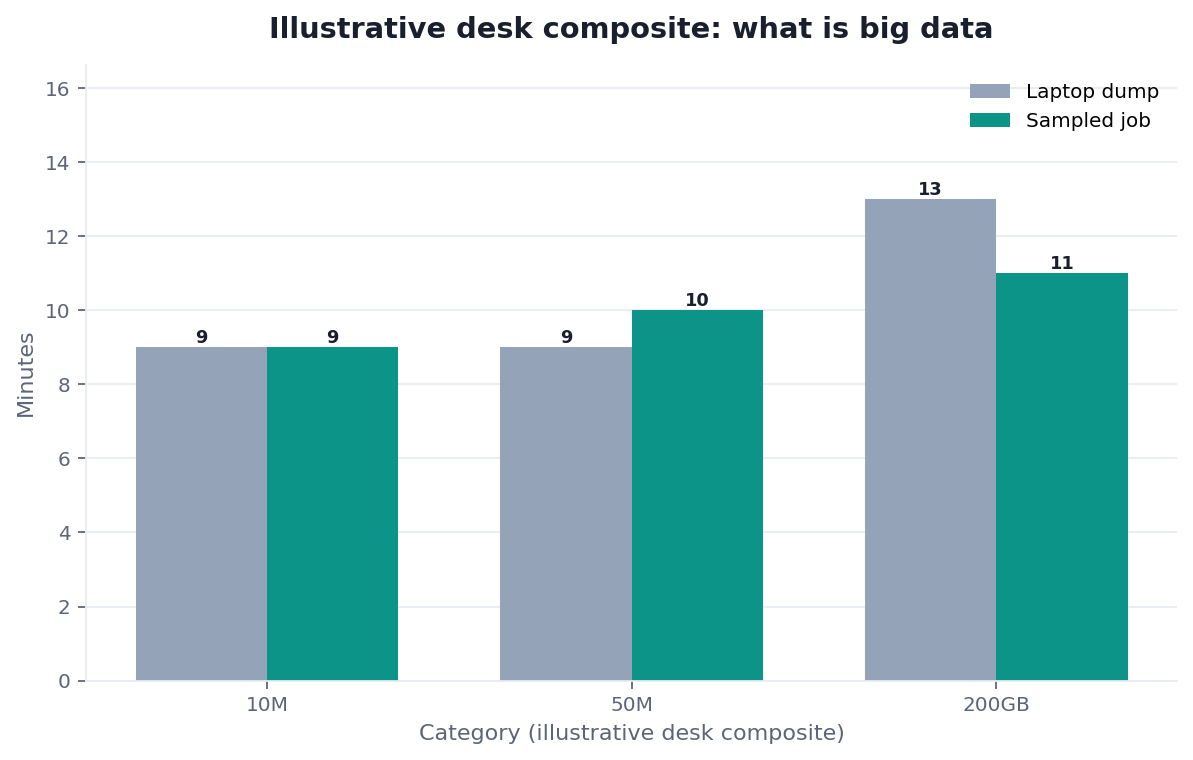
Figure. STATIC QUALITATIVE FIXTURE / NO DATA OR ENGINE RUN / NOT VALIDATED. The matrix visualizes requirements only; it contains no size, runtime, or cost values.
Practical static replay of what is big data
Review the six downloads in sequence:
- Open
workload-characterization-WIBD-20260831.csvand confirm exactly two profile identifiers, eleven qualitative criteria, one status, and one outcome per row. - Open
characterization-criteria-WIBD-20260831.csvand check that each criterion names the measured fields and units or evidence required before a conclusion. - Review
assumption-register-WIBD-20260831.csv. Treat every fixture value as a requirement or hypothesis. - Read
external-source-check-WIBD-20260831.mdfor source scope, retrieval dates, and claim limits. - Follow
independent-reproduction-protocol-WIBD-20260831.mdwith a party independent of InfiniSynapse. - Run
python3 verify-WIBD-20260831.pybeside the CSV and Markdown files. The standard-library verifier performs local structural and claim checks; it makes no network request.
This replay can establish that the static record is internally consistent. It cannot establish what is big data for a real workload. That requires workload-specific observations and a predefined acceptance rule.
Sampling and measured evidence
In a what is big data inquiry, sampling can support discovery: inspect schema, identify categories, draft quality rules, explore distributions, and test an instrumentation plan. But a sample does not prove representativeness unless its frame, design, coverage, nonresponse or exclusion mechanisms, weighting, uncertainty, and validation are justified.
Sampling also does not by itself prove reduced scan volume or reduced cost. Storage layout, predicate handling, engine planning, caching, materialization, pricing, and execution statistics all matter. A sample can still trigger broad reads, and a selective query can still move substantial data. Record actual plan and execution evidence for the system under assessment.
FAIR principles emphasize that digital research objects should be findable, accessible, interoperable, and reusable. FAIR does not certify correctness or scale, but it helps explain why provenance, identifiers, metadata, and reusable evidence belong in a what is big data assessment.
Architecture assessment without a binary rule
For what is big data, architecture follows measured constraints. Start with the decision and service boundary, then compare candidate approaches against the same evidence record:
- Can the approach meet measured volume and velocity under the stated retention and burst conditions?
- Can it represent the required formats, semantics, state, and data-quality controls?
- What compute, storage, memory, and data movement does the operation actually require?
- Can it meet measured latency, freshness, and concurrency targets with the required governance and privacy controls?
- Can an independent party reproduce the test from immutable inputs, configuration, versions, logs, and acceptance rules?
Apache Parquet defines a column-oriented file format; its overview is not proof that a profile should use it. Apache Spark's cluster overview describes application components; it is not proof that distributed processing is required. BigQuery's query-plan documentation explains plan and stage information; it is not proof of performance or cost for an unexecuted workload. No source supports a binary engine recommendation based on the adjective “big.” When you later shortlist engines, use the layer map in big data analytics tools—this page still will not pick one for you.
Characterization feeds the large-scale analysis hub; it does not replace the how-to map. Existing internal guides remain navigation context: analyze large datasets with AI, 200gb data analysis, analyze millions of rows, exploratory data analysis, data governance, what is a data agent, what is data management, long-running analysis job, cost of large analysis, and when large data needs a warehouse. They are not evidence for this fixture.
Independent validation of what is big data
To validate what is big data for a real workload, an independent evaluator should receive the measurement plan before observations are collected. The evaluator should confirm scope, units, instrumentation, source provenance, access constraints, retention, acceptance criteria, and candidate configurations. It should then reproduce measurements on authorized infrastructure and report uncertainty, exclusions, failed checks, and competing explanations.
The evaluator must be organizationally and technically independent of the people who authored the fixture and selected the architecture. InfiniSynapse employees, contractors, internal reviewers, and the page author do not count as independent validation. A third party may reproduce the record, but the result becomes a third-party audit only if that party accepts an audit mandate, applies an identified standard, documents procedures, controls conflicts, and signs the report.
The supplied protocol is deliberately non-executing with respect to a real workload. It describes what an independent party must replace, measure, and retain. Until that occurs, both profiles remain not_validated.
Sources and limited claims
Sources were retrieved on 2026-08-31:
- ISO/IEC 20546:2019, Information technology — Big data — Overview and vocabulary: terminology and concepts only.
- NIST SP 1500-1r2: definitions and taxonomies only.
- NIST SP 1500-3r1: Use Cases and General Requirements only.
- NIST SP 1500-6r1: Reference Architecture only.
- Apache Parquet overview: file-format characteristics only.
- Apache Spark cluster overview: component terminology only.
- BigQuery query-plan explanation: plan and execution-statistics fields only.
- The FAIR Guiding Principles: research-object stewardship principles only.
The preserved URL https://www.iso.org/standard/62631.html is an unrelated legacy context link and does not support this article. It is retained solely for historical URL continuity. The relevant ISO source is ISO/IEC 20546:2019 above.
Earlier contextual links are also retained without evidentiary weight: EMA human-regulatory pages, ICH, Natural Earth, NOAA Education, and the Stanford HAI AI Index. These sources did not validate either profile and do not support runtime, scale, architecture, or product claims.
How to cite this record
Suggested citation: Zhu, William, and InfiniSynapse Data Team. “What Is Big Data? Assess Workload, Evidence, and Scale.” InfiniSynapse, published 2026-08-22, updated and verified 2026-08-31. https://infinisynapse.com/en/blog/what-is-big-data.
Cite this page as a static workload-characterization method and fixture. Cite the direct standards and documentation for their limited claims. Do not describe this page as a benchmark, production case study, customer result, independent validation, certification, or third-party audit.
Authorship context: William Zhu is an InfiniSynapse cofounder (GitHub @allwefantasy); the InfiniSynapse organization maintains public code. Review links: analytics engineering, data platform, LLM security, and editorial. Those reviews are internal.
Company disclosure: InfiniSynapse publishes this educational page and offers commercial software. The fixture can be reviewed without using that software. See About, Privacy, Terms, editorial principles, conflict-of-interest policy, and corrections. Contact zhuhl@infinisynapse.com. The historical company About and InfiniSynapse app links are retained as context, not evidence.
Frequently Asked Questions
Is there a universal threshold for what is big data?
No. There is no universal byte or row threshold. A threshold may be defined for a specific decision, operation, environment, and acceptance rule, but it must not be generalized beyond that scope.
Does size prove what is big data?
No. Size alone does not prove the label and does not recommend an engine. Velocity, variety, variability, quality, value, resources, movement, latency, governance, and evidence can be equally decisive.
Can sampling validate what is big data?
Not by itself. Sampling can aid discovery, but representativeness requires a justified design and evidence. Sampling also does not itself prove reduced scanning or cost.
Do the two profiles recommend an architecture?
No. Both synthetic profiles are qualitative, not_validated, and require workload-specific scale assessment. They provide requirements to measure, not observed performance or a tool selection.
Is this a third-party audit?
No. It is an internally published static record. The independent reproduction protocol specifies a future validation path; no independent party has audited or validated these profiles.
Conclusion
The responsible answer to what is big data is a measured workload characterization, not a universal cutoff. Document all eleven criteria, define units and acceptance rules, preserve provenance, and test candidate approaches against the same workload-specific evidence.
For this page, the evidence stops at a static qualitative fixture. The two profiles are not classified, no engine is recommended, and both remain not_validated with the outcome requires_workload_specific_scale_assessment. That boundary is the result—not a missing benchmark.