When Large Data Needs a Warehouse: Decision Record
By William Zhu & the InfiniSynapse Data Team · Published: 2026-08-22 · Last updated: 2026-08-31 · Last verified: 2026-08-31 · Next review: 2026-11-30 · Editorial standards · Corrections
Table of Contents
- Direct answer
- Key definition
- Evidence boundary
- Three synthetic profiles
- Thirteen decision criteria
- Candidate architecture families
- Practical static replay
- Independent validation
- Sources and limited claims
- How to cite this record
- Frequently asked questions
- Conclusion
Direct answer {#tl-dr}
Decision boundary: Deciding when large data needs a warehouse requires evidence about the authorized workload and its operating obligations. Recurrence and shared definitions are governance signals, not automatic warehouse winners. This static record classifies three synthetic profiles, applies thirteen criteria, and leaves every recommendation provisional and not validated.
No row count, byte threshold, or repetition rule can select an architecture by itself. A governed file workflow may satisfy a sanctioned one-off. A warehouse, lakehouse, or query service may suit recurring shared analytics. A stateful operational pipeline may need distributed processing. Each is a hypothesis, not a benchmark result.
The downloadable architecture decision record, synthetic profiles, and assumption register make the classification inspectable. They contain no workload execution or vendor winner.
Key definition {#key-definition}
When large data needs a warehouse means the point at which authorized representative evidence shows that a warehouse-family service is an appropriate way to meet stated analytical, governance, security, reliability, and operating requirements. It does not mean that “large,” repeated, or shared data inherently belongs in one architecture.
The phrase is useful only after the decision unit is explicit. The unit is not a vague dataset. It is a workload with consumers, cadence, source-of-record responsibilities, updates, consistency expectations, semantics, isolation, security, lineage, recovery, movement constraints, economics, and an accountable team.
Repetition can raise the value of automation. Shared definitions can raise the value of semantic governance. Neither fact proves when large data needs a warehouse. Files can be catalogued, access-controlled, versioned, encrypted, retained, and queried through governed procedures. Warehouses can also be poorly governed. Architecture names do not establish controls.
Evidence Boundary
This page is a static architecture decision exercise dated 2026-08-31. The profiles are synthetic descriptions, not customers, deployments, production observations, or measured experiments. Their validation_status is not_validated; their decision_status is provisional. No source was connected and no workload was run.
Accordingly, this record makes no claim about measured rows, bytes, runtime, scan volume, transfer duration, concurrency capacity, price, savings, customer outcome, or product behavior. It does not infer that a full scan occurred or that copying has a known cost. It does not report query execution, plans, slots, task controls, downloadable product artifacts, or operational experience.
Direct sources explain concepts or evidence surfaces. They do not validate this page's recommendations. NIST provides reference architecture and big-data interoperability context. BigQuery, Snowflake, and Redshift documentation describes selected service concepts and job or history interfaces. Parquet, Iceberg, and DuckDB documentation describes file-format, table-format, and query capabilities. None establishes when large data needs a warehouse for an organization.
Earlier references to Jaeger, GitLab, Google Analytics, the NIST AI Risk Management Framework, and the AWS Machine Learning Lens are retained as historical context only. They are not evidence for an architecture selection here.
Three synthetic profiles
The profiles hold different shapes constant enough to discuss method, but intentionally omit measurements. They frame when large data needs a warehouse, not which platform to buy.
Profile 1: one_off_sanctioned_columnar_extract
- Provisional recommendation:
evaluate_governed_file_workflow - Validation status:
not_validated - Decision status:
provisional - Qualitative description: a bounded analytical question over an authorized columnar extract, with named ownership and an explicit disposal or retention rule.
For when large data needs a warehouse, this profile keeps a governed file workflow in scope. Parquet defines a column-oriented format, and DuckDB documents querying Parquet. Those capabilities do not prove fitness, but prevent the false premise that every governed analytical question requires a warehouse. Validation needs access controls, integrity checks, reproducible logic, lineage, review, and an operating owner.
Profile 2: recurring_shared_governed_analytics
- Provisional recommendation:
evaluate_warehouse_lakehouse_query_service - Validation status:
not_validated - Decision status:
provisional - Qualitative description: recurring analysis shared by multiple consumers under common semantics, security boundaries, retention, and service expectations.
This profile asks when large data needs a warehouse most directly, yet has no winner. Warehouse services can provide managed analytical execution and governance surfaces. A lakehouse can combine a table format such as Iceberg with query engines. A query service may operate over managed tables or object storage. Labels overlap, so when large data needs a warehouse must be evaluated through concrete responsibilities rather than marketing categories.
Profile 3: recurring_stateful_operational_pipeline
- Provisional recommendation:
evaluate_pipeline_distributed_processing - Validation status:
not_validated - Decision status:
provisional - Qualitative description: recurring stateful processing that produces operational outputs, requires recovery semantics, and has downstream service obligations.
This profile separates pipeline work from shared analytical serving. A warehouse could participate as a source or sink, but state, checkpointing, replay, delivery, and recovery may require a pipeline or distributed-processing design. That operating question remains distinct from when large data needs a warehouse.
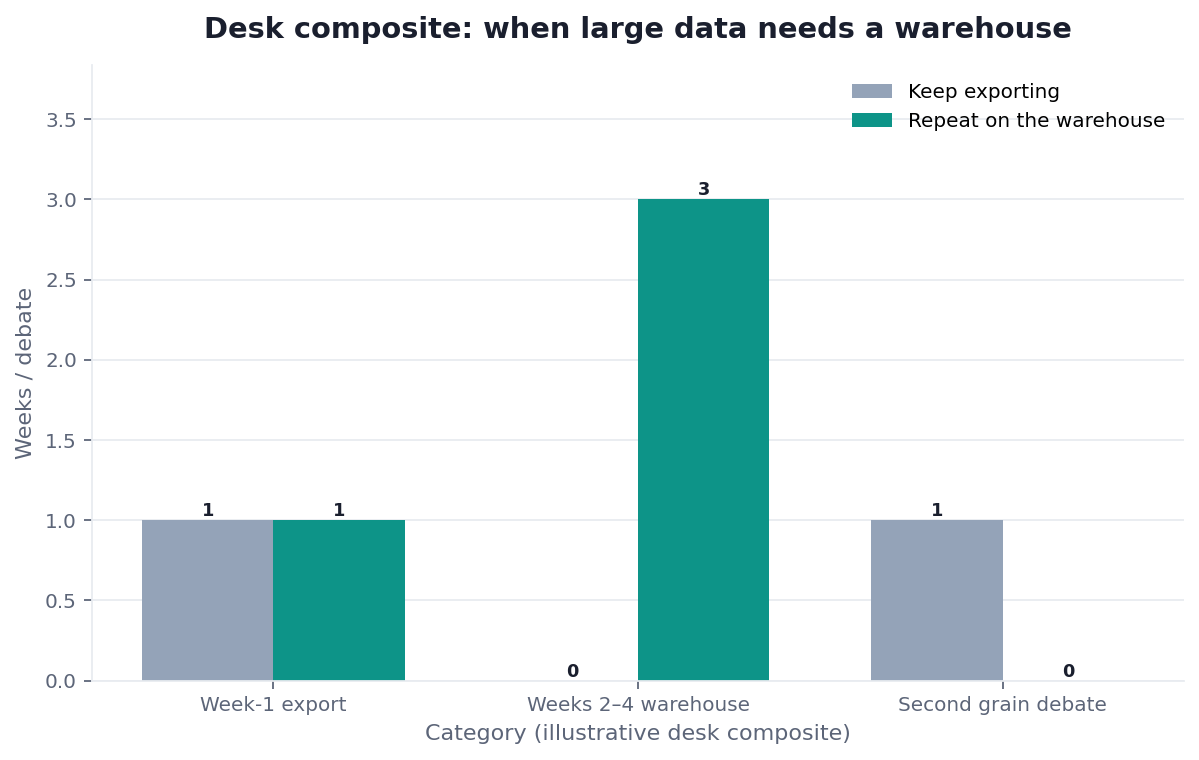
Figure: static architecture record only. Three synthetic profiles × thirteen qualitative criteria. STATIC / NO WORKLOAD RUN / PROVISIONAL / NOT VALIDATED. No quantitative result and no winner.
Thirteen decision criteria
Use all thirteen criteria when recording when large data needs a warehouse. “Unknown” is acceptable in the static replay; it becomes a validation task rather than an invented fact.
- Recurrence and cadence. Record whether the work is one-off, periodic, event-driven, or continuously updated. Cadence affects automation and freshness obligations, but recurrence alone does not select a warehouse.
- Consumers and concurrency. Name human and machine consumers, access patterns, simultaneous demand, and fairness expectations. For when large data needs a warehouse, shared use is a requirement to govern and test, not proof of one engine family.
- Source of record. Identify who owns authoritative inputs and outputs, how corrections propagate, and whether a derived store becomes authoritative for any purpose.
- Ingestion and update. Describe batch, incremental, append, mutation, deletion, late-arriving, and backfill behavior. This evidence constrains when large data needs a warehouse because a static extract and changing table require different controls.
- Transactional consistency. State the atomicity, isolation, snapshot, and cross-table consistency needed by the workload. Avoid assuming that an architecture label supplies the required semantics.
- Semantic governance. Name definitions, owners, versioning, approval, and change communication. Shared definitions signal governance work; they do not independently answer when large data needs a warehouse.
- Query and workload isolation. Describe workload classes, interference risks, prioritization, admission, and evidence needed to test isolation. Vendor histories are possible evidence surfaces, not universal guarantees.
- Security and residency. Record identities, authorization boundaries, encryption, network controls, geographic restrictions, sensitive fields, and approved locations. These constraints can decide when large data needs a warehouse or remove a candidate.
- Lineage and retention. Define provenance, transformation traceability, legal holds, deletion, retention periods, and the evidence required to show each control works.
- Observability, recovery, and SLO. Specify health signals, failure detection, replay or restore expectations, recovery ownership, objectives, and incident procedures. These obligations materially shape when large data needs a warehouse.
- Data movement. Map allowed and prohibited movement between sources, compute, stores, consumers, and regions. Measure representative paths later; do not assume movement is free or inherently harmful.
- Cost model. Identify charge dimensions, fixed and variable components, commitments, storage, compute, transfer, operations, and uncertainty. Compare authorized evidence when judging when large data needs a warehouse, not generic price claims.
- Team capability. Record who can build, secure, operate, review, and recover each candidate. Include on-call ownership, skills, procurement constraints, and the cost of maintaining controls.
The criteria interact. Strict recovery requirements can change the team and cost assessment. Residency can limit movement and candidate services. Consistency can alter ingestion design. A defensible decision makes those dependencies visible instead of reducing when large data needs a warehouse to a single threshold.
Candidate architecture families
Governed file workflow
A file workflow can be appropriate when files are sanctioned, versioned as required, access-controlled, documented, retained, and reproducibly queried. In when large data needs a warehouse, Parquet supplies a columnar representation, not governance; DuckDB supplies query features, not organizational authorization. File workflows can satisfy some requirements and fail others.
Warehouse, lakehouse, or query service
A warehouse commonly couples managed storage, analytical execution, and governance features. A lakehouse commonly applies table-management semantics over object storage while allowing engines to remain more separable. A query service may execute over external files, managed tables, or both. Actual products blur these distinctions. BigQuery, Snowflake, and Redshift documents illustrate service architectures and evidence interfaces, while Iceberg specifies a table format. They do not create a universal answer for when large data needs a warehouse.
Pipeline and distributed processing
A pipeline or distributed-processing system centers transformation, state, orchestration, delivery, and recovery. It may use files, warehouse tables, lakehouse tables, streams, or operational stores. For when large data needs a warehouse, it is not merely a larger query; operational output is not ad hoc analytics because SQL appears in one stage.
Each family can satisfy some requirements with suitable controls and operation. Each can also fail. Warehouses are not universally best; governed files are not universally simple; lakehouses and query services are not interchangeable; distributed pipelines solve a distinct operating problem.
Practical Static Replay
The replay is intentionally executable without a network or data system. It shows how to reason about when large data needs a warehouse without pretending to validate an architecture.
- Download the six artifacts listed below into one directory.
- Inspect the three profile rows and confirm the profile identifiers, allowed provisional recommendations, and qualitative fields.
- Inspect the assumption register for when large data needs a warehouse. Replace unknowns only with authorized evidence; do not edit the synthetic package to imply validation.
- Walk all thirteen criteria for each candidate family. Record what evidence would accept or reject a candidate.
- Read the external-source check to separate documented capabilities from local claims.
- Run
python3 verify-WLDW-20260831.py. The verifier uses only the Python standard library and performs no network request. - Create a new, locally governed decision record for the representative workload. Preserve the static original as a method reference.
Downloads: decision record · profiles CSV · assumption register · source check · independent protocol · offline verifier.
Independent Validation
Internal reviewers can check consistency, editorial quality, security framing, and whether the static files match this article. They are not independent validators. Independence requires a qualified reviewer outside the team that prepared or selected the recommendation, with access to the authorized evidence and freedom to reject the record.
A final decision about when large data needs a warehouse needs an authorized representative workload and predeclared acceptance criteria. At minimum, collect:
- correctness results against trusted expected outcomes and edge cases;
- actual execution plans or equivalent engine evidence for representative operations;
- observed concurrency and workload-isolation behavior under authorized test conditions;
- recovery, replay, restore, and failure-handling evidence;
- comparable cost records covering service charges and operating effort;
- security, residency, authorization, lineage, and retention control evidence;
- operational ownership, observability, escalation, and service-level evidence.
Validation of when large data needs a warehouse should identify provenance, environment, software versions, test window, exclusions, stopping rules, and reviewer. Report failures and uncertainty. Without evidence, retain provisional and not_validated; do not substitute confidence language.
This method also requires decision owners to document explicitly rejected alternatives, unresolved dependencies, evidence freshness, implementation reversibility, migration sequencing, exit criteria, and the authority that approves any change from provisional to final status.
Use the independent reproduction protocol as a starting checklist. It is not itself an audit or certification.
Sources and Limited Claims
All direct sources below were retrieved 2026-09-04. Source inclusion means only that the linked publisher documents the cited concept or interface.
- NIST Cloud Computing Reference Architecture: a reference architecture for cloud roles and relationships.
- NIST Big Data Interoperability Framework: Reference Architecture: a vendor-neutral big-data reference architecture.
- BigQuery introduction: Google documentation for BigQuery concepts.
- BigQuery query plan explanation: a documented plan-inspection surface.
- BigQuery Jobs API: a documented jobs resource.
- Snowflake key concepts: Snowflake architecture concepts.
- Snowflake QUERY_HISTORY: a documented account-usage view.
- Amazon Redshift system architecture: Redshift architecture concepts.
- Amazon Redshift STL_QUERY: a documented query-log relation with stated scope.
- Apache Parquet overview: a column-oriented file-format overview.
- Apache Iceberg specification: a table-format specification.
- DuckDB Parquet overview: documented Parquet read and write features.
These sources do not compare the three profiles, test controls, establish performance, validate recommendations, or determine when large data needs a warehouse. Vendor interfaces differ in scope, retention, naming, availability, and semantics; terms such as query history or plan must not be generalized beyond the cited documentation.
If the goal is to analyze large datasets without uploading the file, this record only decides whether a warehouse is the host. Related internal reading is context, not evidence: analyze large datasets with AI, data governance, semantic layer, and when you still need a warehouse. The last page addresses adjacent no-migration and materialization scope; it does not validate this decision record.
How to Cite This Record
Suggested citation: Zhu, William, and InfiniSynapse Data Team. “When Large Data Needs a Warehouse: Decision Record.” InfiniSynapse, published 2026-08-22, updated and verified 2026-08-31, canonical URL above. Cite the retrieval date and the artifact filename when relying on a downloadable file.
Describe it as a static, vendor-neutral method with three synthetic profiles and provisional recommendations. Do not cite it as a benchmark, customer case study, production test, independent review, third-party audit, certification, or proof of when large data needs a warehouse. The authors and internal reviewers are responsible for the page; they are not independent auditors.
How this page is sourced. William Zhu is cofounder of InfiniSynapse (GitHub @allwefantasy); no personal LinkedIn is published. The InfiniSynapse Data Team prepared the static record. Internal analytics engineering, data platform, LLM security, and editorial reviewers checked the package but are not independent validators. Editorial standards · corrections · publishing principles · About · Privacy · Terms · Contact zhuhl@infinisynapse.com. COI: InfiniSynapse publishes this educational material and sells data software; no product capability is evaluated here.
Frequently Asked Questions
Does repetition prove when large data needs a warehouse?
No. Repetition indicates cadence and may justify automation, but candidate selection still depends on the thirteen criteria and representative evidence.
Do shared definitions require a warehouse?
No. For when large data needs a warehouse, shared definitions require ownership, versioning, access, and change governance. Multiple architecture families may implement those controls.
Can a governed file workflow remain a candidate?
Yes. In when large data needs a warehouse, the one-off profile provisionally evaluates a governed file workflow. Authorization, lineage, integrity, retention, reproducibility, and operations still require validation.
Is a lakehouse the same as a warehouse or query service?
No. The categories overlap in products but describe different separations of storage, table management, and execution. Evaluate concrete semantics and operating responsibilities.
What turns this provisional record into a final decision?
Authorized representative evidence for correctness, plans, concurrency, recovery, costs, security, and operations, reviewed against predeclared acceptance criteria by accountable stakeholders.
Conclusion
The responsible answer to when large data needs a warehouse is a decision process, not a slogan. Start with the workload boundary, compare viable families across all thirteen criteria, and preserve unknowns. The three synthetic profiles illustrate classifications only: governed file workflow, warehouse/lakehouse/query-service evaluation, and pipeline/distributed-processing evaluation.
No profile is a winner. Keep every status provisional and not validated until authorized representative evidence supports a final record. That evidence—not size, recurrence, sharing, or a vendor feature list—determines when large data needs a warehouse.