Analyze Millions of Rows: Verify Every SQL Step
By William Zhu & the InfiniSynapse Data Team · Published: 2026-08-22 · Last updated: 2026-08-31 · Last verified: 2026-08-31 · Next review: 2026-11-30 · Editorial standards · Corrections
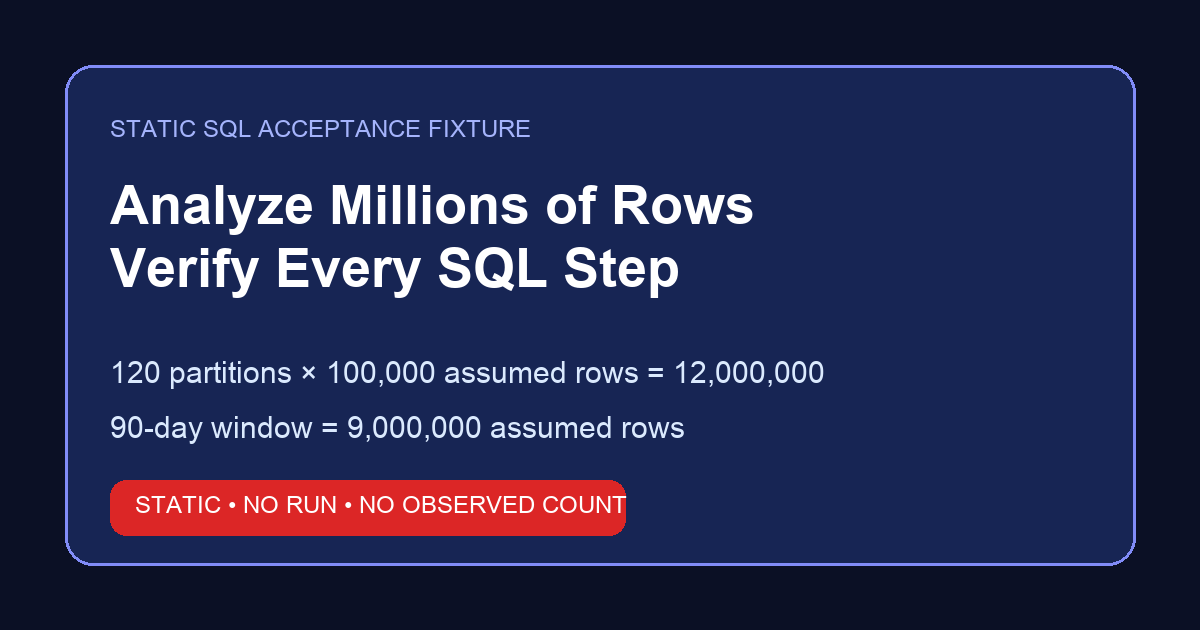
Table of Contents
- TL;DR
- Key definition
- Evidence boundary
- Fixture and acceptance math
- Four SQL controls
- Practical static replay
- Plans, estimates, and execution
- Independent validation
- Downloads
- Sources and limited claims
- Frequently asked questions
- Conclusion
TL;DR
Direct answer: To analyze millions of rows without overstating evidence, start with an authored fixture, not an execution story. This package defines 120 contiguous daily partitions from 2026-05-04 through 2026-08-31, each assigned 100,000 assumed rows. The full fixture therefore expects 12,000,000 rows. A fixed half-open window,
2026-06-03 <= event_date < 2026-09-01, contains exactly 90 partitions and expects 9,000,000 rows. Nothing here was queried from a warehouse.
The downloadable SQL is deliberately marked DO NOT EXECUTE. It contains four controls: a full count, a bounded count with minimum and maximum dates, a grouped reconciliation, and deterministic top-five logic. The Python verifier reads local static files, performs no SQL and no network access, and checks the arithmetic, date continuity, expected controls, held fields, and source-limit declarations.
This is a preflight package for people who need to analyze millions of rows responsibly. It does not report an actual count, query plan, metadata estimate, runtime, bytes processed, output from an engine, role test, second run, warehouse connection, or product behavior.
Key definition
Key Definition: In this guide, analyze millions of rows means verify that SQL text and independently reproducible fixture arithmetic agree before any engine run. It does not mean that this page observed millions of records or proved that an engine scanned them.
The distinction matters. SQL text can show intended table names, boundaries, grouping, and tie breakers. It cannot prove which snapshot an engine saw, whether a connector worked, whether permissions were correct, or how many rows execution processed. When teams say they can analyze millions of rows, the evidence must state whether the number is assumed, estimated, reported by metadata, planned, or actually observed.
The fixture here uses only authored assumptions. No value was copied from table metadata, a customer dataset, a CRM export, a query result, or an InfiniSynapse task. Twelve million is arithmetic: 120 × 100,000. Nine million is arithmetic: 90 × 100,000. An 80-million-row case may be a hypothetical planning context, but it is not evidence on this page.
Evidence boundary
Before you analyze millions of rows, separate acceptance evidence into four states:
| State | What it can support | Status here |
|---|---|---|
| Authored assumption | Reproducible arithmetic and expected SQL shape | Present |
| Metadata or planner estimate | A platform-reported approximation, potentially stale or model-dependent | Held / not observed |
| Execution observation | Actual rows, bytes, runtime, output, plan profile, or side effects | Held / false |
| Independent reproduction | A person outside the authoring team runs the local verifier and records the result | Protocol supplied; not yet claimed |
Internal editorial, analytics-engineering, data-platform, or security review improves clarity but is not independent validation. The author and company cannot upgrade a self-authored fixture into third-party assurance by reviewing it themselves. To analyze millions of rows with an audit trail, preserve that boundary in every summary.
The held-observation register explicitly sets observed=false for actual count, engine plan, metadata estimate, runtime, bytes, engine output, role test, second run, warehouse connection, and product behavior. Those fields must remain false until someone collects corresponding evidence under a separately documented run protocol. A team preparing to analyze millions of rows should assign an evidence state before interpreting any number.
Fixture and acceptance math
The partition manifest is the primary static evidence. It lists every date from 2026-05-04 through 2026-08-31, inclusive. Each row states assumed_rows=100000 and labels the value as authored. Because the dates are contiguous, the manifest has 120 partitions. Summing its assumed rows gives 12,000,000. Anyone using this manifest to analyze millions of rows can recalculate that total instead of inheriting an unexplained headline number.
The bounded acceptance window is half-open: start inclusive at 2026-06-03 and end exclusive at 2026-09-01. It includes June 3–30, all of July, and all of August: 28 + 31 + 31 = 90 daily partitions. At the authored rate, the expected bounded count is 9,000,000. A half-open boundary avoids ambiguity around midnight and makes adjacent windows composable when you later analyze millions of rows in an actual system.
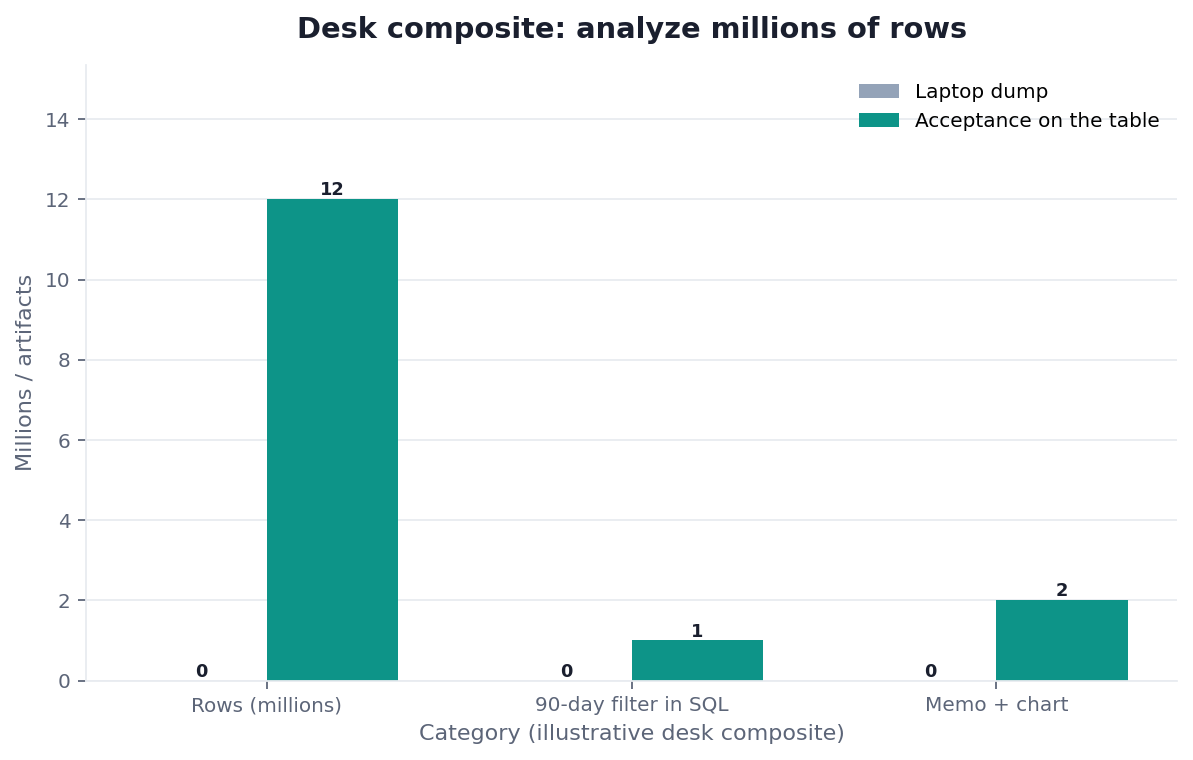
Figure. Authored static fixture only. Left: 120 full partitions versus 90 bounded partitions. Right: 12.0 million assumed full rows versus 9.0 million assumed bounded rows. No query ran; no observed count, runtime, bytes, or platform result is shown.
The manifest is intentionally boring. That is useful: a reviewer can inspect every date rather than trusting a chart. If a date is duplicated, omitted, reordered, or assigned a different count, the verifier fails. This offers a narrow, testable foundation before anyone attempts to analyze millions of rows on paid or sensitive infrastructure.
Four SQL controls
All four statements live in one file with a leading DO NOT EXECUTE warning. They use portable-looking SQL for review, but no cross-platform execution guarantee is claimed.
1. Full-table count
The first control selects COUNT(*) from a placeholder relation. Its expected value is 12,000,000 only because the fixture assumes 120 partitions of 100,000 rows. A matching SQL result would be execution evidence; this package does not contain one. This distinction prevents a plan to analyze millions of rows from becoming a false report of execution. For teams that analyze millions of rows, the control leaves actual count explicitly unobserved.
2. Bounded count and dates
The second control applies the fixed half-open 90-day predicate and requests COUNT(*), MIN(event_date), and MAX(event_date). Under the fixture assumptions, expected values are 9,000,000, 2026-06-03, and 2026-08-31. The minimum and maximum checks make an off-by-one boundary easier to detect, but SQL text alone still does not prove the source contains those dates. Before teams analyze millions of rows, these bounds should be reviewed independently of any count result.
3. Grouped reconciliation
The third control groups by channel and includes row count plus a share calculation. Expected grouped values come from a separate tiny synthetic CSV, not from the 12-million-row manifest. The tiny input has ten static records across five channels. Its expected grouped counts sum to ten. The SQL file also shows a reconciliation CTE so a future execution can compare grouped totals with the bounded total. Until that happens, the 9,000,000 reconciliation is only an expected invariant. This lets reviewers analyze millions of rows as an acceptance design without pretending the grouped totals came from an engine.
Keeping synthetic control rows separate prevents readers from mistaking ten examples for a sample of customer records. The records are authored solely to test parsing, grouping, tie handling, and expected-output logic before they analyze millions of rows elsewhere.
4. Deterministic top five
The fourth control aggregates the tiny static input and orders by score DESC, channel ASC, then applies LIMIT 5. The alphabetical secondary key makes ties deterministic. The expected sequence is Enterprise, Partner, Direct, Organic, Paid. Determinism matters because otherwise two correct engines may return tied rows in different orders, making a static acceptance check noisy. Teams that analyze millions of rows need the same explicit tie rule when comparing future outputs.
Practical static replay
Use this sequence before authorizing any real run:
- Download all nine files into one directory.
- Read
assumption-register-AMR-20260831.csv; confirm every numeric claim is labeled authored. - Inspect the 120 manifest rows and the fixed half-open window.
- Open
four-sql-controls-AMR-20260831.sql; confirm the warning and all four named controls. - Inspect the tiny synthetic input and expected output.
- Confirm every execution-dependent field remains held and false.
- Run
python3 verify-AMR-20260831.pylocally. It uses only Python’s standard library. - Record your environment and verifier output using the independent reproduction protocol.
This replay does not analyze millions of rows in a database. It verifies that the acceptance package is internally consistent. That is valuable because arithmetic and boundary mistakes are cheaper to find before a query consumes slots, scans bytes, touches sensitive data, or triggers platform-specific work.
A later execution protocol should name the engine, dataset snapshot, SQL dialect, permissions, cost controls, plan-capture method, output handling, and stop conditions. None is inferred here. The local verifier will not connect to a source even if environment variables or credentials are present.
Plans, estimates, and execution
Metadata row counts and storage statistics may lag writes, reflect snapshots, apply platform-specific definitions, or differ from COUNT(*). BigQuery’s storage views document table-storage metadata, while job views document job records. PostgreSQL’s row-estimation examples show that planner estimates derive from statistics and selectivity models rather than an exact execution count. Therefore, a metadata number cannot silently substitute for an observed count when you analyze millions of rows. Analysts who analyze millions of rows must keep its timestamp, source view, freshness, and evidence category with the value.
EXPLAIN and EXPLAIN ANALYZE are also different categories. PostgreSQL explains that EXPLAIN shows a chosen plan, while EXPLAIN ANALYZE executes the statement and adds actual timing and row information. Spark’s EXPLAIN syntax describes logical and physical plans. StarRocks documents EXPLAIN ANALYZE and profile analysis separately. Platform semantics vary, so reviewers must consult the engine’s current documentation before running either form.
An execution-bearing explain can have costs or side effects. Even read-oriented statements may consume compute, populate caches or logs, create job records, or expose data in diagnostic output. Data-changing statements can be especially risky. The phrase “explain it” is not a universal no-run instruction. A safe workflow for people who analyze millions of rows distinguishes textual planning from execution-backed profiling.
Grafana’s panel inspector can expose panel data and query details, but a screenshot or inspector view supports only what was actually captured. It does not independently prove source completeness. Similarly, visible SQL proves the text reviewed, not that execution saw the intended full population.
Independent validation
Independent validation requires a reviewer who did not author the package and is not presented as part of the internal review chain. The supplied protocol asks that reviewer to obtain the files, verify checksums if provided by the publisher, inspect assumptions, run the local script, and record deviations. A successful replay supports package consistency—not warehouse execution, product performance, or third-party certification. An independent reviewer can analyze millions of rows as a claim only after separately observing and documenting an authorized run.
To independently test the fixture before you analyze millions of rows, the reviewer should calculate the inclusive full date count and half-open window count without copying expected totals from the article. They should then compare grouped and top-five outputs against the tiny input. Finally, they should inspect the held register for false execution flags and scan the source-check file for claim limits.
How to cite this package
A precise citation is: “InfiniSynapse, Analyze Millions of Rows: Verify Every SQL Step, authored static fixture and local verifier, version 2026-08-31, retrieved [your date].” Add: “No SQL or network execution is reported.” If you ran the verifier, state your own environment and result separately.
Do not call this a benchmark, customer case study, production result, warehouse test, third-party audit, or independent validation by InfiniSynapse. Do not claim that the page itself can analyze millions of rows, that 12,000,000 is observed, or that any platform completed these statements. Internal reviewers are not independent auditors.
Downloads
- Assumption register
- 120-day partition manifest
- Four SQL controls — DO NOT EXECUTE
- Tiny static control input
- Expected output
- Held observation fields
- Standard-library verifier
- External source check
- Independent reproduction protocol
These files form one versioned unit. Keep filenames and the 20260831 suffix together when sharing them. Editing one file without rerunning verification can invalidate the relationships used to analyze millions of rows as a static acceptance exercise.
Sources and limited claims
The following sources are cited only for their documented categories and limitations; none validates this fixture, InfiniSynapse, or a 12-million-row execution:
- BigQuery TABLE_STORAGE view — storage metadata fields and documented freshness/semantics (retrieved 2026-09-04).
- BigQuery JOBS views — job metadata category (retrieved 2026-09-04).
- BigQuery query plan explanation — plan and performance-insight concepts (retrieved 2026-09-04).
- Spark SQL EXPLAIN — plan-display syntax and modes (retrieved 2026-09-04).
- StarRocks EXPLAIN ANALYZE — execution-backed plan profiling category (retrieved 2026-09-04).
- StarRocks ANALYZE PROFILE — profile analysis category (retrieved 2026-09-04).
- PostgreSQL row-estimation examples — planner-estimate examples (retrieved 2026-09-04).
- PostgreSQL EXPLAIN — plan display and execution distinctions (retrieved 2026-09-04).
- Grafana panel inspector — panel inspection category (retrieved 2026-09-04).
Preserved contextual links: StarRocks documentation is an engine-documentation category, Grafana documentation is an observability category, the CNCF project list is an ecosystem catalog, Zendesk help is a support-documentation example, and IBM augmented analytics is category context. The Stanford HAI AI Index is mentioned only as prior industry context; it does not validate this package.
The topic hub for analyze large datasets with an AI data agent is navigation context only. Related internal reading is preserved for navigation, not evidence: analyze large datasets with AI, 200gb data analysis, long-running analysis job, semantic layer, natural language to SQL, ClickHouse analytics, AI for data analysis, Desktop vs Browser for Large Data Analysis, When Large Data Still Needs a Warehouse, and Cost of Large Analysis.
When you analyze millions of rows, cite engine documentation for engine behavior and this package only for its authored fixture. Source citations do not convert assumptions into observations.
Verify the static acceptance pack first
Download the fixture, inspect every assumption, and run the offline verifier before considering an engine run.
Commercial association: InfiniSynapse publishes this educational package and sells data-agent software; no product execution is evidenced here.
Open InfiniSynapseHow this page is sourced. William Zhu is cofounder of InfiniSynapse (GitHub @allwefantasy); no personal LinkedIn is published. This page provides authored assumptions and reproducible local files, not production experience or a customer result. Reviewed internally by analytics engineering, data platform, LLM security, and editorial; these reviewers are not independent validators. Publishing principles · Contact zhuhl@infinisynapse.com.
Frequently Asked Questions
Does this prove an engine can analyze millions of rows?
No. It proves only that authored assumptions, SQL text, tiny control data, and expected outputs agree. To claim you analyze millions of rows in an engine, collect and disclose execution evidence under an authorized protocol.
Why not trust a metadata row count?
Metadata may be delayed, approximate, snapshot-specific, or defined differently from an exact count. Record it as metadata evidence, with source and timestamp, rather than as an actual count.
Does EXPLAIN run the query?
It depends on the command and platform. Plain EXPLAIN often displays a plan, while execution-bearing forms such as PostgreSQL EXPLAIN ANALYZE run the statement. Review current platform documentation and side effects first.
Is 80 million rows evidence here?
No. Eighty million is only a hypothetical scale context if discussed. It is not a customer count, connected source, execution result, or benchmark. It cannot support a claim to analyze millions of rows without separate execution evidence.
How can another person validate the package?
Use the independent reproduction protocol, inspect all assumptions, run the offline verifier, and report the environment and outcome. That supports local consistency only; it does not show the reviewer can analyze millions of rows in a warehouse.
A review should compare filenames, version dates, window boundaries, numeric labels, and evidence states across every artifact. It should also confirm that diagrams summarize the manifest rather than introduce new facts. Differences belong in a deviation note, not in a silent correction. This discipline keeps later execution records separate from the static acceptance package.
Conclusion
A defensible way to analyze millions of rows begins by labeling what is known. Here, 120 dates, 100,000 assumed rows per date, 12,000,000 full expected rows, and 9,000,000 bounded expected rows are authored fixture values. Four SQL controls express intended checks; none was executed. The local verifier tests the package without SQL or network access.
Use the files to catch boundary, grouping, reconciliation, and ordering errors before any engine run. If execution later occurs, report actual counts, plans, bytes, runtime, output, permissions, and side effects as new evidence—never as facts retroactively supplied by this static page.