Big Data and AI: Choose an Engine with Evidence
By William Zhu & the InfiniSynapse Data Team · Published: 2026-08-22 · Last updated: 2026-08-31 · Last verified: 2026-08-31 · Next review: 2026-11-30 · Editorial standards · Corrections

Table of Contents
- TL;DR
- What big data and ai means
- Evidence Boundary
- Eight decision criteria
- Two synthetic requirement profiles
- Practical Static Replay
- Plans, sampling, and benchmarks
- Spark and distributed processing
- Operability, security, and recovery
- Independent Validation
- Sources and Limited Claims
- How to Cite This Record
- Downloads
- Frequently Asked Questions
- Conclusion
TL;DR
Direct answer: Evaluate big data and ai as an engine-selection problem, not as a slogan or a vendor contest. This page supplies a static, non-validated decision record. It classifies exactly two synthetic requirement profiles using explicit rules; it does not report an engine run, benchmark, customer result, or product capability.
For an existing bounded warehouse analysis, the provisional recommendation is evaluate_current_engine_first. For a recurring multi-source stateful pipeline, the provisional recommendation is evaluate_distributed_engine. Neither classification proves that Spark is unnecessary or required. A final decision needs workload-specific plans, an authorized benchmark, cost evidence, failure and recovery tests, security review, and a realistic assessment of team capabilities.
This approach to big data and ai asks eight connected questions:
- Are the sources ready for the candidate engine?
- What workload repeats, and at what cadence?
- What latency objective or SLO applies?
- What state and checkpointing behavior is required?
- How much data movement would the design introduce?
- What does the candidate engine's plan show?
- Can an authorized benchmark compare equivalent work?
- Can the team operate, secure, and recover the system?
What big data and ai means
Key Definition: In this guide, big data and ai means evaluating data and AI workloads against explicit engine requirements and evidence. “Big” is not a row threshold, and “AI” does not select an architecture. The relevant unit is a workload profile with source, cadence, latency, state, movement, plan, benchmark, and operating constraints.
The phrase can cover bounded analysis in a warehouse, recurring feature preparation, stateful event processing, model evaluation, retrieval preparation, or other workloads. Those shapes are not interchangeable. A system that answers an occasional bounded question may need different capabilities from a pipeline that continuously joins multiple changing sources and must recover state after failure.
The parent method remains analyze large datasets with AI. Engine choice still sits under how to run large analysis on existing sources. The existing context pages 200gb data analysis and analyze millions of rows discuss size-oriented framing. This page does not reuse their size labels as proof that one engine wins. Instead, big data and ai decisions start with requirements that can be checked.
Public catalogs remain context for big data and ai. The ISO catalog entry, OGC CRS register, NOAA Education, Copernicus Data Space, and DOE data illustrate definitions, coordinate systems, selection boundaries, and source documentation. They do not validate this record or recommend an engine. The Stanford AI Index is also context, not a benchmark here.
Evidence Boundary
This big data and ai page is a static educational artifact dated 2026-08-31. No candidate engine was executed. No query plan was captured. No runtime, cost, rows processed, bytes scanned, throughput, customer outcome, or production result was measured. The two profiles are synthetic requirements, not observations from a customer system. The chart visualizes fields in the downloadable record only.
The recommendation field is a rules-based static classification. It communicates what to evaluate next, not what to buy or deploy. Internal editorial, analytics engineering, data platform, and security reviewers can improve clarity and catch inconsistencies, but they are not independent validators. Calling their review independent would overstate the evidence.
For big data and ai, a paper design can fail under actual plans, concurrency, permissions, skew, recovery, or team constraints. A familiar engine may also meet a bounded requirement without another processing surface. This record frames questions; it does not settle the choice.
Record vendor versions, regions, editions, workload fingerprints, and timestamps; undocumented environment differences can invalidate a careful comparison.
Eight decision criteria
The downloadable criteria register turns big data and ai into a reviewable sequence. Each big data and ai review records the same eight questions. A missing criterion stays unknown; it is not silently scored as favorable.
| Criterion | Record before choosing | Evidence needed for a final decision |
|---|---|---|
| Source readiness | Formats, catalogs, connectors, quality, ownership, access path | Candidate-specific compatibility and authorization checks |
| Workload and cadence | Bounded or recurring work, arrival pattern, concurrency, schedule | Representative workload definitions and service demand |
| Latency or SLO | Interactive, batch window, freshness, deadline, error budget | Measured performance under representative conditions |
| State and checkpointing | Stateless transforms, joins over time, retained state, replay needs | Failure injection, checkpoint, replay, and consistency results |
| Data movement | Where data starts, where compute runs, expected transfers | Plan and platform evidence for exchanges, reads, writes, and egress |
| Plan evidence | Partition pruning, predicates, joins, exchanges, estimates | Workload-specific explain or runtime statistics from candidates |
| Benchmark protocol | Equivalent inputs, outputs, settings, repetitions, acceptance rules | Authorized executions with retained plans and comparable results |
| Operability, security, recovery | Skills, on-call, IAM, encryption, observability, rollback | Team review plus tested failure and recovery procedures |
For big data and ai, a documented connector does not establish data quality, permissions, schema evolution, or governance. Cadence distinguishes an occasional report from a continuously updating pipeline. Write latency as a requirement, identify state that survives retries, and count exchanges as data movement. Plans and benchmarks test the design; operability tests whether the team can secure and recover it.
Two synthetic requirement profiles
The record contains exactly two profiles so that big data and ai readers can inspect the classification without mistaking a broad taxonomy for measured evidence.
Profile 1: existing bounded warehouse analysis
The big data and ai source is already represented in a governed warehouse, and the requested work is bounded analysis rather than a recurring stateful pipeline. The static rule returns evaluate_current_engine_first. That means the current engine is the first candidate to evaluate using its actual plan, authorization model, expected concurrency, and an agreed benchmark protocol.
It does not mean the warehouse meets every objective, and it does not prove Spark unnecessary. A plan might reveal poor pruning, expensive joins, skew, movement, or unsupported operations. Big data and ai team or recovery requirements can also favor another design. The result narrows the next step.
Profile 2: recurring multi-source stateful pipeline
The second synthetic big data and ai profile combines recurring ingestion from multiple sources with state retained across processing intervals, checkpointing, replay, and a recovery objective. The static rule returns evaluate_distributed_engine. That classification says the evaluation set should include engines designed for distributed, stateful processing and should test their recovery semantics.
It does not prove Apache Spark or another product is required. A warehouse, stream processor, distributed database, lakehouse engine, or combination might fit. Big data and ai candidate selection still depends on connectors, semantics, plans, an authorized benchmark, operations, and skills.
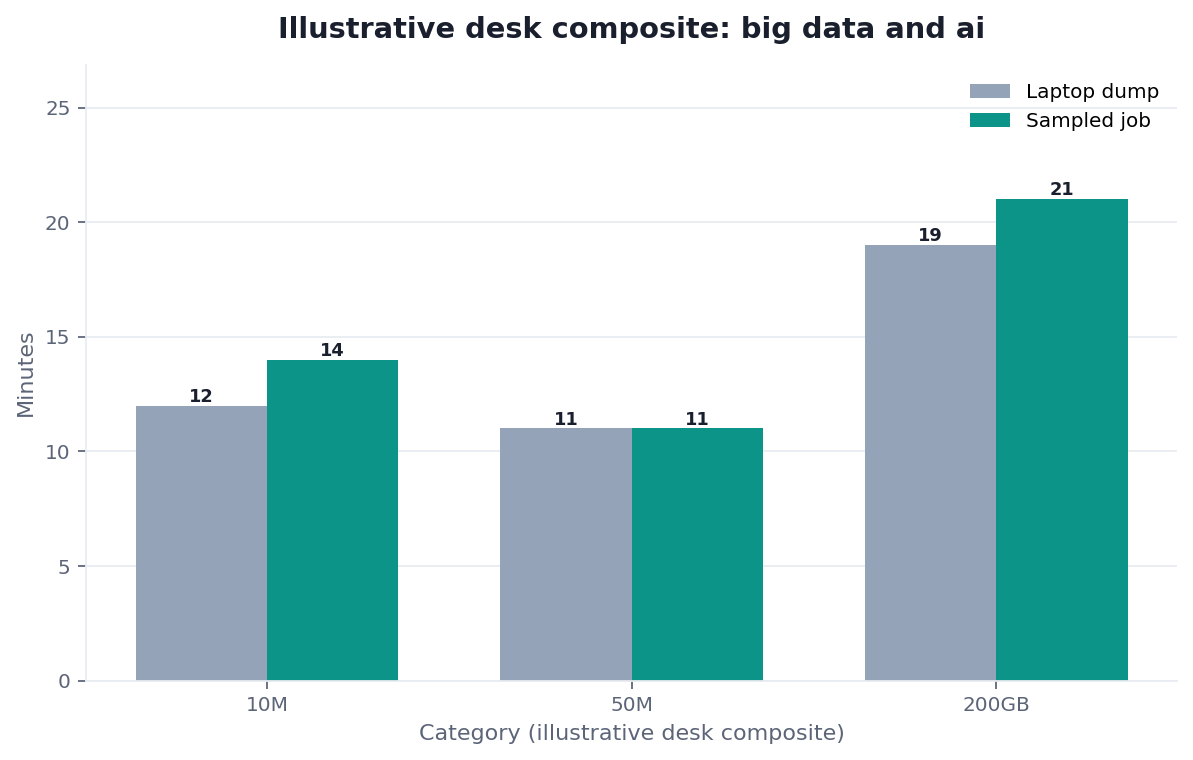
Figure. Static decision matrix generated from the downloadable profiles and criteria. STATIC / NO ENGINE RUN / NOT VALIDATED. It contains no measured rows, bytes, runtime, or cost.
Practical Static Replay
The replay is intentionally mechanical. It lets a reviewer reproduce the classification without accessing a data platform:
- Open
synthetic-workload-profiles-BDAAI-20260831.csv. - Confirm that it has exactly two profile rows and that both use
decision_status=not_validated. - Open
decision-criteria-BDAAI-20260831.csvand confirm all eight required criteria are present. - Apply the rules written in
engine-decision-record-BDAAI-20260831.md. - For a bounded workload whose source is already ready in the warehouse and that has no recurring state requirement, assign
evaluate_current_engine_first. - For a recurring, multi-source workload with state and checkpointing requirements, assign
evaluate_distributed_engine. - Leave the status
not_validated; do not add measured fields. - Run the standard-library verifier to check package invariants.
This static replay supports big data and ai documentation review and change control. It is not a benchmark because it executes no workload. Changing a requirement can exercise a rule, but the output remains provisional. Its value is traceability.
Plans, sampling, and benchmarks
Plans are candidate-specific big data and ai evidence. For Spark SQL, the performance tuning documentation describes statistics, join strategies, partition tuning, and adaptive execution concepts. BigQuery query plan explanation, Athena runtime statistics, and Snowflake query activity expose different forms of plan or execution evidence. Their fields are not directly interchangeable, so normalize acceptance criteria rather than comparing labels.
Sampling can help exploration, but it does not automatically reduce scan volume or cost. An engine may read more data than the returned sample suggests, depending on storage layout, optimizer behavior, predicates, and sampling implementation. Partition pruning or equivalent plan evidence is needed to support a reduced-read claim. Sampling can also bias results when rare groups, temporal patterns, skew, or correlated fields are underrepresented. A representative benchmark for big data and ai should therefore preserve the features relevant to the decision.
Authorize a big data and ai benchmark protocol before execution. Define equivalent inputs and outputs, warm-up and cache treatment, concurrency, settings, repetitions, retained plans, failures, and stop conditions. Record direct cost units and conversion assumptions. Do not report a winner when outputs or tuning differ. Retain candidate versions, checks, and recovery observations; this static page reports none.
Spark and distributed processing
Apache Spark is one distributed processing system; it is not a synonym for distributed processing generally. The Spark documentation describes the project and its libraries. The cluster overview explains coordination among driver, cluster manager, and executors. Structured Streaming documents Spark's stream-processing model. These sources support limited statements about Spark concepts, not a claim that Spark wins either synthetic profile.
Other engines distribute big data and ai work with different storage relationships, execution models, state semantics, and operating boundaries. Deployment mode can change the evaluation. Say “evaluate distributed-engine capabilities” when requirements imply that broad step; reserve “evaluate Spark” for a candidate-specific test.
The reverse distinction is equally important. evaluate_current_engine_first is not “avoid distributed systems.” Many warehouses are already distributed internally. The classification means evaluate the source-adjacent engine first for the bounded profile, using its plan and operating constraints, before introducing another processing surface.
Operability, security, and recovery
Big data and ai evidence extends beyond speed. Assign ownership for deployments, schemas, capacity, alerts, incidents, upgrades, and decommissioning. Security review covers least privilege, secrets, networks, encryption, audit, retention, and deletion. Recovery review defines failure units, tolerated loss, objectives, replay, checkpoints, idempotency, and rollback. Test stateful failures under an authorized protocol.
The Google SRE service best practices provide general context for service objectives and operational design. The NIST Big Data Interoperability Framework Volume 6 provides reference-architecture context. Neither source validates this record or selects an engine for big data and ai.
Independent Validation
Independent big data and ai validation has not occurred. To qualify, a reviewer should be organizationally separate from the authors and should receive the dated package, rule definitions, and acceptance criteria. The reviewer should reproduce the two classifications, confirm that no measured result is implied, and document discrepancies. Internal reviewers named on this page do not satisfy that independence condition.
For a final big data and ai decision, independent work should inspect plans, observe an authorized benchmark, verify equivalent outputs, review costs, witness recovery tests, and assess team capabilities. Results should identify versions and environment boundaries. Until then, both recommendations remain not_validated.
The downloadable independent-reproduction-protocol-BDAAI-20260831.md separates static reproduction from future empirical validation. That separation prevents a successful CSV check from being reported as a successful engine test.
Sources and Limited Claims
Direct technical sources were retrieved on 2026-08-31:
- Apache Spark documentation — project and component documentation.
- Spark cluster overview — cluster roles and execution context.
- Spark SQL performance tuning — documented tuning and plan concepts.
- Spark Structured Streaming — documented streaming model.
- BigQuery query plan explanation — plan-stage interpretation for BigQuery.
- Athena GetQueryRuntimeStatistics — API fields for runtime statistics.
- Snowflake query activity — query-history and activity interface.
- NIST Big Data Interoperability Framework, Volume 6 — reference-architecture context.
- Google SRE service best practices — general service-operability context.
The source-check download maps each URL to a limited big data and ai claim. Documentation describes concepts and interfaces; it does not prove a candidate meets these synthetic requirements. ISO, OGC, NOAA, Copernicus, DOE, and Stanford remain context only. No cited publisher participated.
Preserved internal context includes natural language to SQL, self-service analytics, data visualization, MCP for data analysis, long-running analysis jobs, and when large data needs a warehouse. These links route readers to adjacent topics; they are not evidence for either classification.
How to Cite This Record
Cite this big data and ai page as an InfiniSynapse static engine-decision record, version verified 2026-08-31, and include the canonical URL. If discussing a profile, name it synthetic, quote its provisional recommendation, and retain decision_status=not_validated. Link the downloadable profile and criteria files so readers can reproduce the rule application.
Do not describe the record as a benchmark, customer study, production result, independent audit, third-party audit, or endorsement. Do not attribute its classifications to Apache, Google, AWS, Snowflake, NIST, Google SRE, ISO, OGC, NOAA, Copernicus, DOE, or Stanford. For big data and ai architecture claims, cite the relevant primary documentation separately and keep this record's role limited to the stated classification method.
Authority and conflicts: William Zhu is cofounder of InfiniSynapse (GitHub @allwefantasy); no personal LinkedIn is published. The internal analytics engineering, data platform, LLM security, and editorial reviewers are responsible for the package but are not independent validators. Editorial standards · corrections · publishing principles · Contact zhuhl@infinisynapse.com. Company About. COI: InfiniSynapse operates a commercial application; this educational record does not evaluate that product or claim its behavior.
Downloads
- Engine decision record
- Synthetic workload profiles
- Decision criteria
- Assumption register
- External source check
- Independent reproduction protocol
- Offline verifier
Frequently Asked Questions
Does big data and ai require Spark?
Bottom line: No conclusion follows from the phrase alone. The static stateful-pipeline profile says evaluate_distributed_engine, not “deploy Spark.” Spark is one candidate among distributed processing systems, and the final choice requires candidate-specific evidence.
Should an existing warehouse always be used first?
Bottom line: Only the bounded synthetic profile receives evaluate_current_engine_first. That provisional step can fail when plans, authorized benchmarks, costs, security, recovery, or team requirements do not meet acceptance criteria.
Does sampling guarantee a cheaper scan?
Bottom line: No. In big data and ai work, sampling may or may not reduce scan volume or cost, and it can bias results. Inspect optimizer and partition-pruning evidence and validate representativeness before relying on a sample.
Is this an independent or third-party audit?
Bottom line: No. This is an internally authored static decision record. Internal review is not independent validation, and no engine execution or empirical benchmark was performed.
Conclusion
Big data and ai engine selection should be traceable from requirements to evidence. The two synthetic profiles demonstrate how explicit rules can select the next evaluation step without pretending to select a winner. One starts with the current engine; the other broadens evaluation to distributed-engine capabilities. Both remain not validated.
Use the package to structure a review, then gather workload-specific plans, authorized benchmark results, costs, failure and recovery tests, security evidence, and team-capability assessments. That evidence—not the presence of “big,” “AI,” or a familiar engine name—supports a final architecture decision.