Data Science and AI: Build a Verifiable Handoff Pack
By William Zhu & the InfiniSynapse Data Team · Published: 2026-08-22 · Last updated: 2026-08-31 · Last verified: 2026-08-31 · Next review: 2026-11-30 · Editorial standards · Corrections
Table of Contents
- TL;DR
- Key definition and evidence boundary
- What the static handoff pack contains
- Practical static replay
- Handoff-pack matrix
- Independent validation
- Sources and limited claims
- How to cite this pack
- Frequently Asked Questions
- Conclusion
TL;DR
Direct answer: Use data science and ai to author an analysis handoff pack whose files can be inspected without connecting to a source. This page provides a dated goal, explicit non-goals, a synthetic input contract, a prominently non-executing SQL draft, a manifest, a provenance record, acceptance checks, and a standard-library verifier. File structure is checked; analysis execution is not observed.
This data science and ai specification is a static example. It is not evidence of a query run, an output, a customer engagement, a product test, or an independently reproduced result. A file can exist and match a hash while its analytical logic remains untested.
Key definition and evidence boundary
Key Definition: Here, data science and ai means a documented analysis handoff pack: authored artifacts that state an intended question, expected input shape, illustrative logic, provenance, and acceptance criteria. Structural verification confirms properties of those files. It does not establish that data was accessed, SQL was run, a result is accurate, or another party reproduced the work.
The data science and ai evidence boundary has three levels:
- Authored artifacts: nine local downloads were written for this page. Their content describes a proposed workflow.
- Structurally verified files: the included verifier can check names, JSON shape, status vocabulary, warning comments, and manifest hashes without network access or SQL execution.
- Unobserved claims: execution, rerun behavior, customer use, product behavior, result quality, and independent validation remain
not_observedornot_tested.
That boundary makes data science and ai reviewable without turning file availability into a performance claim. The pack supplies inspectable assertions and limitations, not proof that an analysis happened.
The data science and ai parent context remains analyze large datasets with AI. Handoff packs for large sources are listed on the large-scale analysis topic hub. Related discussions remain available at 200gb data analysis, analyze millions of rows, long-running analysis job, and when large data needs a warehouse. Those links are context only; this pack makes no size, duration, execution, or product claim.
What the static handoff pack contains
A useful data science and ai handoff separates intent, interfaces, draft logic, identity, checks, and limitations. Keeping those objects separate lets a reviewer challenge one layer without assuming another has passed.
| Artifact category | Purpose | Evidence status |
|---|---|---|
| Specification | Defines goal, non-goals, ownership, and boundary | Authored |
| Input contract | Defines synthetic fields and constraints | Authored; schema checked |
| SQL draft | Shows illustrative transformations | Authored; warning checked; never executed |
| Manifest | Lists local files, sizes, and SHA-256 values | Generated from local bytes; self excluded |
| Provenance | Relates entities, activity, and agents | Authored; JSON structure checked |
| Acceptance | Records explicit review statuses | Authored; execution-related items not tested |
| Source check | Records direct references and retrieval dates | Authored; no third-party audit |
| Reproduction protocol | Defines a future independent review | Authored; not performed |
| Verifier | Performs offline structural checks | Authored; standard library only |
Dated goal and non-goals
The dated data science and ai goal for 2026-08-31 is to define a static, inspectable handoff pack for a hypothetical monthly channel summary using synthetic table and field names. The goal is documentation, not analytical output.
Non-goals are equally important. This data science and ai pack does not connect to a database, inspect actual rows, produce a result dataset, evaluate a model, measure performance, verify a vendor feature, or represent customer work. It contains no source URI, credentials, or private data.
Synthetic input contract
The data science and ai input contract defines two synthetic tables, synthetic_orders and synthetic_channels. It provides field names, types, nullability, conceptual keys, and allowed sensitivity classes. Values are schema examples only; there are no actual rows.
For data science and ai, an input contract is an interface proposal. A reviewer can ask whether the intended grain, join key, time field, currency field, and exclusions are sufficiently explicit before implementation. The contract deliberately omits connection details and access instructions.
Non-executing SQL draft
The SQL draft starts with repeated prominent comments: DO NOT EXECUTE — ILLUSTRATIVE SQL DRAFT. It references only synthetic generic tables from the contract. It is supplied for reading and critique, not execution.
The draft gives data science and ai reviewers a surface for questions about grain, filters, joins, aggregation, and null handling. There is no claimed output, query plan, row count, elapsed time, or successful compilation. The verifier reads it as text and checks warnings and identifiers; it never invokes a database client.
Manifest and provenance
The data science and ai artifact manifest records each downloadable file except itself, avoiding a recursive self-hash. Byte counts and SHA-256 hashes describe local files at verification time. A matching hash establishes identity only. It does not establish functional reproducibility, execution, result accuracy, methodological validity, or independent validation.
The provenance record uses W3C-inspired entity, activity, and agent relationships. It says the files were authored locally for this page and associates generation and structural-check activities with named local roles. It does not claim W3C certification, external audit, external authorship, or independent review.
For data science and ai, provenance should answer “who asserted what, about which artifact, and when?” It should not silently upgrade an internal reviewer into an independent validator.
Acceptance checklist and verifier
The data science and ai acceptance checklist uses explicit statuses. Documentation and structural properties may be passed; SQL execution, result accuracy, rerun, customer use, product behavior, and independent reproduction remain not_tested or not_observed.
The offline verifier uses only Python’s standard library. It makes no network request, runs no SQL, launches no external command, and creates no analytical output. Its scope is intentionally narrow.
This is the honest acceptance model for data science and ai: check what is observable, label what is not, and avoid converting a static check into an operational claim.
Practical static replay
A practical data science and ai static replay is a document review, not an analysis rerun:
- Download all nine files into one directory.
- Read the specification’s dated goal and non-goals.
- Confirm the input contract contains synthetic schema only.
- Open the SQL draft in a text editor; do not send it to an engine.
- Inspect manifest scope and provenance relationships.
- Review the acceptance statuses and evidence boundary.
- Optionally run the Python verifier locally to check structure and hashes.
- Record disagreements separately; do not rewrite the supplied evidence statuses.
This replay helps a data science and ai reviewer determine whether the pack is internally legible. Passing it cannot answer whether the proposed logic is correct against real data.
Handoff-pack matrix
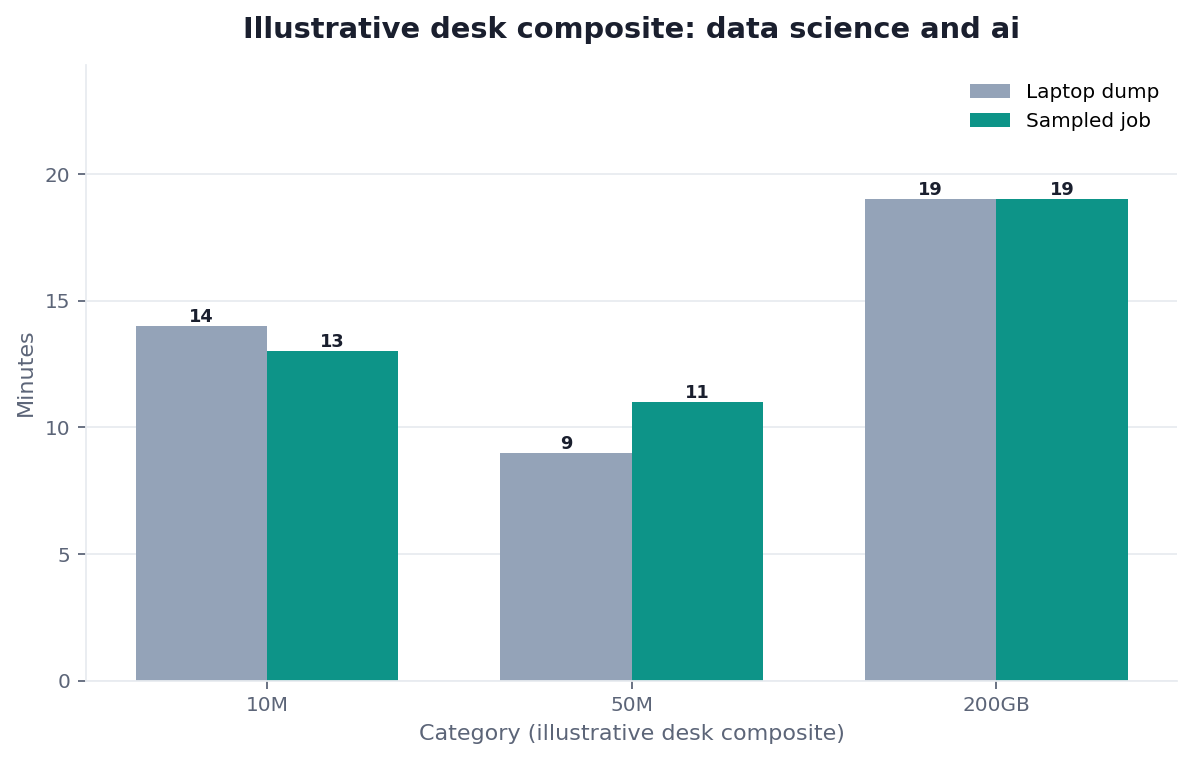
Figure. Static matrix derived from the downloadable files and acceptance statuses. “Included” and selected “structurally checked” cells describe this pack. Execution is not observed; independent validation is not performed. No data run, result, runtime, row count, byte volume, customer result, or product outcome is represented.
The data science and ai matrix prevents a common category error. An included artifact is not necessarily checked; a checked file is not executed; an internally reviewed specification is not independently validated. The columns are deliberately non-substitutable.
Independent validation
Independent validation has not occurred for this data science and ai pack. Internal authors or reviewers are not independent because they share responsibility for the page and artifacts. A future independent reviewer would need to declare conflicts, obtain the frozen pack, verify hashes, assess the specification and draft logic, design an authorized test environment, and publish a signed report separating structural findings from execution findings.
The independent reproduction protocol describes those prerequisites. It is a protocol, not evidence that anyone followed it. Future execution would require separate authorization, safe test data, engine-specific review, and controls outside this page.
This conservative treatment makes data science and ai claims easier to audit. “Available for review” and “independently validated” remain different statements.
Sources and limited claims
The data science and ai sources below inform vocabulary and documentation principles. They did not inspect this pack, run its SQL, endorse InfiniSynapse, or validate this page. Each was retrieved 2026-09-04:
- W3C PROV Overview — provenance concepts.
- W3C PROV-O — entity, activity, and agent relationships.
- DataCite Metadata Schema 4.6 — metadata and identifier context.
- ACM Artifact Review and Badging — distinctions among availability, evaluation, and reproducibility.
- NIST AI Risk Management Framework — risk and governance context.
- Model Cards for Model Reporting — scoped reporting and limitations.
- Datasheets for Datasets — dataset documentation questions.
- The Turing Way: Reproducible Research — reproducibility practices.
The external source check records direct links, retrieval date, and limited claims. Original context links remain available: NCEI, NASA Earthdata, DOE Energy data, OSTI, and ACM Publications. They are examples of public scientific or publication infrastructure, not evidence about this data science and ai pack.
Internal guides what is a data agent, semantic layer, data governance, and what is data management provide adjacent concepts. They do not enlarge this page’s evidence boundary.
How to cite this pack
Cite the data science and ai page title, InfiniSynapse Data Team, publication date 2026-08-22, verification date 2026-08-31, canonical URL, and the specific artifact filename and SHA-256 value when relevant. Describe it as a locally authored static analysis handoff pack.
Do not describe the pack as a third-party audit, independently reproduced study, executed analysis, tested product workflow, customer case study, or benchmark. For data science and ai, precise citation language protects the difference between inspectable design material and observed evidence.
Review the static handoff specification
Inspect the goal, synthetic contract, illustrative SQL draft, provenance, manifest, and acceptance statuses before considering any separately authorized implementation.
Commercial association: InfiniSynapse publishes this educational pack and sells data-agent software. No product behavior is tested here.
Open InfiniSynapseAuthorship and review boundary. William Zhu is cofounder of InfiniSynapse (GitHub @allwefantasy); no personal LinkedIn is published. This page and pack were authored locally as documentation, not as a production-experience report. Internal review roles—analytics engineering, data platform, LLM security, and editor—are not independent validators. See editorial standards, corrections, and publishing principles. Contact zhuhl@infinisynapse.com. Company About.
Frequently Asked Questions
What is the handoff pack on this page?
It is a static data science and ai documentation package: a specification, synthetic schema contract, non-executing SQL draft, manifest, provenance record, acceptance checklist, source check, reproduction protocol, and verifier.
What does structural verification establish?
The data science and ai structural check establishes only tested file properties, such as presence, parseability, status vocabulary, warnings, and matching hashes. It does not establish execution, accuracy, reproducibility, customer use, or product behavior.
Does the SQL draft produce an analytical result?
No. The data science and ai SQL is illustrative text marked “DO NOT EXECUTE.” This page reports no compilation, query, output, performance, or result.
Has this pack been independently validated?
No. The files were authored locally and may receive internal structural review. Internal reviewers are not independent. The protocol describes a possible future review but does not claim it occurred.
Conclusion
A credible data science and ai handoff states what exists, what was checked, and what remains unknown. This pack makes the goal, synthetic interface, draft logic, metadata, provenance, and acceptance boundaries visible without claiming a data run.
Use the data science and ai artifacts to review documentation quality. Treat execution, result accuracy, rerun behavior, customer evidence, product behavior, and independent validation as separate work requiring separate evidence.