ClickHouse Use Cases: Qualify Questions Before SQL
By William Zhu & the InfiniSynapse Data Team · Published: 2026-08-22 · Last updated: 2026-08-31 · Last verified: 2026-08-31 · Next review: 2026-11-30 · Editorial standards · Corrections
Table of Contents
- TL;DR
- What ClickHouse use cases are for an agent
- Evidence Boundary
- A framework for questions you can reopen
- Methods: event questions vs industry listicles
- Tool landscape around auditable use cases
- Qualification Method
- Implementation steps
- Practical Static Replay
- Independent Validation
- Sources and Limited Claims
- Failure modes
- Frequently Asked Questions
- Conclusion
TL;DR
Direct answer: Use this static package to turn broad ClickHouse use cases into reviewable question contracts before anyone executes SQL. Each contract names a bounded window, synthetic source, input and output grain, required fields, draft location, evidence status, qualification result, and held fields. Nothing here connected to ClickHouse, parsed SQL, inspected data, measured a result, or validated product behavior.
The ClickHouse use cases fixture contains four synthetic candidates. A 24-hour event-name rank and a three-step funnel are QUALIFIED FOR STATIC REVIEW only. A freshness check is NEEDS EVIDENCE / HOLD. “Logging, metrics, and ML” is REJECTED AS UNDERSPECIFIED under this page’s policy. These statuses assess document completeness, not engine suitability, syntax, access, correctness, or performance.
Use this ClickHouse use cases package to:
- separate broad ClickHouse use cases categories from executable question contracts;
- verify that a draft has a window, object, grain, dimensions, and measures;
- keep access, execution, data, clocks, and results explicitly held;
- reproduce the authored outcomes with a deterministic standard-library verifier.
The ClickHouse analytics parent guide, chat with your data, and event analytics in ClickHouse provide broader context. They do not validate this fixture.
What ClickHouse use cases are for an agent
Key Definition: Common usage allows a “use case” to mean a workload category such as observability, time-series analysis, or real-time analytics. Operationally, this page defines an auditable case more narrowly as a question contract with a bounded window, named synthetic source, input grain, output grain, required dimensions and measures, SQL draft file if applicable, evidence status, qualification result, and held fields.
That ClickHouse use cases definition does not claim industry categories are never ClickHouse use cases. It says a category alone is insufficient for this static gate. The category becomes reviewable when one question, one time boundary, one source object, and one output grain are declared.
Royal Society Publishing, JSTOR, FAIRsharing, W3C VoID, and RDF 1.1 Concepts are retained as publications or vocabulary context. They did not inspect these ClickHouse use cases, execute the drafts, or certify the method.
Evidence Boundary
These ClickHouse use cases form a static, synthetic, non-executing fixture. No ClickHouse host, source, event table, partition, principal, grant, result, cache, board, product task, warehouse copy, federation path, or production workflow was observed. No statement was executed. No minutes-per-question, conversion, rank, freshness, runtime, customer outcome, benchmark, SLA, production experience, or named external review is reported.
The SQL files say DO NOT EXECUTE. They are illustrative text, not claims of ClickHouse parser acceptance, syntax compatibility, version compatibility, semantic correctness, or conformance. “Qualified” means complete enough for static review under authored rules. It does not mean approved to execute.
For real ClickHouse use cases results, collect environment-specific evidence:
SHOW CREATE TABLEand relevantsystem.tablesrows for the exact source, including engine, columns, sorting and partition metadata.- Effective grants for the real principal, inherited roles, row policies, settings profiles, and applicable quotas.
- The exact executed query or normalized hash,
query_id, server version, andsystem.query_logevidence, subject to logging configuration and retention. - A source snapshot identifier, bounded window, inclusive/exclusive boundary policy, and timezone.
- A result artifact and checksum, with output schema and row-count reconciliation.
- For freshness, definitions and observations for the source-arrival clock, server clock, ingestion or part metadata, and cached-board clock.
- An independent reproduction record that identifies reviewer independence, scope, versions, and deviations.
Official documentation can establish capabilities and documented patterns. It cannot establish what happened in this run because there was no run.
A framework for questions you can reopen
Every ClickHouse use cases candidate in question-contracts-CHUC-20260831.json carries the same qualification fields.
| Field | Static requirement | Boundary |
|---|---|---|
| Question ID and business question | unique ID and one answerable sentence | not a generated task |
| Bounded time window | explicit start, end, timezone, and boundary rule | no partition claim |
| Named synthetic source | authored object name | not deployment metadata |
| Input and output grain | one row meaning on each side | not observed data |
| Dimensions and measures | explicit lists | no measured values |
| SQL draft file | named local file or null | text only; do not execute |
| Access/evidence status | held or unavailable where appropriate | no read-only grant claim |
| Qualification result | policy label | not vendor or engine verdict |
| Held fields | missing proof listed by name | null is intentional |
This contract turns ClickHouse use cases into inspectable planning objects without pretending that a draft is a result.
Four synthetic candidates
| ID | Candidate | Authored outcome | Why |
|---|---|---|---|
CHUC-Q1-RANK | 24-hour event-name rank | QUALIFIED FOR STATIC REVIEW only | window, object, grain, dimensions, measure, and bounded draft are present; execution, access, and data are held |
CHUC-Q2-FUNNEL | three-step funnel | QUALIFIED FOR STATIC REVIEW only | ordered semantics, denominator, user grouping, and window assumptions are explicit; no conversion was observed |
CHUC-Q3-FRESHNESS | freshness check | NEEDS EVIDENCE / HOLD | source-arrival, server, ingestion/part, and cached-board clocks are unavailable |
CHUC-Q4-CATEGORY | “logging, metrics, and ML” | REJECTED AS UNDERSPECIFIED | it lacks one question, window, object, and output grain |
These four ClickHouse use cases candidates test contract completeness. The fourth label is a policy result. Official ClickHouse documentation describes observability and time-series workload categories, so the rejection must not be read as a vendor or engine claim.
Methods: event questions vs industry listicles
Broad labels can be useful discovery terms. The official observability guide discusses logs, traces, metrics, collection, storage, and visualization. The official time-series guide discusses temporal workloads. Those are legitimate category-level ClickHouse use cases in common usage.
This ClickHouse use cases page applies a different operational test: can a reviewer tell exactly what one output row means and what evidence is still missing? “Logging, metrics, and ML” fails that test only because three labels do not define one contract. Split the phrase into separate questions before drafting execution plans.
The exploratory data analysis, data visualization, dashboard, and self-service analytics guides remain contextual. No board, chart, task, or download was generated by an agent or product for this fixture.
Tool landscape around auditable use cases
For rank ClickHouse use cases, the draft names synthetic_analytics.events_fixture, selects only event_name and count() AS event_count, filters an explicit UTC interval, groups, orders, and limits. It does not use SELECT *. The column and object names are synthetic; no actual product-event source or day partition is asserted.
For funnel ClickHouse use cases, the draft is deliberately pseudo-style SQL. It documents the sequence page_view → add_to_cart → purchase, one synthetic user key, a 24-hour analysis window, ordered event-time semantics, and a denominator of users with step one in the window. It reports no observed conversion. ClickHouse’s windowFunnel documentation is relevant to future implementation, but exact semantics and server-version behavior require review before authorized execution.
For freshness ClickHouse use cases, the draft preserves required observations as NULL. It does not invent a cached-board timestamp or infer freshness from a tile. Date/time functions are documented in the official date-time reference; the real-time OLAP analysis guide adds planning context. Neither reference provides this fixture’s clocks.
The connect ClickHouse to AI, ClickHouse dashboard from question, ClickHouse vs warehouse for AI, and analyze a database without ETL pages remain architecture context. After a hosted cluster exists, complete hosting before access. This package makes no first-class-source, no-write, no-copy, or federation claim.
Qualification Method
Review ClickHouse use cases candidates in a fixed order:
- Confirm a unique question ID and one business question.
- Require explicit start, end, timezone, and boundary semantics.
- Require a named synthetic source and both input and output grain.
- List dimensions and measures; do not infer them from a category label.
- Inspect the associated draft as text and confirm the DO NOT EXECUTE warning.
- Record access and evidence as held unless actual authorized artifacts exist.
- Assign the policy outcome and list every held field.
The selecting data types guide can inform a future schema review. It does not prove that these synthetic fields exist or use appropriate types.
Implementation steps
1. Read the register and contracts
Compare use-case-register-CHUC-20260831.csv with question-contracts-CHUC-20260831.json. All four IDs, source names, draft references, outcomes, and held fields must agree. This is the starting point for reviewing ClickHouse use cases as contracts.
2. Inspect the three drafts
Read the rank, funnel, and freshness files. The rank is bounded and limited. The funnel is a simplified event-sequence contract with no syntax claim. The freshness draft keeps all required observations null. The underspecified candidate has no executable draft.
3. Compare rules and expected outcomes
The ClickHouse use cases rules explain why Q1 and Q2 pass static review, Q3 is held, and Q4 is rejected. expected-qualification-CHUC-20260831.json records the same outcomes. Neither file authorizes execution.
4. Run the offline verifier
From the downloads directory, run python3 verify-CHUC-20260831.py. It uses only the Python standard library and local files. It validates the exact artifact set, hashes, IDs, required fields, outcomes, bounded rank text, funnel semantics, freshness nulls, rejection state, and disclaimers. It is not a semantic SQL parser.
Practical Static Replay
A practical replay of these ClickHouse use cases is a file comparison:
- Read the assumptions and keep environment facts unresolved.
- Reconcile the CSV register with the JSON contracts.
- Match each applicable candidate to one draft.
- Confirm that held evidence is still held or null.
- Run the verifier and retain its deterministic output with the package version.
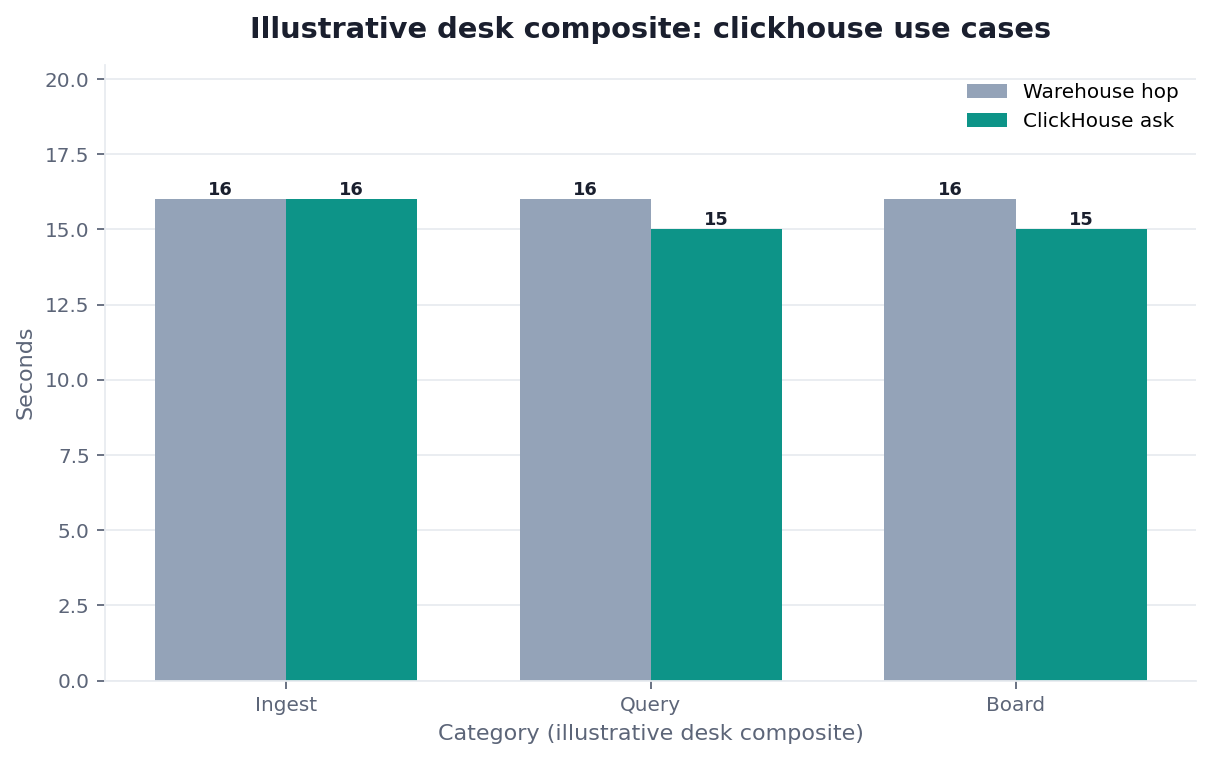
Figure. STATIC FIXTURE / NOT EXECUTED / NOT INDEPENDENTLY VALIDATED. The matrix shows policy outcomes, not measured counts, conversion, freshness, runtime, or engine results.
Passing this ClickHouse use cases replay means the files agree with one another. It does not mean the SQL is compatible, access exists, data is complete, a query was run, or a result is correct.
Independent Validation
Internal editorial, analytics-engineering, data-platform, or security review is not independent validation. A qualified independent reviewer would need authorized evidence from the target environment, a declared scope, server and client versions, sampling rules, and a signed or otherwise attributable report.
For these ClickHouse use cases, the reviewer should reconcile object definitions, partition metadata, effective grants, exact executed text and query identifiers, source snapshots, result checksums, and clock definitions. Until that work occurs, this package remains not independently validated.
Sources and Limited Claims
Direct official sources were checked on 2026-08-31. The observability, time-series, windowFunnel, system.query_log, system.tables, date-time functions, and data-type pages resolved. The suggested real-time analytics URL returned 404 and is retained only as a documented unavailable URL; no claim relies on it.
For ClickHouse use cases, official documentation supports bounded descriptions of workload categories, a funnel aggregate, metadata fields, query-log evidence conditions, date/time functions, and schema choices. It does not validate these ClickHouse use cases, drafts, synthetic objects, grants, data, results, clocks, product behavior, or production suitability.
How to Cite
Cite this page as: “InfiniSynapse, ClickHouse Use Cases: Qualify Questions Before SQL, static non-executing qualification fixture, version 2026-08-31, not independently validated.” Link the canonical page and identify the downloaded files used. Do not describe it as a third-party audit, certification, benchmark, parser test, compatibility test, production validation, customer case, or SLA.
Downloads:
- Use-case register
- Question contracts
- Rank query draft
- Funnel query draft
- Freshness query draft
- Expected qualification
- Qualification rules
- Held evidence fields
- Assumption register
- External source check
- Independent reproduction protocol
- Offline verifier
Failure modes
Treating a category as a complete question
Observability can be a valid category among ClickHouse use cases. It still needs a separate question contract before this gate can qualify a draft.
Reporting a draft as a result
A bounded statement is planning evidence, not execution evidence. Q1 and Q2 have no observed rank, user count, sequence count, or conversion.
Comparing clocks that were never collected
Freshness requires defined clocks and actual observations. Q3 remains held because source-arrival, server, ingestion or part, and cached-board clocks are unavailable.
Inferring access or architecture
Static text cannot prove a read-only grant, denied write, no warehouse copy, local execution, or federation. Those claims require separate authorized evidence.
Frequently Asked Questions
Are industry categories valid ClickHouse use cases?
Yes, in common usage. This page simply requires a narrower question contract before assigning a static qualification outcome.
Does “qualified for static review” mean execute it?
No. It means the authored contract and draft contain the fields required by this policy. Access, data, execution, compatibility, and results remain unverified.
Why is the funnel not a conversion result?
The file declares ordered steps, denominator, grouping key, and window assumptions but was never executed. No numerator, denominator, or conversion rate was observed.
Why is freshness held?
The four required clocks and supporting metadata are unavailable. A draft cannot substitute for source-arrival, server, ingestion/part, and cached-board observations.
Does the verifier validate SQL?
No. It checks deterministic text and structured files. It is not a ClickHouse parser or semantic SQL validator.
Conclusion
Qualify ClickHouse use cases by making the question contract explicit before SQL execution: bounded window, synthetic source, grains, required fields, draft location, evidence status, outcome, and held evidence. Keep rank and funnel in static review, hold freshness until clocks exist, and reject only the underspecified contract—not an industry or engine category.
For company context, InfiniSynapse describes itself on its About page; About is a self-description, not independent authority. Site Privacy and Terms apply.