ClickHouse Materialized View: Verify Grain and SQL
By William Zhu & the InfiniSynapse Data Team · Published: 2026-08-22 · Last updated: 2026-08-31 · Last verified: 2026-08-31 · Next review: 2026-11-30 · Editorial standards · Corrections

Table of Contents
- TL;DR
- What the object actually does
- Evidence Boundary
- Define source, target, and question grain
- Choose the expected object
- Implementation steps
- Practical Static Replay
- Independent Validation
- Sources and Limited Claims
- Failure modes
- Frequently Asked Questions
- Conclusion
TL;DR
Direct answer: An incremental ClickHouse materialized view acts like an insert trigger: its
SELECTtransforms newly inserted blocks from a source and writes rows to a target table. It is not automatically a generic cache, a single hidden aggregate, or a mechanism that revisits all older source rows after mutations. Verify the three objects, the grain contract, and the downstream query before any authorized execution.
This package is a static, DO NOT EXECUTE fixture. It uses synthetic names and authored policy outcomes. It did not connect to ClickHouse, parse SQL with ClickHouse, run a query, inspect a deployment, measure performance, or obtain independent validation. “Accepted” and “rejected” below mean only that text agrees or disagrees with this page’s object-choice policy.
Use this review to:
- confirm that the source is synthetic event-grain
analytics.events; - confirm that the target is synthetic hour ×
event_namegrainanalytics.events_by_hour; - inspect a synthetic ClickHouse materialized view named
analytics.events_by_hour_mvthat declaresTO analytics.events_by_hour; - require
sum(event_count)withGROUP BY hour, event_namewhen reading the SummingMergeTree-style target; - allow the raw source for unique users because the target deliberately drops
user_id; - reject a silent raw-source fallback when the question contract requires the hourly target.
The ClickHouse analytics parent guide and OLAP SQL for agents provide broader planning context. They do not validate this fixture.
What the object actually does
Key Definition: In this guide, an incremental ClickHouse materialized view is a source-bound insert-time transformation whose result is written to a target table. The source, view definition, target engine, historical coverage, and read query are separate evidence objects.
ClickHouse’s incremental materialized view guide describes the insert-trigger model: computation moves from query time to insert time and processes newly inserted blocks. The CREATE VIEW reference documents materialized-view creation and target behavior. Those sources support the model; they do not show that the synthetic DDL in this package was accepted by an engine.
A ClickHouse materialized view does not necessarily own one implicit stored aggregate. A ClickHouse materialized view definition can write to an explicit target with TO, and different target engines represent and merge results differently. The fixture uses a SummingMergeTree-style target solely to make a common downstream obligation visible.
Newly inserted blocks are the input
An incremental ClickHouse materialized view processes the inserted block rather than rereading a final, fully merged source table. ClickHouse’s cascading materialized views guide makes this limitation explicit for cascades. Existing source-row mutations or changes are not automatically replayed through the view. Historical population, backfill, cutover, deduplication, and reconciliation require a separate plan.
This boundary matters. A correct-looking ClickHouse materialized view statement cannot prove that old rows reached the target, that inserts have never failed, or that target counts reconcile with source events. A real ClickHouse materialized view review must establish those facts from authorized system evidence.
Why the target query sums again
The synthetic ClickHouse materialized view target stores event_count by hour and event name. With a SummingMergeTree-style design, rows with the same sorting key can remain in separate parts until background merges occur. Therefore, a downstream query may need GROUP BY hour, event_name plus sum(event_count) to obtain a stable aggregate across parts. This is an engine-specific reason to inspect the target query, not a universal rule for every ClickHouse materialized view target.
Evidence Boundary
No actual source table, target table, view, user, grant, query log, mutation, insert failure, or monitoring system was inspected. The package does not claim a trusted inventory, bound note, read-only user, agent-generated query, runtime, second pass, raw fallback behavior, lack of copying, lack of writes, customer result, benchmark, SLA, production experience, or named external review.
For a real ClickHouse materialized view, collect at least:
SHOW CREATE TABLEoutput for source, materialized view, and target, retained with server version and collection time.- Relevant
system.tablesrows, includingengine,create_table_query,as_select,target_database,target_table, and dependency fields where supported by the deployed version. - Effective grants for the principal used to inspect or run the objects, including inherited roles and applicable row-policy or settings controls.
- Source-to-target row or aggregate reconciliation over a controlled window, with late data, duplicate handling, and target merge semantics documented.
- Historical and backfill boundaries: creation time, population method, cutover, mutation handling, and any replay procedure.
- Insert-failure and monitoring evidence appropriate to the deployment, including how failures are surfaced and remediated.
system.query_logevidence only after authorized execution, with logging configuration, retention, and query attribution understood.
Documentation defines fields and behavior. Only evidence from the reviewed environment can establish its state.
Define source, target, and question grain
The ClickHouse materialized view fixture makes three grains explicit:
| Object | Synthetic name | Authored grain | Important boundary |
|---|---|---|---|
| Source | analytics.events | one event | retains user_id |
| Target | analytics.events_by_hour | hour × event_name | stores event_count; drops user_id |
| View | analytics.events_by_hour_mv | transforms each inserted source block | writes to the target with TO |
The ClickHouse materialized view definition groups an incoming block by toStartOfHour(event_time) and event_name, then emits count() as event_count. Because the target omits user_id, it cannot answer a unique-user contract. Because the target can contain multiple rows or parts for a logical key, the accepted count query aggregates again.
Exploratory data analysis, real-time OLAP analysis, and event analytics in ClickHouse are related context. None establishes the grain or freshness of a deployed ClickHouse materialized view.
Choose the expected object
For a ClickHouse materialized view, object choice begins with the question contract, not a speed claim.
| Question contract | Expected object | Policy outcome | Reason |
|---|---|---|---|
| Hourly event counts by event name | analytics.events_by_hour | ACCEPTED | target grain matches; query sums and groups |
| Hourly unique users by event name | analytics.events | ACCEPTED | target dropped user_id |
| Hourly event counts, but SQL reads raw source | analytics.events_by_hour | REJECTED | silent fallback violates the authored contract |
The third row is not a syntax verdict. A raw-source query may be valid SQL and may calculate a number, but this package rejects it because the stated contract requires the hourly target. Likewise, “accepted” does not mean parser acceptance, engine compatibility, correctness on real data, or authorization.
The legacy cite-or-ignore idea is retained in a narrower form: cite the object actually read and explain why its grain answers the question. The connect ClickHouse to AI, ClickHouse vs warehouse for AI, MCP for data analysis, dashboard, and data governance pages remain context only. This static ClickHouse materialized view fixture makes no product or task capability claim.
Public research links are context, not validation
OSTI Pages, the arXiv computer-science archive, Nature, SSRN, and FAIRsharing are retained from the original URL inventory as general research or registry context. They did not evaluate ClickHouse behavior, this ClickHouse materialized view fixture, or any InfiniSynapse deployment.
Implementation steps
1. Inspect the synthetic DDL
Open synthetic-view-ddl-CMV-20260831.sql. Confirm the file is labeled DO NOT EXECUTE, names the source, target, and ClickHouse materialized view, uses TO analytics.events_by_hour, and groups the inserted-block transformation by hour and event name. Treat it as text, not engine-tested DDL.
2. Read the grain contract
Open grain-contract-CMV-20260831.json. Check that event counts map to the target and unique users map to the source because the ClickHouse materialized view target lacks user_id. The contract is authored policy, not metadata obtained from SHOW CREATE TABLE.
3. Compare accepted and rejected queries
The accepted hourly query reads analytics.events_by_hour, calls sum(event_count), and groups by hour and event name. The accepted unique-user query reads analytics.events and calls uniqExact(user_id) because that dimension is unavailable in the target. The rejected query reads the raw source despite a target-required contract.
4. Reconcile matrix and lint output
Compare object-choice-matrix-CMV-20260831.csv with expected-lint-CMV-20260831.json. The same three contracts and statuses must appear. This verifies fixture consistency only.
5. Run the offline verifier
From the downloads directory, run python3 verify-CMV-20260831.py. It uses only the Python standard library and local files. It validates the exact file set, declared hashes, required object names, TO target, groupings, query object choices, statuses, disclaimers, and manifest. It is intentionally a text checker, not a complete semantic SQL parser.
Practical Static Replay
The practical ClickHouse materialized view replay is non-executing:
- Read the assumption register and leave environment facts unresolved.
- Compare the DDL with the grain contract.
- Match each question to its expected object.
- Inspect each accepted and rejected query as text.
- Run the verifier and retain its output with file hashes.
- Record that no ClickHouse parser, server, or data was used.
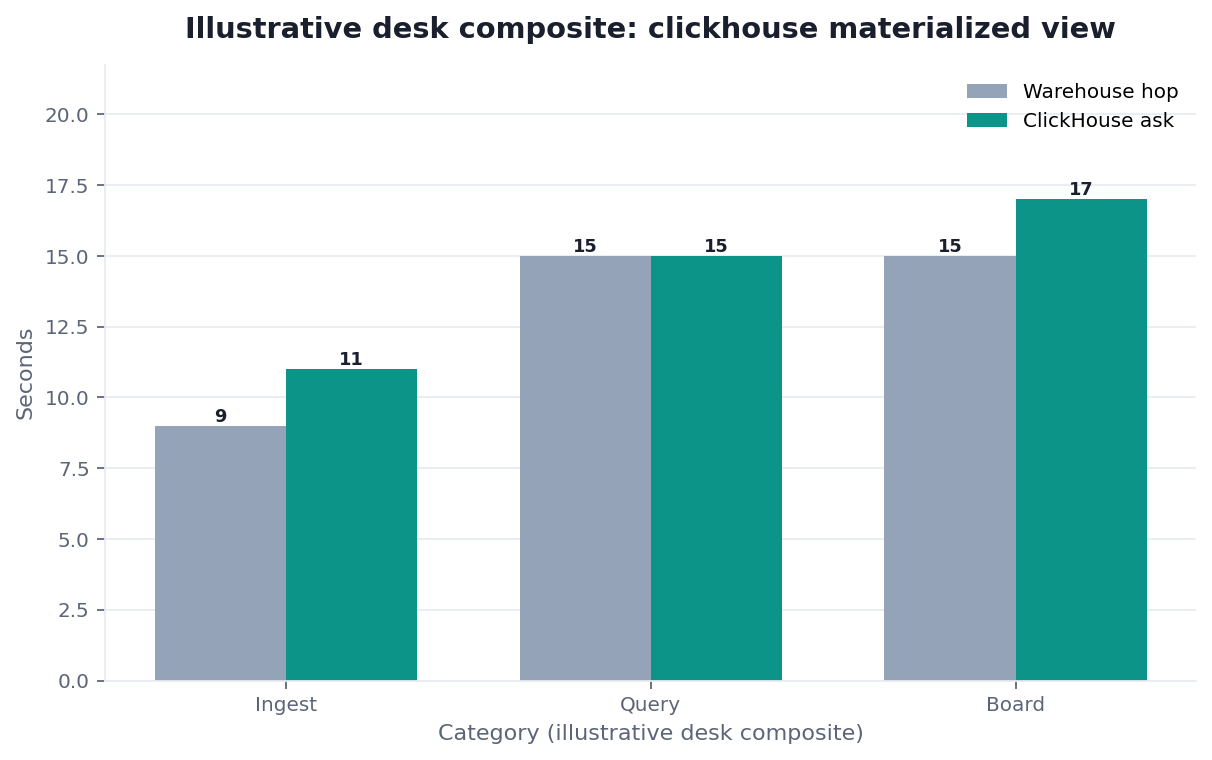
Figure. STATIC FIXTURE / NOT EXECUTED / NOT INDEPENDENTLY VALIDATED. It shows authored object-choice policy, not runtime, performance, or query results.
The replay demonstrates that the package agrees with itself. It cannot demonstrate that a deployed ClickHouse materialized view exists, receives every insert, has complete history, or returns reconciled results.
Independent Validation
Editorial, analytics-engineering, data-platform, or security review within the publishing organization is not independent validation. A qualified independent reviewer would need authorized evidence from the target environment and a defined scope, version, sampling plan, and report.
That reviewer should compare source, view, and target definitions; effective grants; historical population boundaries; controlled-window reconciliation; target merge behavior; insert-failure evidence; and, after authorized execution, relevant query-log records. Until that occurs, this ClickHouse materialized view package is not independently validated.
Sources and Limited Claims
Direct official ClickHouse sources were checked on 2026-08-31. The top-level incremental guide, CREATE VIEW reference, system.tables, system.query_log, and cascading guide resolved during retrieval. Three suggested nested incremental-guide URLs returned 404 during this check and are documented as unavailable aliases in the source-check artifact; no substantive claim relies on them.
Official documentation supports these bounded claims:
- an incremental ClickHouse materialized view processes newly inserted blocks and shifts work to insert time;
TOassociates a materialized view with a target table;system.tablesexposes metadata fields useful for source/view/target inspection;system.query_logcan provide query evidence when logging and authorized execution conditions are met;- cascades receive inserted blocks, not necessarily a final merged table result.
The documentation does not validate this fixture, a deployment, grants, data completeness, backfill, reconciliation, performance, or an InfiniSynapse product workflow.
How to Cite
Cite this page as: “InfiniSynapse, ClickHouse Materialized View: Verify Grain and SQL, static non-executing fixture, version 2026-08-31, not independently validated.” Link the canonical page and identify any downloaded files used. Do not describe it as a third-party audit, certification, benchmark, parser test, engine-conformance test, production validation, or SLA.
Downloads:
- Synthetic source, target, and view DDL
- Grain contract
- Accepted hourly target query
- Accepted raw unique-users query
- Rejected silent fallback
- Object-choice matrix
- Expected lint output and manifest
- Materialized-view review rules
- Assumption register
- External source check
- Independent reproduction protocol
- Offline verifier
Failure modes
Treating the view as a hidden cache
A ClickHouse materialized view has a definition, source, target, and data-flow boundary. Calling it a cache hides which object stores rows and which query reads them.
Assuming historical rows were populated
Creating an incremental ClickHouse materialized view does not prove historical coverage. Require a dated population and reconciliation record.
Reading a SummingMergeTree-style target without final aggregation
Separate parts can retain multiple rows for one logical key. The fixture therefore requires sum(event_count) and GROUP BY; verify the actual target engine before generalizing.
Silently switching to the raw source
Raw data is appropriate for the unique-user contract because user_id was dropped. It is policy-rejected for the hourly-count contract that explicitly requires the target.
Frequently Asked Questions
Does this DDL prove ClickHouse compatibility?
No. It is synthetic, non-executing text and makes no syntax, engine-version, compatibility, or conformance claim.
Does a ClickHouse materialized view update old rows automatically?
An incremental ClickHouse materialized view processes newly inserted blocks. Existing source mutations are not automatically reprocessed through it; plan and verify backfill or replay separately.
Why does the accepted target query use sum and GROUP BY?
The fixture models a SummingMergeTree-style target where logical keys may remain across rows or parts before merges. The downstream query aggregates them explicitly.
Why is raw source accepted for unique users?
The synthetic target drops user_id. The question therefore requires event-grain source data. This is a contract decision, not proof that the query was authorized or executed.
Conclusion
Review a ClickHouse materialized view as a three-object data flow: inserted source blocks, transformation definition, and target table. Then match each question to a grain and inspect the downstream SQL. Keep backfill, mutations, merges, grants, monitoring, and query logs inside the evidence boundary.
This package supplies a deterministic static replay, not deployment evidence. For company context, InfiniSynapse describes itself on its About page; this self-description is not third-party authority. Privacy and Terms apply to the site.