Data Infrastructure: What It Hosts, Not Just the Warehouse
By William Zhu & the InfiniSynapse Data Team · Published: 2026-09-02 · Last updated: 2026-09-27 · Last verified: 2026-09-27 · Next review: 2026-12-02 · Editorial standards · Corrections
Author credentials: William Zhu, Cofounder of InfiniSynapse. Public identity: GitHub @allwefantasy. Profile and review roles: editorial standards. This page is signed by a named person, not an anonymous editorial org. No personal LinkedIn is published. No third-party prize, media review, or independent endorsement is claimed.
Table of Contents
- TL;DR
- What data infrastructure hosts when the unit is a job
- What data infrastructure is made of
- A five-object frame for the hosted job
- Data infrastructure vs a warehouse vs chat
- Landscape: shells, runtimes, and stores
- Jev as a bounded decision service
- How to stand up a named job
- Desk sample: first-party host protocol
- How to score data infrastructure before you fund it
- Failure modes
- Frequently Asked Questions
- Conclusion
TL;DR
Direct answer: Data infrastructure is the system that collects, stores, processes, and governs data, and the runtime that hosts the job using that data. The job carries input, sources, views, evidence, gates, and artifacts, with isolation, resume, quota, and a veto. Vibe coding compiles the app shell. A chat bubble is not that unit. A warehouse table is not that unit.
We review these patterns at the InfiniSynapse desk on sanitized composites. Figures on this page are illustrative, not customer uplifts.
What you'll learn:
- What data infrastructure must host once the unit is a Decision Job
- Three reuse, ownership, and interface judgments before you rebuild a runtime
- Five questions that separate a demo from a job that can survive Monday
- How a generated UI, a warehouse, and a hosted kernel split work
- When to embed an analyst in an existing product instead of minting another shell
What data infrastructure hosts when the unit is a job
Key Definition: Data infrastructure collects, stores, processes, and governs data, then hosts the Decision Job that uses it. The host layer is runtime, isolation, resume, quota, and tool governance. The job carries input, authorized sources, named intermediate views, evidence, gates, and artifacts. It is not a warehouse slide and not a chat turn. The longer meaning is on what is data infrastructure.
A data agent plans, queries, retries, and writes files. Those steps outlive an HTTP timeout. If you store only the last paragraph, you do not have a host. You have a transcript.
Independent published context (retrieved 2026-09-02). Compare each source, then stop. IBM’s page on augmented analytics, the AWS Machine Learning Lens, and ISO/IEC 27001 did not run this fixture. None of them hosts tonight’s job.
| Cited source | What it owns | What tonight still needs |
|---|---|---|
| IBM augmented analytics | Analysis as a governed process | A job host, not prettier chat |
| AWS ML Lens | Identity, isolation, recovery | Those bars on a Decision Job |
| ISO/IEC 27001 | Who may touch evidence | Who opened tonight’s job |
| European Commission AI policy | Oversight and purpose limits | The veto row, not a vendor score |
| Kubernetes docs | Isolation and restart | Restart of the same job id |
| Wikipedia: SQL | The language of facts at rest | A table is an input, not the job |
Use that bar when you decide whether your stack is a host or a prettier chat.
Three judgments before you call it infra
Ask three questions before you brand a repo as data infrastructure:
- Can unrelated apps reuse the kernel without copying queues and secrets?
- Who hosts state, failure, and recovery when the model stalls?
- Is there a boundary between messy internals and a stable job interface?
If any answer is “the page owns it,” you still have a demo. Data infrastructure exists only when those answers are named owners, not hope.
When data infrastructure is holding the job back
A live demo can still fail Monday. Stale resume, no veto, and a trail that dies with the tab are the signals. Data infrastructure must answer:
- Where did the conclusion come from?
- Can the process resume from the same id?
- What may the model decide, and what must it not?
- Who can say no?
- Can the result keep flowing into the next job or report?
If you cannot answer those five, do not call the stack data infrastructure. Call it a prototype and keep the label honest.
Agentic analytics covers the multi-step narrative shape. This hub asks a different question: should you rebuild the runtime that hosts that narrative?
A five-object frame for the hosted job
Mature data infrastructure is not “more tables.” It is five hosted objects around one job identity.
| Object | What it holds | Acceptance signal |
|---|---|---|
| Runtime | Job id, plan, step events | You can reopen the same id after a tab close |
| Isolation | Secrets, source grants, tenant walls | A second app cannot read the first app’s trail |
| Resume | Checkpointed views and the next step | A killed job continues without a new chat |
| Quota | Tokens, minutes, concurrent jobs | A runaway loop stops without taking the cluster |
| Tool governance | Allowed tools, deny list, human veto | The model cannot call a write it was not granted |
AWS ML Lens (table above) treats identity, isolation, and recovery as architecture, not chat UX. Data infrastructure for agents inherits that bar even when the worker is a model. ISO/IEC 27001 (table above) is who may touch evidence. If your stack cannot say who opened a job, you do not have an audit object.
Choose the five-object frame if several products will share one kernel. Choose a single-app queue if you are still proving one screen and you accept that you will throw the queue away.
What data infrastructure is made of
The five objects above are the host. The stack under them is five layers. Open the sibling when that layer is the next sprint. Storage is not the host.
| Layer | What it holds | Open next |
|---|---|---|
| Ingest | Connectors and contracts | Building data infrastructure |
| Storage | Warehouse or lakehouse facts | Data platform architecture |
| Transform | Tested models | Data engineering |
| Access | BI, APIs, and the job that reads them | Data infrastructure and analytics |
| Governance | Grants, lineage, and the veto | What is data infrastructure |
Data infrastructure vs a warehouse vs chat
Teams collapse three different objects into one slide. Data infrastructure is only the hosted runtime.
| Approach | Owns | Choose it if | Reject it if |
|---|---|---|---|
| Chat bubble | A paragraph | You need a quick read of one file | You need resume, veto, or a second consumer |
| Warehouse / lake | Tables and jobs that load tables | You need durable facts at rest | You think a new store hosts the Decision Job |
| Vibe-coded shell | Screens, routes, domain copy | You need a product the user already understands | You bury analysis state inside the page |
| Hosted runtime | Job identity and artifacts | Unrelated apps must reuse one kernel | You only have one throwaway prototype |
Choose a chat bubble if the question dies in the same sitting. Choose a warehouse if the missing object is a fact table. Choose a vibe-coded shell if the missing object is a screen. Choose hosted data infrastructure if the missing object is a Decision Job that must survive the tab.
European Commission AI policy (table above) asks for human oversight and purpose limits. That is the veto row, not a vendor score.
If the product already exists and you only need an analysis slot on a screen you own, stay with embed an AI data analyst. If an IDE must call the same kernel, use Claude Code data analysis. Neither page replaces data infrastructure; both consume it.
Landscape: shells, runtimes, and stores
The 2026 landscape mixes four layers people keep renaming.
- Generated UI. Vibe coding compiles intent into routes and forms. That is the first compile. It is not the host.
- Agent framework. Graphs, tools, and memory helpers. Useful. Still not a job host unless they persist identity and resume.
- Warehouse and query engines. Facts at rest. SQL (table above) remains the language of those facts. A table is an input to a Decision Job, not the job.
- Hosted kernel. Data infrastructure in the sense of this pillar: runtime, isolation, resume, quota, tool governance.
Kubernetes docs (table above) remind you isolation and restart are platform objects. A prompt box sold as a platform is the AI case on data infrastructure for AI. Do not rebuild analysis state inside every generated page.
Jev as a bounded decision service
Jev is a proposed, replaceable decision service, not a system of record. Start with Jev AI and Jev LLM. A Jev agent route still sits inside a Decision Job. Limits, the API adapter, and the benchmark stay on Jev analysis limits, the Jev API guide, and the Jev benchmark. None of that is a claim that InfiniSynapse currently integrates Jev.
How to stand up a named job
Use this sequence when you want data infrastructure you can defend in a review. Inputs and acceptance signals are listed with each step.
- Name the Decision Job, not the chat. Write the input, the authorized sources, and the artifact you will accept. Acceptance: a reviewer can reject the job without reading Slack.
- Bind sources as grants, not as pasted files. Point at a warehouse, a database, or a file the tenant already authorizes. Acceptance: secrets never sit in the browser.
- Require named intermediate views. Each step must produce a view a human can reopen. Acceptance: a wrong join is a named object, not a vibe.
- Attach evidence and a gate. Row counts, null checks, and a human veto sit on the job. Acceptance: the model cannot publish past a failed gate.
- Persist identity, events, and files. The same id must reopen in
/tasksor the calling app. Acceptance: killing the tab does not kill the trail. - Set quota and a deny list. Cap minutes and tools. Acceptance: a loop stops; a write tool stays dark unless a human opens it.
If step 5 is missing, you do not have a host. You have a longer chat.
Desk sample: first-party host protocol
Cite this protocol. Do not cite a customer percentage, an 8 / 42 / 88 figure, or the chart bars as a study.
First-party method log (replayable):
| Field | Record |
|---|---|
| Operator | InfiniSynapse Data Team; William Zhu, public as GitHub @allwefantasy |
| First run | 2026-09-02 |
| Replay / last verified | 2026-09-03 |
| Input | One authorized, sanitized weekly units pack; no secrets |
| Paths compared | Chat bubble only vs three thin apps on one kernel |
| Objects scored | 5 (runtime, isolation, resume, quota, tool governance) |
| Scorecard rows | 5 |
| Acceptance | Same id reopens; two kills resume; one red gate stops a memo |
| Fail | Only a paragraph remains after the tab closes |
We stood up three shells on one kernel, killed two jobs, and resumed both from the same id. The 2026-09-03 replay failed the same way when only a bubble remained. Quote the protocol table, not a customer percentage. Review: editorial standards.
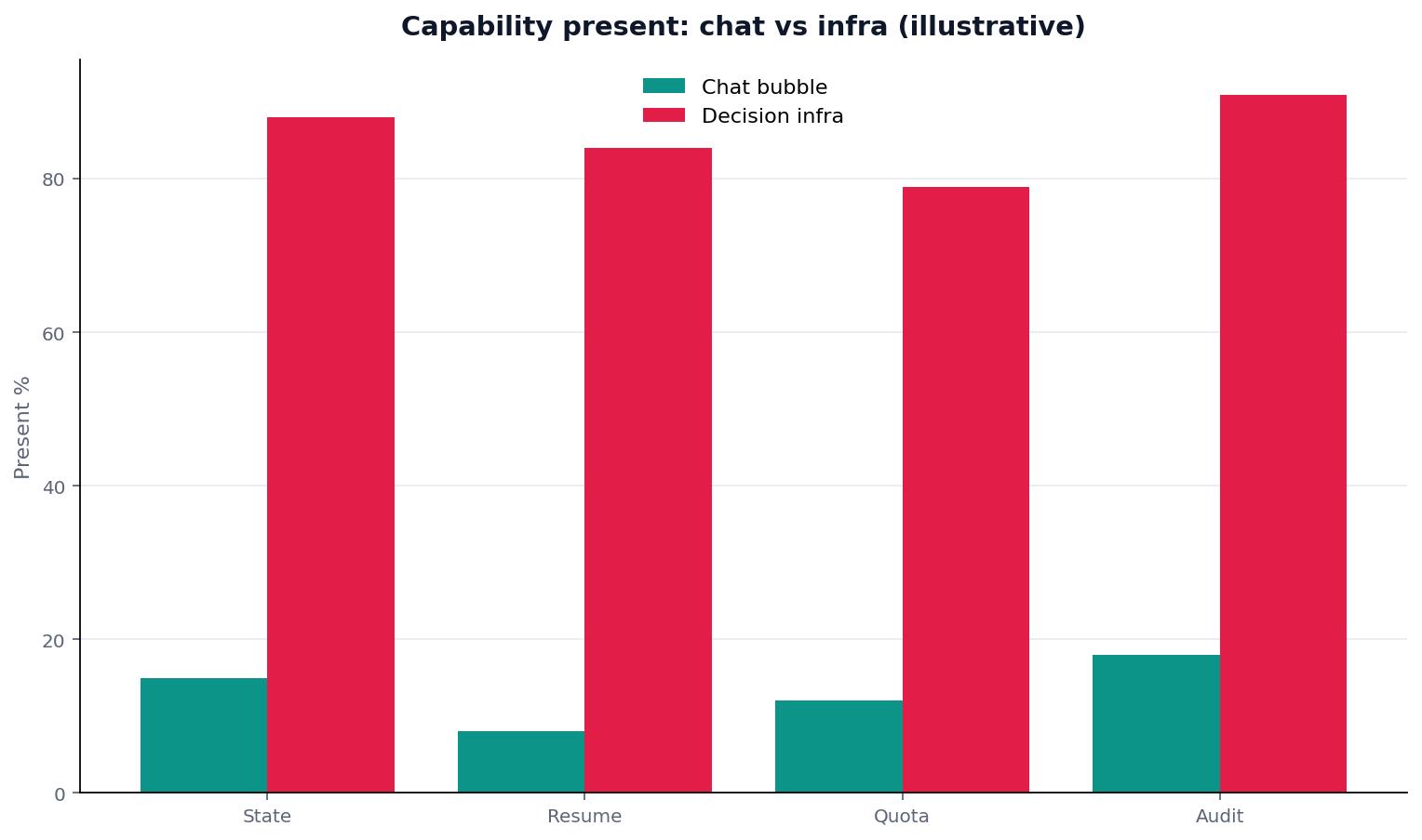
Figure. Teaching schematic. Not a measured study. Source: the protocol table above.
A teaching sketch used 8 sources, 42 views, 88 edges, and 12 jobs. Those figures are not a benchmark. Chat has the paragraph. Data infrastructure has state, resume, quota, and audit. Quote the protocol, not the bars.
How to score data infrastructure before you fund it
Score the last agent demo you ran. Data infrastructure is the “host” column.
| Signal | Stay in chat | Rebuild in-house | Host as shared data infrastructure |
|---|---|---|---|
| Unrelated apps need the same trail | No | Only if you will staff a platform team | Yes |
| Job must resume after a kill | No | Months of queue and checkpoint work | Yes |
| A human must veto before an action | Soft prompt only | Custom policy engine | Yes, as a gate on the job |
| Result must feed the next report | Copy-paste | One-off export scripts | Yes, as a named artifact |
| Secrets must not live in the page | Risky | You will re-implement isolation | Yes |
Host shared data infrastructure if two or more apps will ask analysis questions. Rebuild only if you have already staffed resume, audit, and tool governance and you accept that cost. Stay in chat if the question is disposable.
Failure modes
Most failures are shape failures, not model failures.
Treating the bubble as the system of record
A confident paragraph with no views and no gate cannot be reopened. Support will invent a second story. Data infrastructure stores the job, not the bubble.
Rebuilding the kernel inside every generated app
Each vibe-coded page grows its own queue, its own secret store, and its own half-resume. Unrelated apps cannot reuse it. That fails the first infra judgment. Put data infrastructure under the apps, not inside them.
No veto and no quota
If the model may call every tool, and nothing stops a loop, you do not have tool governance. Data infrastructure without a deny list is a demo with a longer timeout.
Those three failures are why this hub exists. The definition page asks what is data infrastructure when the worker is an agent, not a warehouse diagram. The unit page treats the decision job as input, views, evidence, gates, and artifacts rather than a table. The compiler page splits data infra from vibe coding so the shell does not swallow the trail. The architecture page maps data platform architecture as a runtime sitting beside the database. The build page scores building data infrastructure before you clone a graph framework and an object store. The failure page hosts data infrastructure and analytics paths for resume, dual timelines, and a missing veto.
If you cannot name those six jobs, you are still decorating a chat.
When the missing object is resume, quota, and audit around the job, read data ops. When the prompt box is being sold as a platform, use data infrastructure for AI.
When the question is weeks to host versus rebuild, score analytics infrastructure before you start a rewrite.
Start a named task, not a sync chat
Create a long task with a source and a goal, then watch progress events and files. This check uses only sources you authorize.
Commercial association: You do not need the workspace to complete the educational diagnosis on this page.
Open InfiniSynapseHow this page is sourced. William Zhu is cofounder of InfiniSynapse, public as GitHub @allwefantasy. Company self-description, not independent authority. No third-party prize is claimed. No personal LinkedIn is published. Evaluation basis: We evaluate (hands-on) by asking whether the runtime hosts a Decision Job—id, resume, quota—or only a chat bubble. First-party data infrastructure protocol dated 2026-09-02, replayed 2026-09-03. Reviewed internally by analytics engineering · data platform · LLM security · editor. Editorial standards · corrections · publishing principles · About · Privacy · Terms. Contact zhuhl@infinisynapse.com. COI: InfiniSynapse sells an AI-native Data Agent; the banner is a commercial association. The educational diagnosis does not require it. Fact-check: IBM, AWS ML Lens, ISO/IEC 27001, EC AI policy, Kubernetes docs, Wikipedia SQL as cited. Figures 8 / 42 / 88 / 12 are a teaching sketch. No external organization audited this page.
Frequently Asked Questions
What is data infrastructure?
Bottom line: Data infrastructure collects, stores, processes, and governs data, and hosts the job that uses it. The longer meaning sits on what is data infrastructure.
How often should teams review data infrastructure?
Bottom line: Review the five objects every quarter, and again when you add an agent or a new store. A stack that passed in January can fail when autonomy expands.
Is a warehouse the same as this runtime?
Bottom line: No. A warehouse stores facts. Data infrastructure hosts the Decision Job that reads those facts, names views, and keeps evidence.
Can vibe coding replace the kernel?
Bottom line: No. Vibe coding compiles the shell. Data infrastructure does the second compile: why the answer holds. Do not bury resume inside a generated page.
Do I need a new store before I host a job?
Bottom line: No. Bind sources you already authorize. Data infrastructure is identity, isolation, resume, quota, and gates—not another lake.
What if only one app will ever ask questions?
Bottom line: You may stay thinner. Shared data infrastructure pays off when a second unrelated app needs the same trail, veto, and artifacts.
How do I know the demo is past a demo?
Bottom line: Answer the five questions: origin, resume, model scope, veto, and flow. If any answer is missing, data infrastructure is not in place.
What on this page is citable?
Bottom line: Cite the protocol table, the five-object frame, and the six-source comparison. Do not cite the chart bars or the 8 / 42 / 88 / 12 sketch as measured results.
Conclusion
Data infrastructure for agents is not a prettier warehouse diagram and not a chat product. It is the runtime that hosts a Decision Job so a conclusion can be reopened, gated, and reused. Vibe coding can still compile the shell. The kernel must hold identity, isolation, resume, quota, and tool governance.
InfiniSynapse describes itself on About. Privacy and Terms apply. If you later use the workspace, open InfiniSynapse only with authorized, sanitized inputs.