Jev API for Data Agents: Safe Integration Guide
By William Zhu & the InfiniSynapse Data Team · Published: 2026-09-23 · Last updated: 2026-09-23 · Last verified: 2026-09-23 · Next review: 2026-12-23 · Editorial standards · Corrections
Author credentials: William Zhu is Cofounder of InfiniSynapse, with a public engineering identity at GitHub @allwefantasy. This developer guide was checked against current TypeSafe and Vercel documentation. It describes a proposed architecture and does not claim that InfiniSynapse currently integrates Jev.
Table of Contents
- TL;DR
- Integration status and evidence boundary
- Prerequisites
- The current request and response contract
- Seven executable integration steps
- Validation that catches real failures
- Failures, retries, and idempotency
- Safe fallback matrix
- Security controls for production
- Download the conceptual reference adapter
- Frequently Asked Questions
- Conclusion
TL;DR
Direct answer: The Jev API accepts shared state plus named, typed questions and returns answers that code can validate. Keep the API key on a trusted server, make Jev advisory rather than authoritative, persist the resolved model and probabilities, retry only transient failures, and place idempotency around the business action. A probability may route a job; it must not grant permission to pay, delete, publish, or write production data.
This Jev API page completes a developer task: prepare a bounded decision, call the current endpoint, validate the response, record it, and choose a safe fallback. The downloadable conceptual TypeScript reference adapter implements that boundary with no third-party dependencies. It has not been run against InfiniSynapse or live TypeSafe credentials.
We evaluated the published request shapes for this guide without adding a new live API call, and we use William Zhu’s separate public endpoint observation to test the Jev API fallback design below.
Integration status and evidence boundary
As of the verification date, TypeSafe documents Jev as a System One model for narrow typed judgments. The current official API reference documents POST https://api.typesafe.ai/v1/systemone, bearer authentication, a model, shared state, and named questions. That is an official interface fact, not an InfiniSynapse test.
Important: the architecture below is proposed. InfiniSynapse does not claim a current native Jev integration, production deployment, partnership, measured uptime, or first-party performance result. Before shipping, confirm the API, account terms, model availability, limits, and pricing in your own account.
For the runtime role before implementation, see Jev for AI agents. For an evidence-first release decision after implementation, use the separate Jev benchmark protocol rather than vendor multipliers.
Prerequisites
The Jev API prerequisites are a TypeSafe account and server-side API key, a backend capable of making HTTPS requests, a labeled validation set from your own decision domain, and an execution service that already enforces authorization. You also need a durable job identifier. If no job record exists, the Jev API result has nowhere auditable to live.
The TypeSafe model page currently maps the moving jev-latest alias to a versioned release and says versioned IDs are accepted. Use the alias while exploring; pin a tested version for a controlled release, and always persist the model string returned by the service.
Define the decision before writing code
Write one sentence for the decision, enumerate every allowed answer, identify the cost of a false positive and false negative, and choose the fallback before calling the Jev API. A useful first case is “may this generated report proceed to human review?” It is not “should the system publish whatever the model approves?”
Keep arithmetic, dates, row counts, permissions, and schema checks in deterministic code. TypeSafe’s own Jev 1.13 jaggedness note warns about numeric precision, counting, dates, literal wording, adversarial state, and long context. Those limits argue for a narrow semantic gate, not a universal policy engine.
The current request and response contract
The direct request has three top-level fields:
state: a string, object, or array containing the evidence to judge;model: for examplejev-latestor a pinned model ID;questions: a map whose keys are chosen by your application.
TypeSafe documents three primitives. Noul returns a yes probability. Choice selects one declared option and returns the full distribution plus confidence. Score evaluates ordered descriptive levels and returns a probability-weighted score, legend, distribution, and confidence. The official primitives guide is the source of truth for their exact shapes.
State is evidence, not instructions
Send only the fields necessary to decide. Prefer a stable object such as:
{
  "job_id": "job_01J...",
  "artifact_type": "weekly_revenue_report",
  "quality_checks": {
    "row_count_passed": true,
    "reconciliation_passed": true
  },
  "review_note": "Two regions use provisional FX rates."
}
Do not send database credentials, raw access tokens, unnecessary personal data, or hidden authorization rules. Treat user-controlled text inside state as untrusted data. The Jev API can judge it, but your application must still enforce policy.
Questions must be narrow and versioned
One possible Noul question is: “Does the evidence require manual review before release?” A Choice could route to finance_review, data_quality_review, or ready_for_review. Put question definitions and thresholds in a reviewed configuration file, assign a question_version, and store that version with every answer.
Avoid overlapping options such as billing_problem and payment_problem. A model can be confidently wrong when labels are ambiguous. Add examples to your validation set, not to production claims.
Seven executable integration steps
1. Accept a job, never a browser secret
The browser sends a job ID to your backend. The backend loads authorized, minimized state. The key remains in a server secret manager and is read into an environment variable at runtime. Never embed it in JavaScript delivered to a user.
2. Build a typed request
Construct state from allowlisted fields. Add the selected model and named questions. Reject an empty option set, duplicate labels, missing criteria, or an oversized state before the network call. This is also where you attach your internal decision_id and question version to the local record—not as invented Jev API fields.
3. Call the documented endpoint
Send Authorization: Bearer <API_KEY> and Content-Type: application/json to the endpoint. The reference adapter uses the platform fetch implementation, an abort timeout, and the official request shape. It does not claim that TypeSafe accepts an idempotency header, because the reviewed API documentation does not document one.
Vercel offers a separate, documented route. Its TypeSafe-compatible AI Gateway guide uses base URL https://ai-gateway.vercel.sh/typesafe, model typesafe-ai/jev, and POST /v1/systemone. Choose one provider path per environment; do not silently fail over between providers without recording that change.
4. Validate structure before semantics
Require a successful Jev API HTTP status, JSON object, returned model, answers object, and an answer for every requested key. For Choice, ensure the selected value belongs to your declared criteria and probabilities are finite and approximately sum to one. For Noul, require a finite value between zero and one. For Score, verify the legend and level probabilities.
Type correctness is not business correctness. A valid Choice can still choose the wrong team. The Jev API response passes only the transport gate at this step.
5. Convert the answer into an advisory decision
Map the validated answer to one of three outcomes: continue_to_review, escalate, or fallback. Do not map it directly to execute_payment or publish_report. Thresholds must come from held-out labels for the same task. If you have no validation set, default to escalation.
The Jev API supplies the signal; this local mapping owns the operational meaning.
6. Persist an audit record
Store the job ID, decision ID, question version, requested model, returned model, minimized state hash, answer, probability distribution, threshold, route, latency, attempt count, and error class. Do not log the bearer token or raw sensitive state.
This record connects the Jev API call to the decision job, where sources, evidence, gates, and artifacts share one identity. The broader data infrastructure hub explains why that identity belongs in the runtime rather than a chat transcript.
7. Execute through a separate authorized service
After the advisory route, call a deterministic policy gate. That service verifies the actor, tenant, resource, current job state, approval status, and idempotency key. Only then may an allowed side effect occur. The Jev API never owns the credential or permission for that action.
Validation that catches real failures
Create contract tests with recorded synthetic responses for each primitive, unknown answer types, missing keys, malformed probabilities, and non-JSON bodies. Then create task tests with labeled examples that include ambiguous and adversarial text. Report accuracy by class, abstention or escalation rate, and high-risk false positives.
Run a shadow stage first: the Jev API produces a record while the existing route remains authoritative. Compare disagreements. Promote only after a human approves thresholds and fallback behavior. This is a release process, not a benchmark claim.
The Vercel AI SDK provider documentation shows another supported client shape using experimental_evaluate, evaluationModel('jev-latest'), and Choice, Score, and Boolean answers. That format calls a provider adapter; do not mix its boolean naming with TypeSafe’s direct noul request in one validator.
Failures, retries, and idempotency
Classify failures before retrying
The official Jev API reference lists 401 for a missing or invalid key and 422 for request validation. These are terminal until configuration or payload changes. It lists 429 for rate limiting and 529 for overload; those are transient and should use exponential backoff. Timeouts and connection failures are uncertain outcomes, so record them and take the safe fallback.
That fallback is supported by founder-reported operating evidence, not just defensive theory. In a public 10-call serial check during an 11-minute window, the official endpoint completed 4/10 calls; the six failures were one read timeout, two remote disconnects, two 503 responses, and one 529 system_overloaded. Successful calls took 0.64–1.61 seconds. This is a short observational window, not an uptime estimate, but it is enough to test every Jev API failure branch before release.
Use a small retry budget, full jitter, and a deadline for the whole decision. A practical policy is at most three attempts inside the job’s latency budget. Do not retry malformed requests, and never run an unbounded loop.
HTTP semantics in RFC 9110 help separate safe network retries from application side effects, but they do not create business idempotency for you. Even if an evaluation is logically read-only, a retry can still consume quota and produce a different model result.
Put idempotency around execution
Derive an execution key from job_id + action_type + artifact_version. Insert it into a database table with a uniqueness constraint before the side effect. If the key already exists, return the prior outcome. The Jev API decision record may have several attempts; the downstream action must have at most one committed execution.
This distinction matters after a timeout. You may repeat a judgment, but you must not repeat a payment, deletion, production write, or publication. Data ops covers the resume and audit path around the same job ID.
Safe fallback matrix
| Condition | Route | Reason |
|---|---|---|
| 401 or 422 | Stop and alert owner | Retrying cannot repair credentials or schema |
| 429 or 529 after budget | Existing deterministic route | Availability must not weaken policy |
| Timeout or malformed answer | Human review | Outcome is unknown |
| Low confidence or close Choice probabilities | Stronger model or human | Uncertainty is the signal |
| High-risk action | Human approval plus policy gate | Probability is not authorization |
| Read-only, reversible suggestion | Queue for review | Lower blast radius permits automation |
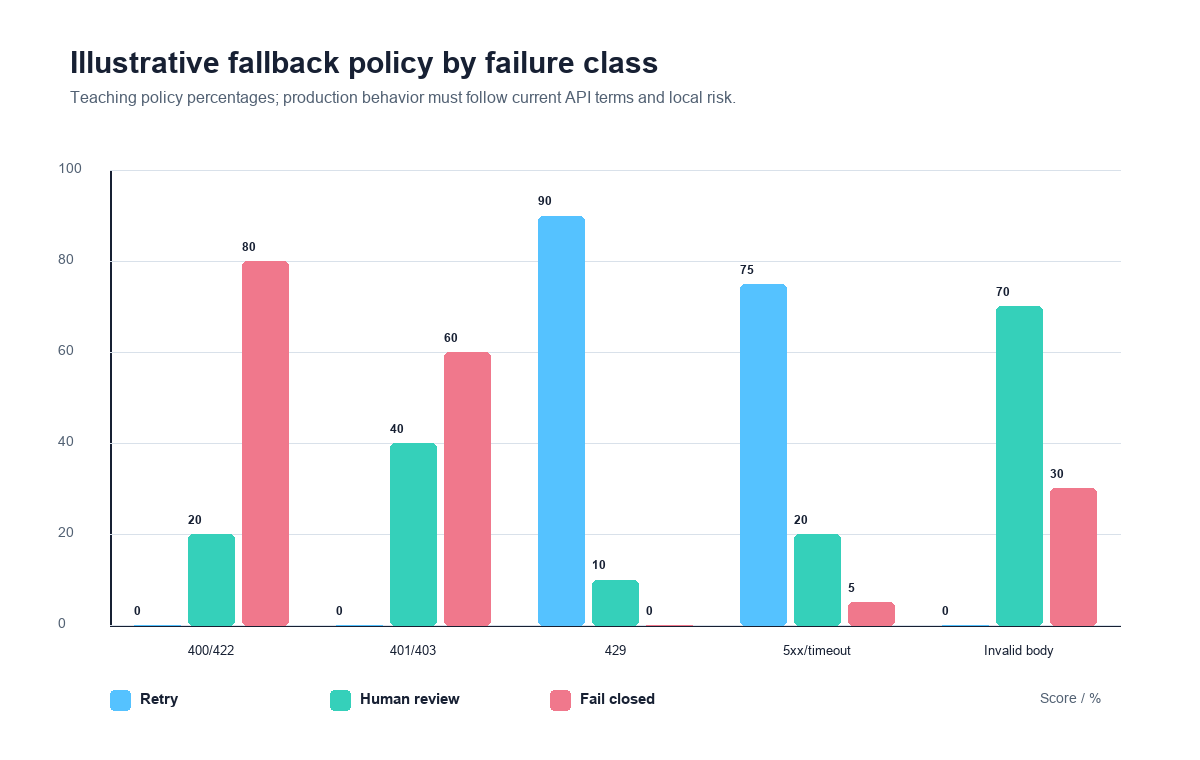
Figure. Illustrative fallback policy; production behavior must follow current API terms and local risk.
For the Jev API, fail closed does not always mean stop the entire data product. It means preserve the previous safe route. A report can remain a draft; a routing suggestion can enter a review queue; a dashboard can show “decision unavailable.”
Security controls for production
Keep the Jev API key server-side, rotate it, restrict access to the service identity, and redact it from logs. OWASP’s API Security project is useful for reviewing broken authorization, resource consumption, inventory, and unsafe API consumption around the adapter.
Minimize state and define retention. Hash state only if a hash is sufficient for audit; otherwise encrypt the necessary snapshot and apply the same access controls as the source. Record provider and resolved model because a moving alias can change behavior without a code deploy.
Download the conceptual reference adapter
The downloadable TypeScript adapter includes Jev API request construction, timeout handling, status classification, bounded backoff, response checks, an audit-record shape, and a separate execution-idempotency key helper. It is conceptual and credential-free: we did not run it against a TypeSafe account. Review it against current docs, your runtime, and your security policy before use.
Frequently Asked Questions
What endpoint does the Jev API use?
Bottom line: TypeSafe currently documents the direct System One endpoint shown above. Vercel’s compatible gateway uses its own base URL and model naming. Verify both at implementation time.
Can I expose the API key in a frontend app?
Bottom line: No. A frontend secret is recoverable by users. Call the Jev API from a trusted backend and expose only your authorized job endpoint.
Should I retry every error?
Bottom line: No. Retry documented transient statuses such as 429 and 529 with bounded exponential backoff. Fix 401 and 422 instead of retrying them.
Does a high confidence score authorize an action?
Bottom line: No. Confidence can route a decision. Authorization belongs to deterministic policy and, for high-risk actions, a human approval.
Does InfiniSynapse currently integrate Jev?
Bottom line: This article does not claim that. It presents a proposed architecture and an uncredentialed conceptual adapter for evaluation.
Conclusion
A safe Jev API integration is a narrow decision boundary: minimized state in, typed answer out, validation and audit in the middle, and deterministic authorization after it. Keep the key on the server, preserve the resolved model, retry only transient failures, and make downstream execution idempotent. Most importantly, retain a safe fallback. A decision signal can improve routing without becoming the owner of the action.