Decision Job: Name the Unit, Then Host (2026)
By William Zhu & the InfiniSynapse Data Team · Published: 2026-09-02 · Last updated: 2026-09-03 · Last verified: 2026-09-03 · Next review: 2026-12-02 · Editorial standards · Corrections
Author credentials: William Zhu, Cofounder of InfiniSynapse. Public identity: GitHub @allwefantasy. Profile and review roles: editorial standards. This page is signed by a named person, not an anonymous editorial org. No personal LinkedIn is published. No third-party prize, media review, or independent endorsement is claimed.
Table of Contents
- TL;DR
- What a decision job actually contains
- A six-row frame for the unit
- Chat turn, warehouse table, or decision job
- Landscape: hosts, shells, and stores
- How to create one hosted job
- Desk sample: first-party six-part protocol
- Scorecard: name the job or keep the bubble
- Failure modes
- Frequently Asked Questions
- Conclusion
TL;DR
Direct answer: A decision job is the unit of agentic data work: one identity that carries input, authorized sources, named intermediate views, evidence, gates, and artifacts. It is not a warehouse table and not a chat turn. Create one decision job, keep one timeline, and refuse a second story in Slack when the model stalls.
We review these patterns at the InfiniSynapse desk on sanitized composites. Figures on this page are illustrative, not customer uplifts.
What you'll learn:
- The six parts that make a decision job a unit, not a paragraph
- How a table, a chat turn, and a decision job own different objects
- A sequence that names sources, views, and a gate before a memo
- When to split a decision job and when to keep one id
- How this unit sits under the data infrastructure hub
What a decision job actually contains
Key Definition: A decision job is one hosted identity that carries input, authorized sources, named intermediate views, evidence, gates, and artifacts. It is not a table and not a chat turn. Reviewers reopen the same decision job id, not a transcript, when they ask where a number came from.
Teams still treat “the analysis” as either a warehouse object or a fluent reply. A decision job is neither. The warehouse object is an input. The reply is a symptom. The unit is the job that binds them.
Independent published context (retrieved 2026-09-02). IBM’s augmented analytics, Snowflake’s Cortex Analyst, and AWS Redshift did not run this fixture.
| Cited source | What it owns | What tonight still needs |
|---|---|---|
| IBM augmented analytics | Analysis as a governed process | A process with an identity |
| Snowflake Cortex Analyst | Question to SQL on governed data | Views, evidence, and a gate on one id |
| AWS Redshift | A store and a query engine | Point the unit at it; do not replace it with a cluster name |
| Apache Spark | A compute graph called a job | An analysis unit, not a compute unit |
| Apache Airflow | Scheduled DAGs that load sources | A load is not an analysis identity |
| Python docs | A script that can mint views | Views without a hosted id are not the unit |
Use that process bar when you name a decision job. A process without an identity is a sitting.
Six parts, one identity
A complete decision job names six parts:
- Input — the question, the constraint, and the artifact you will accept.
- Sources — grants, not pasted files, that the tenant already authorizes.
- Named intermediate views — each step is an object a human can reopen.
- Evidence — row counts, nulls, and the SQL or plan that produced them.
- Gates — deterministic checks plus a human veto before publish.
- Artifacts — the memo, file, or next-job input that leaves the runtime.
If any part is missing, you still have a demo. A decision job exists only when those six share one timeline.
A bounded model route is one event on that timeline, not a seventh authority. The Jev agent inside one job ID page shows how to store its typed decision, confidence, evidence reference, fallback, and eventual runtime action under the same job ID.
Why a table is not the unit
A table answers “where do facts rest.” A decision job answers “which work produced this conclusion.” Facts matter. They are sources. They are not the unit.
AWS Redshift (table above) is a reminder that a warehouse is a store and a query engine. You can point a decision job at Redshift. You cannot replace the job with a cluster name.
Explainable AI for data analysis covers the trail a reviewer opens. This page names the object that holds that trail: the decision job.
A six-row frame for the unit
Mature work uses a six-row frame. Each row is a field on the decision job, not a slide title.
| Part | What it holds | Acceptance signal |
|---|---|---|
| Input | Question, constraint, accepted artifact | A reviewer can reject the job without watching a recording |
| Sources | Authorized grants and schemas | Secrets never sit in the browser |
| Named views | Intermediate tables the agent named | A wrong join is an object, not a vibe |
| Evidence | Counts, nulls, plan, step events | A second person can replay the same grain |
| Gates | Row, null, recon, human veto | The model cannot publish past a failed gate |
| Artifacts | Memo, file, next-job input | The result can leave without a Slack rewrite |
Apache Spark documentation (table above) shows how easy it is to treat a job as a compute graph. A Spark job is a compute unit. A decision job is an analysis unit. Do not swap the words because both say “job.”
What a reviewer must reopen
A reviewer of a decision job must reopen three things without asking the model to “glance again”:
- The named view that produced the quoted grain
- The evidence that the gate saw
- The artifact that left, if any did
If those three live in three tools with three ids, you do not have a decision job. You have a scavenger hunt.
Choose the six-row frame if the number will be quoted outside the sitting. Choose a disposable chat if the question dies in the same hour and nobody will audit it.
Chat turn, warehouse table, or decision job
Teams collapse three objects into one meeting title. Only the third is a decision job.
| Approach | Owns | Choose it if | Reject it if |
|---|---|---|---|
| Chat turn | A paragraph | The question is disposable | You need resume, veto, or a second consumer |
| Warehouse table | Facts at rest | You lack a durable grain | You think a table hosts the analysis unit |
| Pipeline run | A scheduled load | You need freshness of tables | You need an agent’s named views and gates |
| Decision job | One identity across six parts | Unrelated apps must reuse the same trail | You only have a weekend prototype |
Choose a chat turn if the sitting ends the question. Choose a table if the missing object is a fact. Choose a pipeline run if the missing object is freshness. Choose a decision job if the missing object is work that must survive the tab.
Airflow documentation (table above) is the language of scheduled DAGs. A DAG can load sources a decision job later reads. The DAG is not the decision job. Scheduling a load is not hosting an analysis identity.
Python documentation (table above) shows how a script can look like a complete analysis. A script can mint views. Without a hosted id, those views are still not a decision job.
Agentic analytics describes the multi-step narrative shape. This page stays on the unit: the decision job that the narrative must sit on.
Landscape: hosts, shells, and stores
The 2026 landscape keeps renaming four layers. A decision job lives on only one of them.
- Generated UI. The shell compiles intent into routes. It may start a decision job. It must not store the six parts in the page.
- Agent framework. Graphs and tool helpers. Useful. Still not a decision job host unless they persist identity and resume.
- Warehouse and engines. Facts at rest. A source for the decision job, not the job.
- Hosted kernel. Runtime, isolation, resume, quota. This is where a decision job gets an id.
The data infra page splits the two compilers: vibe shell versus why the answer holds. Read it after you can name the six parts of a decision job. Compilers without a unit become another slogan.
Apps keep the veto
Pattern note, not a review: a mole-style research desk, a ProjectValueLab-style valuation desk, and a DataForNGO-style reporting desk can each start a decision job on one kernel. Each app keeps domain rules, the veto, and the final action. The kernel hosts the decision job. The apps do not become the unit.
If the product already exists and you only need a slot on a screen you own, stay with embed an AI data analyst. Embedding consumes a decision job. It does not invent a second unit.
Do not mint a new decision job id every time the user types. That is how dual timelines start. One question, one id, until a reviewer splits it on purpose.
How to create one hosted job
Use this sequence when you want a hosted unit you can defend in a review. Inputs and acceptance signals sit with each step.
- Write the input as a rejectable object. Name the question, the constraint, and the artifact you will accept. Acceptance: a second person can refuse the job without watching you type.
- Bind sources as grants. Point at a warehouse, a database, or a file the tenant already authorizes. Acceptance: no secret in the prompt.
- Require named intermediate views. Each step produces a view with a name. Acceptance: a wrong join is a named object.
- Attach evidence and a gate. Row counts, nulls, recon, and a human veto sit on the same job. Acceptance: a failed gate blocks the artifact.
- Persist one identity. The same id reopens in
/tasksor the calling app. Acceptance: killing the tab does not mint a second job. - File the artifact or stop. The memo, file, or next-job input leaves only after the gate. Acceptance: Slack is not the system of record.
When to split a job
Split the unit when the input changes grain, the source grant changes, or a reviewer rejects the artifact and asks a different question. Do not split because the model retried. A retry is the same job. A new question is a new job.
If step 5 is missing, you do not have the unit. You have a longer chat.
Desk sample: first-party six-part protocol
Cite this decision job protocol. Do not cite a customer percentage, an 8 / 42 / 88 figure, or the chart bars as a study.
First-party method log (replayable):
| Field | Record |
|---|---|
| Operator | InfiniSynapse Data Team; William Zhu, public as GitHub @allwefantasy |
| First run | 2026-09-02 |
| Replay / last verified | 2026-09-03 |
| Input | One authorized, sanitized weekly units pack; no secrets |
| Paths compared | Six-part hosted unit vs a parallel chat with no id |
| Parts scored | 6 (input, sources, named views, evidence, gates, artifacts) |
| Scorecard rows | 5 |
| Acceptance | One id; resume after kill; failed gate stops the memo |
| Fail | Fluent paragraph; no id; a second story |
We created one unit with sources, views, and a gate, then kept a single timeline. The 2026-09-03 replay used the same fail. That is a first-line decision job replay, not a customer case. Review: editorial standards.
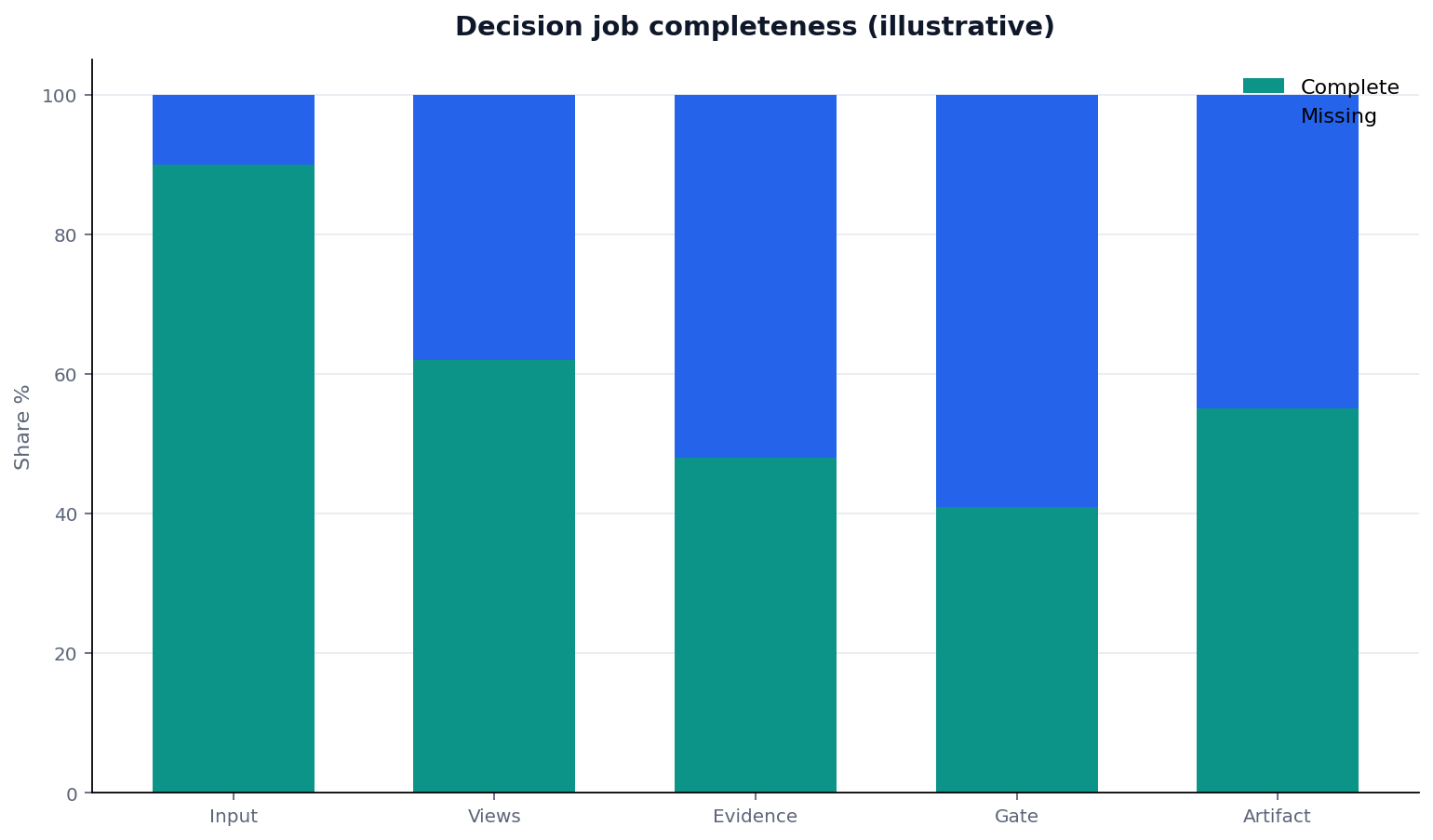
Figure. Teaching schematic. Not a measured study. Source: the protocol table above.
A teaching sketch used 8 sources, 42 views, and 88 edges. Those figures are not a benchmark. Quote the protocol, not the bars.
Scorecard: name the job or keep the bubble
Score the last analysis you quoted. The unit is the “name the job” column.
| Signal | Keep the bubble | Name the unit | Split into two jobs |
|---|---|---|---|
| The number will be quoted next week | No | Yes | Only if the grain changed |
| You can point at named views | Rarely | Required | Each job needs its own views |
| A human must veto before action | Soft prompt only | Gate on the job | Do not share one veto across grains |
| The model stalled and retried | New chat, new story | Same id | No — retry is not a split |
| A second app must reuse the trail | Copy-paste | Same job artifact | New input, new job |
Name the unit if anyone outside the sitting will quote the number. Keep the bubble if the question dies today. Split only when the input or grant actually changed.
Data infrastructure and analytics hosts the failure paths—resume, dual timelines, missing veto—that the unit must survive. Read that page after you can name the six parts.
Failure modes
Most failures are unit failures, not model failures.
Missing intermediate views
The unit with only a final paragraph cannot show the broken join. Reviewers argue about the number because they cannot point at a view. Name the intermediates or admit you do not have the unit.
Dual timelines for one question
Two chats, two ids, one question. Support picks the prettier paragraph. The unit forbids that. One question keeps one timeline until a reviewer splits it.
Gate after the memo
If the artifact left before the gate, the job is already a leak. Hold the memo. A late assert is a postmortem, not a gate.
Those three failures are why the unit exists. The hub on data infrastructure hosts the runtime around the job. This page stays on the unit itself.
Create one decision job with sources and gates
Start a task that names sources, views, and a gate before it writes a memo. This check uses only sources you authorize.
Commercial association: You do not need the workspace to complete the educational diagnosis on this page.
Open InfiniSynapseHow this page is sourced. William Zhu is cofounder of InfiniSynapse, public as GitHub @allwefantasy. Company self-description, not independent authority. No third-party prize is claimed. No personal LinkedIn is published. Evaluation basis: We evaluate (hands-on) by creating one Decision Job with sources, views, and a gate, then keeping a single timeline. Protocol dated 2026-09-02, replayed 2026-09-03. Reviewed internally by analytics engineering · data platform · LLM security · editor. Editorial standards · corrections · publishing principles · About · Privacy · Terms. Contact zhuhl@infinisynapse.com. COI: InfiniSynapse sells an AI-native Data Agent; the banner is a commercial association. The educational diagnosis does not require it. Fact-check: IBM augmented analytics, Snowflake Cortex Analyst, AWS Redshift, Apache Spark, Apache Airflow, and Python docs as cited. Figures 8 / 42 / 88 are a teaching sketch. No external organization audited this page.
Frequently Asked Questions
Is a warehouse table the unit?
Bottom line: No. A table stores facts. The unit is the hosted object that reads those facts, names views, and keeps evidence.
Is a chat turn enough if the answer looks right?
Bottom line: No. A fluent paragraph has no id. The unit is the object you reopen when the model stalls.
Can two apps share one unit?
Bottom line: They can consume the same artifact. They should not write two timelines for one question. Shared job identity lives on the kernel, not in each page.
When do I start a second unit?
Bottom line: When the input, grain, or grant changes. A retry is the same job. A new question is a new job.
How do I know the unit is complete?
Bottom line: Point at input, sources, views, evidence, gates, and artifacts on one id. If any part is missing, the job is still a demo.
What on this page is citable?
Bottom line: Cite the decision job protocol table, the six-row frame, and the six-source comparison. Do not cite the chart bars or the 8 / 42 / 88 sketch as measured results.
Conclusion
The unit is not a table and not a chat turn. It is one identity that carries input, sources, named views, evidence, gates, and artifacts so a conclusion can be reopened and reused. Vibe coding can still compile the shell. The unit must stay a Decision Job.
InfiniSynapse describes itself on About. Privacy and Terms apply. If you later use the workspace, open InfiniSynapse only with authorized, sanitized inputs.