Jev vs LLM: Which Model Should Your Agent Use?
By William Zhu & the InfiniSynapse Data Team · Published: 2026-09-23 · Last updated: 2026-09-23 · Last verified: 2026-09-23 · Next review: 2026-10-23 · Editorial standards · Corrections
Author credentials: William Zhu is Cofounder of InfiniSynapse, with a public engineering identity at GitHub @allwefantasy. The InfiniSynapse Data Team reviews data-agent architecture and evidence boundaries. Product statements about Jev are attributed to TypeSafe AI; no vendor benchmark is presented as an InfiniSynapse result.
Table of Contents
- TL;DR
- Jev vs LLM at a glance
- Choose code when the answer is deterministic
- Choose Jev for a bounded semantic judgment
- Choose an LLM for open-ended generation
- Choose a human for accountable exceptions
- A four-layer allocation model
- One task assigned three ways
- Five data-agent decision examples
- Transparent comparison criteria
- How the selection matrix scores a task
- Worked example: route an ambiguous metric request
- Deployment checks after selection
- A proposed InfiniSynapse architecture
- Evidence limits
- Frequently Asked Questions
- Conclusion
TL;DR
Direct answer: Jev vs LLM is not a contest between interchangeable models. Use deterministic code when rules fully specify the answer. Evaluate Jev when the answer space is fixed but semantic judgment is needed. Use an LLM when the task must discover, reason through, or generate open-ended content. Add human review when consequences or policy require accountable approval.
TypeSafe describes Jev as a System One decision model that accepts state plus Choice, Score, or Noul questions and returns typed answers with probabilities. An LLM generates token sequences and can produce explanations, plans, code, and other open-ended artifacts. Both can make wrong judgments. A valid enum is not automatically a valid business decision, and valid JSON from an LLM does not make the values true.
We evaluated public Jev vs LLM contracts for this comparison without adding a new model run, and we incorporate William Zhu’s previously published first-party comparison as a labeled case below.
This comparison publishes its criteria and a downloadable selection matrix with a worked example. It presents a proposed architecture, not a claim that InfiniSynapse currently integrates Jev. InfiniSynapse has not independently reproduced TypeSafe AI's latency, cost, or accuracy claims.
Jev vs LLM at a glance
The practical Jev vs LLM decision starts with the output contract, not model size.
| Criterion | Deterministic code | Jev decision model | Generative LLM | Human reviewer |
|---|---|---|---|---|
| Best answer space | Exactly specified | Bounded candidates or rubric | Open or discoverable | Policy and exception space |
| Typical output | Boolean, number, enum | Choice, Score, Noul + probabilities | Text, code, plan, structured generation | Approval, correction, rationale |
| Semantic judgment | Only encoded rules | Core use | Core use | Core use |
| Free-form generation | No | No | Yes | Yes |
| Owns side effects | Yes, under authorization | No | No | Approves where required |
| Main failure | Bad rule or implementation | Wrong valid judgment | Wrong, fabricated, or malformed content | Inconsistency, delay, bias |
| Required control | Tests and permissions | Evaluation, thresholds, fallback | Validation, grounding, evaluation | Clear queue, evidence, accountability |
TypeSafe's Jev launch article says possible outputs are defined in advance and reports major speed and efficiency advantages over LLMs on its chosen System One tasks. Those performance figures are vendor-reported. They should inform a benchmark plan, not settle a procurement decision.
Criterion 1: output contract
Jev returns a decision from a contract designed around known options, ordered levels, or a yes probability. An LLM can produce an open-ended sequence and can also be constrained to a schema.
In a Jev vs LLM assessment, write the required output before choosing the model. The distinction is not simply “structured versus unstructured.” OpenAI's Structured Outputs documentation says supported models can match a supplied JSON Schema, but it also states that models can still make mistakes within the values and can fail because of refusal or truncation. Therefore, Jev vs LLM compares the task each model is optimized to perform, not whether either can emit JSON.
Criterion 2: known options or an open answer space
Ask whether the correct answer is already in the candidate set.
- A Jev vs LLM review should mark whether “none of the above” is valid.
- “Which of these three approved metric definitions applies?” is bounded.
- “Find the missing metric definition and propose one” is open.
- “Calculate the variance from these two numbers” is deterministic.
- “Approve publication despite an unresolved policy exception” is accountable human work.
If candidates may be missing, force-fitting the task into Choice creates false completeness. If the answer is fully determined by a formula, sending it to either side of Jev vs LLM adds uncertainty without value.
Criterion 3: type correctness or judgment correctness
Type correctness means the result obeys the interface: a declared enum, score, probability, or schema. Judgment correctness means the selected value is right for the case.
These are separate tests in every Jev vs LLM comparison. Jev can return the wrong valid option. An LLM can return schema-valid JSON containing a wrong explanation or number. Code can enforce a flawed rule. A human can approve inconsistently. Selection must include an evaluation plan rather than assuming one model family removes error.
Criterion 4: latency, cost, and workflow complexity
Latency and cost matter only after the task contract fits. A cheap, fast wrong layer is still wrong. A capable LLM may be justified when it must synthesize documents; it may be wasteful for repeated binary triage.
The Jev vs LLM review should measure end-to-end latency, retry behavior, manual-review rate, and high-consequence error cost on the same labeled tasks. Do not compare a vendor's optimized classifier workflow with an unrelated long-form prompt and call the result universal.
Choose code when the answer is deterministic
Code should win before Jev vs LLM is considered when a rule, lookup, permission, or formula fully determines the result.
Use code for:
- SQL calculations and reconciliations;
- schema and type validation;
- access-control checks;
- hard policy constraints;
- idempotency and retry limits; and
- execution of approved side effects.
For example, if a report may publish only when every required field exists and a named approver signed, code can test those facts. A model may help classify ambiguous evidence, but it should not replace the enforceable gate.
That result is a valid Jev vs LLM outcome: choose neither model for the deterministic gate.
Choose Jev for a bounded semantic judgment
Choose Jev for evaluation when the correct answer must come from a developer-defined set, the distinction depends on meaning rather than an exact rule, and a fallback catches uncertainty.
The Jev vs LLM boundary favors Jev only for the bounded part. Good Jev vs LLM candidates include routing a ticket among known queues, scoring evidence against ordered levels, selecting among approved data sources, or deciding whether supplied text expresses a defined intent. The application should retain probabilities and question versions, and it should provide an abstain or human route where the candidate set can be incomplete.
Read Jev AI for the definition and the Choice, Score, and Noul boundaries. The forthcoming Jev for AI agents page owns the detailed routing architecture.
Choose an LLM for open-ended generation
Choose an LLM when the task must produce or discover content that cannot be enumerated in advance: a plan, SQL draft, explanation, root-cause narrative, transformation, or synthesis across sources.
In Jev vs LLM terms, generation is the LLM's clear side of the boundary. Anthropic's building effective agents guide recommends simple, composable patterns and describes routing as classifying an input before directing it to a specialized follow-up task. That supports a layered Jev vs LLM design: a bounded classifier can route, while an LLM performs the open-ended work.
An LLM still needs evidence references, output validation, tool restrictions, and evaluation. Structured generation is useful, but schema adherence does not confer factual accuracy.
Choose a human for accountable exceptions
A human belongs in the allocation when the consequence is high, policy requires named approval, the evidence is contested, or no evaluation set can justify autonomous action.
Google Cloud's human-in-the-loop architecture guidance describes checkpoints where a person can approve, reject, correct, or provide input before an agent continues. The tradeoff is operational complexity: a review queue, response target, evidence packet, and escalation owner must exist.
Human review is not a decorative final step or a tie-breaker in Jev vs LLM. In a serious Jev vs LLM architecture, it is an explicit state with a reason code and a resumable job.
A four-layer allocation model
The recommended allocation is:
- Code for permissions, calculations, hard constraints, and side effects.
- Jev or another evaluated decision model for bounded semantic judgments.
- LLM for open-ended interpretation, planning, and generation.
- Human for high-consequence approvals and unresolved exceptions.
Google Cloud's agentic architecture component guide recommends considering task complexity, latency, performance, and cost, and describes model routing as a way to reserve stronger models for complex work. The four-layer model adds two controls often omitted from a binary Jev vs LLM debate: deterministic code before the models and accountable review after them.
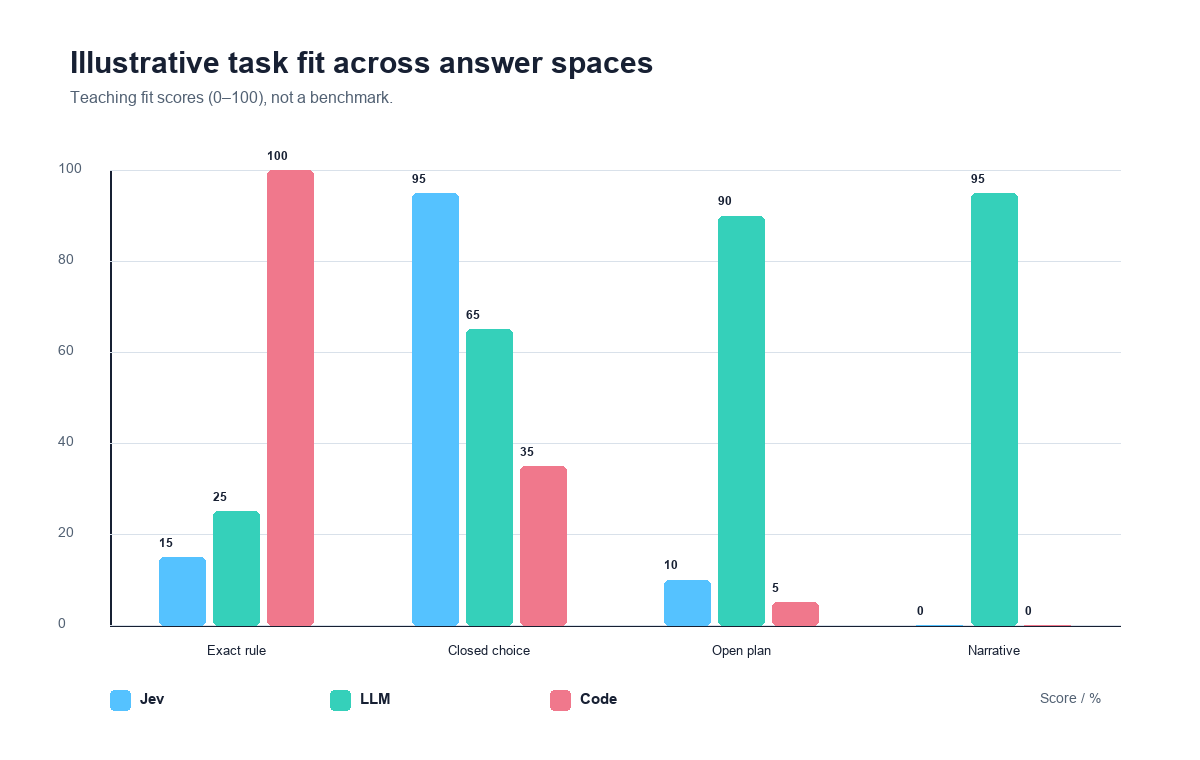
Figure. Illustrative task-fit scores for teaching, not a model benchmark.
Separate the decision signal from execution authority
Neither Jev nor an LLM should implicitly own a destructive action. A decision response should enter job state. Code then evaluates permissions, thresholds, mandatory approvals, and idempotency before any tool executes.
This separation makes errors recoverable. A wrong route can be corrected without pretending the model had database authority. The decision job provides the durable unit for state, intermediate views, evidence, gates, and artifacts.
Escalate on consequence as well as uncertainty
Low confidence is one reason to escalate. High consequence is another. A model can be highly confident and wrong, so mandatory approvals must not disappear above a probability threshold.
Design a two-axis policy:
| Consequence | Model confidence | Action |
|---|---|---|
| Low | High | automate with logging |
| Low | Low | retry, stronger model, or sample review |
| High | High | human approval remains mandatory |
| High | Low | block and escalate with evidence |
The Jev vs LLM choice affects how a signal is produced. It does not define who is accountable for acting on it.
One task assigned three ways
Consider: “Route this analysis request.”
The same input makes the Jev vs LLM boundary visible when each layer receives only the work it can complete.
Code-only version: match exact request tags to an owner table. This is best when tags are reliable and complete.
Jev version: present the request state and a Choice among approved queues, including needs_review. This fits when wording varies but the destination set is stable.
LLM version: interpret the request, identify missing details, propose a plan, and explain why several teams may need to collaborate. This fits when the destination or work plan is not known in advance.
The comparison is not about which model is “smarter.” It is about which contract completes the task with the least unnecessary freedom.
A public founder-run Jev vs LLM test makes that boundary concrete. On 79 Apple 10-K question-document pairs, Jev 1.13 and the production DeepSeek Flash baseline each reported 92.2% accuracy; Jev averaged 1.0 second versus 11.3 seconds and retained 25/25 gold documents. The result supports testing Jev for this bounded relevance decision only—it does not establish superiority on generation or other domains.
Five data-agent decision examples
| Data-agent task | Recommended primary layer | Why | Fallback |
|---|---|---|---|
| Calculate month-over-month revenue | Code | Exact arithmetic | fail validation |
| Select one approved source for a known metric | Decision model | Bounded semantic match | abstain or human |
| Draft SQL for a novel question | LLM | Open-ended generation | validate and review |
| Rate whether evidence is sufficient | Decision model + code | Rubric judgment, then enforce gate | stronger model or human |
| Publish a regulated report | Human + code | Accountable high-consequence approval | block |
These allocations are hypotheses to test. The same task can move between layers when its answer space, evidence, or consequence changes. The Jev data analysis sibling will cover use cases and failures in more depth.
Transparent comparison criteria
Use these seven criteria for every Jev vs LLM decision:
- Determinism: Can code derive the answer exactly?
- Boundedness: Are all valid answers known before inference?
- Generation need: Must the system create novel text, code, or a plan?
- Semantic load: Does meaning, rather than a lookup, determine the result?
- Consequence: What happens if the answer is wrong?
- Verifiability: Can a labeled set or deterministic validator test it?
- Fallback quality: Can the system abstain, retry, use another layer, or wait for a person?
NIST's Generative AI Profile frames risk management around context, risk tolerance, testing, evaluation, and human-AI configurations. It does not supply a universal confidence threshold. Teams must define thresholds and controls for their use case.
How the selection matrix scores a task
Download the Jev vs LLM selection matrix. It publishes every criterion, weight, option score, formula, and worked example. The matrix is an original decision aid, not an empirical performance benchmark.
Each criterion has a weight from 1 to 5. Each candidate layer receives a score from 0 to 3. Multiply weight by score and sum by layer. Then apply two hard overrides:
- if
exact_rule_available = yes, code is primary; - if
high_consequence_requires_named_approval = yes, human review is mandatory.
The weighted result helps expose assumptions; it does not authorize deployment. Validate the selected layer on representative cases.
Worked example: route an ambiguous metric request
The included worked example asks which layer should route a request for “weekly active accounts” when three approved definitions exist.
- No exact rule selects among definitions because request context matters.
- The candidate set is bounded.
- Semantic judgment is required.
- No free-form output is needed for the route.
- A wrong route has high reporting consequence.
- A labeled set can be built from previously adjudicated requests.
The matrix gives the decision-model column the highest suitability score for the narrow route. The human column is mandatory because consequence is high, so the operational answer is decision model proposes; human resolves low-confidence or ownership conflicts; code enforces the gate. An LLM may explain the selected definition afterward.
This is a hypothetical, reproducible worked example. It is not a claim that InfiniSynapse tested Jev on production requests.
Deployment checks after selection
Before deploying either side of Jev vs LLM, record:
- task definition and excluded tasks;
- input-state construction and data authorization;
- model and question or prompt version;
- representative labeled evaluation set;
- accuracy, calibration where relevant, and high-risk error rate;
- p50 and p95 end-to-end latency;
- cost including retries and human review;
- abstain, timeout, and provider-outage behavior;
- tool permissions and side-effect controls; and
- rollback owner and review date.
Do not infer universal superiority from one provider demo. Compare layers on the same cases and count the cost of the entire workflow.
A proposed InfiniSynapse architecture
Under the data infrastructure hub, a proposed Decision Job could store the request, candidate definitions, evidence references, decision response, thresholds, approval, and final artifact. Code would own authorization and execution. Jev could provide a bounded route. An LLM could produce the explanation or SQL. A human could resolve high-impact exceptions.
This is explicitly a proposed architecture. It is not a claim that InfiniSynapse currently integrates Jev. A future integration would require current API review, security and retention review, representative evaluation, failure testing, and product documentation.
Evidence limits
As verified on 2026-09-23, Jev was newly announced and official sources were concentrated in TypeSafe AI and integration partners. TypeSafe's speed, efficiency, calibration, and comparison figures remain vendor evidence until independently reproduced under a disclosed protocol.
The Jev vs LLM criteria on this page are transparent but normative: they organize engineering decisions; they do not prove Jev wins a task. The future Jev benchmark article is reserved for real model access, fixed versions, labeled data, comparable baselines, saved results, and disclosed limitations.
Frequently Asked Questions
What is the main Jev vs LLM difference?
Bottom line: Jev vs LLM compares a bounded decision contract with open-ended generation. Jev selects or scores within developer-defined criteria; an LLM can generate explanations, plans, code, and other novel content.
Can an LLM return the same structured output as Jev?
Bottom line: An LLM can follow supported JSON schemas, but schema adherence does not guarantee correct values. The Jev vs LLM choice should consider task fit, evaluation, latency, cost, and fallback—not JSON alone.
When should code replace both Jev and an LLM?
Bottom line: Use code when a rule, formula, lookup, permission, or validation fully determines the answer. Models should not approximate what software can calculate exactly.
Does higher confidence allow automatic high-risk actions?
Bottom line: No. Confidence can inform escalation, but policy and consequence define authorization. High-risk actions should remain behind deterministic controls and named approval where required.
Does InfiniSynapse integrate Jev today?
Bottom line: No integration is claimed. This Jev vs LLM article proposes how code, a decision model, an LLM, a Decision Job, and human review could be separated.
Which model should a data agent use?
Bottom line: Use the least permissive layer that completes the task: code for exact rules, an evaluated decision model for bounded judgment, an LLM for open generation, and a human for accountable exceptions.
Conclusion
The practical Jev vs LLM choice begins with the work, not the model brand. Keep exact rules in code, test bounded judgments against labels, reserve LLMs for open-ended generation, and require human approval where consequence demands it. A layered system can use all four without confusing a typed answer with truth or permission.