Jev Data Analysis: Use Cases and Limits
By William Zhu & the InfiniSynapse Data Team · Published: 2026-09-23 · Last updated: 2026-09-23 · Last verified: 2026-09-23 · Next review: 2026-12-23 · Editorial standards · Corrections
Author credentials: William Zhu, Cofounder of InfiniSynapse, and the InfiniSynapse Data Team. This page supplies an original eligibility framework and illustrative worked example. It contains no customer experiment, measured Jev benchmark, or production integration claim.
Table of Contents
- TL;DR
- Judgment is not computation
- Eight appropriate use cases
- Six explicit anti-cases
- The downloadable eligibility worksheet
- Design the evaluation before deployment
- Place the judgment inside a Decision Job
- Frequently Asked Questions
- Conclusion
TL;DR
Direct answer: Jev data analysis can help choose a path inside an analysis workflow when the answer space is closed, the judgment can be evaluated, and mistakes have a safe fallback. It does not run SQL, perform arithmetic, establish causality, grant authorization, or write an evidence-backed report.
This is a proposed architecture, not a claim that InfiniSynapse currently integrates Jev. The useful boundary is simple: Jev data analysis may judge a bounded state; deterministic systems compute and enforce; analysts approve consequential exceptions. The downloadable Jev eligibility worksheet applies that boundary to a worked metric-definition routing example.
We evaluated the interface for this page without adding a new service call or production measurement, and we use William Zhu’s previously published retrieval evaluation as a labeled case below.
Judgment is not computation
Data analysis mixes at least four kinds of work:
- retrieval finds potentially relevant sources;
- judgment classifies or scores ambiguous context;
- computation runs SQL, arithmetic, statistics, and reconciliation;
- governance enforces access and publication policy.
Jev data analysis belongs only in the second category. Jev’s extraction example demonstrates typed Choice, Score, and Noul questions over supplied state in a bounded extraction use case. That pattern can route an analysis, but it cannot replace the warehouse, query engine, statistical method, or authorization service.
GoogleSQL documents arithmetic as operators over numeric operands in the BigQuery operators reference. If a task requires an exact sum, ratio, date difference, or join, code should calculate it. Asking a probabilistic model to “decide” the number weakens a deterministic operation.
The eligibility test.
A candidate is suitable only when all five statements are true:
- the input state is available without hidden credentials;
- acceptable answers can be enumerated before inference;
- semantic judgment, not exact computation, is the missing step;
- expected labels and error costs can be evaluated;
- low confidence or service failure has a safe destination.
Fail any one of these tests and Jev data analysis should not own the step. The worksheet encodes this as a transparent decision rule rather than a vague maturity score.
Eight appropriate use cases
The eight cases below are proposed Jev data analysis placements. They are not claims of measured Jev accuracy. Each names what Jev data analysis may judge and what the surrounding system must still do.
1. Route among authorized source candidates
Given a small list of source descriptors, a Choice can propose which source best matches the question’s subject, grain, and freshness. The source connector must then recheck access and open the selected source.
Good Jev data analysis state includes source names, descriptions, freshness, and supported grains. Bad state includes credentials, unrestricted row samples, or a request to search every system without candidates.
The founder’s public Apple 10-K evaluation provides a concrete boundary. Its vector baseline separated gold and negative documents by only 0.012 in mean similarity and reached 64.6% only with an oracle threshold fitted on that dataset; official Jev reported 92.2% accuracy on the same 79 pairs. The practical lesson is to use vectors for top-k retrieval and evaluate Jev data analysis as a second-stage semantic filter—not to treat either number as portable to a new corpus.
2. Select a knowledge-base collection
An analyst may have approved collections for metric definitions, support policy, product events, and finance controls. A bounded Jev data analysis route can select the most relevant collection before retrieval. Retrieval still ranks documents, and citations still support any final claim.
This case is strongest when collection ownership is stable and the answer set includes none_or_review. It is weak when the knowledge base is unknown or rapidly changing.
3. Route a metric-definition candidate
When multiple governed metrics have similar names, Jev data analysis can propose gross_revenue, net_revenue, recognized_revenue, or human_review from supplied definitions. The semantic layer remains authoritative.
dbt’s documentation treats semantic models as definitions built on models and entities. A probabilistic route may choose which definition to inspect; it must not silently rewrite the metric or bypass its governed expression.
4. Choose a table or view candidate
Given catalog metadata for five approved relations, Jev data analysis can judge which is semantically closest to the request. The query planner then validates columns, grain, and freshness. A candidate selection is not proof that a join is valid.
Include no_suitable_relation as an answer. Without it, the model is forced to pick a bad table even when none qualifies.
5. Score anomaly triage priority
A Jev data analysis Score can map an anomaly description onto a predeclared rubric such as informational, investigate this week, investigate today, or stop publishing. Deterministic monitors still calculate deviation, volume, and threshold breaches.
The model should see the computed facts and business context. It should not calculate the anomaly itself. Error costs also matter: false reassurance on a finance control needs a safer fallback than over-prioritizing a dashboard cosmetic issue.
6. Judge evidence sufficiency for the next step
A Jev data analysis Noul probability can estimate whether the supplied evidence addresses a checklist, while a Choice can select collect_more, reconcile, or ready_for_gate. Required evidence remains deterministic: missing lineage, row counts, or reconciliation results are hard failures.
This use case prioritizes work; it does not certify correctness. The quality gates must stay outside the model and block artifacts when required checks fail.
7. Route report-publication risk
A bounded rubric can classify a proposed artifact as internal draft, needs subject-matter review, needs privacy review, or blocked. A human or policy engine then applies the publication rule.
The underlying checks may include sensitivity labels, unsupported claims, and unresolved reconciliation. Jev data analysis may summarize the risk lane. It may not approve release by itself.
8. Escalate ambiguous cases to a human
The final use case is the safety valve for every other one. If probabilities are diffuse, confidence is below an evaluated threshold, candidates are incomplete, or the cost of error is high, Jev data analysis should return or trigger a review lane.
Human escalation is not a failure metric to minimize at all costs. It is the destination that makes bounded automation defensible. Track whether review was useful and whether the original answer set omitted a recurring legitimate case.
Six explicit anti-cases
These tasks may appear near the eight use cases, but they require a different system.
1. Do not use Jev to run or generate SQL
Jev data analysis returns typed judgments from supplied state; it is not a SQL parser, planner, or execution engine. Use governed query generation and warehouse validation for SQL. A route may select a query template, but code must bind parameters, validate the plan, and execute it.
PostgreSQL’s SELECT documentation specifies the clauses and processing of a query. That deterministic language contract cannot be replaced by a probability attached to a label.
2. Do not use Jev for exact arithmetic
Revenue totals, rates, weighted averages, confidence intervals, and reconciliations belong in tested code. BigQuery’s mathematical functions include explicit behavior for arithmetic and error handling. Jev data analysis may classify the context around a number; it must not manufacture the number.
3. Do not use Jev to claim causal effects
“Why did sales fall?” is not solved by selecting a plausible reason. Causal analysis requires a design, assumptions, comparison, and uncertainty. Google documents a dedicated AI.CAUSAL_EFFECT function with intervention timing, counterfactual estimates, and statistical outputs. Whether that method is appropriate still requires expert review.
Use Jev data analysis to route the question to a causal-analysis workflow, not to declare a cause.
4. Do not use Jev for authorization.
A source can be relevant and forbidden at the same time. Identity, grants, purpose, and row-level controls must be evaluated by the data platform. BigQuery’s data control language uses explicit GRANT and REVOKE statements over resources. A high Jev data analysis probability is not a grant.
5. Do not use Jev as the final quality gate.
Required controls should be deterministic where possible: schema checks, row counts, freshness, reconciliation, privacy labels, and approval state. Jev data analysis can route a failed or ambiguous case, but it cannot waive a gate.
This boundary prevents a semantic judgment from becoming an undocumented exception mechanism.
6. Do not use Jev to write the final analysis.
Jev data analysis is not a report generator. A final narrative needs computed results, citations, limitations, and approved evidence. Use an analyst or a generative model operating over stored evidence, then apply review and publication gates.
The final report must distinguish facts from hypotheses. A route label alone cannot support a sentence about business performance.
The downloadable eligibility worksheet
The eligibility worksheet is the information-gain asset for this page. It contains:
- five mandatory eligibility questions;
- six prohibited capability flags;
- a deterministic
eligible,conditional, orineligiblerule; - the eight candidate use cases;
- the six anti-cases;
- one completed metric-definition routing example.
Because the worksheet is JSON, reviewers can parse it, inspect the rule, and compare the worked answer with the stated outcome. The file labels every example value as illustrative.
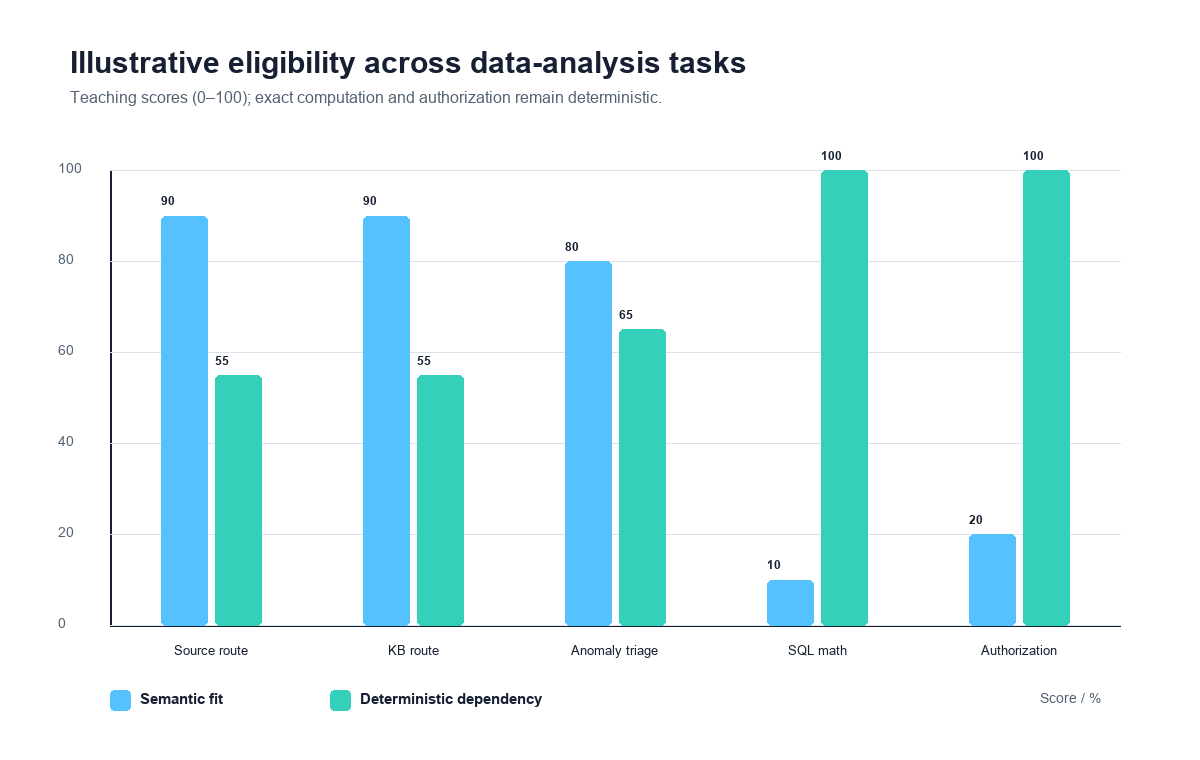
Figure. Illustrative eligibility scores; exact computation and authorization remain deterministic.
Worked example: metric-definition routing
The example asks which approved metric definition matches “weekly revenue after refunds and credits.” Its answer set is gross_revenue, net_revenue, recognized_revenue, and human_review.
The worksheet marks the candidate eligible with controls because the answer space is closed, semantic judgment is the missing step, labels can be prepared, and uncertainty can go to a human. It also marks SQL, arithmetic, causal inference, and authorization as outside Jev.
After a route selects net_revenue, the semantic layer supplies the definition, the warehouse computes the value, and the user’s permissions are checked independently. That handoff is the core Jev data analysis boundary.
Design the evaluation before deployment
An eligible use case is not yet a production-ready use case. Build a labeled set from representative states, including ambiguous and out-of-scope examples. Record class balance, reviewer agreement, and the cost of each error type.
Evaluate the pinned model and question version together. Measure per-class precision and recall, calibration where relevant, abstention or escalation rate, latency, and high-cost errors. Do not copy vendor-wide performance claims into a domain decision.
Set thresholds by consequence
A low-risk knowledge-base route may tolerate a lower automation threshold because retrieval and citations provide another check. A publication-risk route should require stricter evidence and more review. One global confidence threshold is rarely defensible.
Thresholds also need a change process. If the answer definitions, source catalog, or model version changes, rerun the evaluation before restoring automatic handling.
Place the judgment inside a Decision Job
The Decision Job keeps input, sources, named views, evidence, gates, and artifacts under one identity. Attach each Jev data analysis event to the object it reads and record the eventual runtime action.
The data infrastructure hub provides the broader runtime context. For agent-specific route contracts, see the sibling architecture page on Jev for AI agents. For implementation details, the future Jev API for data agents owns the adapter boundary.
Record the handoff, not just the label
Persist the candidate set, question version, model version, probability distribution, confidence, thresholds, fallback reason, and final action. Also record which deterministic system performed the next step: catalog, semantic layer, warehouse, policy engine, or review queue.
That final field prevents an audit trail from implying Jev data analysis performed SQL, arithmetic, causal analysis, or authorization.
Frequently Asked Questions
Can Jev analyze a dataframe by itself?
Bottom line: It can judge supplied row or state content through an integration, but the dataframe library still loads, transforms, and computes the data. Evaluate row-wise costs and errors before use.
Can Jev calculate a KPI?
Bottom line: No. Calculate the KPI with SQL or tested code. Jev may route the request to the correct governed metric definition.
Can Jev decide whether a user may access a table?
Bottom line: No. Relevance is not authorization. The data platform must enforce identity, grants, and resource policy.
Is anomaly scoring an appropriate use case?
Bottom line: Triage can be appropriate when deterministic systems have already computed the anomaly and the score uses a closed rubric with a safe review path.
Does InfiniSynapse currently integrate Jev?
Bottom line: This page does not make that claim. It describes a proposed architecture and a worksheet for evaluating possible placements.
How should low-confidence answers be handled?
Bottom line: Route them to a declared fallback—usually more evidence, a deterministic default, or human review. Never convert uncertainty into permission.
Conclusion
Jev data analysis is useful at bounded semantic junctions: source, collection, metric, relation, triage, evidence, publication-risk, and escalation routing. It fails as a substitute for SQL, arithmetic, causal analysis, authorization, quality gates, or report writing. Use the worksheet to prove the first category before integration and to keep the second category outside the model.