Quality Gates: Hold the Pack, Then Act (2026)
By William Zhu & the InfiniSynapse Data Team · Published: 2026-09-02 · Last updated: 2026-09-03 · Last verified: 2026-09-03 · Next review: 2026-12-02 · Editorial standards · Corrections
Author credentials: William Zhu, Cofounder of InfiniSynapse. Public identity: GitHub @allwefantasy. Profile and review roles: editorial standards. This page is signed by a named person, not an anonymous editorial org. No personal LinkedIn is published. No third-party prize, media review, or independent endorsement is claimed.
Table of Contents
- TL;DR
- The boundary: explore versus impact
- A three-action boundary framework
- Methods: free probe versus gated delivery
- Tool landscape at the boundary
- Implementation steps before anyone acts
- Desk sample: first-party crossing protocol
- Scorecard: which actions must wait
- Failure modes at the boundary
- Frequently Asked Questions
- Conclusion
TL;DR
Direct answer: Quality gates sit before irreversible actions: sending a board pack, triggering a job, or writing a test table. Explore freely. Deliver only after deterministic row, null, and recon checks. Chat is not an asset. Default English delivery is a workspace named result plus review. A later save needs permissions, a whitelist, and human approval.
This page is the boundary under the data quality hub: explore zone versus external-impact zone. It is not a production SLA and not an orchestrator replacement.
What you'll learn:
- Why quality gates apply to the deliver zone and not to every scratch probe
- Three irreversible actions: board pack, triggered job, test-table write
- When to stay in explore
- A landscape that keeps the boundary visible
- Numbered steps before anyone acts
- A first-party crossing protocol you can cite, plus a labeled teaching sketch
- Failure modes: explore-as-delivery, red-log trigger, automatic write
The boundary: explore versus impact
Key Definition: Quality gates sit before irreversible actions—sending a board pack, triggering a job, or writing a test table. Explore may fail. The deliver zone cannot. The boundary is the moment someone outside the desk will act on the number. Chat is not an asset and not a crossing signal.
Independent published context (retrieved 2026-09-02). Compare each source, then stop. The Stanford HAI AI Index, OWASP Application Security Verification Standard, and UK NCSC zero-trust architecture did not run this fixture. None of them places tonight’s quality gates.
| Cited source | What it owns | What tonight still needs |
|---|---|---|
| Stanford HAI AI Index | AI adoption without a shared action boundary | Tonight’s crossing name |
| OWASP ASVS | Checks before sensitive actions | Tonight’s row, null, recon |
| UK NCSC zero-trust | Do not trust a path because it is internal | Chat is still not delivery |
| NIST CSRC | Controlled actions | The hold before anyone acts |
| Wikipedia: business intelligence | Vocabulary for published packs | Tonight’s board-pack hold |
| Snowflake docs | Tables you can query again | Querying again is not a crossing |
Teams treat every red probe as a crisis and every green sentence as a ship. That flattens the map. Quality gates are mandatory when the next step cannot be undone in chat. They are optional while you are still mapping grain.
If the missing object is the single hold on a bubble, continue in quality gate. This page is the boundary: which actions require that hold.
A model benchmark can inform a threshold, but it cannot replace the hold at the impact line. The Jev benchmark protocol keeps accuracy, calibration, latency, cost, and high-consequence errors visible before a bounded decision is allowed near delivery.
Explore may fail on purpose
A probe that returns 0 rows is useful. A join that doubles the grain is useful if you stop. Quality gates do not punish explore. They refuse to let explore leak into a board pack. Stay in the scratch zone until the grain is known.
UK NCSC zero-trust (table above) does not replace quality gates at the impact line. An internal chat is still not delivery.
Impact actions need a hold
A board pack leaves the desk. A triggered job starts work other people will see. A test-table write, even if it is not production, is still a write. Quality gates sit in front of those three. If you cannot name which action is next, you are not ready to cross.
NIST CSRC (table above) does not authorize skipping the hold. You still run quality gates before anyone acts.
A three-action boundary framework
Three actions cross the line. Explore does not.
| Action | Zone | Gated? | Pass signal |
|---|---|---|---|
| Scratch probe | Explore | No | You learned; you stopped |
| Board pack | Impact | Yes | Green row, null, recon |
| Triggered job | Impact | Yes | Same green log + owner |
| Test-table write | Impact | Yes | Permissions, whitelist, approval |
| Chat sentence | Neither | Not a crossing | — |
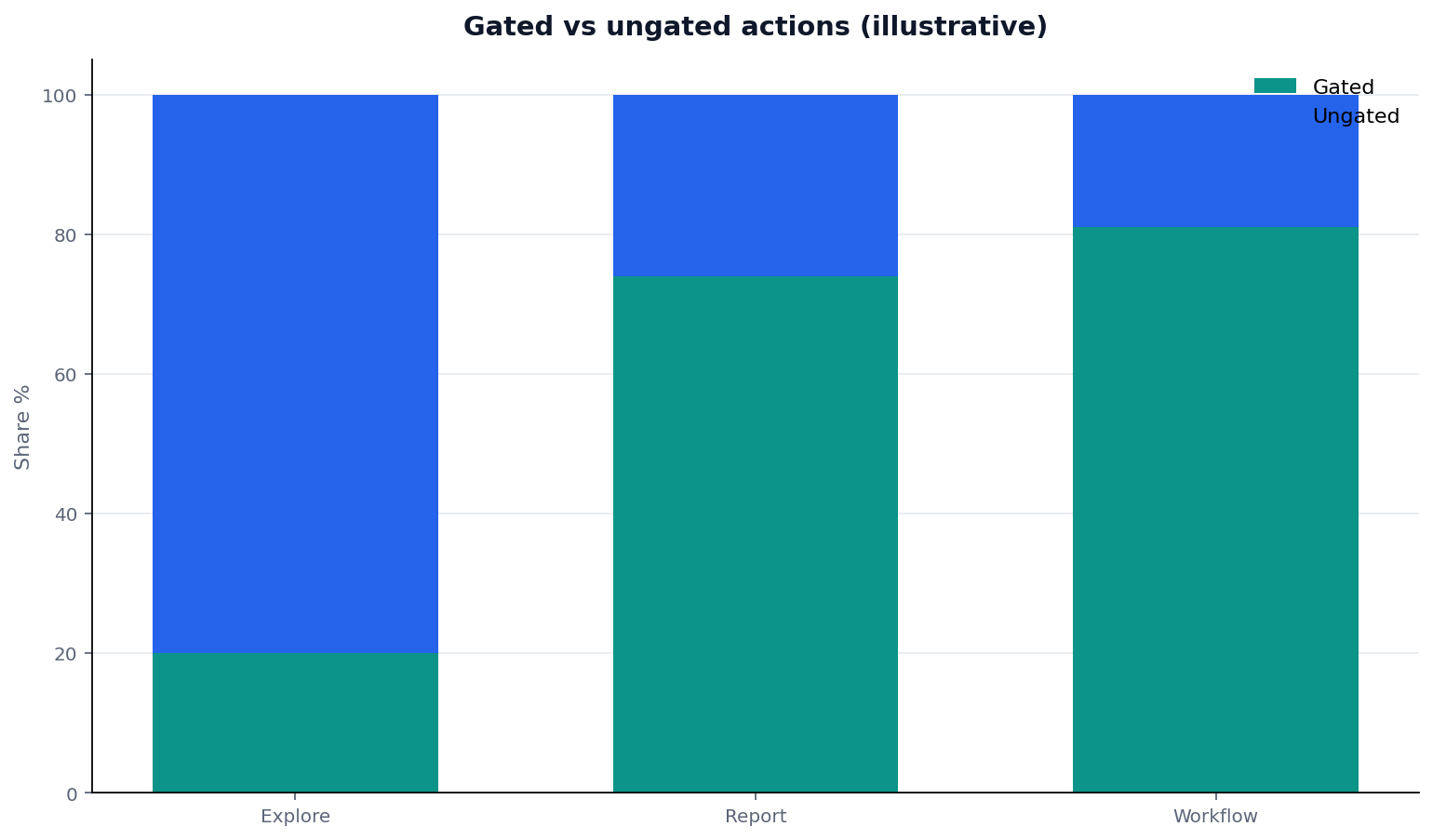
Figure. Teaching schematic. Not a measured study. Source: the protocol table below.
Explore is mostly ungated. Report and job actions are gated. That split is quality gates as a boundary picture, not a taste test.
Name the irreversible action first
If you cannot say “board pack,” “triggered job,” or “test write,” you are still in explore. Write the action. Then run quality gates. A missing action name is how teams ship a probe by accident.
Wikipedia: business intelligence (table above) does not replace quality gates on tonight’s table. A published pack is still an impact action.
Keep explore ungated until you cross
Do not copy delivery rules into every probe. That burns attention and trains people to ignore red. Quality gates become mandatory at the crossing. Before that, fail, learn, and stay inside the desk.
If product fields are missing at the crossing, open the data quality definition and write grain, owner, and consumer first.
Methods: free probe versus gated delivery
Two methods are sold as quality gates. They are not substitutes.
| Candidate | Outcome | Why |
|---|---|---|
| Gate every scratch probe | Reject as a program | Trains people to ignore red |
| Ship explore as delivery | Reject | Impact without a hold |
| Free explore, gated impact | Accept | Boundary is visible |
| Model glance at the line | Reject | No expected value |
| Policy PDF | Wrong layer | Catalog, not tonight’s action |
Choose free explore if
Choose free explore if no one outside the desk will act. A red join is information. Quality gates are not required yet. Choose A if you are mapping. Choose B if a pack, job, or write is next.
Choose gated delivery if
Choose gated delivery if the next step is irreversible. Run row, null, and recon. Hold on red. That is how quality gates protect the impact zone. Data governance remains the policy layer. This page remains the boundary.
If you need a reading copy after the crossing is green, use the AI data report generator. The file is not the boundary.
Tool landscape at the boundary
The landscape around quality gates is smaller than a platform catalog.
| Shape | Explore | Impact | Cannot replace |
|---|---|---|---|
| Task console | Ungated probes | Assert log + hold | A production write |
| Chat | Questions | Nothing | The crossing |
| Job trigger | — | Must wait for green | Tonight’s human hold |
| Embedded host | — | Same hold as the desk | A bypass |
| Scheduler | Later rerun | Later gated run | Tonight’s decision |
Snowflake docs (table above) do not make a second query a crossing. Crossing into a board pack still needs quality gates.
Triggered jobs are not automatic writes
A job trigger is an impact action. It is not a license to write production. If a later save is offered, it needs permissions, a destination whitelist, and human approval. This page does not promise automatic writes to production databases. Quality gates do not become an ETL product because a trigger exists.
This page is not an Airflow replacement and not a production SLA. Orchestrators schedule. The desk decides whether the number may leave. Those jobs stay separate.
If the number will be consumed inside another product, embed an AI data analyst still needs the same crossing. Hosting does not erase quality gates.
Implementation steps before anyone acts
- Name the irreversible action. Input: what happens next. Acceptance: board pack, triggered job, or test write—or stay in explore. Quality gates start only if you are crossing.
- Stay in explore until ready. Input: failed probes. Acceptance: you learned; you did not paste.
- Write expected values. Row band, null cap, recon. Acceptance: values exist before the crossing.
- Run the asserts. Input: the named table. Acceptance: green or owned skip.
- Hold on red. Input: the log. Acceptance: no pack, job, or write.
- Name the result. Input: the passing table. Acceptance: a workspace id.
- Act only after green. Input: the action you named. Acceptance: send, trigger, or request a reviewed save only after quality gates pass.
- Keep save reviewed. Input: a write request. Acceptance: permissions, whitelist, and a human. Never an automatic production write.
Input for every step is an authorized table. Output is a crossing or a stay. There is no step called “the model said it was fine to send.”
A reviewer should be able to ask “which action is next?” and get a one-word answer. If the answer is “we’ll see,” you are still in explore and quality gates are not yet the job. If the answer is “board pack,” the hold is the job. Write the action on the task so a second person can see the boundary without reconstructing the chat.
The crossing is also where teams burn trust. Eight readers acting on a red recon is not speed. It is a leak with a meeting attached. Keep explore cheap and delivery expensive. That is the only way quality gates stay visible instead of becoming a sticker on every probe.
Desk sample: first-party crossing protocol
Cite this quality gates protocol. Do not cite a customer percentage, an 8,420 figure, or the chart bars as a study.
First-party method log (replayable):
| Field | Record |
|---|---|
| Operator | InfiniSynapse Data Team; William Zhu, public as GitHub @allwefantasy |
| First run | 2026-09-02 |
| Replay / last verified | 2026-09-03 |
| Input | One authorized, sanitized weekly units pack; no secrets |
| Paths compared | 42 failed probes kept in explore vs board pack on a red recon |
| Actions scored | 3 (board pack, job trigger, test write) |
| Scorecard rows | 7 |
| Acceptance | Action named board pack; weekly_units_desk green before send |
| Fail | Pack attached while recon is red; eight readers would act |
We kept failed probes in explore, then held the pack until recon was green. The 2026-09-03 replay used the same fail. Quality gates were never placed at the crossing on the fail path. The citable result is three impact actions, one hold rule, seven scorecard rows. GitHub @allwefantasy is a public artifact, not a prize. Review: editorial standards.
A teaching sketch used 8 joins, 42 failed probes, 8,420, and eight readers. Those figures are not a benchmark. Quality gates change the last three rows. They do not punish the first row. Quote the protocol. Do not quote the bars as a study.
Keep a short crossing note on the task: “action = board pack” or “action = stay in explore.” If the line is missing, assume you have not crossed and do not send.
Scorecard: which actions must wait
| Signal | Cross? | Hold | Why |
|---|---|---|---|
| Explore probe red | No | Stay in explore | Failure is useful |
| Board pack + green log | Yes | — | Quality gates passed |
| Board pack + red log | No | Yes | Impact cannot fail open |
| Job trigger + red log | No | Yes | Other people will see it |
| Test write requested | — | Until permissions, whitelist, and approval | No automatic production write |
| Chat sentence only | No | Yes | Not an asset |
| Policy PDF exists | Irrelevant | Irrelevant | Wrong layer for tonight |
Score the action, not the adjective. A plain table with green quality gates may cross. A beautiful probe with a red log must stay.
If two actions compete—send the pack now, or wait for recon—wait. Eight readers acting on a red number is not a meeting. It is an owned leak.
Failure modes at the boundary
Treating explore failure as delivery
A useful red join is not a ship. Teams that paste it erase quality gates and call the paste “transparency.” It is a leak.
When the hub picture is missing, return to data quality and walk the six-step chain.
Triggering a job from a red log
A trigger is irreversible enough. Quality gates sit in front of it. A red log plus a trigger is an owned incident, not speed.
Calling a test write automatic
A test-table write is still a write. If a save is offered, it requires permissions, a destination whitelist, and human approval. Automatic production write-back is out of scope on this page. Calling that path “quality gates automation” is a category error.
When the single hold is missing, open quality gate. When product fields are missing, open the data quality definition before you name the consumer.
Run the gates before anyone acts on the number
List the irreversible action, then run row, null, and recon gates first. This check uses only sources you authorize.
Commercial association: You do not need the workspace to complete the educational diagnosis on this page.
Open InfiniSynapseHow this page is sourced. William Zhu is cofounder of InfiniSynapse, public as GitHub @allwefantasy. Company self-description, not independent authority. No third-party prize is claimed. No personal LinkedIn is published. Evaluation basis: We evaluate (hands-on) by letting explore fail, then blocking a board pack that still sits on a red recon. Protocol dated 2026-09-02, replayed 2026-09-03. Reviewed internally by analytics engineering · data platform · LLM security · editor. Editorial standards · corrections · publishing principles · About · Privacy · Terms. Contact zhuhl@infinisynapse.com. COI: InfiniSynapse sells an AI-native Data Agent; the banner is a commercial association. The educational diagnosis does not require it. Fact-check: Stanford HAI AI Index, OWASP ASVS, UK NCSC zero-trust, NIST CSRC, Wikipedia business intelligence, and Snowflake docs as cited. Figures 8 / 42 / 8,420 are a teaching sketch. No external organization audited this page.
Frequently Asked Questions
Can explore fail without blocking delivery?
Bottom line: Yes. Quality gates apply to the deliver zone. Explore may fail.
What counts as irreversible?
Bottom line: A board pack, a triggered job, or any write. Quality gates sit in front of those actions.
Is a test-table write automatic?
Bottom line: No. If a save is offered, it needs permissions, a whitelist, and human approval. Quality gates do not promise an automatic production write.
Do I need gates for a private scratch question?
Bottom line: Not in explore. Quality gates become mandatory when someone outside the desk will act.
What on this page is citable?
Bottom line: Cite the quality gates protocol table, the three-action boundary, and the six-source comparison. Do not cite the chart bars or the 8 / 42 / 8,420 sketch as measured results.
Conclusion
Quality gates sit at the crossing: board pack, triggered job, or reviewed write. Explore may fail. Delivery may not. Chat is not an asset. Keep writes behind permissions, a whitelist, and a human. If you later use the workspace, open InfiniSynapse only with authorized, sanitized inputs.