Data Quality Definition: Write Fields, Then Hold (2026)
By William Zhu & the InfiniSynapse Data Team · Published: 2026-09-02 · Last updated: 2026-09-03 · Last verified: 2026-09-03 · Next review: 2026-12-02 · Editorial standards · Corrections
Author credentials: William Zhu, Cofounder of InfiniSynapse. Public identity: GitHub @allwefantasy. Profile and review roles: editorial standards. This page is signed by a named person, not an anonymous editorial org. No personal LinkedIn is published. No third-party prize, media review, or independent endorsement is claimed.
Table of Contents
- TL;DR
- What a product definition must name
- A four-field product framework
- Methods: catalog page versus product pack
- Tool landscape around product fields
- Implementation steps from fields to gate
- Desk sample: first-party field protocol
- Scorecard: complete versus missing fields
- Failure modes that fake a product
- Frequently Asked Questions
- Conclusion
TL;DR
Direct answer: A data quality definition for an analysis product names grain, gates, owner, and the next consumer in a bound note, then the task runs the asserts. It is not a policy PDF and not a file-export tutorial. Chat is not a product. Explore may fail. Delivery may not. Default English delivery is a workspace named result plus review.
This page assetizes the pack under the data quality hub. It does not teach you how to download a PDF. It asks whether the four product fields exist before a number leaves.
What you'll learn:
- Why a data quality definition without an owner cannot be reviewed when the number moves
- The four fields: grain, gates, owner, consumer
- When a catalog page is the wrong object
- A landscape that keeps the bound note in the task
- Numbered steps from fields to gate
- A first-party field protocol you can cite, plus a labeled completeness sketch
- Failure modes: policy PDF, missing owner, export-as-product
What a product definition must name
Key Definition: A data quality definition for an analysis product names grain, gates, owner, and the next consumer in one bound note. It is not a policy PDF, not a file-export tutorial, and not a confident chat sentence. The product is the named table plus those four fields.
Independent published context (retrieved 2026-09-02): compare each source to the four-field rule, then stop. The Stanford HAI AI Index is independent context for how organizations adopt AI without a shared product language. The NIST Privacy Framework is independent reading on identifying owners and data actions. Kubernetes documentation is independent reading on declared desired state. Those sources did not run this fixture.
| Cited source | What it actually owns | What this pack still has to do |
|---|---|---|
| Stanford HAI AI Index | Adoption tracking | Adoption is not four product fields |
| NIST Privacy Framework | Owners and data actions | Write tonight’s owner on the pack |
| Kubernetes docs | Declared desired state | Declare fields before the run |
| Apache Spark docs | Declared compute | Does not write your grain sentence |
| OpenTelemetry docs | Traces you can reopen | Bound note plus assert log is the trace |
| Prometheus docs | Named metrics with labels | Identity is not tonight’s hold |
Teams paste a number and call the paste a product. A product has fields. If grain, gates, owner, or consumer is blank, you have a chat object. You do not have a data quality definition.
If the missing object is the reusable table itself, continue in what is data quality. That page is the asset test. This page is the field list that turns the asset into a product.
Grain, gates, owner, consumer
Grain is the sentence: who, what, which window. Gates are the four checks: row band, null cap, recon, threshold. Owner is the person who holds the pack when the number moves. Consumer is the next report or the next agent. A data quality definition that skips any field cannot be reviewed.
Kubernetes docs (table above) are an analogy: you declare the product fields before the run, the way a manifest declares objects. It is not a recipe for this workspace. It does not replace a written data quality definition.
Not a policy PDF and not an export tutorial
A stewardship PDF is a program. An export tutorial is a file path. A data quality definition is tonight’s product card. Mixing the three is how teams invent a fourth object—a slide that claims “we defined quality” while the pack has no owner.
Data governance stays the policy layer. This page stays the product card. If you need a reading copy after the fields exist, use the AI data report generator. The file is not the data quality definition.
A four-field product framework
Four fields must be complete. Collapse them and you cannot point at the broken product.
| Field | Question | Pass signal | Fail signal |
|---|---|---|---|
| Grain | What row is one unit? | One sentence bound before SQL | Mixed grains in one view |
| Gates | What must be green? | Four expected values written | “Looks fine” with no object |
| Owner | Who holds the pack? | Named person | A shared inbox |
| Consumer | Who opens it next? | Next report or agent named | “Anyone who needs it” |
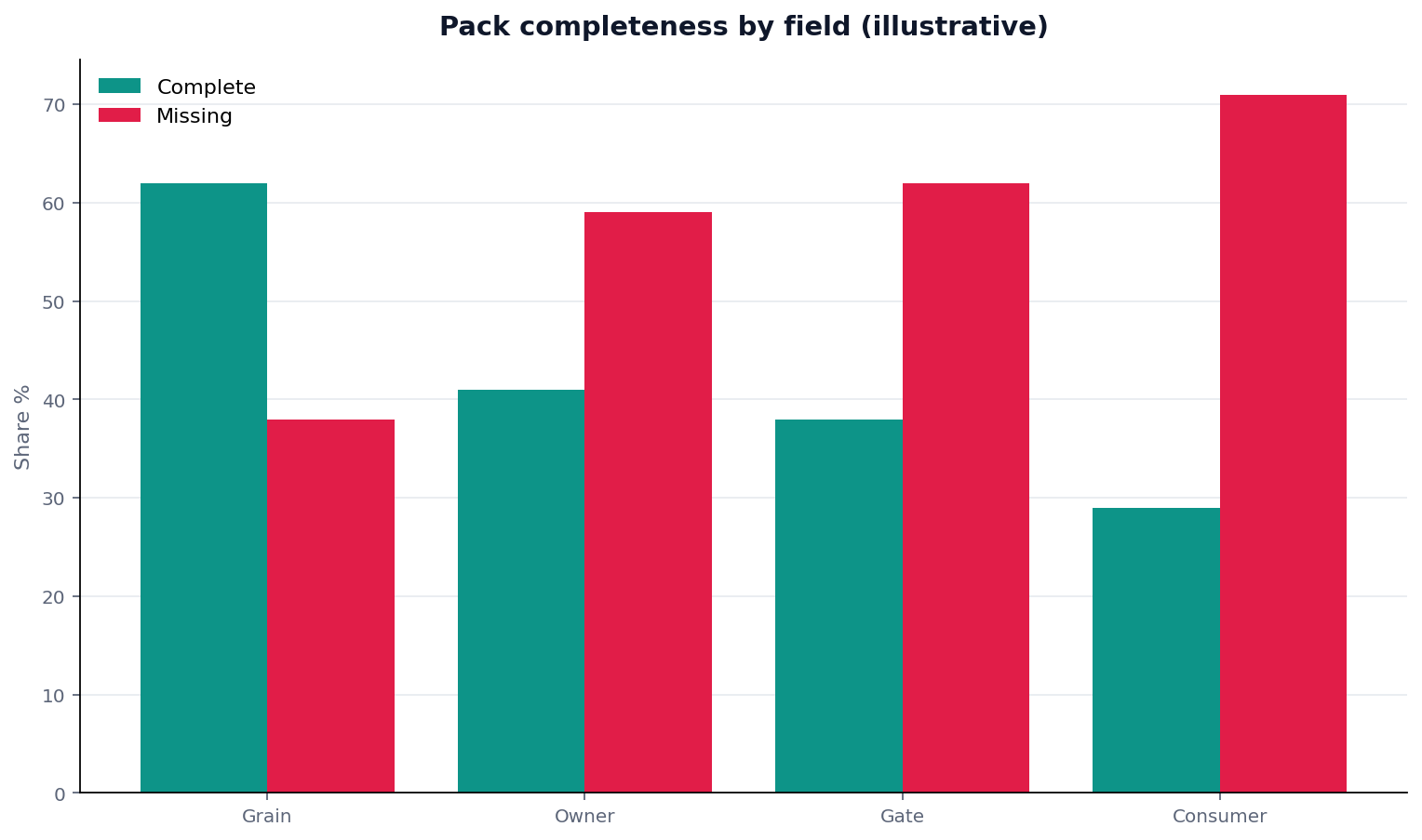
Figure. Teaching schematic. Not a measured study. Source: the protocol table below.
Complete packs have all four fields. Missing packs fail on owner and consumer first. That split is a data quality definition as a completeness test, not a taste test.
Write the fields before the run
If the owner is invented after the query returns, the product is theater. Write the four fields first. A data quality definition written after the number exists is a caption, not a contract.
Apache Spark docs (table above) are independent vendor reading on declared compute. They do not write your grain sentence. You still need a data quality definition before you treat the output as a product.
Run the gate after the fields exist
Fields without a gate are a wish list. After the note is bound, run row, null, recon, and threshold on the table. A data quality definition that never executes is a slide. Execute, then name the workspace result.
OpenTelemetry docs (table above) are independent reading on traces you can reopen. Treat the bound note plus the assert log as the trace of the product. That is how a data quality definition becomes reviewable.
Methods: catalog page versus product pack
Two methods are sold as a data quality definition. They are not substitutes.
| Candidate | Outcome | Why |
|---|---|---|
| Policy PDF | Reject as tonight’s product | Catalog, not four fields |
| File-export tutorial | Reject | Path, not a product |
| Bound four-field note + gate | Accept | Grain, gates, owner, consumer |
| Chat caption | Reject | No owner, no expected values |
| Semantic catalog only | Incomplete | Program layer, not tonight’s pack |
Choose a catalog page if
Choose a catalog page if the question is “who owns the metric across quarters.” That is a program. The semantic layer page is the metric-binding layer if the dispute is the sentence across tools. Neither page is tonight’s data quality definition. Choose A if you are writing a program. Choose B if a pack must leave today.
Choose a product pack if
Choose a product pack if someone will paste a number in the next hour. Write the four fields. Run the gate. Name the result. That sequence is a data quality definition you can point at.
Tool landscape around product fields
The landscape around a data quality definition is smaller than a platform catalog.
| Shape | Can hold the fields | Cannot replace |
|---|---|---|
| Task bound note | Grain, gates, owner, consumer | A production write |
| Chat | A request to write the note | The note itself |
| Policy wiki | Program language | Tonight’s owner |
| File export | A reading copy | The four fields |
| Metrics store | Shared sentences | Tonight’s hold |
Prometheus docs (table above) are independent reading on named metrics with labels. Use them as a reminder that a product has identity. They do not replace a written data quality definition on this desk.
Bound notes live with the task
One task. One note. One assert log. If the data quality definition lives in a slide and the table lives in a console, you will lose the pair. English-language hand-off still means a named workspace result plus a reviewer. If a later save is offered, it needs permissions, a destination whitelist, and human approval. This page does not promise automatic writes to production databases.
This page is not an Airflow replacement and not a production SLA. Orchestrators schedule. The desk binds fields. Those jobs stay separate.
Implementation steps from fields to gate
- Write the grain. Input: the business question. Acceptance: one grain, one inclusion rule, one window. That sentence is the first field of a data quality definition.
- Write the gates. Input: the grain. Acceptance: row band, null cap, recon query, threshold exist before SQL returns.
- Name owner and consumer. Input: the pack. Acceptance: a person and a next report or agent.
- Bind the note to the task. Input: the four fields. Acceptance: a reviewer can read them without opening chat.
- Run the asserts. Input: the named view. Acceptance: green or owned skip.
- Hold on red. Input: the log. Acceptance: no memo leaves.
- Name the result. Input: the passing table. Acceptance: a workspace id the consumer can open. The id plus the note is the data quality definition as a product.
- Release or keep the hold. Input: the compare note. Acceptance: a human mark, not a model adjective.
Input for every step is an authorized table plus a bound note. Output is a named product or a hold. There is no step called “export first, define later.”
A reviewer should be able to open the task and read the four fields without asking the author. If the note is in a private doc and the table is in the console, the product is already split. Keep the bound note next to the assert log so the data quality definition and the evidence stay one object.
Desk sample: first-party field protocol
Cite this data quality definition protocol. Do not cite a customer percentage, an 8,420 figure, or the chart bars as a study.
First-party method log (replayable):
| Field | Record |
|---|---|
| Operator | InfiniSynapse Data Team; William Zhu, public as GitHub @allwefantasy |
| First run | 2026-09-02 |
| Replay / last verified | 2026-09-03 |
| Input | One authorized, sanitized weekly units pack; no secrets |
| Paths compared | Four-field bound note vs owner-blank chat caption |
| Fields scored | 4 (grain, gates, owner, consumer) |
| Scorecard rows | 8 |
| Acceptance | Bound note names a person and board_units_memo; named result reopens |
| Fail | Owner blank; consumer is “the board”; only a chat sentence remains |
We wrote grain and gates, left owner blank, then named a reviewer and next object. The incomplete pack failed on owner first; the complete pack named both. The 2026-09-03 replay used the same fail. That is a first-line data quality definition replay, not a customer case. The citable result of this data quality definition run is two packs, four fields, eight scorecard rows. GitHub @allwefantasy is a public artifact, not a prize. No external organization audited the pack. Independent review: editorial standards.
A teaching sketch used 8,420 and an 88-unit move; those figures are not a benchmark. A data quality definition without an owner is a caption. Quote the protocol table. Do not quote the bars as a study.
When irreversible action is the next step, read quality gates before anyone acts. This page stays on the product card.
Scorecard: complete versus missing fields
| Signal | Product? | Hold | Why |
|---|---|---|---|
| Four fields + green log | Yes, after name | — | A complete data quality definition |
| Owner missing | No | Yes | No one holds the move |
| Consumer missing | Incomplete | Yes | Next open unproven |
| Policy PDF only | No | Yes | Wrong layer |
| File export only | No | Yes | Reading copy |
| Save requested | — | Until permissions, whitelist, and approval | No automatic production write |
| Explore probe red | Stay in explore | Not a delivery hold | Explore may fail |
| Chat caption only | No | Yes | Not a product |
Score this data quality definition on the fields, not the prose. A plain note with four fields and a green log may leave. A beautiful memo with a blank owner is still chat. That scorecard is a data quality definition as a completeness test.
Failure modes that fake a product
Calling a policy PDF the definition
A program PDF can be excellent and still leave tonight’s pack empty. Teams point at the PDF and say they have a data quality definition. They have a catalog. The pack still has no owner. The hub method in data quality still has to run.
Shipping without an owner
A number that moves without an owner becomes folklore. A data quality definition without an owner cannot be reviewed. The failure is the blank field, not the model.
Treating export as assetization
Exporting a PDF feels like a product. It is a reading copy. Assetization is fields plus a named table. If a later save is offered, it requires permissions, a destination whitelist, and human approval. Automatic production write-back is out of scope on this page. Calling export a data quality definition is a category error.
When the hub picture is missing, return to data quality. When the asset test is missing, open what is data quality before you write the consumer.
Write the definition, then run the gate
Write grain, null rule, and consumer in a bound note, then run the task. This check uses only sources you authorize.
Commercial association: You do not need the workspace to complete the educational diagnosis on this page.
Open InfiniSynapseHow this page is sourced. William Zhu is cofounder of InfiniSynapse, public as GitHub @allwefantasy. Company self-description, not independent authority. No third-party prize or certificate is claimed. No personal LinkedIn is published. Evaluation basis: We evaluate (hands-on) by writing grain, gates, owner, and next consumer before compute, then refusing a policy-PDF stand-in. First-party protocol dated 2026-09-02, replayed 2026-09-03. Reviewed internally by analytics engineering · data platform · LLM security · editor. Editorial standards · corrections · publishing principles · About · Privacy · Terms. Contact zhuhl@infinisynapse.com. COI: InfiniSynapse sells an AI-native Data Agent; the banner is a commercial association. Fact-check: Stanford HAI AI Index, Kubernetes docs, NIST Privacy Framework, Apache Spark docs, OpenTelemetry docs, and Prometheus docs as cited in the body. No external organization audited this page.
Frequently Asked Questions
Is a policy PDF a data quality definition?
Bottom line: No. A data quality definition for analysis names grain, gates, and the next consumer.
Do I need an owner field?
Bottom line: Yes. A data quality definition without an owner cannot be reviewed when the number moves.
Is this a PDF export tutorial?
Bottom line: No. A data quality definition is about the product fields, not how you download a file.
Does the product write the production database?
Bottom line: No. Default delivery is a workspace named result plus review. A save needs permissions, a whitelist, and human approval.
What on this page is citable?
Bottom line: Cite the data quality definition protocol table, the four-field frame, and the six-source comparison. Do not cite the chart bars or the 8,420 / 88-unit sketch as measured results.
Conclusion
A data quality definition names grain, gates, owner, and consumer, then the gate runs. Chat is not a product. A policy PDF is not tonight’s card. Explore may fail. Delivery may not. Keep writes behind permissions, a whitelist, and a human. If you later use the workspace, open InfiniSynapse only with authorized, sanitized inputs.